Megatrend · Aging Population
The one business where every customer is “100% certain” to show up
In an investing world where almost nothing is certain, one business has its demand locked in by a law of nature — everyone dies, and the baby boomers are aging into the years where annual deaths keep climbing, toward a peak around mid-century. This is the story of the death care industry — a fragmented, local business now being rolled up, sitting on insurance-like prepaid revenue (“paid years before death”), and facing one big shock: people are switching to cheaper cremation, which is now the majority.

01What it is
Picture a business that knows in advance that every single person on earth will use its service one day — no exceptions. That's the Death Care industry: the end-of-life services we're all familiar with but would rather not talk about.
It rests on two pillars: the funeral home, which handles the ceremony — the service, preparing the body, the cremation or burial — and the cemetery, which sells and maintains burial plots, niches, and memorials. Both make money from services (the ceremony fee) plus merchandise — caskets, urns, headstones, flowers — all in one place.
At-need = buying the service “when you actually need it,” right after a family member has died — an urgent decision, made in grief. Pre-need = “booking and paying in advance” for your own funeral, years before death. This is the special mechanism that makes this business unlike any other — and the star of this lesson (we go deep in Chapter 3).
On the megatrend map, this node is a branch under Aging Population. Its definition, in plain terms: “providers of funeral homes, cemeteries, cremation, and pre-need sales — a customer base that cycles with demographics.” In other words, its demand isn't driven by fashion or the economy, but purely by demographics.
02Why it matters — the most certain demand in the world
In investing, “recession-proof” gets thrown around far too easily — but this business is the real thing. Demand doesn't hinge on whether the economy is good or bad, or whether rates rise or fall. It hinges on the one most certain thing in human life.
And the demographics are clearly breaking the industry's way. The baby boomers (born 1946–1964) once numbered as many as 79 million in the US. Now they're entering their later years, so annual US deaths are steadily climbing — expected to reach ~3.6 million a year around 2037 (about 1 million more than in 2015), and to keep rising to a peak around mid-century.
It's gotten to the point where, in the latest year (ending July 2025), US births outnumbered deaths by only ~518,000 — a sharp drop from 2007, when the gap was 1.9 million. And the Congressional Budget Office (CBO) expects that by 2030, for the first time, Americans will die faster than they're born. That's the structural “tailwind” behind this industry for decades to come.
The market isn't small, either. The US funeral services market is worth about $75 billion, and the whole death care industry is expected to grow to ~$103 billion by 2030 (CAGR ~6–7%). This is a business that's big, quiet, and predictably growing.
03The heart of the model: Pre-need selling
If this business were only interesting because “more people are dying,” it would just be a plain demographics story. But what makes investors' eyes light up is the financial mechanism hidden inside — Pre-need selling.
The idea is simple but powerful: many people choose to “plan their own funeral in advance” — pick the type of service, pick the plot, pay today — even though the actual service won't happen for years, or decades. The customer's reasoning: lock in today's price (an inflation hedge), and spare their children from having to make a sad decision in the final moment.
But for the company, this is a treasure chest. The money a customer prepays gets parked in a trust or insurance policy, which the company invests for a return while it waits — just like an insurer's “float.” The revenue itself, meanwhile, is booked as a big backlog that converts into recognized revenue over future years. That makes the company's revenue far steadier and more predictable than a normal business.

You can see the sheer size of this backlog most clearly at the market leader, Service Corporation International (SCI), whose prepaid funeral and cemetery backlog stood at $17 billion at the end of 2025 — like “revenue already sold but not yet delivered,” which will turn into real revenue over many years (in 2025 it recognized about $800 million from backlog).
04Where it fits in “Aging Population”
Death Care is the “final stop” of the Aging Population megatrend. Think of a boomer's life as a single conveyor belt: early on, they're customers of Senior Care and various health services. Then they reach the endpoint that this node handles. It's the one branch of the aging group whose demand is “guaranteed” — the other branches just delay its arrival. Death Care simply takes the handoff.
What's interesting is how tightly it ties to financial trends. The pre-need mechanism turns death care companies into quasi-institutional investors — holding big pools of trust/insurance money they have to grow. This is where it touches the world of Retirement Income & Annuities, which also plays with “a lump sum paid today to be used in the future” — the only difference is where the money ends up.
And it's a deeply local business by nature. Most people choose a funeral home that's near home, familiar, and well-regarded in the community. That makes each location a kind of “mini-monopoly” in its own area, with real pricing power — a trait that sets up the roll-up story in the next chapter.
05Where it stands now
Three things are setting this industry's direction in 2024–2026: (1) consolidation of fragmented local businesses, (2) the shift to cremation, which squeezes revenue per case, and (3) the rising death rate, as already covered.
Story 1 — the roll-up
This industry is extremely fragmented. The US has roughly 19,000 funeral homes, and about 89% are still family- or independently owned. That gap is exactly what lets big companies buy up small businesses one at a time — the “roll-up” model. Once acquired, they use bargaining power (cheaper caskets, flowers, and so on) and a standardized pre-need sales system to push margins higher than the business earned on its own.
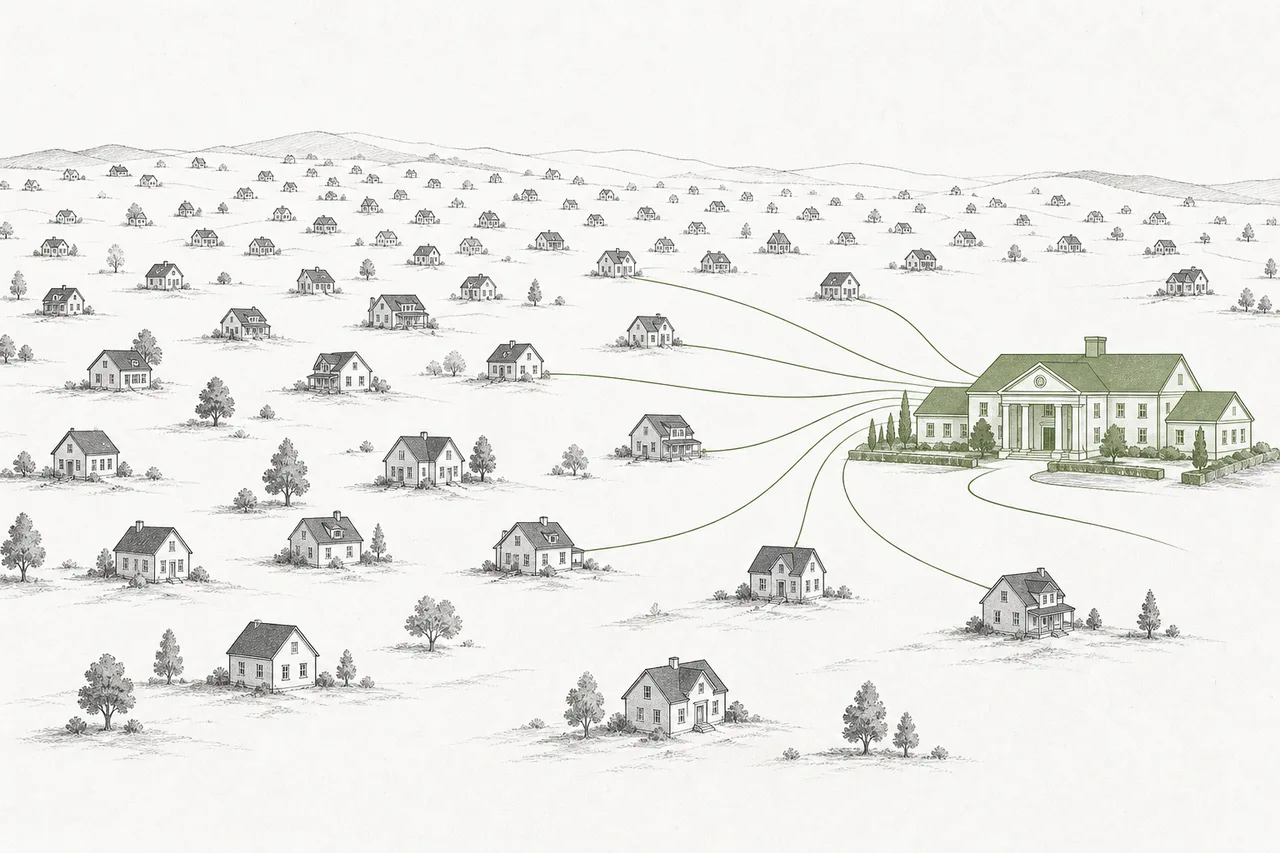
Even the market leader, SCI, doesn't dominate outright — together, SCI and Carriage Services hold about 23% of combined funeral and cemetery service revenue, and the top six players combined hold only ~25–30%. That means there's still an enormous “market to buy up” left. It's why private equity is playing on this field too.
Story 2 — the cremation shift
This is the most important shift in the business model. Consumers are moving fast from “burial” to “cremation,” because it's much cheaper, more flexible, and easier on the environment. The US cremation rate rose to ~63% in 2025 (from ~62% in 2024), and is expected to hit ~68% by 2029 and surge past 80% by 2045.

Why is it worrying for companies? Because a simple direct cremation makes far less money than a full burial. A burial with a service averages about $8,600, while a direct cremation averages just ~$2,200 — about 74% cheaper, because it cuts four big line items entirely: the expensive casket, the underground vault, the cemetery plot, and the digging and filling. The more people choose cremation, the more a funeral home's revenue per case shrinks. This is the “headwind” that offsets the “tailwind” of rising deaths.
The companies' counter-strategy is to “sell added value” even when the customer chooses cremation — memorial services, premium urns, memorial gardens, interring ashes in a cemetery — to claw revenue per case back. That's why merchandise makers, like those selling urns and cremation equipment, can still grow against the trend.
Key players in this field
06The road ahead
The first direction: the “demographic tailwind” hasn't peaked yet. Annual deaths will keep climbing for decades, to a peak around mid-century — the longest, most predictable tailwind any business could hope for. The question isn't “will demand come,” but “who can capture the most of it per case.”
The second direction: consolidation keeps going. As long as the market is still 89% fragmented, big players like SCI and Carriage — plus private equity — have plenty of “food” left to buy up. That's why investors see this as a “compounder” — slow but steady, growing through roll-ups plus the steady cash flow from pre-need.
The third direction: adapting the model to the cremation era and new options. Companies have to pivot toward selling “experience and remembrance” rather than expensive burials, while embracing the wave of green/alternative options — like natural burial and natural organic reduction (composting the body), which is becoming legal in several states and growing fast. Whoever adapts first to the “cheaper but more meaningful” trend will better protect their revenue per case.
07Challenges & risks
The appeal of a “guaranteed demand” business comes with its own specific risks you need to understand fully.
The first risk is cremation squeezing revenue per case. This is the structural challenge that directly offsets the demographic tailwind — even as more people die, if each case pays less and less (because they pick a simple cremation), revenue growth will be slower than the death numbers suggest. Companies that are slow to pivot to selling added value will hurt first.
The second risk is the ceiling on consolidation. Roll-ups work well when assets are cheap and good businesses are available to buy. But as buyers compete, asset prices rise, returns on acquisitions fall, and borrowing to buy gets expensive in a high-rate era — a model that relies purely on buying things up starts to grind when the market “saturates” or the cost of money is high.
The third risk is regulation and consumer sensitivity. This business is watched closely on pricing and high-pressure selling in a moment of grief (in the US, the Funeral Rule governs price disclosure). Private equity's entry has also stoked worries about higher prices. Reputational and regulatory risk run especially high in an industry that touches a customer's “most vulnerable moment.”
And as the case of China's Fu Shou Yuan reminds us — “recession-proof” doesn't mean “risk-free.” The number of deaths may be certain, but how much each family is willing to pay can always vary with the economy and culture. When China's economy slowed, consumers immediately chose cheaper packages — enough to push even the market leader to its first loss in over a decade.
In short: Death Care is a business that sells something no one wants to buy but everyone has to use. Its demand is as solid as a law of physics, and the pre-need model gives a rare kind of steady cash flow. But the real challenge isn't “will there be customers” — there will be — it's “how do you make money from customers who increasingly choose simple and cheap.” That's the question that decides the winners of the next era.