Megatrend · Aging Population
Beds full, no one to staff them: the business with overflowing demand but no workers
Senior-care buildings across America are nearly full and the waitlists are long, because the first baby boomers turn 80 right around 2026. Yet this business is caught in a strange trap — supply is short, demand overflows, and the thing in shortest supply isn't buildings, it's caregivers. Nursing assistants quit at 70–80% a year. This is the story of the companies that actually run the care — not the building owners, but the ones who hire the staff, set the shifts, serve the meals, and look after people living with dementia.
01What it is — the ladder of care
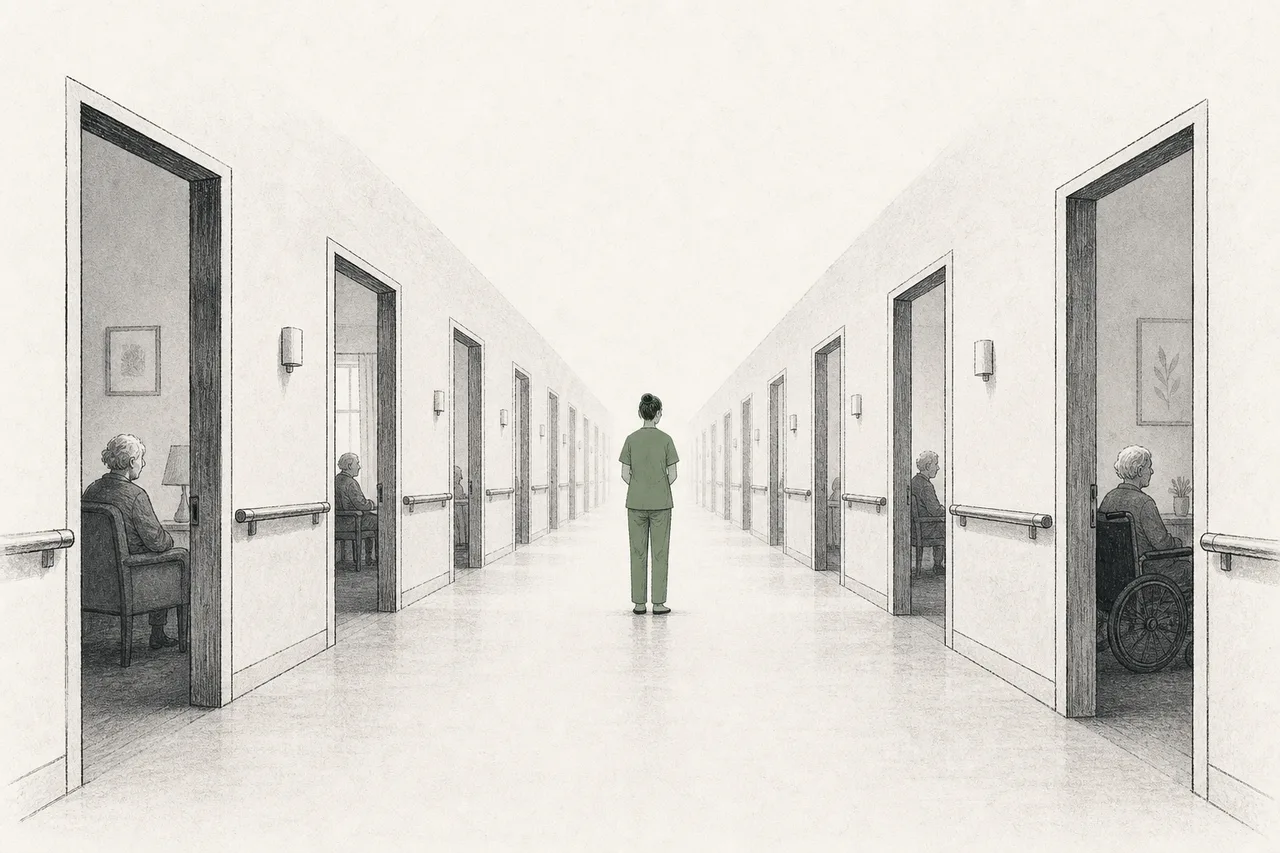
Picture your own parents growing older. In the early days they live at home just fine. But over time, cooking gets hard, they forget their medication, they fall when they walk, and one day they no longer recognize their own family. With each step down in physical ability, the "level of care" they need steps up. This node is the business of the companies that take on the care at each of those steps.
First, an important distinction: this is not a "building owner" business, it's an "operator" business — companies that hire the nurses, schedule the staff, cook the food, give the medication, and care for real people every single day. The ones who own the building are usually real-estate funds — a completely different business (see Senior Housing & Healthcare REITs). Think of an airline that flies the planes versus a company that owns the planes and leases them out.
Senior care lines up like a "ladder" by how heavy the condition is — the industry calls it acuity (how intensive the care is). The higher you climb the ladder, the more people, higher skills, and higher fees it takes:
- Independent Living: seniors who can still take care of themselves living together for the community and services (meals, cleaning, activities), with the least medical care
- Assisted Living: help with daily routines — bathing, dressing, taking medication — but not yet full-time nursing. This is the heart of the business
- Memory Care: a dedicated wing for people with Alzheimer's / dementia, with doors locked to prevent wandering and more staff per resident than usual. This is the fastest-growing and heaviest step
- Skilled Nursing: almost like a hospital, with 24-hour nurses for the seriously ill or for post-surgery recovery. The most expensive, and often dependent on public money (Medicaid/Medicare)
A term for "how sick or dependent" a person is. The higher the acuity, the more staff each resident needs and the higher the fee — memory care and skilled nursing are the high-acuity groups, independent living the lowest. The ability to care well for high-acuity residents is what separates a great operator from an ordinary one.
This node sits under the megatrend Aging Population, and needs to be clearly separated from two close cousins: it's not the REIT that owns the building, and it's not Home Healthcare that sends nurses to people's homes — this node is the one that runs the senior-care facilities directly.
02Why it matters — the wave you can see coming
Most trends in investing are hard to forecast. But this one is different — you can see it clearly decades ahead, because everyone who'll need these services 15 years from now is already born. You can literally count heads.
A key turning point just happened: the first baby boomers turn 80 in 2026, and the group that matters most for this business is people 85 and older — because that's the age when most people start to need serious care. U.S. Census Bureau figures show this group will nearly triple, from 6.7 million in 2020 to 11.8 million in 2035 and 18.5 million in 2050.
The heaviest wave is in dementia. Worldwide there were over 57 million cases in 2023, projected to surge to 78 million by 2030 and 139 million by 2050. In America alone, there are about 7.2 million people aged 65+ with Alzheimer's in 2025, reaching ~13 million by 2050. These people are the customers of memory care — the step that's high-acuity, expensive, and fastest-growing.
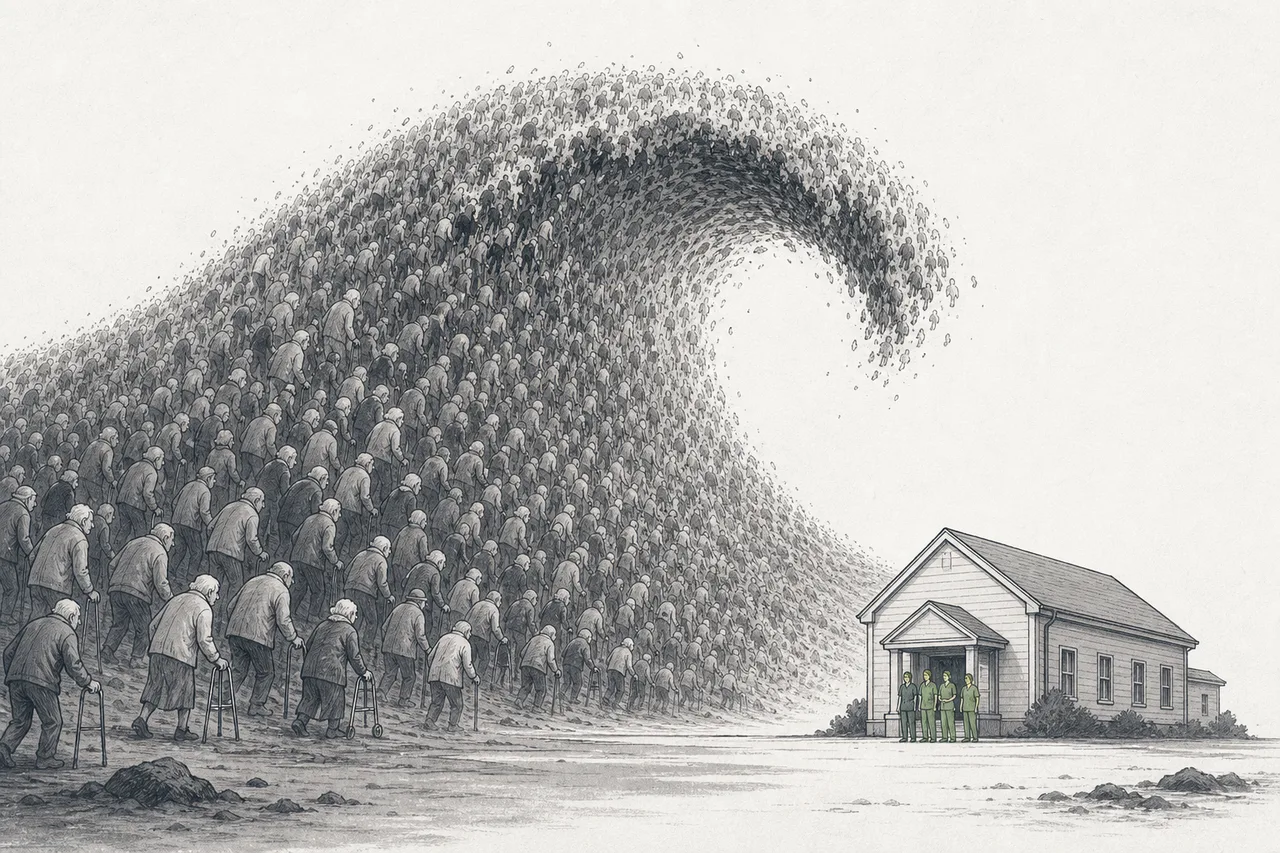
And there's another side that makes this especially "hot" — just like the real-estate REITs, it's a supply shortage. During COVID and the high-rate years, almost no one built new buildings. Units under construction in major markets fell to about 17,000 in Q3 2025 — the lowest since 2012 — while demand surged. The result: people pack into the existing buildings, pushing occupancy and prices up together. The U.S. is estimated to need about 806,000 more senior-housing units by 2030 just to keep the current ratio.
03How it works — a thin-margin business locked by labor
If demand overflows this much, why isn't this an easy money-maker? Because this is a "labor-intensive service" business, not a real-estate business — and that changes everything.
The revenue model is straightforward: revenue = occupied beds × monthly fee. That's why the whole industry is obsessed with one number — occupancy. Because the building cost is fixed, every empty bed is money lost with almost no drop in expenses. Conversely, once occupancy passes break-even, the incremental profit comes flooding down hard.
But the cost side is dominated by one single biggest chunk — labor. A well-run operator keeps labor costs around 30% of revenue. Pair that with ~90% occupancy and operating margin can reach 40%. But if it slips out of control — having to hire expensive agency staff to plug the gaps in shifts — the margin collapses instantly.
This is the key to the whole node: in other businesses, a "shortage" means profits jump automatically. But in senior care, no matter how much demand overflows and how full the buildings are, you can't open more beds without caregivers. The real profit isn't locked by demand, it's locked by the ability to find, hire, and keep staff.
04The real bottleneck: not enough caregivers
If you understand just one thing about this node, understand this — the caregiver labor crisis. This is what separates the winners from the losers in this business.
The numbers are shocking: caregiver turnover in the industry runs about 75–80% a year — and most quit within the first 100 days. In other words, nearly the entire team turns over every year. Over 95% of care providers report moderate to severe staffing shortages, and 77% have even had to turn away new clients because there's no one to provide care.
Why is it like this? Because the work is hard, but the pay is low. The base wage for a care aide in the U.S. is about $16.82/hour (2024 BLS data) — only a touch above fast food, even though they have to bathe people, turn them in bed, and care for the seriously ill. When the pay isn't compelling, people drift off to easier jobs that pay about the same.
And this labor wave runs frighteningly against the demand wave — the U.S. needs about 765,800 new care positions a year through 2034 (one of the most short-staffed occupations in the country), while the number of working-age people per senior keeps falling. This gap is exactly what forces wages up and pushes operators toward technology.
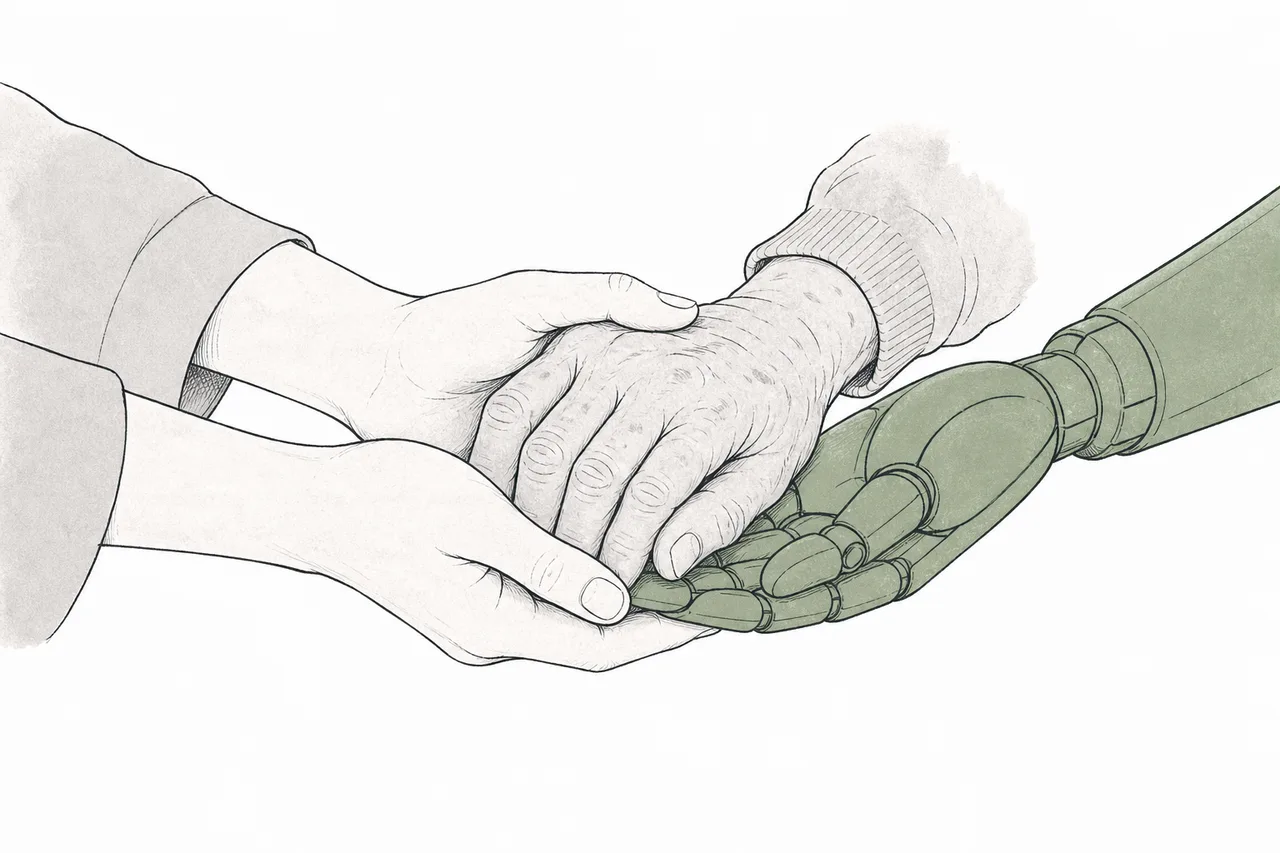
This is where humanoid robots and AI enter the picture — not to replace the warmth of a human, but to cut the work that burns staff out. Sensors that detect falls, AI systems that flag when a senior behaves abnormally, automated shift scheduling, and robots that help lift or carry — all of it is an effort to let one staffer care for more people without breaking down.
05Where it sits in the ecosystem
Senior Care is one piece of the giant megatrend Aging Population, which covers everything about a world growing older — from drugs for chronic disease and medical devices to financial services for retirement. This node is the "end of the line for care" that people reach when they can no longer manage on their own.
It connects closely with neighboring nodes, and that boundary matters a great deal to investors:
- With Senior Housing REITs — two sides of the same coin: the REIT owns the building and leases it out, taking rent or a share of revenue, while this node is the operator that actually runs the work. Sometimes they pair up landlord-to-tenant, sometimes they're entangled more deeply. When the market recovers, operators tend to capture more of the upside from price increases — but they carry the full labor risk
- With Home Healthcare & Hospice — rival and alternative: instead of moving a senior into a facility, you send nurses to their home. Many families choose this first because it's cheaper and more familiar — both a competing alternative and the "step before" things get heavy enough to need a facility
- With Humanoid Robots & Physical AI — the way out of the labor crisis: this node creates demand for robots and AI because there aren't enough people. Every technology that lets one staffer care for more is something this industry urgently needs
- With Biotech & Genomic Medicine — a double-edged sword: if drugs that slow dementia really work (like the new class for Alzheimer's), they could push back the time when people enter memory care — cutting some demand, but also keeping people in the lower-acuity steps for longer
In short: this node is the "care operator" sitting at the tail end of the senior value chain — taking in people past the at-home and home-care steps, using the REIT's buildings as a base, and thirsting for robotics to solve the people shortage.
06Where things stand now + who the players are
2024–2026 is the clearest "recovery" this industry has seen in years. After COVID hit it hard (when people were too scared to send their parents into facilities and occupancy plunged), the numbers have come back strong.
U.S. senior-housing occupancy ended 2025 at 89.1% — rising for 18 straight quarters — and climbed further to 89.5% in Q1 2026, with independent living breaking 90% (its highest since 2019) and assisted living at ~88%. Many forecasters expect the whole industry to reach a "stable" level around 93% by 2028.
But when you go looking for the "real players," you hit one important truth: in the operator business, many of the biggest players are private companies that aren't on the stock market (like Atria and Sunrise Senior Living). So the ones you can actually invest in are concentrated, led by U.S. and Canadian players:
What every player is doing the same right now is using the shortage to push prices up — when buildings are full and new rivals are scarce, operators can raise fees. Brookdale reported revenue per unit (RevPAR) growing about 5.7% in 2025 — the first time in years that pricing power has shifted back to the providers.
07The road ahead
The first direction is a supply gap that keeps widening. While demand surges, new construction is unusually slow. The world is estimated to need about 100,000 new senior-housing beds a year through 2040 to keep up, but only a fraction of that is being built. The result: the pricing power of operators who already own buildings will strengthen for years to come.
The second direction is technology stepping in to break the labor bottleneck. Because the people shortage can't be solved by hiring more alone (there's no one to hire), the industry is racing to adopt AI and automation — fall-detection sensors, predictive health monitoring that warns before an incident, and smart scheduling. The goal isn't to cut people, but to let one staffer care for more with less exhaustion. Some research houses argue that operators who control costs well with technology still have room to push margins back toward 40%.
The third direction is Asia becoming the new arena. Japan, Korea, China, and Thailand are aging faster than the West on some measures, but their care structures aren't fully developed — a huge opportunity and a cultural challenge at once (many Asian societies still expect children to care for their parents at home). Players who find a model that fits local culture will open a vast market that's still empty.
08Challenges & risks
Demand you can see coming sounds like a dream investment. But this business has its own particular risks you need to understand fully.
The first and biggest risk is labor. As long as caregivers keep quitting at 70–80% a year and wages have to climb to compete for people, the business's biggest cost will keep pressuring profits. If wages rise faster than fees can, margins get squeezed instantly — and in deep shortages, operators have to hire expensive agency staff, which eats profit like a leak.
The second risk is profits that are already thin. The net profit margin of a typical assisted-living facility is only around 3–12% (very different from the pretty 30–40% operating margin). That means the business has almost no cushion. An unexpected event — a pandemic, a wage spike, or a drop in occupancy — can hit net profit hard. The COVID lesson is still fresh: occupancy plunged while costs surged, and many operators took heavy losses.
The third risk is dependence on public money and regulation, especially on the skilled-nursing side where most revenue comes from Medicaid/Medicare. Cuts to reimbursement rates, rules on minimum staffing per patient (staffing mandates), or tighter quality audits all hit profits directly — and they're factors the operator can't control.
In short: Senior Care is the story of a business that can see its future most clearly — the wave of seniors is surely coming, buildings are full, prices rise. Yet it's caught in a trap where the thing in shortest supply isn't buildings or customers, but the "people" who will provide the care. Understanding why a business with overflowing demand still has thin profits is understanding why this node is both the clearest opportunity and one of the hardest arenas of the aging-society era.