Megatrend · Aging Population
Selling a lump sum to buy a 'paycheck that never runs out'
Everyone fears the same thing in retirement: 'Will my money run out before I die?' An annuity is a financial product designed to answer exactly that fear — you hand an insurance company a lump sum, and you get back 'money every month, for the rest of your life.' Right now Americans are aging all at once on a scale never seen before, interest rates are high, and annuity sales have set records four years running. And behind the scenes, a quiet revolution is tying 'insurance' to 'private credit' — reshaping the entire industry.

01What it is — a paycheck that never runs out
Think about the hardest problem in retirement. Say you've saved up a lump sum over a lifetime — how many years do you have to make it last? 20 years? 35? The catch is that nobody knows how long they'll live. Spend too freely and you're terrified of running out in old age; pinch too hard and you live frugally while sitting on money. This is what finance calls 'longevity risk' — and you can't solve it just by saving.
An annuity is the product insurers designed to fix exactly this. The mechanism is dead simple: you pay an insurance company a lump sum (or in installments), and the company promises 'money coming in every month' in return — and with some types, it keeps paying until the day you die, whether you live to 80 or 105. In effect, you toss the fear of 'money running out before death' over to the insurer instead.
It's a transformation of money — from a pile of assets you have to keep watching, into a 'paycheck' that lands in your account as steadily as when you were working. That's why this is a sub-theme under the Aging Population megatrend — it's the 'financial layer' of growing old. Where its sibling nodes care for the body (Senior Care), housing, or medicine, this node looks after the wallet of people who've stopped working.
It sounds odd — how can living a long life be a 'risk'? In financial terms, 'risk' means uncertainty, and not knowing how many more years you'll need money makes planning very hard. An annuity works by pooling the risk of many people together: those who die earlier than average help subsidize those who live longer, so the insurer can confidently promise to pay for life — because on average the numbers work out, even if no single person is predictable.
There are many versions, from a 'locked-rate' type (fixed) — like a deposit that pays guaranteed interest — to ones whose returns are tied to the stock market but come with a buffer against losses. But they all share one core idea: hand longevity risk and market volatility to the insurer to carry for you, in exchange for peace of mind.
02Why it's booming now
This product has been around for centuries, yet over just the last 3–4 years it has exploded to record levels. Two reasons converged at exactly the same time.
One: the 'Peak 65' wave — the US is entering the period when baby boomers turn 65 in the largest numbers in history. In 2024, 4.1 million Americans turned 65, about 11,200 a day, and over 2024–2030 more than 30 million will reach this age. The worrying part: over half (52.5%) have less than $250,000 in assets — meaning a huge number of people are retiring with the fear that their money won't last. That's enormous demand flowing toward a product that sells 'don't worry about running out.'

Two: interest rates are high again — ever since central banks hiked rates hard in 2022, annuities instantly became 'worth buying' again, because insurers can invest your money in bonds and assets that pay higher yields, so they can offer much more generous guaranteed rates. When a 'safe' product like a fixed annuity can easily out-pay a savings account, money pours in.
The result is records broken again and again. US retail annuity sales jumped from ~$310B in 2022 to $434B in 2024 (up 13%), and set yet another record at $464B in 2025 — the fourth straight record year.
03How it works (+ the private credit flywheel)
The basic mechanism of an annuity is the 'spread' trade. The insurer takes your lump sum, promises to pay you back at one rate (say 5% a year), then invests that money to earn more than that (say 6.5%). The difference is the company's profit. It looks simple — but this is exactly where the industry is going through its biggest transformation in decades.
Insurers used to put their reserves into high-quality, liquid bonds — safe but low-yielding. But since around 2020, the giants of private equity — Apollo, KKR, Brookfield — spotted a gold mine: they bought entire insurance companies to take policyholders' vast 'reserves' and put them into private credit (off-market lending and secured loans) yielding 75–150 basis points more than ordinary bonds. This is the 'flywheel' that keeps spinning faster.
Lending to companies or projects 'outside the public bond market' — instead of issuing bonds to sell on the market, a company borrows directly from a private credit fund. Yields are higher because the assets are illiquid and hard to trade. Annuity reserves are 'long-term money that doesn't need to be withdrawn quickly,' so they pair perfectly with these illiquid assets — which is exactly why private equity wants insurers so badly.
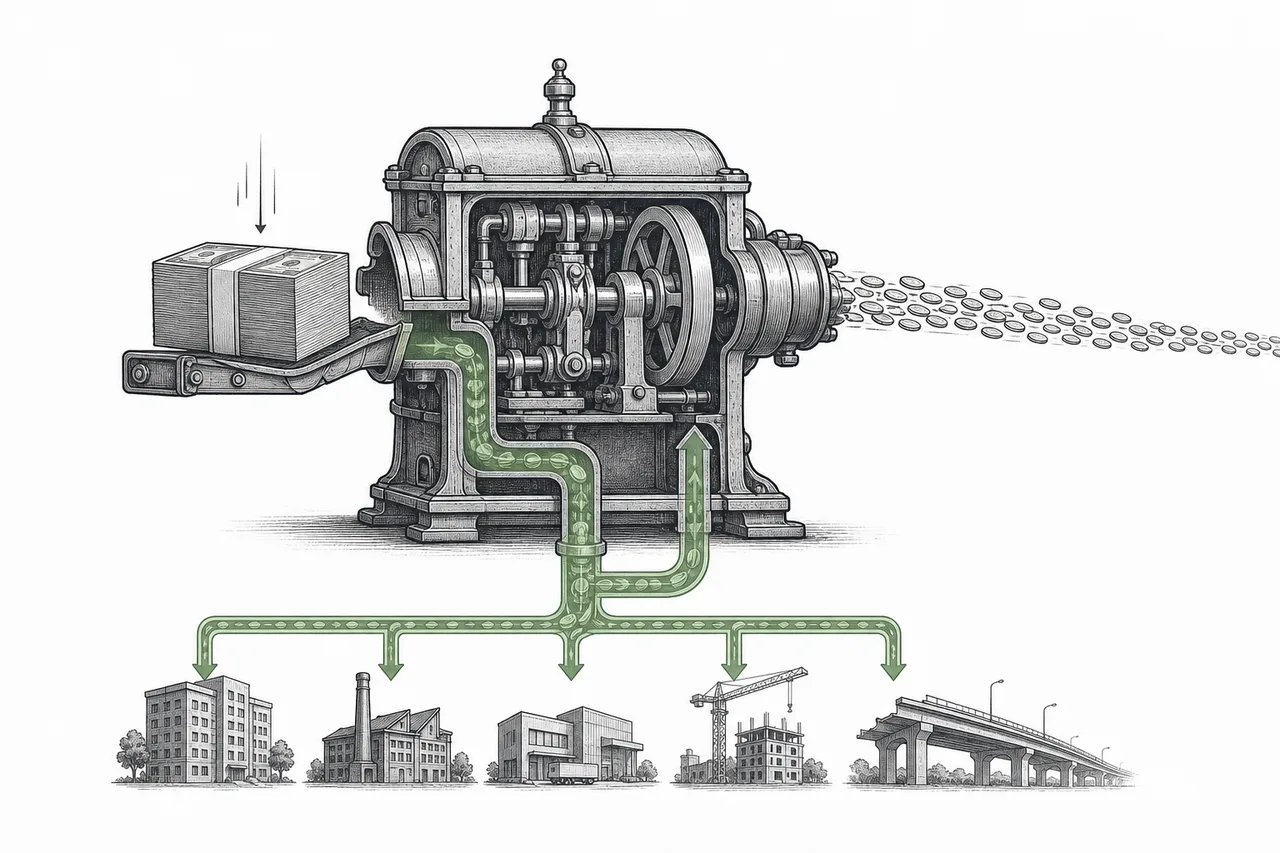
It's a marriage of 'insurance' and 'private credit' that fits together frighteningly well: the insurance side earns higher returns to offer better rates than rivals, drawing in lump sums non-stop; the private equity side gets 'cheap, permanent capital' (reserves customers won't withdraw for decades) to feed its own lending machine. The more the flywheel turns, the bigger it gets, and the better the rates it can offer — so it spins faster still.
04Where it sits in the aging trend
The Aging Population megatrend covers every business that cares for 'people who've grown old' — from Senior Care (elder-care facilities) and Home Healthcare to Death Care (the funeral business). Most of these care for the elderly body, but Retirement Income & Annuities is the piece that cares for the wallet — the 'capital base' that actually lets people pay for healthcare, housing, and end-of-life costs without fear of running out.
What's interesting is how deeply it reaches across into other trends:
- Becomes an engine for Digital Finance & Tokenization: the vast annuity reserves are the 'fuel' that grows private credit and alternative capital markets — this node creates demand for the entire alternatives category
- Collides with Digital Wealth & Robo-advisory: planning 'how to use a lump sum so it lasts for life' (decumulation) is shifting from insurance salespeople onto digital platforms and fee-based advisors
- Depends on Longevity & Life Extension in reverse: if science keeps extending lifespans, the insurer's risk of 'paying longer than calculated' grows too — technology that extends life is a direct risk to this business
Put simply, this node is the point where 'the demographics of aging' transform into 'capital flows in the global financial markets' — a bridge between the aging trend and the modern-finance trend.
05Where it stands now + the players
The 2025 picture has two standout stories. The first is that the product mix has changed — people used to buy annuities with returns tied fully to the stock market (variable), but the hot sellers now are the 'index-linked with a buffer' types like FIA and RILA, which offer a slice of market upside while capping the downside. Together these 'index-linked' products made up 45% of all sales in 2025 — up from just 24% a decade ago.
The second is that who owns this industry is changing hands. Private equity has moved in to grab the beachhead fast. Today PE controls about 20% of US annuity reserves — up from just 2% in 2011 — and 139 insurers are PE-owned (mid-2025). This is the biggest ownership shift in the industry's history.
The clearest example is Apollo–Athene. Apollo bought Athene, an annuity seller, and fed over $300B of its reserves into Apollo's own private credit machine. In 2025, Athene alone poured $45B into private credit at an average 6.8% yield. And crucially — Athene accounts for roughly half of both the assets and the profits of the entire Apollo group. This is no longer a side business; it's the heart.
There's also an adjacent market booming alongside it: pension risk transfer (PRT) — when a big company wants to stop carrying its employees' pension burden, it pays an insurer a lump sum to take that burden off its hands. In 2024 this market hit $51.8B, and J.P. Morgan expects it to climb toward ~$100B a year within a few years. It's the 'wholesale' version of an annuity, sold to organizations instead of individuals.
And this is still mostly a US story. Asia has its own giants taking on longevity risk — Ping An in China, Japan Post Insurance and Tokio Marine in Japan, Legal & General in the UK — a reminder that the aging wave is a global phenomenon, not just an American one.
06The road ahead
First direction: demand hasn't peaked yet. The Peak 65 wave runs through about 2030, and most people retiring are still 'under-saved' — so the fear of running out isn't going anywhere. As long as rates don't plunge back to rock bottom, annuities will keep selling peace of mind. The 'wholesale' market like PRT, heading toward $100B a year, is another leg that keeps growing.
Second direction: the private credit flywheel keeps turning — but under closer scrutiny. As long as private equity can earn a spread, it will keep buying insurers and pulling reserves into its lending machine. Moody's expects the private credit market to top $2 trillion in 2026 and reach ~$4 trillion by 2030 — and annuity reserves are one of the main fuels behind that growth.
Third direction: 'selling a post-retirement paycheck' goes digital. The big challenge in finance is shifting from 'how to save enough' (accumulation) to 'how to spend a lump sum so it lasts for life' (decumulation), which opens the door for fee-based advisors and robo-advisory platforms to design withdrawal plans with annuities baked in — a product once sold mainly through agents is being repackaged for the digital world.
07Challenges & risks
The charm of this flywheel comes with risks embedded deep inside — and they fall on the retirees who've entrusted the security of their later years to these contracts.

One: private credit risk and 'transparency'. When reserves that should be safe get moved into assets that are hard to trade and impossible to see into, the question becomes 'is what's in the box actually good?' Life insurers' investment in private credit hit $849B in 2024 (double 2014). Moody's warns of concentration and liquidity risk — if the economy turns and off-market borrowers start defaulting, the assets backing those lifetime-payment promises may not be as solid as they look.
Two: pressure from regulators. With private equity controlling 20% of reserves, regulators are starting to move. The NAIC has made 'life-insurance portfolio transparency' a priority for 2026 and is issuing tougher rules — for example, a 45% capital (RBC) add-on for the riskiest tranche of CLOs, plus tighter controls on offshore reinsurance. Tougher rules will squeeze the flywheel's profit spread.
Three: sensitivity to interest rates. Part of this boom comes from high rates. If rates plunge back down sharply, fixed annuities will struggle to offer attractive rates, and companies that locked in high guaranteed rates at the peak may come under pressure if their investment returns fall short.
The core risk of this business is that the 'liability side' (the promise to pay for life) and the 'asset side' (the money put to work) have to match up on duration and liquidity. If the promises are long-term but the assets are too hard to sell — or if a rush of withdrawals and market turmoil hit at once — that mismatch is where the trouble erupts. And it's exactly what regulators worry about most.
In short: the annuity is an ancient product that answers humanity's most basic fear — 'will my money run out before I die?' — and in an era when people are aging all at once on a scale never seen before, it's booming like never before. But behind that simple promise, an increasingly complex financial machine is spinning. Understanding how the 'insurance + private credit' flywheel works is understanding why the most boring-sounding node in the aging trend has become one of the hottest, most closely watched battlegrounds in today's financial markets.