Megatrend · Biotech & Genomic Medicine
The world's deadliest disease is being rewritten
Heart and vascular disease is humanity's number-one killer — nearly 18 million lives a year. Yet in business terms it was long the "most boring field" there is, because its workhorse drugs, the statins, have all turned into cheap generics. So the exciting story isn't the overall market — it's the "new mechanisms": a cholesterol shot you take just twice a year, a diabetes drug that became a heart drug, and a weight-loss drug proven to actually cut heart attacks.
01What it is
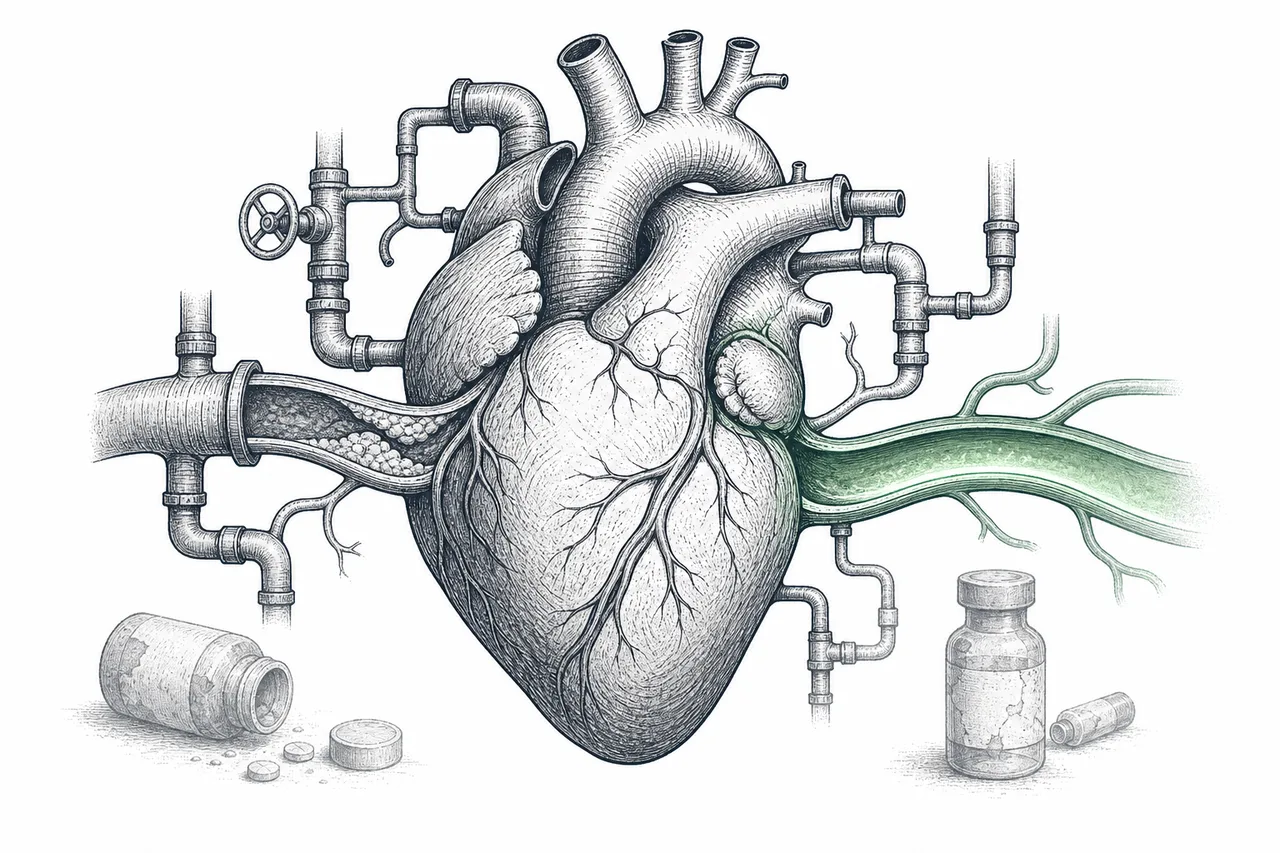
Picture the plumbing in your house — if the pipes clog or the pump starts to weaken, the whole house stops working. Our bodies are the same: the heart is the "pump" and the blood vessels are the "pipes." The drug group we call Cardiovascular & Heart-Failure Therapeutics takes care of both — keeping the pipes clear, and getting a tired pump working again.
More precisely, it splits into two big problems that sit at opposite ends. The first is "keeping the pipes from clogging" — lowering the bad cholesterol (LDL) that builds up as plaque in artery walls until they narrow and rupture into a heart attack or stroke. The second is "propping up the failing pump" — treating heart failure, where the heart muscle weakens until it can't pump enough blood for the body.
It doesn't mean the heart "stops." It means the heart can't pump enough blood for what the body needs — like a water pump that's still turning but has lost its force. Patients tire easily, retain fluid, and end up hospitalized again and again. It's a chronic condition that eats up enormous healthcare resources — and it's also where the "new-generation" drugs are creating the most value.
It's one of the sub-themes under the megatrend Biotech & Genomic Medicine, but Cardiovascular has a clearly different character from siblings like cancer or rare-disease drugs — this is a "big but old" market. Many of its leading drugs have already become cheap generics, so the real innovation value is concentrated in just a handful of new mechanisms. That's the heart of the story we're about to tell.
02Why it matters — the world's number-one disease
Start with the heaviest number: heart and vascular disease is humanity's number-one cause of death. The World Health Organization (WHO) estimates it kills about 17.9 million people a year — more than all cancers combined, and more than any infectious disease. It's no longer a disease of the elderly in rich countries; it's spread worldwide as lifestyles have changed.
That huge patient base makes the market for these drugs big too — worth around $156 billion in 2025, expected to grow to roughly $215 billion by 2034. But look closely and the growth rate is surprisingly slow — just ~3.5% a year.
Why does the "world's number-one" market grow this slowly? The answer is one word — genericization. The pillar of the field, the cholesterol-lowering statin — the most famous being atorvastatin (former brand name Lipitor, once the best-selling drug in history) — went off patent long ago. Today the price has fallen to pennies a pill. That's wonderful for patients and the health system, but for drugmakers it means the value has "evaporated entirely."
This is the key to the lesson: most of the heart-drug market has already become a cheap commodity. So the real value and competition aren't in the "overall market" but are concentrated in a few new mechanisms that still have patents and can still command high prices — and that's exactly where the fresh money is flowing.
03How the drugs work
The heart of this is a two-step "ladder." The first step is lowering LDL, the bad cholesterol in the blood. The lower you get it, the less fatty plaque in the vessels, and the lower the chance of a heart attack. The industry sums up the principle as "lower is better" — and the whole evolution of these drugs is about getting it "lower and lower, in more and more convenient ways."
Let's climb this ladder one rung at a time — each rung is a more advanced era of drugs:
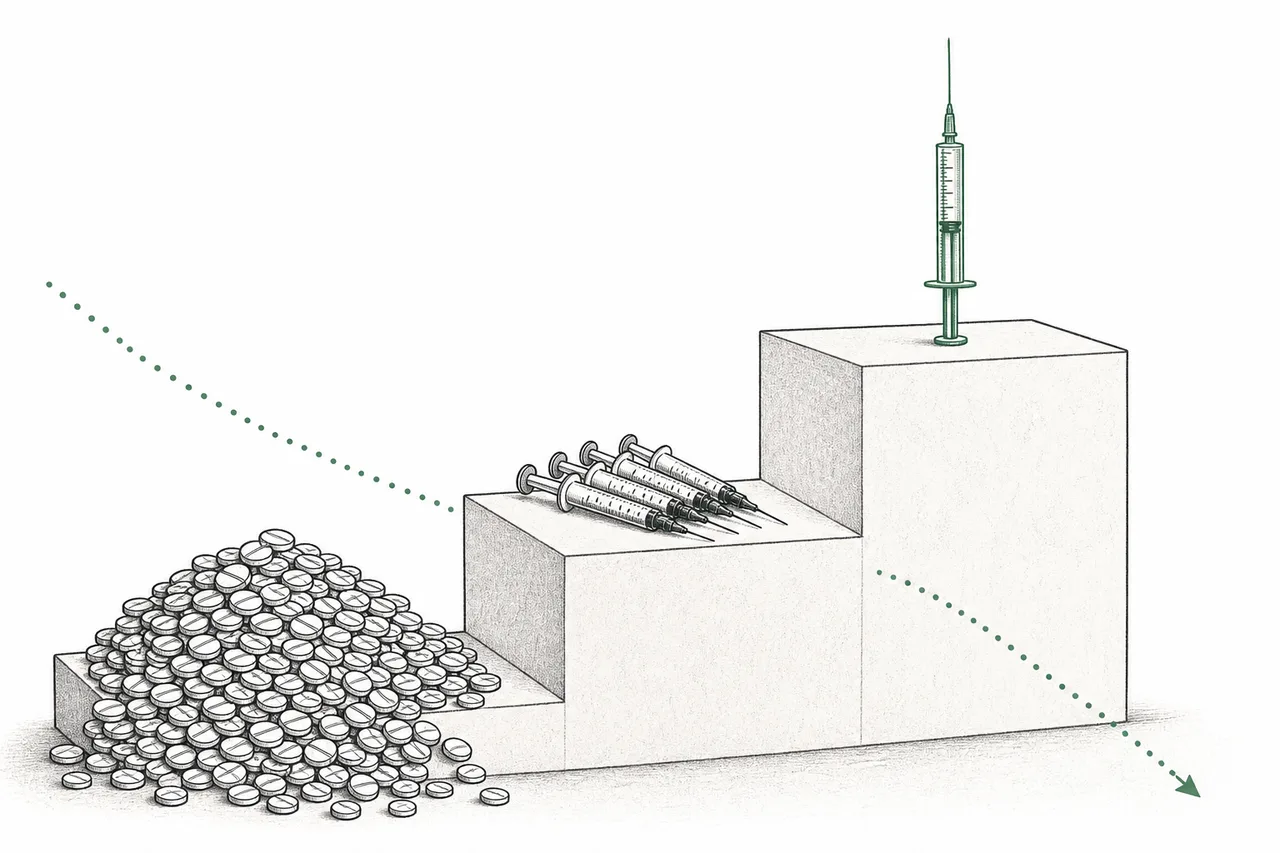
The first rung is the statin — a daily pill that cuts cholesterol production in the liver. Very cheap, but with weaknesses: some people don't lower enough, and a daily pill is easy to "forget." The second rung is the PCSK9 inhibitor, a new-generation shot that lowers LDL far more deeply — but you have to inject it every two weeks.
It's a protein in the body whose job is to "destroy the receptors" the liver uses to pull LDL out of the blood. Put simply, PCSK9 makes the liver worse at sweeping up bad cholesterol. So the new class of drugs is designed to "block PCSK9" — once PCSK9 is shut off, the liver can reabsorb more LDL, and blood cholesterol plunges. This is the same mechanism used by both Repatha (an antibody shot) and inclisiran (an RNAi shot).
The third rung is the star of this era — inclisiran (brand name Leqvio). It doesn't block the PCSK9 protein directly; instead it switches it off at the source — blocking the mRNA blueprint for making PCSK9 in the first place. This technology is called RNA interference (RNAi), and its magic is its "staying power": just two shots a year keeps cholesterol in check all year long. Compared with a daily pill or a biweekly injection, it solves the single biggest problem of chronic disease head-on: patients don't have to remember to take a drug every day.
The heart-failure side, meanwhile, works by a completely different mechanism — it doesn't scrape plaque out of the vessels, but helps "lighten the load" on a weakened heart. A drug like Entresto widens the blood vessels and reduces the fluid the heart has to pump, easing the work of the tired pump. Patients are hospitalized less and live longer.
04Where it sits in Biotech
Cardiovascular is one of the oldest fields in Biotech & Genomic Medicine — but the interesting part is that today it's reconnecting so tightly with other fields in the family that you can't pull them apart. That's where the industry's new energy is coming from.
- Leans directly on RNA Therapeutics: inclisiran is entirely an RNAi drug, designed by Alnylam (the pioneer of this technology) before Novartis acquired it to bring to market. You could say the most advanced cholesterol drug today is really a "child of the RNA trend" — the revolution in RNA is flowing straight in to remake heart drugs
- Overlaps massively with Metabolic, Diabetes & Obesity: this is the biggest convergence of all. SGLT2-class diabetes drugs and GLP-1-class weight-loss drugs have both been proven to "cut cardiac events." The line between "diabetes drug," "weight-loss drug," and "heart drug" is dissolving — we're entering the era of cardiometabolic drugs that treat the whole system at once
- Tied to aging societies and longevity: the longer people live, the longer the heart has to work. Heart failure and the protein-buildup heart disease (ATTR-CM) are both diseases of older age, so the patient base grows along with the world's aging population

05Where it stands now
If one word captures this moment, it's "resurrection." After a long quiet spell once statins went generic, several new "warheads" are emerging at once — and the interesting part is they're coming from multiple directions.
Warhead 1 — cholesterol shots are proving themselves Novartis's inclisiran (Leqvio) broke past $1.2 billion in sales in 2025, up 57% year on year, becoming a full-fledged blockbuster. The antibody-side rival, Amgen's Repatha, is accelerating too — up 40% in Q3 2025 — and the latest VESALIUS-CV trial showed it can cut the risk of a first heart attack by 25%, opening the door to use in people who have "never" had heart disease, a far bigger market than before.
Warhead 2 — the convergence with weight-loss drugs This is the biggest story of the decade. The SELECT trial (17,604 patients) proved that semaglutide (Novo Nordisk's Wegovy) cut major cardiac events (heart attack/stroke/death) by 20% in obese people who did not have diabetes — and crucially, it worked even when weight didn't drop much. That means weight-loss drugs are becoming "heart drugs" in their own right.
Warhead 3 — diabetes drugs that crossed over to become heart drugs SGLT2-class drugs like Farxiga (AstraZeneca) and Jardiance (Boehringer/Lilly) started out as diabetes drugs. But the DAPA-HF, EMPEROR, and DELIVER trials showed they reduce hospitalization and death from heart failure whether or not the patient has diabetes. Today they've become standard drugs in treating heart failure.
A disease in which a protein called transthyretin (TTR) misfolds and builds up as "deposits" in the heart muscle, making the heart stiff so it can't pump blood out. It's a disease of older people that used to be overlooked, but it's now one of the hottest fields — because there are "stabilizer" drugs that grab onto TTR and stop it misfolding, slowing the disease. And patients pay a premium because there's no other option.
It's this ATTR-CM field where a small company is genuinely challenging the giants. Pfizer dominates the market with tafamidis (Vyndaqel/Vyndamax), which sold $6.3 billion in 2025 and holds about a 75% share. But BridgeBio has just entered with the drug Attruby (acoramidis) — a stronger-than-expected debut at $362 million in its first year, from nearly 8,000 prescriptions, with the selling point that it stabilizes TTR "almost completely (≥90%)." This is a clear example of the whole lesson's theme — enormous value concentrated in just a few "new mechanisms."
06The road ahead
The clearest direction is "fewer shots, more prevention." If inclisiran lets people control cholesterol with two shots a year, the next question is — what about "one shot and done"? There's research developing gene editing techniques to switch off the PCSK9 gene permanently in a single dose. If it works, it would turn heart-disease prevention from "treat for life" into "handle once" — connecting directly to the Gene & Cell Editing trend.
The second direction is the heart-metabolic convergence going deeper still. New-generation GLP-1 drugs that drive more weight loss and are tested directly on heart failure (not just as a side benefit) are set to become a pillar of heart treatment. The whole split between "the diabetes doctor" and "the heart doctor" may have to be rethought from scratch.
And the third direction is specialized conditions that were once overlooked, like ATTR-CM and hypertrophic cardiomyopathy (HCM), drawing in more players. Now that Cytokinetics's aficamten and BridgeBio's acoramidis have proven these markets really make money, other companies will follow — giving patients more choices and gradually lowering prices over the long run.
07Challenges & risks
There's a side of this story that has to be said plainly — and it's a structural risk baked into the very nature of the heart market.
The first risk is the ever-present shadow of genericization. The best-selling heart drugs in history all ended up as cheap generics. Statins did; and most recently Entresto just lost its main US patent in July 2025, with generics already entering the market. Every flagship drug today is tomorrow's cheap generic — so value has to be rebuilt constantly, with no rest.

The second risk is the double-edged sword of GLP-1. On one hand it's an enormous tailwind — a weight-loss drug that really cuts heart attacks expands the heart market far wider. But on the other, if a single drug (say semaglutide) can handle weight, diabetes and the heart all at once, it might "swallow" the need for some specialized heart drugs. Patients already on a weight-loss drug may not want add-on medications — and that's an uncertainty no one has the answer to yet.
The third risk is price and access. The new-mechanism drugs are priced very high — tafamidis runs about $225,000 a year. With a heart-disease patient base of hundreds of millions worldwide, insurers and governments will naturally pile pressure on price. A drug that's good but too expensive may reach only a small minority, and risks price controls in many countries.
In short: heart disease is the single biggest enemy of human health, and after a long silence while cheap drugs ruled the market, it's coming back as a battleground for innovation again — driven by RNA, weight-loss drugs, and a new generation of specialized drugs. Understanding that "value concentrates in the new mechanisms, not the overall market" is the key to seeing this trend clearly.