Megatrend · Whole-trend overview
The Drug-Making Ladder: From Pills to Editing Genes
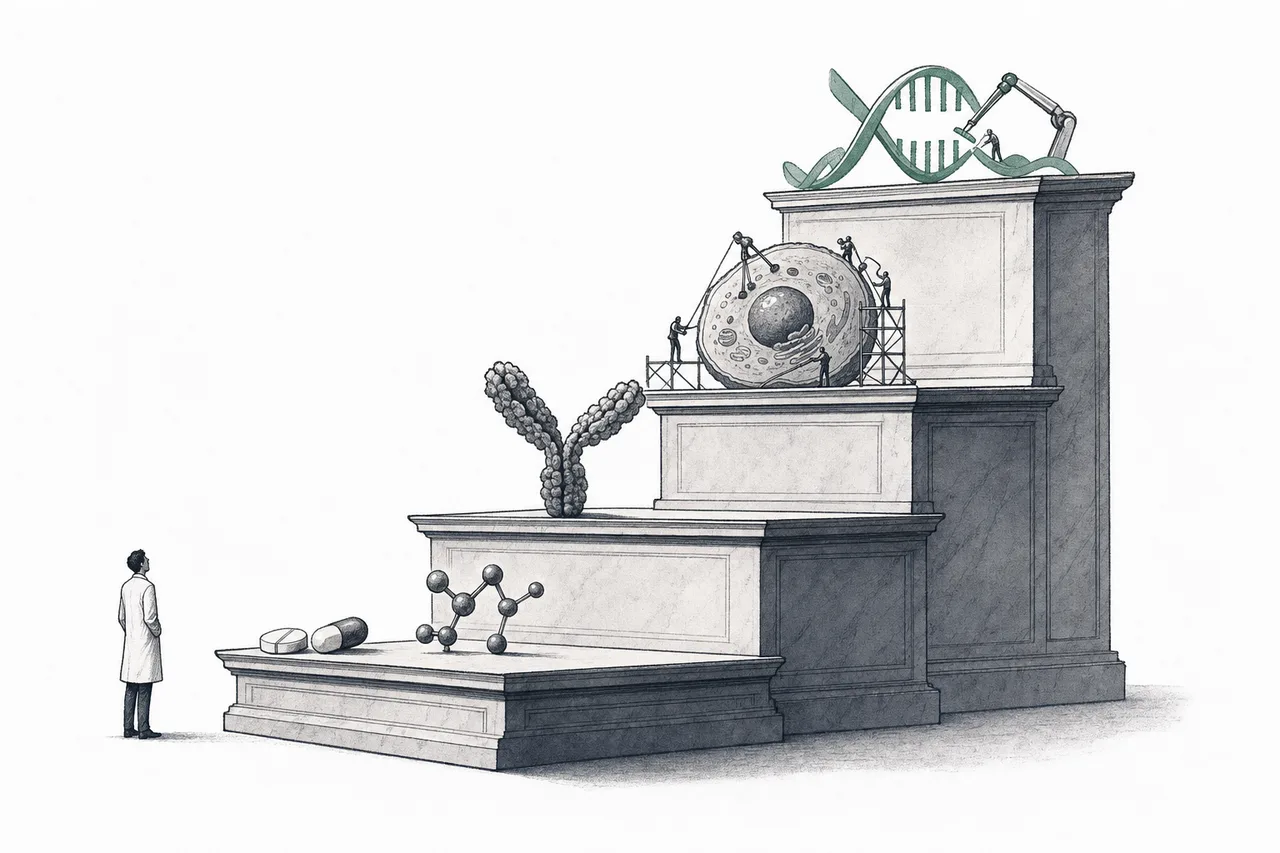
For all of history, humans treated disease with "pills" — small molecules. But over the last 40 years we've climbed a whole ladder: from pills, to biologics grown from living cells, to injecting cells and genes that repair the body, all the way up to RNA that tells the body to make its own medicine. This node is the map that threads the 16 categories of Biotech into one picture — how each "way of making a drug" differs, who feeds whom, and why the weight-loss wave is shaking the entire industry (each category has its own deep-dive chapter).
01The Big Picture: Why Medicine Became a "Technology"
When you're sick and take a pill, you rarely think about where that pill came from. But behind it sits one of the most research-intensive industries on Earth. And here's the key part — it's steadily redefining what "medicine" even means, from small chemicals synthesized in a factory, to proteins grown from living cells, and most recently to genetic "instructions" you inject so the body repairs itself.
The scale here is enormous. The biopharmaceutical market alone was about $452 billion in 2024 and is expected to grow to roughly $740 billion by 2030 (CAGR ~8.8%) — and that doesn't even count traditional chemical drugs, tools, and diagnostics. Count the whole ecosystem and it's a multi-trillion-dollar market where everyone on the planet becomes a "customer" sooner or later.
But what makes this industry harder to follow than others is that it isn't split by "disease" alone — it's also split by "how the drug is made" (modality). And each way of making a drug sits at a very different level of complexity, like a ladder you climb one rung at a time. That's the map we'll lay out in this chapter.
02The Map: What Are the 16 Sub-Categories
Biotech & Genomic Medicine breaks into 16 categories, which group into 3 big "families" — platforms (new ways of making drugs), disease areas (what you point those ways at), and infrastructure (the tools and manufacturing everyone needs). Each category has its own deep-dive chapter (tap to read):
Family 1 — Platforms (new ways of making drugs)
- Gene & Cell Editing: editing genes directly (e.g. CRISPR) and engineering cells to treat disease — the top of the ladder, because it fixes the root cause at the DNA level
- RNA Therapeutics: drugs that use RNA to make the body produce its own proteins or "silence" disease-causing genes — the same platform that made the COVID vaccines work
- AI Drug Discovery: using AI to design and screen drug molecules — not a drug itself, but an "accelerator" for discovery that's reshaping the whole field
- Regenerative Medicine & Tissue Engineering: repairing and rebuilding tissue and organs to replace what's damaged — stem cells, tissue engineering, and fixing the body at a structural level instead of just "giving a drug." Market ~$42 billion (2024), growing fast at ~25% CAGR
Family 2 — Disease areas (what you treat)
- Metabolic, Diabetes & Obesity: diabetes and obesity — home of the GLP-1 drugs (Ozempic, Mounjaro) that are the industry's biggest wave right now
- Oncology Therapeutics: cancer drugs — the largest disease area (~37% of the biopharmaceutical market) and one of the fastest-growing
- Autoimmune & Immunology: diseases where the immune system attacks itself (rheumatoid arthritis, psoriasis) — home of "blockbuster" drugs like Humira
- Neuroscience & Neurodegenerative: brain and neurodegenerative diseases (Alzheimer's, Parkinson's) — the hardest field and the biggest prize
- Cardiovascular & Heart-Failure: heart and vascular drugs (heart failure, cholesterol, blood pressure) — one of the largest disease areas, a market of about $156 billion in 2025, with new RNAi drugs like Leqvio changing the game
- Antiviral & Infectious-Disease: antivirals and infectious disease (HIV, hepatitis, flu, COVID) — a market of about $66 billion in 2025, the stronghold of Gilead and GSK
- Rare Disease: rare diseases — where gene therapy and RNA show their clearest results, because they often stem from a single faulty gene
- Vaccines: vaccines, both traditional and recombinant — preventing illness before it starts, a key link to the RNA platform
- Biosimilars 📘: the "copycat versions of biologics" that move in to compete once the original loses patent protection — deep-dive chapter available
Family 3 — Infrastructure (tools and manufacturing)
- Tools, Diagnostics & CDMO: research tools, diagnostics, and contract drug manufacturing — the "picks and shovels" every drug company has to buy, no matter who wins
- Plasma-Derived & Blood Products: drugs extracted from human blood plasma — old but indispensable infrastructure, with only a few players
- Diabetes Devices (CGM & Insulin): continuous glucose monitors and insulin pumps — hardware that works hand-in-hand with diabetes drugs
03How It All Connects (the modality ladder)
The axis that makes this whole map easier to grasp is the "ladder of drug-making" (modality ladder) — each rung is a way of making drugs that's more complex and treats disease more deeply, but is also harder and more expensive to make. Every disease area on the map pulls its "drug" from one rung or another of this ladder:
Small molecule = a chemical you can synthesize reliably, like a recipe you can repeat exactly — so cheap copies (generics) appear once the patent expires · biologic = a large protein grown from living cells that can't be reproduced identically, so you only get a "similar" version (biosimilar) that's still expensive and much harder to copy.
The key connection is that disease areas "pull" drugs from the ladder, while the tools layer "supports" every rung — cancer, for example, uses both biologics (antibodies) and cell therapy (CAR-T), while rare diseases usually need gene therapy or RNA. And no matter which rung's drug you make, every company leans on the same tools, diagnostics, and factories (CDMO) — which is why the tool sellers make money no matter who wins.
04Where the Value and Power Sit
The key rule of this industry is that value piles up on "the patent of a best-selling drug" — a single blockbuster still under patent earns enormous money and has near-total pricing power. The moment the patent expires, competitors (generic/biosimilar) rush in, prices crash, and the value evaporates.
Look at the power of a single drug: Humira (an immunology drug) once earned over $20 billion a year at its peak, before losing patent protection and getting its share eaten by biosimilars — that kind of money from one drug explains why drug companies pour enormous research budgets into finding the "next one."
Notice that antibodies (mAb) dominate at ~61% of the market — because they work broadly across both cancer and immune disease. Cell/gene/RNA, meanwhile, may be the top of the ladder and the "future," but they're still a small share (only just starting to scale). This is the classic picture of a technology whose "future is bright but present is still small."
The lesson for reading this trend: don't just ask "does this company make drugs," ask "how many years of patent does its flagship drug have left, and is there a next one in the pipeline".
05Forces That Move the Whole Trend
Even though the categories differ, there are 4 big forces moving the entire industry at once:
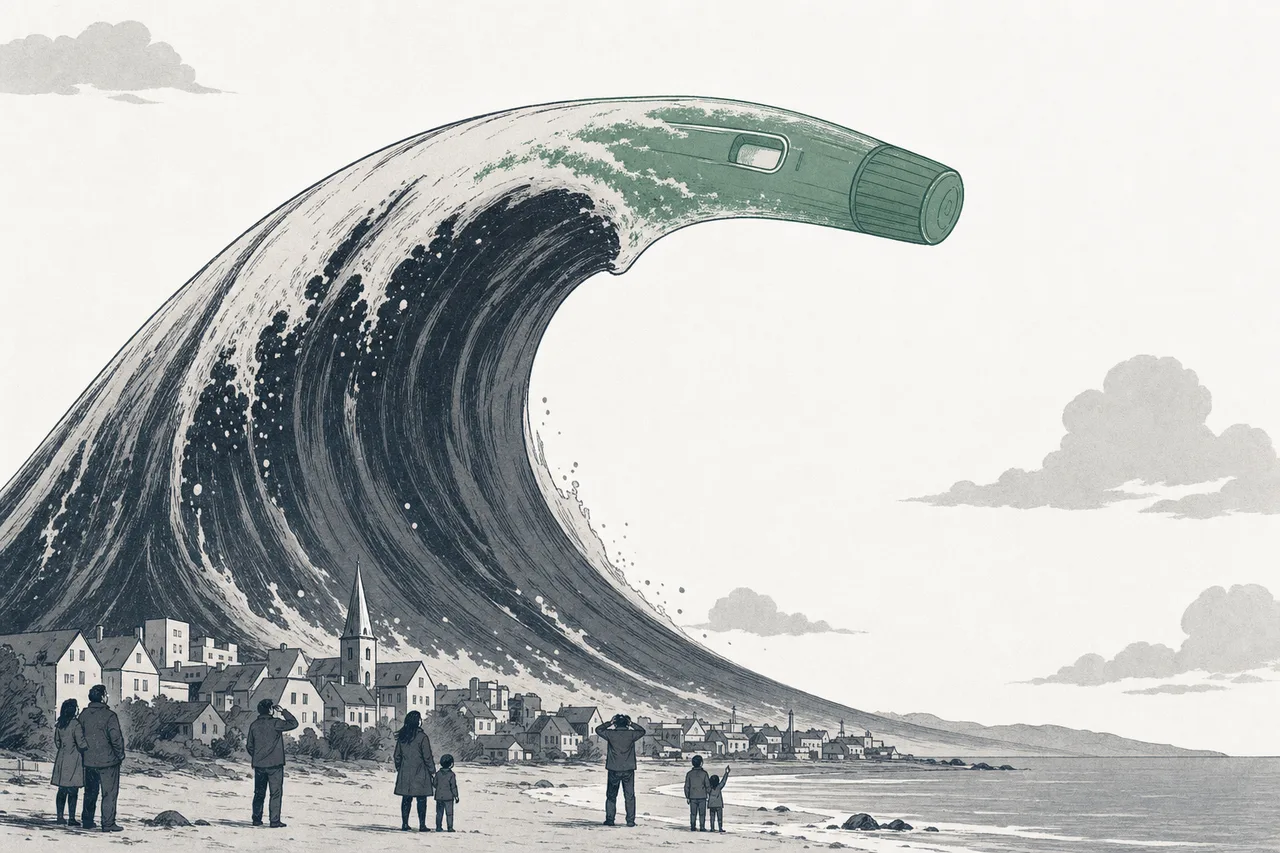
1. The weight-loss wave (GLP-1 / obesity) — this is the biggest and fastest force right now. GLP-1 drugs like Ozempic, Mounjaro, and Zepbound turned from diabetes drugs into weight-loss drugs with demand overflowing supply. The whole incretin/GLP-1 market is expected to surge from about $53 billion (2024) to $150–200 billion by 2030, with just two players (Eli Lilly and Novo Nordisk) holding a combined share of about 94%.
2. AI has entered the lab — traditional drug discovery is very expensive and slow (on average ~$2.6 billion and up to 15 years per drug). AI is now starting to help design and screen molecules faster. The AI drug discovery market is still small (~$1.7 billion in 2024) but growing fast at ~30% CAGR — a force that could change the "economics of drug discovery" across the board.
3. An aging society — the world keeps getting older, and the elderly are the biggest customers for medicine (cancer, dementia, chronic disease). This force ties the Biotech industry directly to the aging society and longevity trends — disease-side demand grows with the population structure no matter what the economy does.
4. The patent cliff (patent cliff) — this is the "negative" force pressing on the whole industry. Drugs earning a combined over $180 billion a year in the US (and nearly $300 billion globally) are about to lose patent protection between 2024–2030 — forcing pharma giants to race to find (or buy) new drugs to replace them before the old revenue falls off the cliff.

06Where Things Stand Now + the Champion of Each Category
2025–2026 is the era where every rung of the ladder is working at once — GLP-1 drugs sell so well they run out of stock, CRISPR has successfully treated its first real patients, and "in-body" (in vivo) gene therapy has passed Phase 3 for the first time. Below are the "champions" of each category, reflecting how power is spread across both modalities and regions (US/Europe):
07The Future and the Risks
Looking ahead, this industry has both tailwinds and risks you need to watch together.
On the opportunity side: the upper rungs of the ladder (cell/gene/RNA) are moving from "promise" to "reality" — the cell and gene therapy market is expected to grow from about $14 billion (2024) to $80–105 billion by 2030–2033 (CAGR ~22–25%), and the FDA has already approved ~37 of these drugs, targeting 10–20 approvals a year. Add the GLP-1 wave and AI accelerating discovery, and this industry has several "growth engines" running at once.
On the risk side, there are several layers to watch:
- The patent cliff: many giant drugs are about to lose patent protection at once — if replacements don't arrive in time, the big companies' revenue will fall hard
- Drug discovery is still high-risk: even with AI's help, most drugs still fail in the clinic. The ~$2.6 billion cost per drug is a bet that can be wasted entirely — R&D productivity is a chronic problem for the industry
- Price and politics: some gene therapies cost millions of dollars per dose, igniting pressure over "who can afford it" and drug-pricing policy (in the US, for example). That's a risk that lives outside the financial statements
- Concentration in GLP-1: with research money and attention pouring into weight-loss drugs, if this wave slows or long-term side effects surface, the whole board shakes
And that's why this chapter is a "map," not a "deep-dive guide" — because the real value of seeing the whole trend is seeing that every category threads together on the same ladder before you walk in to explore each rung in detail — tap into the deep-dive chapter of whichever category interests you (start with Biosimilars, which already has a chapter ready).