Megatrend · Biotech & Genomic Medicine
One gut hormone that became the biggest drug wave in history
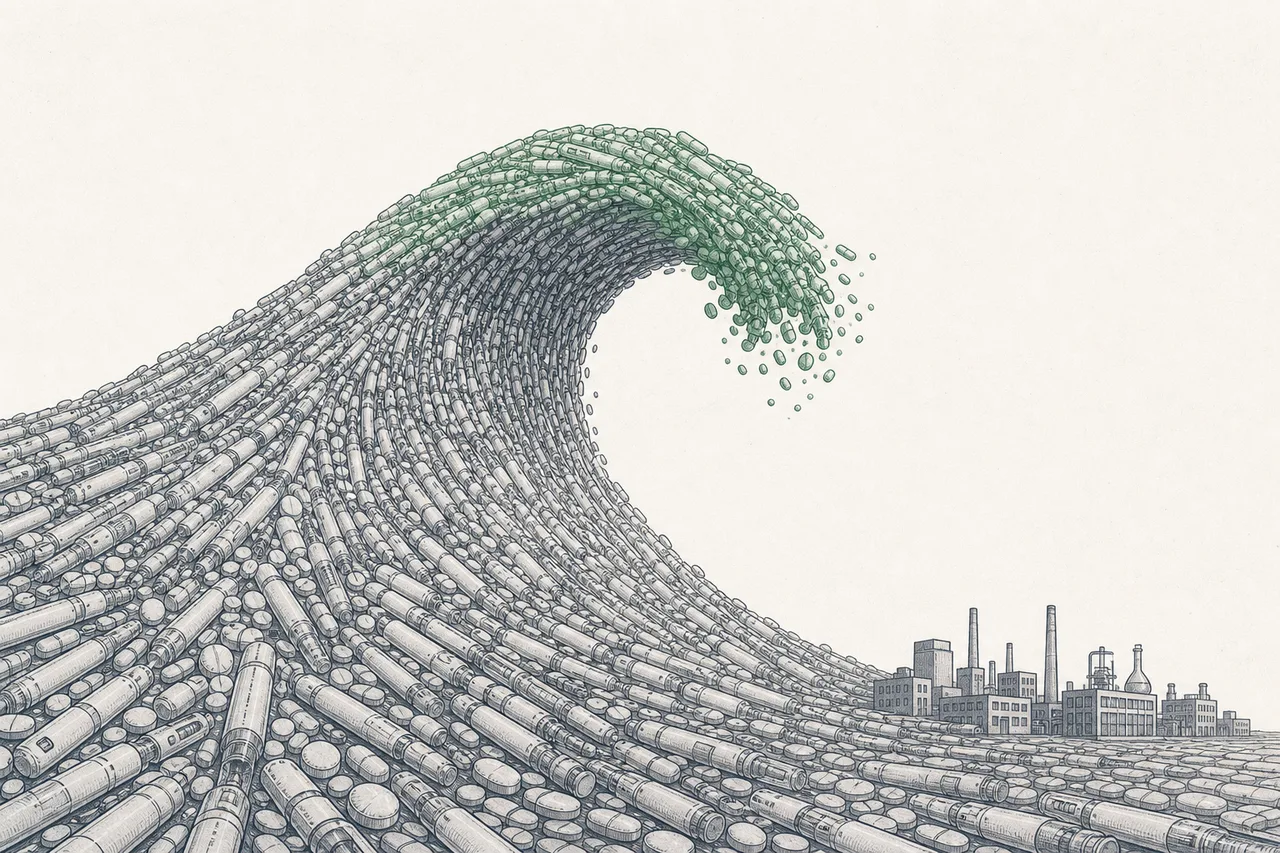
Ozempic, Wegovy, Mounjaro, Zepbound — they're all the same family of drug, mimicking the 'full' hormone our gut releases. They cut weight to a degree that used to require surgery, control diabetes, and on top of that reduce heart attacks and kidney disease. The result: a drug market growing from ~$53 billion in 2024 toward $150–200 billion by 2030 — with just two companies holding almost the entire thing. This is the biggest 'super-cycle' in biopharma.
01What it is (the GLP-1 hormone)
Start with a fact that sounds ordinary: every time we eat, our small intestine releases a hormone called GLP-1. It's like a 'signal' that runs to the brain saying 'I'm full now, that's enough,' while at the same time prompting the pancreas to release insulin to handle blood sugar. The problem is that this hormone breaks down very fast — it lasts just a few minutes in the bloodstream.
What scientists did was design a molecule that mimics GLP-1 but lasts for weeks. The result: the body acts as if it's getting the 'full' signal all the time — less hunger, less eating, weight falling, and better blood sugar. This is the heart of the class of drugs called GLP-1 receptor agonists — known by brand names like Ozempic, Wegovy, Mounjaro, and Zepbound.
A group of gut hormones released when you eat, to tell the pancreas to release insulin. GLP-1 is the most important incretin; the other is GIP. The more powerful newer drug tirzepatide (Mounjaro/Zepbound) is a 'dual agonist' that stimulates both GLP-1 and GIP at once — so it drives more weight loss than the first generation, which had only GLP-1.
On our megatrend map, this segment is a sub-theme under Biotech & Genomic Medicine — and not an ordinary one. Its definition says it plainly: it's 'the biggest source of value in the drug industry.' That's because it doesn't treat rare diseases, but targets obesity and diabetes — health problems for hundreds of millions of people worldwide — all at once.
02Why it shakes the global economy
The first reason is the size of the problem. In 2024, more than a billion people worldwide were obese; in the US alone, about 40% of adults are. This isn't a niche market — it's a 'world population' market. And crucially, obesity is the root of a cascade of other diseases — diabetes, heart disease, high blood pressure, joint disease — which makes the real market for this drug far wider than just 'people who want to be thin.'
The second reason is money. The GLP-1 drug market was worth about $53 billion in 2024, and analysts expect it to surge to $150–200 billion by 2030 — growing at over 18–20% a year. Numbers like that are rare in a slow, saturated drug industry. This is 'creating a new market' wholesale, not just taking share from existing ones.
And the impact doesn't stop at drug companies — it spreads through the whole economic chain. Restaurants, snacks, high-sugar drinks, even airlines calculating passenger weight all have to rethink what happens if hundreds of millions of people eat 20–30% less. Some analysts even call it a 'demand shock' for the entire food industry.
The third and deepest reason is that it's proving a single drug can change the course of several chronic diseases at once — we'll save that for the later chapters, but it's exactly why the market sees this segment's value as nowhere near its ceiling.
03How it works — the gut talks to the brain and pancreas
The charm of this class of drugs is that it doesn't work in one place — it sends signals to three places at once. It starts in the gut, which releases GLP-1 (or a drug that mimics it). The signal runs in two directions — up to the brain to suppress hunger, and to the pancreas to manage blood sugar. Let's look at the whole mechanism:
The cleverest part of this mechanism is the word 'glucose-dependent' — the drug prompts insulin only when blood sugar is high, and stops once it returns to normal. That's different from injecting insulin directly, which risks a dangerous blood-sugar crash. This is why it's safe enough to use in an enormous number of people.
The weight loss comes from two paths: the brain says 'less hunger,' plus the gut slows digestion (gastric emptying), keeping food in the stomach longer, so you feel full longer after a single meal. The net effect is that patients eat less without having to 'force it' — something conventional dieting can barely achieve.
The speed at which food moves from the stomach into the intestine. GLP-1 drugs slow it down, so food stays in the stomach longer and you feel full longer. But the side effect that follows is nausea and bloating — the main reason some patients can't tolerate the drug and stop taking it.
04What it connects to within Biotech
This segment sits right at the center of several tightly interwoven trends. Start with the closest sibling — Diabetes Devices (CGM & Insulin Delivery), the skin-worn blood-sugar monitors (CGM) and insulin pumps. Both live in the same diabetes world. The relationship is interesting because it's both 'friend' and 'rival': a GLP-1 drug that controls blood sugar well may reduce the need for insulin injections in some patients, but at the same time, diabetic patients using it still need to measure their blood sugar.
Connecting one layer further is Cardiovascular & Heart-Failure Therapeutics — and this is where the story starts to get big. Trial data found that GLP-1 genuinely lowers the risk of heart attack and stroke, blurring the line between a 'weight-loss drug' and a 'heart drug.'
From a broader megatrend view, it's also entangled with other trends in meaningful ways:
- Supports an aging society: this drug helps older people better manage the metabolic diseases that come with age — obesity and diabetes are 'accelerators' of the body's decline, and controlling them effectively extends the healthy years of life. So it connects directly to the Longevity trend
- Depends on AI: finding the next generation of GLP-1 molecules — especially small-molecule pills that are easier and cheaper to make than injectables — takes enormous AI simulation and screening. This is the area where AI Drug Discovery is starting to play a role
- The opposite pole of Biosimilars: today GLP-1 drugs are the highest-earning 'expensive innovator drugs' — but in another 10–15 years, when the patents on semaglutide and tirzepatide expire, they'll become the biggest target the biosimilar industry has. Today's hero is tomorrow's treasure chest for others to pick up
05Where it stands now — and who controls the market
The first thing to understand is that this enormous market is held by just two companies — Eli Lilly (US) and Novo Nordisk (Denmark). Together they control about 94% of the entire GLP-1 market. This is a 'duopoly' you almost never see in the modern drug industry, and the war between these two is the heart of the 2025–2026 story.

The striking part is that the wave is turning. Novo Nordisk was once the market king with Ozempic and Wegovy (the drug semaglutide). But once Lilly launched tirzepatide (Mounjaro/Zepbound), which stimulates both GLP-1 and GIP and drives more weight loss, Novo's share fell from 55.7% to 49.3% within a single year (August 2025). Lilly's combined Mounjaro+Zepbound sales reached about $36 billion in 2025, overtaking Novo's Ozempic+Wegovy for the first time.
The biggest milestone of this period is the just-approved 'pill'. Until now, almost all GLP-1 drugs had to be injected, which limited both the number of people willing to use them and the production capacity. But from late 2025 into early 2026, everything changes: the FDA approved Novo's oral semaglutide (oral Wegovy) as the first oral GLP-1 drug for weight loss, followed by Lilly's orforglipron (Foundayo) — a non-peptide small molecule that's easier to manufacture and has no restriction on taking it with food.
This is no small thing, because switching from 'inject' to 'swallow' unlocks a market many times bigger than before — the enormous number of people afraid of needles, and a pill-manufacturing system that scales up far more easily than making biologic injectables.
06The future: pills, a new wave, and beyond weight
The biggest battlefield of the near future is the pill. It changes the whole game, because injectables are stuck on production capacity and people fear needles, while pills are easier to make and can spread far wider. The interesting thing is that Lilly's orforglipron drives about 12% weight loss — just slightly below the Wegovy injectable (13.7%) — but the huge gain in convenience may easily make up the difference.
The second battlefield is a more powerful 'third wave'. Newer drugs keep pushing the ceiling of weight loss higher. Let's see how far the trial numbers run — some are starting to approach the results of stomach-shrinking surgery:
This new wave doesn't just compete on 'losing more.' It also competes on:
- Fewer injections: Amgen's MariTide is a once-a-month injection instead of once a week — far more convenient for long-term use
- Preserving muscle: a big problem with this generation is that the weight lost is both fat and muscle; many newer drugs try to add an ingredient that preserves muscle mass (muscle-preserving)
- amylin — a second hormone: Novo's CagriSema combines semaglutide with cagrilintide (which mimics the hormone amylin), a new mechanism that could push the weight-loss ceiling even higher
But the deepest and most important battlefield over the long run is 'beyond weight' — the way this drug is gradually proving it can genuinely treat other chronic diseases. Every time the FDA approves a new indication, the drug's market widens by another layer:
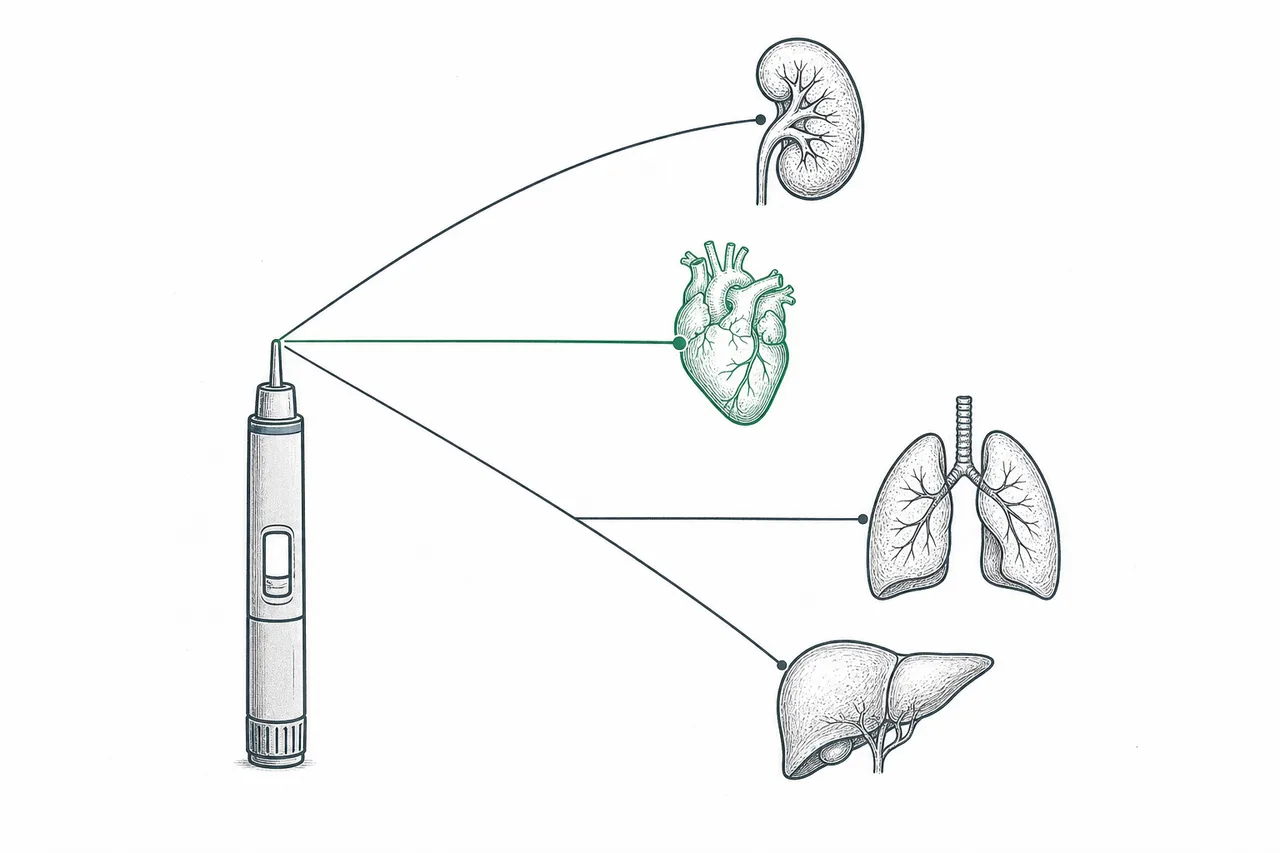
This is why investors see this segment's value as nowhere near its ceiling — a single drug that started as 'weight loss' is becoming a 'complete metabolic-disease treatment,' and every new indication is a new market, plus a reason for insurers to agree to pay.
07Challenges & risks
This bright picture has a side to watch out for, and an investor who sees this trend clearly has to see both sides.
The first risk is the 'pill' that could upend the whole board — it's both an opportunity and a threat. Once small-molecule pills are far easier and cheaper to make than biologic injectables, the wall that protected the duopoly (the difficulty of making injectables) gets lower, opening the door for new players like Structure or Viking and Chinese manufacturers to compete more easily. The price war that follows could squeeze everyone's margins.
The second is muscle loss. The weight lost isn't all fat. Research finds part of it is lost muscle mass, which over the long run could affect strength, especially in older people. This is a clinical risk still to watch — and a field where newer drugs have to prove they can solve it.
The third is price and access. This generation of injectables lists at hundreds of dollars a month, so half of the people who'd like to use it say they 'can't afford it.' Pressure from governments and insurers to cut prices is rising worldwide. At the same time, people buying their own compounded versions from compounding pharmacies during shortages creates both safety risks and revenue cannibalization.
The last risk is concentration risk — when one market is held by just two companies, and those companies' stock-market value depends on just a handful of drugs, a single piece of bad news (an unexpected side effect, a failed trial, or a rival with a better drug) can shake their value violently. So investing in this trend means understanding that you're betting on 'a handful of drugs' that carry the expectations of the whole market.
In short: Metabolic, Diabetes & Obesity is a very rare kind of trend in the drug industry — demand on a world-population scale, treatment effects proven across weight, heart, and kidney, and still room to keep expanding indications. It's genuinely a 'good for the health of the whole world' story. But in business terms, the key question isn't 'will it be big,' it's 'who will survive and take the most share' as the field gets crowded and prices start to fall.