Megatrend · Biotech & Genomic Medicine
The drug that doesn't treat you — it orders your body to heal itself
An ordinary drug is a chemical we put straight into the body. An RNA drug does something completely different — it's a short 'instruction' sent in to tell your cells which protein to make, or which one to stop making. This is the platform that produced a COVID vaccine in 11 months, and it's now turning its barrel toward cancer and rare diseases.
01What an RNA drug is
At the end of 2020, the world saw something it had never seen before. The COVID vaccines from Pfizer/BioNTech and Moderna were designed within days of Chinese scientists releasing the virus's genetic code — not the years a traditional vaccine takes. They went through trials and into real-world use in about 11 months, the fastest in history. That speed wasn't luck; it came from a new technology called mRNA — and it's just one page of a much bigger story.
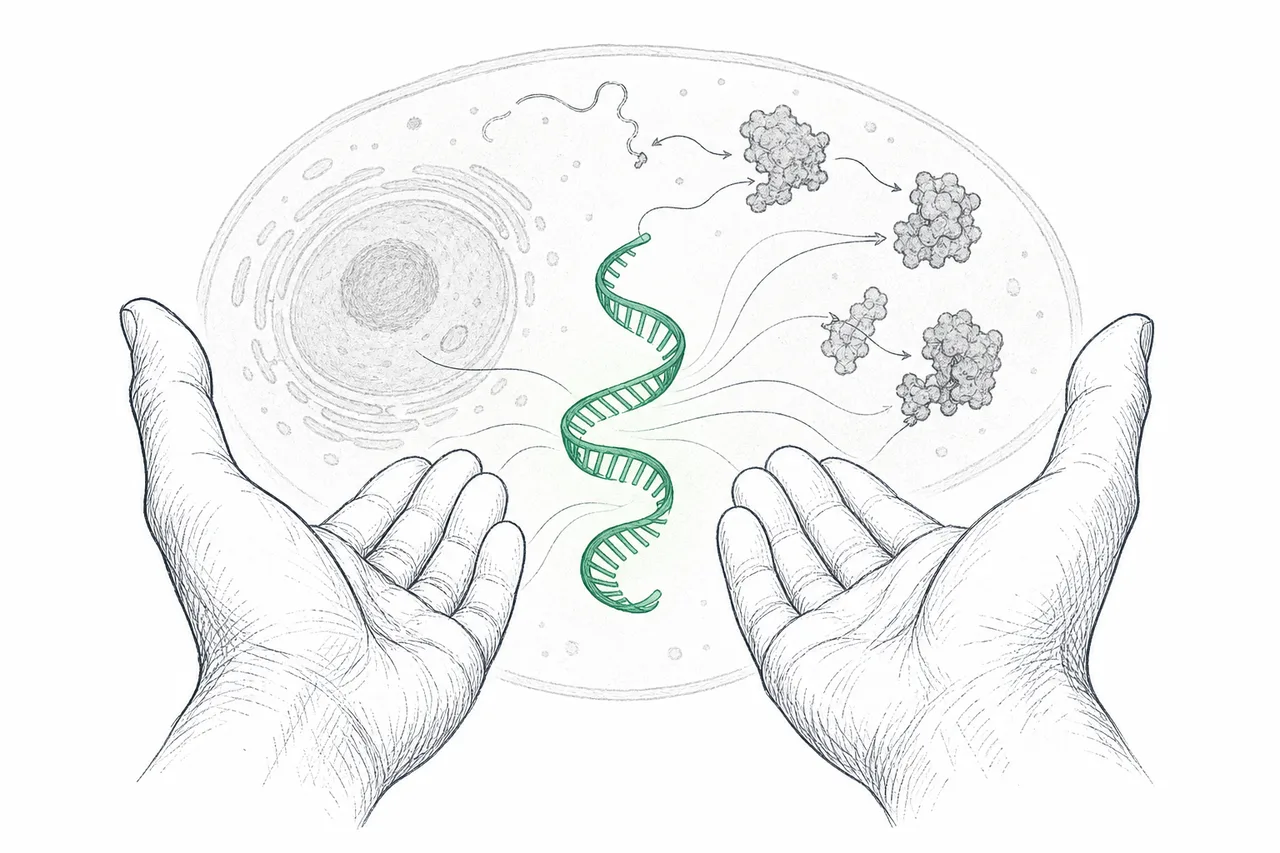
Almost every drug we know, whether paracetamol or an expensive antibody drug, works the same way: we put a finished drug into the body and let it bind to a target. RNA drugs flip that logic on its head. They don't deliver the 'drug' itself — they deliver an 'instruction': a short piece of genetic code that tells your own cells to make a protein you need, or stop making a protein that causes disease. Put simply, instead of delivering a ready meal, we're handing over the recipe and letting the body's kitchen cook it.
In every cell, DNA is the 'master blueprint' kept in the nucleus. RNA is the 'instruction copy' transcribed out of it for actual use — in particular, messenger RNA (mRNA), which carries the recipe for building a protein to the cell's protein factory, the ribosome. RNA drugs are about writing or intercepting these 'instruction copies' to treat disease.
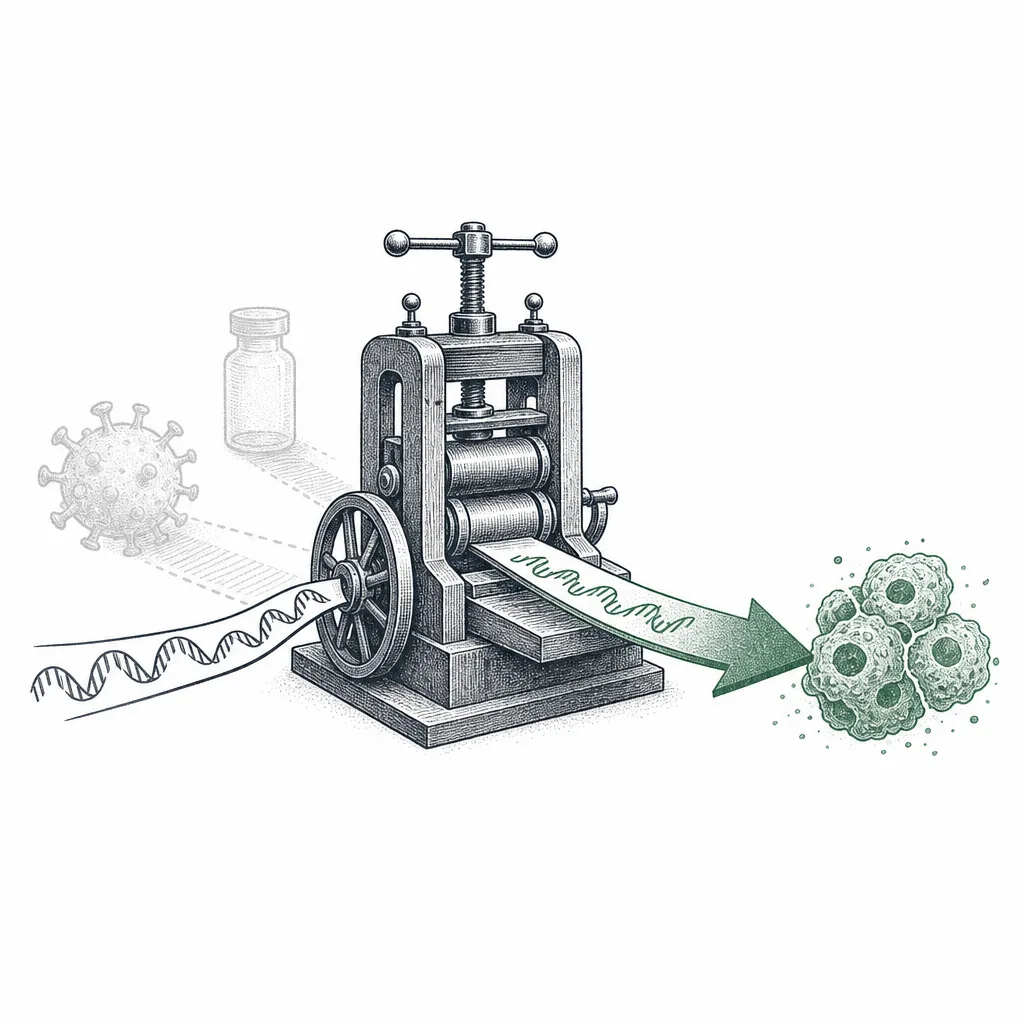
On the megatrend map, RNA Therapeutics is a sub-theme under Biotech & Genomic Medicine, and it holds a special status — it isn't a single drug but a 'platform.' Think of a printer you can swap the plate on: designing a new drug just means swapping the RNA sequence, while the rest of the manufacturing and delivery machinery is almost entirely reusable. That's what makes RNA drugs fast and powerful.
02Why it's a game-changer
The first reason is that it treats diseases the old drugs can't reach. Chemical drugs and antibody drugs can only target about 20% of all proteins in the body; the rest are called 'undruggable.' But RNA drugs don't play with the protein — they play with the instruction that makes the protein, upstream. If you know the code of the gene causing a disease, you can design an RNA drug to deal with it. In theory, that opens the door to all the targets the old drugs could never reach.
The second reason is speed. COVID was the global proof. Moderna finished designing its vaccine sequence within 2 days of getting the viral code, and in 2021 it sold $17.7 billion of vaccine across 807 million doses — numbers no drug platform had ever produced in that little time. It proved that when a new disease appears, an RNA platform can 'reprogram' itself in weeks, not years.
And the third reason is the size of the market taking shape. The global RNA drug market was around $13.5 billion in 2024, and many research houses expect it to grow at roughly 20% a year, passing $40 billion by 2030. What matters is that this number is changing its face — from being pure COVID-vaccine revenue to drugs used continuously in everyday life: cholesterol-lowering drugs, rare-disease treatments, and cancer vaccines.
03Two ways to command a cell: mRNA vs siRNA
Under the term 'RNA drug' sit two big families that work in completely opposite directions — and these are the two sub-categories of this field. One is adding, the other is subtracting.
The first is mRNA Platforms. The principle is to send in an instruction and let the cell make the protein you want. COVID vaccines work this way: we send in mRNA carrying the recipe for the 'viral spike,' the cell produces that spike, and the immune system sees it and rehearses its response — the body builds its own 'sample of the enemy' without any real virus going in. The same principle is now being applied to cancer vaccines and to telling the body to make proteins that are missing in rare diseases.
The second is RNAi / Antisense Oligonucleotides, which does the opposite — it goes in and 'silences' a disease-causing gene. Instead of adding protein, it catches and destroys the bad gene's instruction copy (mRNA) before it can be translated into protein. The result: the body makes less of the protein behind the disease. This is the technology behind drugs from Alnylam and Ionis, used to treat rare genetic diseases and high cholesterol.
This difference matters a lot in business. The mRNA side is great at vaccines (an occasional shot; the immune system remembers on its own), while the siRNA/antisense side is great at chronic diseases that need a bad gene kept suppressed continuously — and thanks to new delivery technology (more on that next chapter), some siRNA drugs need just two shots a year to keep a disease controlled all year.
04The hardest problem — delivery
If the idea is this good, why have RNA drugs only succeeded in the last few years? The answer lies in the one problem that haunted this field for decades: getting the drug into the cell.
Naked RNA is an extremely fragile molecule. Our bodies have enzymes constantly destroying foreign RNA (because it's also a sign of viral infection), and even if it survives, the cell wall carries a charge that repels RNA molecules. Inject naked RNA and it falls apart before it reaches its target. This is the wall that kept the dream of RNA drugs stuck in the lab for decades.
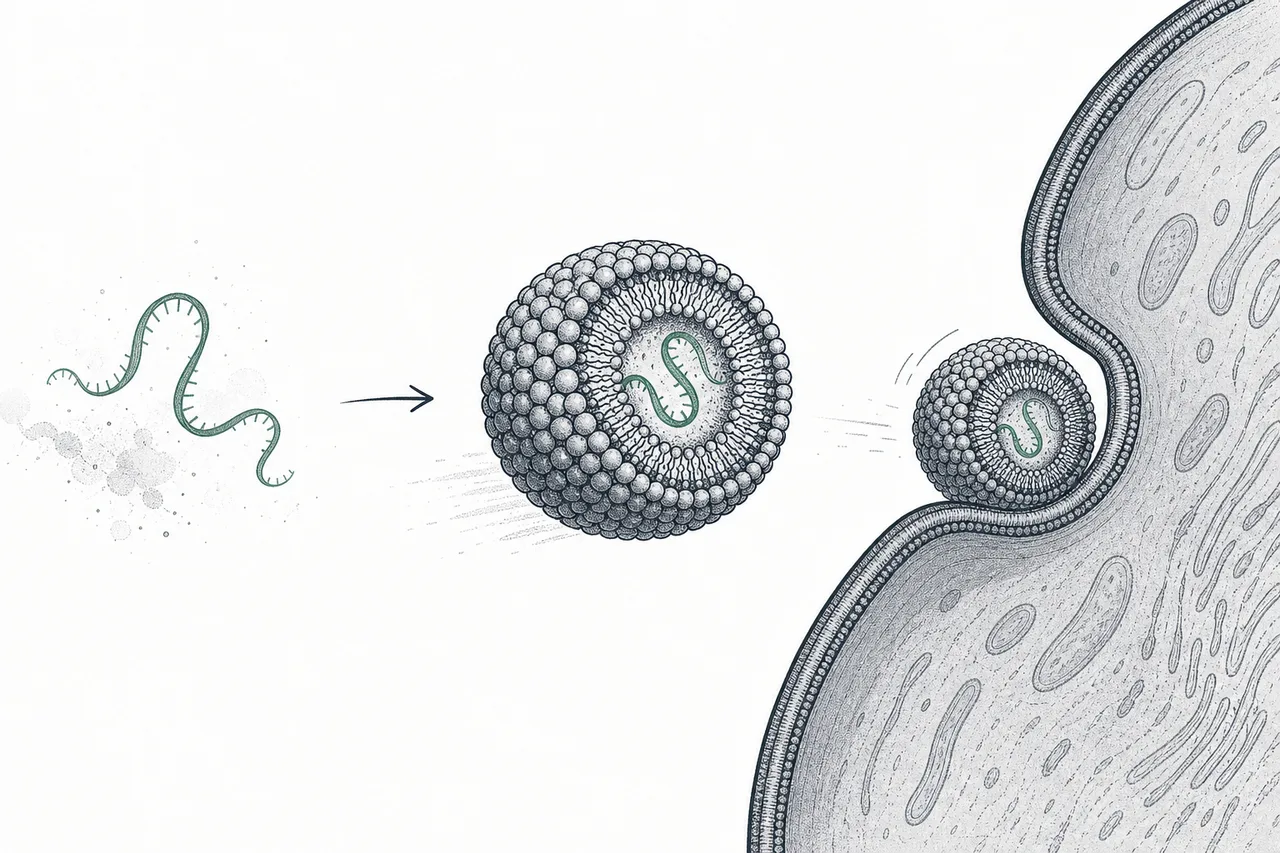
The key that unlocked everything was the delivery system. Two approaches became the heart of the industry:
A nano-sized droplet of fat that wraps a strand of mRNA inside, protecting it from destruction and helping it slip through the cell wall. This is the technology that made the mRNA COVID vaccine possible — and the reason the vaccine has to be stored at very cold temperatures, because the LNP is fragile to heat.
A type of sugar molecule attached to a siRNA drug that works like an 'address label,' carrying the drug straight to the liver, because liver cells have receptors that grab GalNAc very well. This technology from Alnylam is why modern siRNA drugs need only a few injections a year under the skin — and why most RNAi drugs today treat liver-related diseases.
Here's the point you really need to grasp: the value and the moat of this industry aren't in the RNA itself — they're in the delivery system. Anyone can design an RNA sequence, but having LNP or GalNAc technology that delivers the drug to its target safely and precisely is what separates companies that actually sell drugs from companies stuck in the lab. And it's also the industry's single biggest constraint right now, because GalNAc is only good at the liver and LNP tends to pile up there too — delivering a drug to other organs (brain, muscle, heart) is a problem no one has fully solved.
05How it connects in the ecosystem
RNA Therapeutics is one rung on the drug-making 'ladder' of the Biotech megatrend — above chemical and antibody drugs (which deal with proteins), but below Gene & Cell Editing (which permanently rewrites the original DNA). This middle position has a charm of its own: RNA drugs act at the level of the 'instruction,' which is temporary and reversible, so they're safer than DNA editing that can't be undone — at the cost of having to dose again and again.
It's also tightly entangled with other fields:
- Same platform as Vaccines: mRNA is the next-generation vaccine technology. The success of the COVID vaccine is what set this whole field on fire, and it's now expanding into RSV, flu, and cancer vaccines
- A new weapon for Oncology: personalized cancer vaccines are mRNA's hottest battlefield right now — building a vaccine tailored to each patient's own tumor
- A hope for Rare Disease: most siRNA and antisense drugs treat rare genetic diseases caused by a single faulty gene — a clear target that's well-suited to 'silencing' a gene
- Pushing into Cardiovascular: siRNA drugs like inclisiran (Leqvio) lower cholesterol with two shots a year — a sign that RNA is moving from rare diseases to diseases that millions of people have
- Relies on AI: designing stable RNA sequences, and especially designing the 'neoantigens' for personalized cancer vaccines, takes enormous computation — AI steps in to help pick the targets and cut the time
06Where it stands now
We're at an interesting crossroads. The COVID-vaccine revenue wave has receded — Moderna's total revenue fell from $6.7 billion in 2023 to $3.2 billion in 2024, with 2025 guidance of just $1.5–2.5 billion. This is the 'post-COVID reset' that forces investors to ask a serious question: with COVID over, what will this platform make money from?

The answer is getting clearer, and it splits into two camps along the two families we already covered. The siRNA/antisense side is the one making real, steady money right now — Alnylam, the siRNA leader, topped $1.8 billion in revenue in 2024 from 4 approved drugs, and Novartis's Leqvio (inclisiran) — which lowers cholesterol with two shots a year — grew +64% in the first half of 2025, a sign that RNA is moving from the rare-disease market into a real mass market.
The mRNA side, meanwhile, is betting its future on cancer vaccines. The result that woke up the whole industry was Moderna's mRNA-4157 (V940) vaccine paired with Keytruda — in a trial of high-risk melanoma (skin cancer) patients, it cut the risk of recurrence or death by 44% compared with Keytruda alone. It's now in a phase 3 trial. BioNTech has its own cancer vaccine (BNT111) too, which posted positive phase 2 results in 2024.
Geographically, the real players are clustered mainly in the US and Germany (BioNTech is a German company), with Asia catching up. Here are the players setting the direction of this field:
07The road ahead
The biggest battlefield of this decade is personalized cancer vaccines. The idea: scan each patient's tumor, find its unique 'signature,' then print an mRNA vaccine that teaches the immune system to hunt that specific person's cancer cells — a drug made in batches of 'one person, one recipe.' The first approval is expected around 2027–2029. If the phase 3 results are good, it will prove the mRNA platform has a life after COVID that's bigger than before.
The second trend is stepping out of the liver. Today almost all siRNA drugs treat liver diseases, because GalNAc carries the drug to the liver best. Whoever solves delivery to muscle, brain, or heart will unlock a huge market — and this is the field where companies like Arrowhead and Avidity are planting their flags. If they pull it off, the RNAi market will expand from a handful of rare diseases to common diseases that enormous numbers of people have.
The third trend is fewer and fewer doses. From drugs that need frequent injections, to drugs given twice a year (Leqvio), and now moving toward once a year. The fewer the doses, the more patients stay on them, and the better the drug competes with a daily pill — this is the path that turns RNA drugs into medicines ordinary people use, not just expensive specialty drugs.
08Challenges & risks
This future looks bright, but there are real walls worth stating plainly.
The first risk is that the 'post-COVID reset' isn't over. Moderna's numbers make it clear that the big vaccine revenue vanished fast — from $17.7 billion in 2021 to about $3.2 billion in 2024, and expected lower still in 2025. The new businesses (cancer vaccines, rare diseases) are still too small to fill that gap in the short term. So this is a 'revenue chasm' that mRNA companies have to burn research money to cross.
The second risk is the delivery problem that's still unsolved. As covered, RNA drugs are only good at the liver; delivery to other organs remains a wall that limits how many diseases can actually be treated. If that wall isn't broken, the RNAi market will stay concentrated mainly on liver-related diseases for a long time yet.
The third risk is durability of the effect. Because RNA acts temporarily and the body breaks it down over time, patients have to dose for life — unlike Gene & Cell Editing, which rewrites DNA once and is done. This is both a strength (safer, reversible) and a weakness (high long-term cost, patients need discipline). Over the long competition, RNA has to prove it's worth more than the 'fix it once' alternatives.
In short: RNA Therapeutics is redefining what a 'drug' means — from a chemical we put in, to an instruction that tells the body to heal itself. It proved its power to the whole world once, in the COVID crisis. Now it's attempting something harder — becoming a drug that's with us in everyday life, not just in emergencies.