Megatrend · Cybersecurity & Digital Trust
When hackers don't have to break anything — they just wait for you to misconfigure it
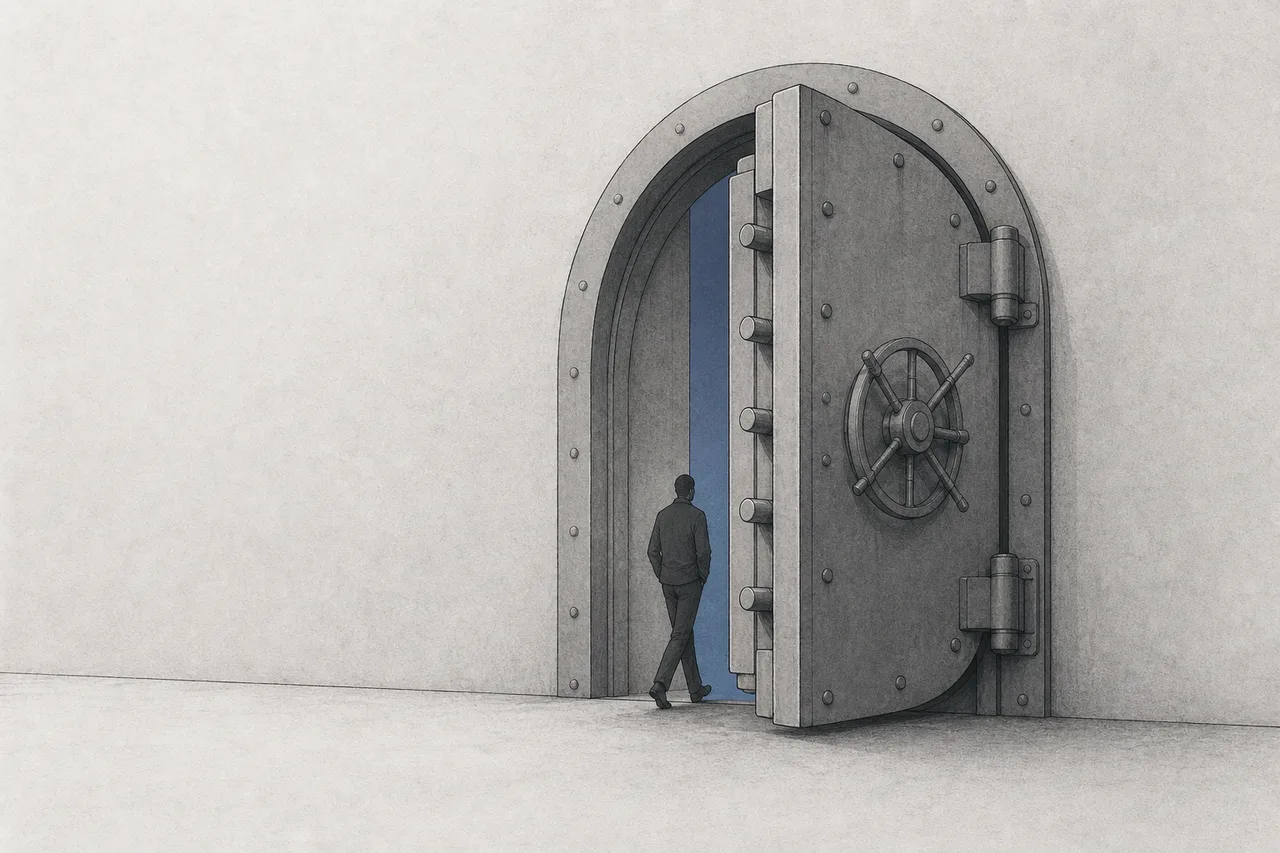
We moved everything to the cloud — apps, data, whole companies — onto machines we don't own, machines that rewrite themselves every hour with code. Here's the catch: the biggest threat to the cloud isn't a brilliant hacker breaking through the wall. It's the door we accidentally left open ourselves. This is the story of an industry built to close that door — and of the deal Google paid $32 billion to win.
01What is it?
Ten years ago, companies kept their data and ran their programs in their own server rooms — walls, fences, a guard at the gate. Security was like defending a castle: one moat, and anyone who wanted in had to come through the front door. Today, almost every company has moved to the cloud — running apps, storing data, doing their entire business on machines owned by AWS, Microsoft Azure, and Google Cloud. Which means we're putting our most valuable assets on machines we don't own, sitting right next to a million other customers.
Cloud & Workload Security is the field that protects everything running on the cloud — the infrastructure itself (virtual servers, storage), the "workload" (the programs actually running, like apps and containers), and even the code before it ever ships. Put simply, it's the guard and the monitoring system for a company's new home. And this home doesn't sit still — it's constantly expanding, shrinking, and changing shape.
A "workload" is a unit of work actually running on the cloud — it might be a virtual machine (VM), a container (a little box that wraps an app so it can run anywhere), or a function that spins up for a second and vanishes (serverless). These days an app isn't one big block anymore — it's chopped into hundreds of containers that are born and die constantly. So security has to keep up with that pace.
On the megatrend map, this node is a sub-theme under Cybersecurity & Digital Trust, and it's the hottest one right now — because the whole security battlefield is moving here. Wherever the world moves its work to the cloud, the criminals follow.
02Why it matters — securing what we don't own
Here's the fact that made the whole industry rethink everything — Gartner's analysis finds that through 2025, 99% of cloud security failures are the customer's own fault, not the cloud provider's. And the main cause is one thing: misconfiguration.
It sounds minor, but it's the heart of everything. Picture this: a team creates a storage bucket on the cloud, then accidentally sets it to "public" instead of "internal only" — and just like that, millions of customer records are sitting on the open internet for anyone to reach, without anyone needing to "hack" a thing. Hackers just run a tool that scans for doors left open, and walk in. And research shows over 80% of these misconfigurations come from human error.
Why do people misconfigure things so often? Because the cloud is too complex and changes too fast to keep up with by hand. Modern apps are built with "code" that tells the cloud to spin up hundreds or thousands of servers on its own, changing all the time. Closing holes one by one by hand is impossible — it's like trying to lock every door in a building that's adding a new room every minute.
And this is a huge, fast-growing market. The global cloud security software market sits at roughly $50 billion in 2025 and is expected to reach ~$95 billion by 2030 (about 14% a year). It's driven by a simple fact: the more the world moves to the cloud, the more there is to protect.
03How it works (CNAPP scans the whole lifecycle)
If the problem is "holes we accidentally left open," the answer is to have a "scanner" that constantly looks for them — and not just once things are running, but going all the way back to when the code is being written. The modern tool that pulls all of this into a single platform has a name: CNAPP.
CNAPP (Cloud-Native Application Protection Platform) is a single platform that combines several cloud security tools — two key ones are CSPM (Cloud Security Posture Management), which checks the cloud's "settings" for anything wrongly left open, and CWPP (Cloud Workload Protection Platform), which watches "the running programs themselves" for vulnerabilities or intrusions. CNAPP is a term the research firm Gartner coined to describe combining these tools.
The heart of the idea is a phrase: "shift left". Picture an app's lifecycle as a line running left to right: the far left is "writing the code," the far right is "running it live for real users." We used to check security at the far right (push it to the cloud, then go hunting for holes) — which is too late and hard to fix. Shift left means moving the checks as far left as possible — catching vulnerabilities and misconfigurations while they're still just code, before they become real holes on the cloud.
The benefit of one platform isn't just convenience — it's context. Separate tools can only tell you "there's a vulnerability here." But a CNAPP that sees the whole picture can tell you "this vulnerability + this public setting + these over-broad permissions combine into a path a hacker can actually walk to reach customer data" — turning "a list of thousands of alerts" into "here are the 3 most dangerous holes, close these first."
04Where it sits in the Cybersecurity world
Cloud & Workload Security is one of the sub-themes under Cybersecurity & Digital Trust, and it gets a lot clearer once you see how it connects to its neighbors:
- Builds on Hyperscale Cloud: AWS, Azure, and GCP are the "home" everything moves into — this node is that home's "guard." The more people move in, the more the guard matters, and the two grow together
- Paired with Identity & Access Management: half of cloud breaches come from "over-broad permissions" — who can access what is an identity question, and these two work side by side, almost inseparable
- Different from Endpoint & Network Security: that side protects "people's machines" (laptops, phones) and networks — this node protects the "app's machines" running on the cloud. Different checkpoints
- Same lens as Observability & DevOps: DevOps teams are the ones who build and ship apps to the cloud. To truly shift-left, security has to sit inside the developers' tools — not show up to inspect afterward
In the bigger picture, the AI revolution makes this node even more important — because all AI models run on the cloud, and the data they train on lives there too. Cloud security is becoming the foundation the entire AI field depends on.
05Where it stands now — the Wiz deal and the platform war
If there's one event that says "cloud security is the most important battlefield right now," it's this deal — on March 11, 2026, Google closed its acquisition of Wiz, a cloud security startup, for $32 billion in cash. It's the largest acquisition in Google's 28-year history — nearly three times the size of buying Motorola.

Why so expensive? Because Wiz is the fastest-growing software company ever — founded in early 2020, it took its annual recurring revenue (ARR) from $1 million to $100 million in just ~18 months (a world record), then hit $350 million in early 2024, and crossed $1 billion in 2025, with nearly half of the Fortune 100 as customers. The $32 billion price tag works out to about 32x ARR — well above the norm for a software company — but Google paid it because Wiz is the key to what's about to be the biggest battlefield of all.
But Wiz is just one player in a fierce fight. Right now every giant is racing to build the most complete CNAPP — to become the "single platform" customers use instead of scattered tools. Because today a company's security team manages an average of 45–75 tools that each raise their own alerts and don't talk to each other. That's why "consolidation" has become the industry's main current.
06The road ahead
The first direction is consolidation accelerating even more. The CNAPP market in particular is growing faster than the overall market — from about $11 billion in 2025 to ~$28 billion by 2030 (around 21% a year), driven by companies tired of juggling 45–75 tools and wanting to collapse them into a single platform. That's why the Wiz deal happened, and why more consolidation deals will follow.
The second direction is containers and Kubernetes becoming the standard for every app. CNCF's 2025 survey found that 82% of organizations using containers already run Kubernetes in production (up from 66% in 2023). The more everything gets chopped into containers that are born and die constantly, the more impossible it becomes to watch security by hand — only automated systems can keep up.
The third direction is AI arriving from two sides — on one hand, AI helps the defenders, narrowing thousands of alerts down to "the 3 truly dangerous holes" faster. But on the other hand, companies rushing to run AI agents on the cloud creates a whole new "attack surface" that nobody really knows how to defend yet — AI security on the cloud is the next frontier everyone is racing toward.
07Challenges & risks
Cloud & Workload Security's appeal comes with risks worth weighing.
The first risk is a "platform war" against the giants who own the cloud itself — Google bought Wiz, Microsoft has Defender for Cloud, and Amazon has built-in tools too. Independent players have to face rivals who can "sell security bundled with the cloud." The big question is whether customers pick "the convenient built-in option" or "the independent, cloud-neutral one" — and that's exactly why Google had to promise it would keep Wiz supporting AWS/Azure, or its core value would disappear.
The second risk is that multi-cloud multiplies the complexity. Most companies don't use just one cloud — they mix AWS + Azure + GCP, each configured differently, each with its own set of terms. The more complex it gets, the more chances to misconfigure — which is both this industry's opportunity (plenty of work to do) and the customer's risk (harder to defend).
The third risk is that consolidation is a double-edged sword. Collapsing down to a single platform cuts the chaos — but it also means "putting all your eggs in one basket." If that platform stumbles, or becomes something everyone depends on and can't leave (vendor lock-in), the bargaining power shifts to the vendor. And the industry's classic lesson is this: "the best tool is worthless if people still configure it wrong." Technology only ever solves part of the human problem.
In short: Cloud & Workload Security is the story of how we moved the whole world onto machines we don't own, and discovered the toughest enemy isn't some mysterious hacker — it's "the hole we accidentally left open ourselves." Google paying $32 billion to win Wiz is the clearest signal yet that whoever controls the closing of those holes controls one of the most important battlefields of the digital age.