Megatrend · Cloud & Digital Infrastructure
Rent the world's computers instead of buying your own
Almost every app, website, and AI model you use doesn't run on the computer of the company that built it — it's "rented" on the machines of a handful of giants. This is the story of the digital age's plumbing and power — something that had slowed down, until AI suddenly lit it back up into its fastest growth in years, dragging along a wave of investment the world has never seen before.
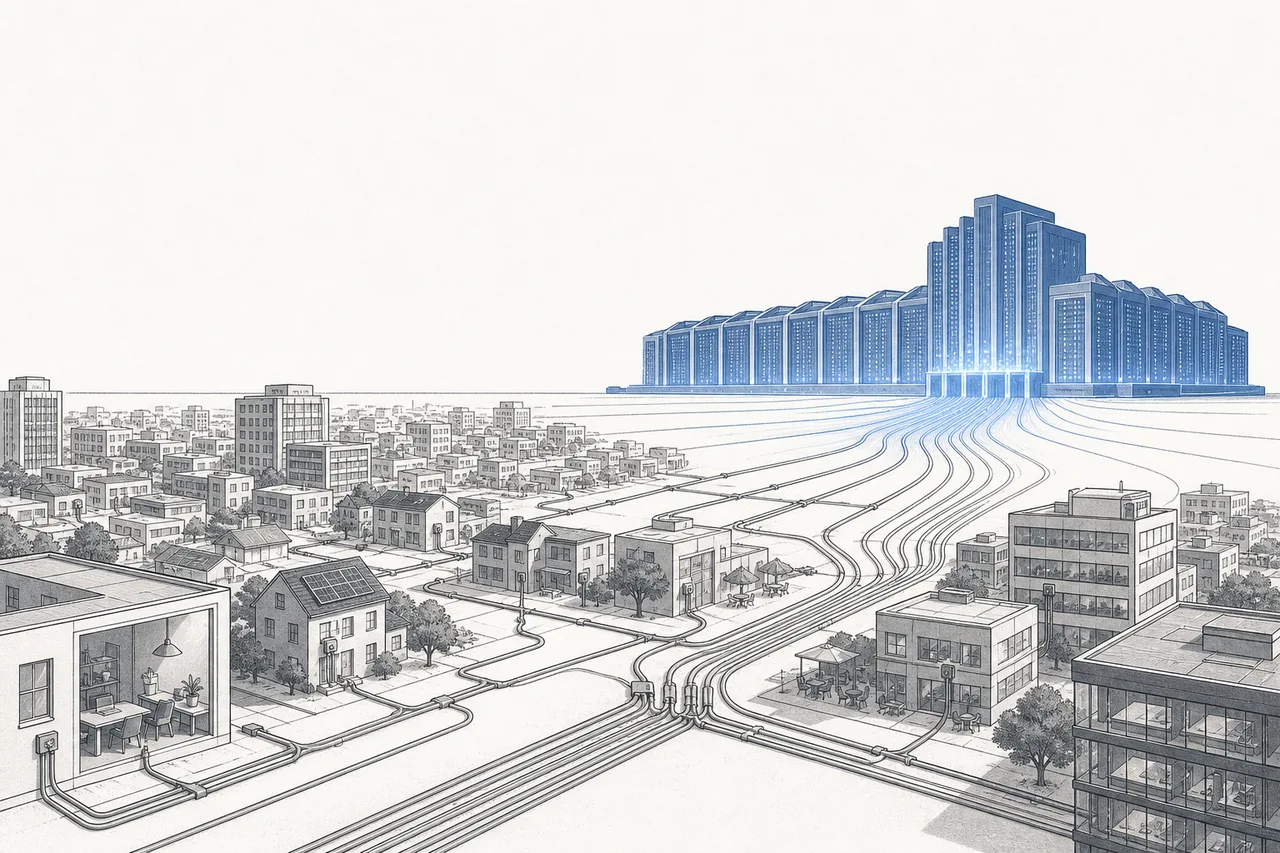
01What it is (rent instead of buy)
Go back about 20 years: if you wanted to launch a website or build an app, you had to buy real servers and put them in a room — sink millions into them, hire people to babysit them, and pray that launch day didn't bring a crowd big enough to crash them, or that you hadn't over-bought and left them gathering dust. Everything had to be guessed in advance, and one wrong guess cost a fortune.
Hyperscale Cloud flips that whole logic. Instead of buying computers, you rent them from companies that run huge data centers spread across the world — spin up 10 servers in the afternoon, hand them back in the evening, and pay only for the hours you actually used, like turning on a tap and paying for what flows. The word "hyperscale" means a scale so large that an ordinary company can't do it itself — data centers with millions of servers, drawing as much power as a whole small town.
This node covers the two bottom layers of the cloud · IaaS (Infrastructure-as-a-Service) = renting the "raw materials" — servers, storage, networking, like renting empty land plus utilities · PaaS (Platform-as-a-Service) = renting the "ready-made tools" that sit on top, like a database that's managed for you or a system that runs your code, so developers can build faster without assembling every piece themselves.
This node splits into two worlds at completely different scales — and we'll tell both together, because they're two sides of one story:
- Mega-cap Hyperscalers (the giants): the general-purpose cloud platforms of the "Big Three+" — AWS, Microsoft Azure, Google Cloud, plus challengers like Oracle and Alibaba. They're so large they've become the infrastructure of the entire internet
- Specialized / Developer Cloud (specialized clouds): smaller providers focused on developers, SMBs, and specific workloads (like managed hosting) — selling simplicity, clear pricing, and an experience developers love, rather than trying to match the giants on scale
On the megatrend map, this node sits under Cloud & Digital Infrastructure and is its most "foundational" layer — because everything in that trend, from software to data, has to run on the cloud this node is about.
02Why it's the utility of the digital economy
The best way to grasp how important the cloud is, is to compare it to electricity. A hundred years ago, every factory had to build its own generator — until the "power grid" arrived and you could just plug in and pull electricity from a central plant. Factories stopped generating their own power and focused on making products instead. The cloud is the same thing, but for "computing power": companies stop buying servers and focus on their real business.
The size of this grid is enormous, and growing fast. In the first quarter of 2026, the world spent about $119 billion on cloud infrastructure — in three months alone, growing ~35% year over year, even faster than in earlier years. The full-year cloud market is about to cross the $1 trillion mark for the first time.
But the more shocking number is the "concentration." The world's cloud is held by just three companies, the so-called "Big Three" — Amazon (AWS), Microsoft (Azure), and Google (Google Cloud) — which together take about 68% of the entire global market. The rest is single-digit scraps split among everyone else. This is a true oligopoly — a market a few large players own almost outright.
03How it works — the IaaS → PaaS → SaaS layers
The cloud isn't one solid block — it's "layers" stacked on top of each other. The higher you go, the more ready-made it is; the lower you go, the more you control yourself. The most popular way to remember it is the "pizza" analogy: you can make a pizza from scratch yourself (buy your own machines), rent a kitchen to make it (IaaS), order ready-made dough and top it yourself (PaaS), or have it delivered hot (SaaS) — each layer, you "do it yourself" less and less.
The heart of what makes this model revolutionary is pay-as-you-go. The cost is charged by the resources you reserve and the time you use them — run a big server for 10 hours and you pay for 10 hours; switch it off and the charges stop. This turns a "big upfront purchase" (capex) into a "monthly bill" (opex) that stretches and shrinks with your actual business. So two people building a startup in a bedroom can reach the same computing power as a big company — just add a credit card and go.
This is where the giants and the specialized clouds go separate ways · the giants sell "everything in one place" — hundreds of services to piece together · the specialized clouds sell "simplicity" — predictable pricing, set up in a few clicks, perfect for developers who don't want to drown in the giants' menu of a hundred options.
Capex (capital expenditure) = a big chunk of money paid upfront to buy an asset, like buying a whole room of servers · Opex (operating expenditure) = an operating cost paid in installments based on actual usage · the appeal of the cloud is turning a huge capex bet on the future into an opex that flexes with reality — but seen another way, it just shifts that enormous capex burden onto the cloud provider's shoulders instead (which is the heart of the next few chapters).
04Why it's hard to leave (the cloud's moat)
The question investors ask most often is: if the cloud is just "renting servers," why is the moat this strong? Why don't customers move to someone cheaper? The answer has three layers.
The first layer is capital intensity. Building one hyperscale data center costs billions of dollars, plus chips, power systems, cooling, and fiber around the world — only a handful of companies on earth can afford it. This is the first wall that shuts the door on new rivals.
The second layer is "data gravity". Once a company puts terabytes of data on one cloud, that data tends to "stay put," because moving it out is expensive and a hassle. Providers usually charge a steep "data egress fee" to take data out, while bringing it in is free — and that asymmetry is deliberate: easy to suck data in, expensive enough to think twice before pulling it out.
The third layer is switching cost. Once a team of engineers builds an entire app to depend on that cloud's specific tools (databases, AI, DevOps tools, and so on), moving to another provider means rewriting almost everything — costing money, time, and risk. The deeper you use PaaS, the harder it is to pull out. These three layers together are why the cloud has such "sticky" customers and earns unusually high profits for a business that looks, on the surface, like just renting out machines.
05How it connects in the ecosystem
Hyperscale Cloud is the "floor" almost every other trend stands on. It takes in raw materials from upstream and sends computing power downstream to nearly every digital trend:
- Twined with AI as one strand: modern AI has to run on the cloud, and AI demand is the engine that lit the cloud back up — but AI's "GPU hunger" is starting to split off into its own trend: AI Compute Cloud & Neoclouds (providers selling pure GPU power, like CoreWeave) and AI Data Center (building data centers purpose-built for AI)
- Stands on Semiconductors: every data center is a giant pile of chips — CPUs, GPUs, memory. Every cloud expansion is a big chip order, so the cloud and the chip cycle dance together
- Carries Horizontal SaaS on top: the ready-made software businesses use every day (CRM, email, documents) almost all runs on this node's IaaS/PaaS — SaaS is the cloud's biggest "tenant"
- Relies on energy and raw materials: AI data centers eat enormous amounts of power, becoming a new factor straining national power grids — which binds the cloud inseparably to the energy transition trend
06Where it stands now
The biggest story of 2025–2026 is "AI re-accelerated the cloud." Before this, many people feared the cloud had fully matured and would slowly drift down like a business that's run out of room. But the AI wave flipped everything — companies rushed in to rent computing power to train and run models, and the cloud started growing fast again. And the interesting part: the rankings are starting to shake.
And this wave isn't only rattling the Big Three — the other pole is the "specialized cloud," the fastest-growing corner of the field · neoclouds like CoreWeave/Nebius rent out pure GPUs at about half the Big Three's price, Oracle is back with AI deals worth hundreds of billions, and Cloudflare/DigitalOcean win developers' hearts with simplicity (dig into this pole → Specialized / Developer Cloud).
It's a year of interesting contradictions: AWS is still number one and the largest (run-rate revenue around $150 billion a year) but the slowest-growing of the three (~28%), while Azure grows ~39–40% and Google Cloud surges hardest at ~63% in the latest quarter — accelerating three quarters in a row, with a signed backlog that nearly doubled in a single quarter to about $460 billion.
Profit is a completely different story too. The cloud is an unusually high-margin business — Azure (Intelligent Cloud) runs a margin of ~43%, the highest in the group, while AWS sits around ~35% (squeezed a bit by AI investment), and Google Cloud has just turned genuinely profitable, its margin jumping from ~17% to ~24% in a single year — proof that the bigger the scale, the better the profit.
Meanwhile, the new challengers exploded onto the scene — Oracle (OCI), once seen as having missed the cloud, came roaring back with huge AI contracts, its backlog (RPO) surging to ~$523 billion (+438% year over year) within a single fiscal year. And there's the Neocloud CoreWeave, which sells pure GPU power and became one of the fastest-growing clouds in history. On the China side, Alibaba Cloud dominates its home market (~37% of China's IaaS) and has posted triple-digit AI growth for ten straight quarters.
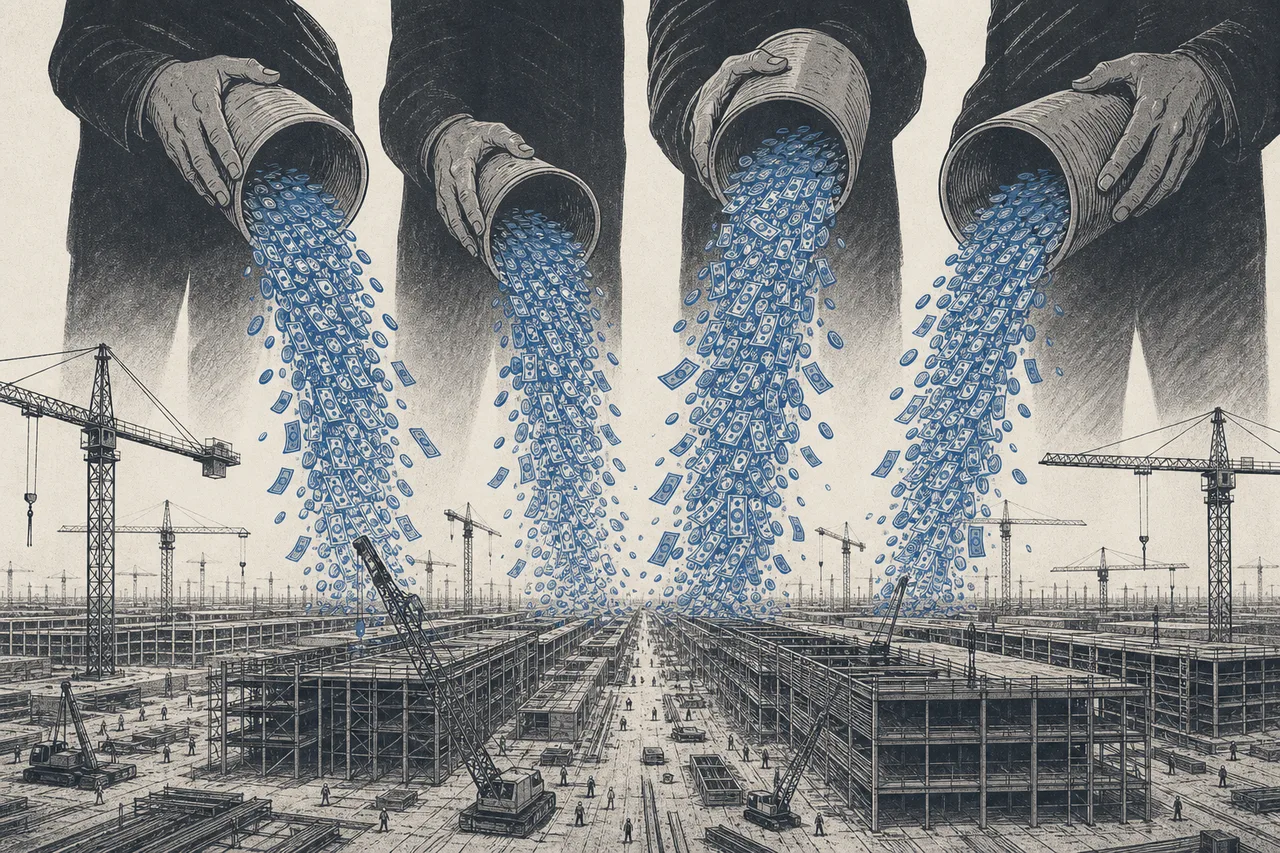
But the number that shook the industry most is capex. To catch the AI wave in 2026, four giants (Amazon, Microsoft, Google, Meta) plan to invest a combined ~$725 billion — up more than 77% from the year before, most of it poured directly into AI infrastructure (GPU chips, servers, data centers). This is one of the biggest money-pouring races in business history.
07The road ahead
The first direction is the cloud becoming more and more "about AI." The main battlefield is shifting from "who rents servers cheapest" to "who has the best GPU power and AI tools." Google Cloud and Oracle accelerated entirely on big AI deals, not old-style cloud. This also opens the door for new Neoclouds to slip in and grab a slice of the pie that once belonged to just three giants.
The second direction is "sovereign cloud." Many countries, especially in Europe, are growing worried that critical national data sits on American or Chinese clouds, and are pushing for clouds that keep data inside the country and under local law. American giants, European players, and Alibaba are all rushing to build regional data centers to ride this trend — geopolitics is becoming a factor in who wins which customer.
The third direction is the "are we overinvesting?" question. When capex blows past $725 billion a year, the question that follows is whether real AI demand will justify the enormous money poured in. If it does, this is a cloud supercycle that could run for years. But if demand can't keep up with the investment, we could see overcapacity and squeezed margins — the variable that decides the whole group's profits.
08Challenges & risks
The appeal of Hyperscale Cloud — beautiful profits, sticky customers, re-accelerating growth — comes paired with risks baked into its own structure.
The first risk is capex intensity eating into profit. When every giant races to pour in $725 billion a year to win AI work, enormous depreciation and interest costs follow and squeeze future profit. If AI demand grows slower than the investment, those once-beautiful margins can shrink fast — and the challengers who borrowed heavily, like Oracle or CoreWeave, are most exposed to this risk.
The second risk is concentration. When the infrastructure of the entire internet sits in the hands of a few companies, a single data-center outage can take thousands of websites and apps down at once, worldwide (it's happened many times). On top of that, the concentration keeps drawing more attention from regulators over monopoly power and vendor lock-in.
The third risk is "repatriation" and energy. Some companies whose cloud bills ballooned are starting to move parts of their workloads back onto their own machines, having calculated it's cheaper in the long run — a warning that the cloud isn't always cheaper in every case. On the other side, power-hungry AI data centers are hitting an energy ceiling — in some regions, electricity limits have become a bigger cap on cloud expansion than money or chips.
In short: Hyperscale Cloud is the story of the world giving up on buying computers and turning to rent from a few giants instead, until the cloud became the utility grid of the digital economy. What was once seen as fully matured suddenly came back as one of the hottest battlefields of the AI age — and understanding "who controls the faucet that powers the whole digital world" is understanding why this node is the foundation every other trend has to stack on.