Megatrend · Climate Adaptation & Water
The world heats up, so we pay to keep ourselves “cool” — but that cooling heats the world even more
Every second from now to 2050, the world installs 10 new air conditioners. Fiercer heatwaves are turning “air conditioning” from a luxury into a necessity for staying alive — and creating one of the largest structural demands of the century. But there's a double trap inside it: cooling eats 10% of the world's electricity, and the refrigerant that leaks out heats the planet thousands of times more than CO₂. This lesson is about a business that sells the solution to a problem it created itself — and the two “levers” that decide who wins.

01What is it?
Picture a day when Bangkok hits 40°C and the power goes out — that feeling is the heart of this lesson. Cooling & Heat Resilience is the group of businesses that keep people, buildings, and goods “alive” through worsening heat — air conditioning (HVAC), heat pumps, building cooling systems, district cooling for whole cities, and the cold chain that keeps food and vaccines from spoiling.
It's a sub-theme under the Climate Adaptation & Water megatrend — the group of “money spent to adapt to a changed climate.” Not money spent to stop warming (that's the job of Energy Transition), but money spent to survive once the world has already heated up.
HVAC (Heating, Ventilation & Air Conditioning) = the systems that heat, ventilate, and cool a building · Heat pump = one machine that does both cooling and heating, by “moving” heat instead of “burning” fuel — which makes it several times more efficient than a heater or gas boiler, and the star of the transition.
There's one important line to draw: this node is about cooling the “environment people live in” — homes, offices, malls, warehouses. Cooling the AI servers in data centers is a different story (it lives in AI Data-Center Infrastructure) — even though the technologies keep overlapping more and more, which we'll come back to at the end.
02Why it matters — heat is the demand
Here's the number that tells the whole story: today the world has about 1.6 billion air conditioners, and the IEA expects that to surge to 5.6 billion by 2050 — more than triple, or 10 new ACs sold every second for the next 30 years. The reason isn't just comfort; it's survival. Of the 2.8 billion people in the world's hottest regions, only 8% have air conditioning — versus over 90% in the US and Japan. When hot countries get richer and hotter at the same time, demand explodes.
Translated into money, it's a big, steadily growing market. The global HVAC market is worth around $300 billion in 2025 and is expected to reach $408 billion by 2030 (growing ~6.4% a year), with heat pumps the fastest-growing segment (~8.5% a year) — because they're the solution that delivers cooling and helps drop fossil fuels for heating at the same time.
And there's an adjacent market growing even faster: the cold chain — cold-storage warehouses, refrigerated trucks, frozen containers that let fresh food and vaccines travel — worth around $380 billion in 2024 and growing double-digits a year, driven by food e-commerce and temperature-sensitive biologic drugs.
03How it works — the trap and two levers
This is the heart of what makes Cooling different from your typical “sell stuff for a warming world” trend. It has a vicious loop built in: the hotter the world gets, the more we run the AC → the AC eats more power and releases more refrigerant → the world gets hotter still. Cooling is both the solution and part of the problem.
The damage cooling does comes from two pipes. The first is electricity — cooling uses about 10% of the world's electricity (and ~20% of building electricity). In hot countries like India, AC could eat up to 45% of peak load by 2050. The second is leaking refrigerant — these HFCs heat the planet hundreds to thousands of times more than CO₂ per kilogram. Put both pipes together and the cooling sector emits about 7% of global greenhouse gases (~4.1 billion tons of CO₂e a year), and could climb to 10–15% by 2050 if nothing changes.

This is where the two “levers” come from — the ones that decide which company wins this trend. Not who sells the most ACs, but who's best at cutting this trap:
Lever 1 — efficiency: switch from old ACs and heaters to heat pumps and high-efficiency systems — same cooling, far less power. The IEA calculates that if the whole world used only the most efficient machines, the average efficiency of the world's ACs would more than double by 2050 — cutting both electricity bills and carbon emissions in half.
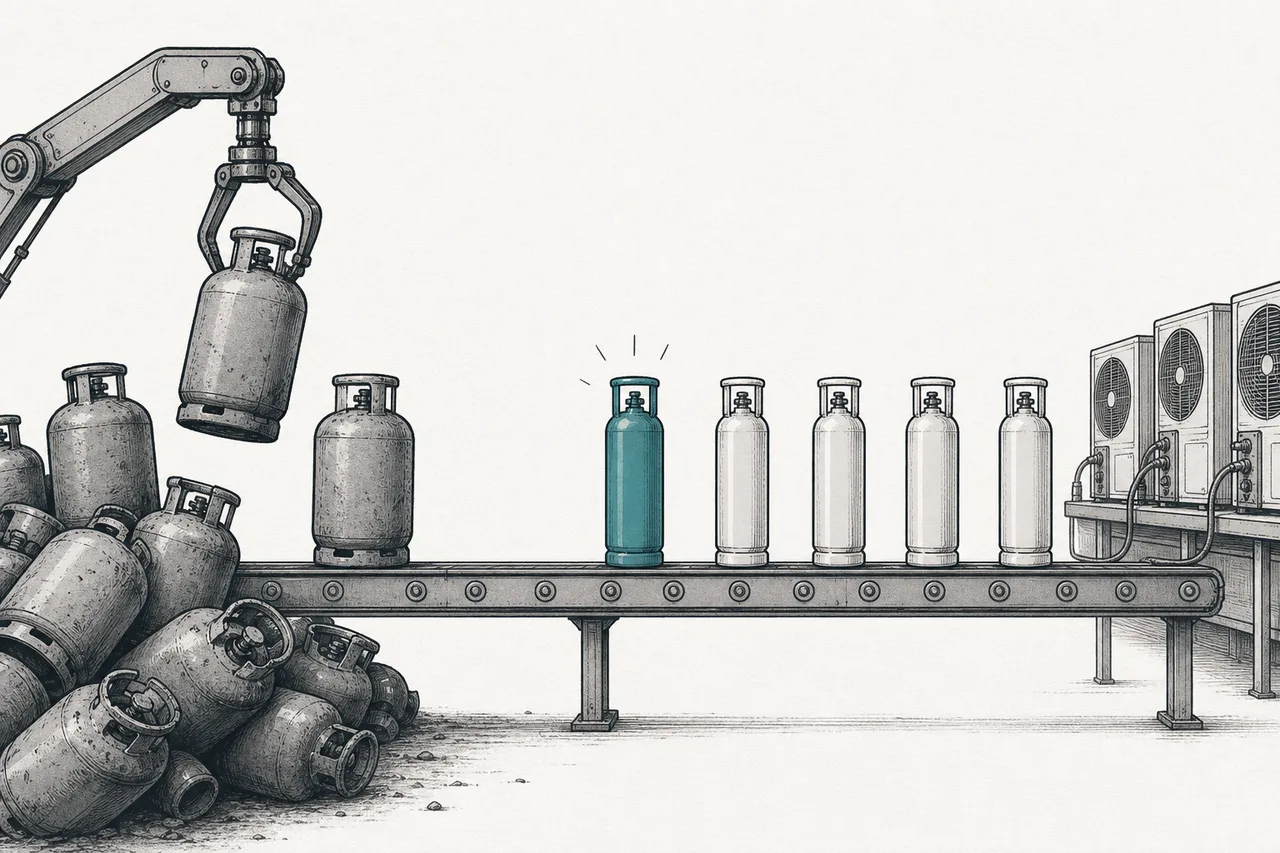
Lever 2 — low-GWP refrigerant: this is the part investors tend to overlook. The long-used refrigerant R-410A has a GWP as high as 2,088 (leak 1 kg = release 2,088 kg of CO₂). Laws around the world are forcing the switch to newer refrigerants like R-454B (GWP ~466) or R-32 (GWP 675). Every time you change the refrigerant, the machine has to be redesigned from scratch — opening a massive replacement cycle that forces customers to buy new, and gives pricing power to whoever gets low-GWP refrigerant ready first.
04Where it sits on the Climate map
Cooling is one of the “pillars of adaptation” under Climate Adaptation & Water, alongside siblings like Resilient Buildings & Retrofit (heat-tolerant buildings), Water Utilities, Climate-Resilient Agriculture (climate-tough food), and Drought/Wildfire/Flood Resilience — each an answer to a different face of a hotter, more extreme world. Of them, Cooling is the most tangible and has the biggest market.
But what's more interesting is how deeply it connects across trends:
- Partners with Energy Transition & Power Demand: heat pumps are the bridge Cooling crosses to become part of decarbonization — but at the same time, enormous AC demand pushes up the electrical load, making these two trends pull on each other both ways: cooling needs clean power, and the grid has to handle the AC peak
- Overlaps with data-center cooling: AI data centers run so hot that “blow-air” AC can't keep up, so they need liquid cooling. That market is far smaller (~$5.7 billion in 2024) but growing fast at 25%+ a year, and it uses the same thermodynamics expertise as HVAC — which is why players like Johnson Controls and Trane are moving in (see AI Data-Center Infrastructure)
- Tied to an aging society: older people are the most vulnerable to heatwaves, which makes cooling a public-health issue, not just comfort
- Depends on key raw materials and supply chains: compressors, copper, and the new-generation refrigerant chemicals
05Where things stand now + who the players are
2025–2026 is the most important “regulatory turning point” this industry has seen in decades. On January 1, 2025, the US banned manufacturing residential ACs and heat pumps that use R-410A under the Technology Transitions Rule, forcing the whole industry to switch its product lines to low-GWP refrigerant at once. This sits under the AIM Act, which targets cutting HFC use by 85% by 2036 (phasing down 40% in 2028, 70% in 2033) — in step with the global Kigali Amendment. This refrigerant-switch cycle is both a cost and an opportunity: companies that are ready early gain an edge, the slow ones get hurt.
On the heat-pump side, the 2024–2025 picture is mixed: global sales were nearly flat (–1% in 2024) because Europe fell hard (–21%, its worst on record, from cut subsidies and lower gas prices) — but the US grew 15%, and for the first time heat-pump sales outsold gas furnaces by 30%. China is still the biggest market (30% of the world) — a sign the long-term trend is still strong, even if the short term stumbles with each country's subsidy policy.
The players in this field are mostly publicly listed industrial giants — unlike newer trends where the leaders are still private startups. This is a long-established business, but one being “upgraded” by refrigerant rules and the heat-pump wave. We've arranged them by competitive position and market share in each channel:
Above these American and Japanese names sit the Asian giants who dominate the mass market — China's Midea and Gree, plus LG and Mitsubishi Electric — cranking out enormous volumes of ACs for emerging markets, where demand grows fastest in the world.
06The road ahead
The first direction is “unavoidable demand” — unlike tech trends that can be a passing fad, heat is physics, not fashion. As long as the world keeps warming and hot countries keep getting richer, installing 10 ACs a second goes on — which makes this trend's demand base unusually solid.
The second direction is value shifting from “hardware” to “systems and services”. Heat pumps + energy-management software + long-term service contracts give higher margins and more recurring revenue than selling an AC box once — so companies that sell a “system” (like Trane, JCI) gain an edge over those that just sell a “machine.”
The third direction is merging with AI data centers. As AI chips get hotter, racks need 60–140 kilowatts of cooling each — beyond what air can do. HVAC firms' heat-management expertise becomes an asset AI wants — opening a new market growing several times faster than the core one, even if it's still smaller in size.
07Challenges & risks
Cooling's appeal — solid demand — comes with risks you have to understand.
The first risk is cyclicality and policy sensitivity. Long-term demand is strong, but short-term sales are tied to the housing economy, interest rates, and — most of all — subsidies. Europe's heat-pump market dropping 21% in 2024 is the clear lesson: when governments cut subsidies or gas prices fall, demand can shrink fast. This is a group you have to time, not buy and forget.
The second risk is uncertainty in the refrigerant rules. The R-410A → R-454B/R-32 switch is both an opportunity (driving replacements) and a risk — companies that pick the “wrong” refrigerant line, or retool too slowly, can lose share. And some new refrigerants are more flammable (A2L), needing new safety standards and retrained technicians — which adds cost and complexity.
The third risk is competition and commoditization. The Chinese giants (Midea, Gree) make cheap ACs in enormous volumes, squeezing margins at the low end. Western players have to run upmarket into high-end systems, services, and proprietary refrigerant/technology to protect their value.
The fourth risk is that the overlap with data centers (DC cooling) is a double-edged sword. The liquid-cooling market is growing fast, true, but it's still small, fiercely contested, and tied to the volatile AI investment cycle. HVAC firms hoping it'll be a main growth engine may be disappointed in the short term — it's an exciting “bonus,” more than a replacement for the core market.