Megatrend · Quantum Computing
In a quantum gold rush, the surest way to get rich is to sell shovels
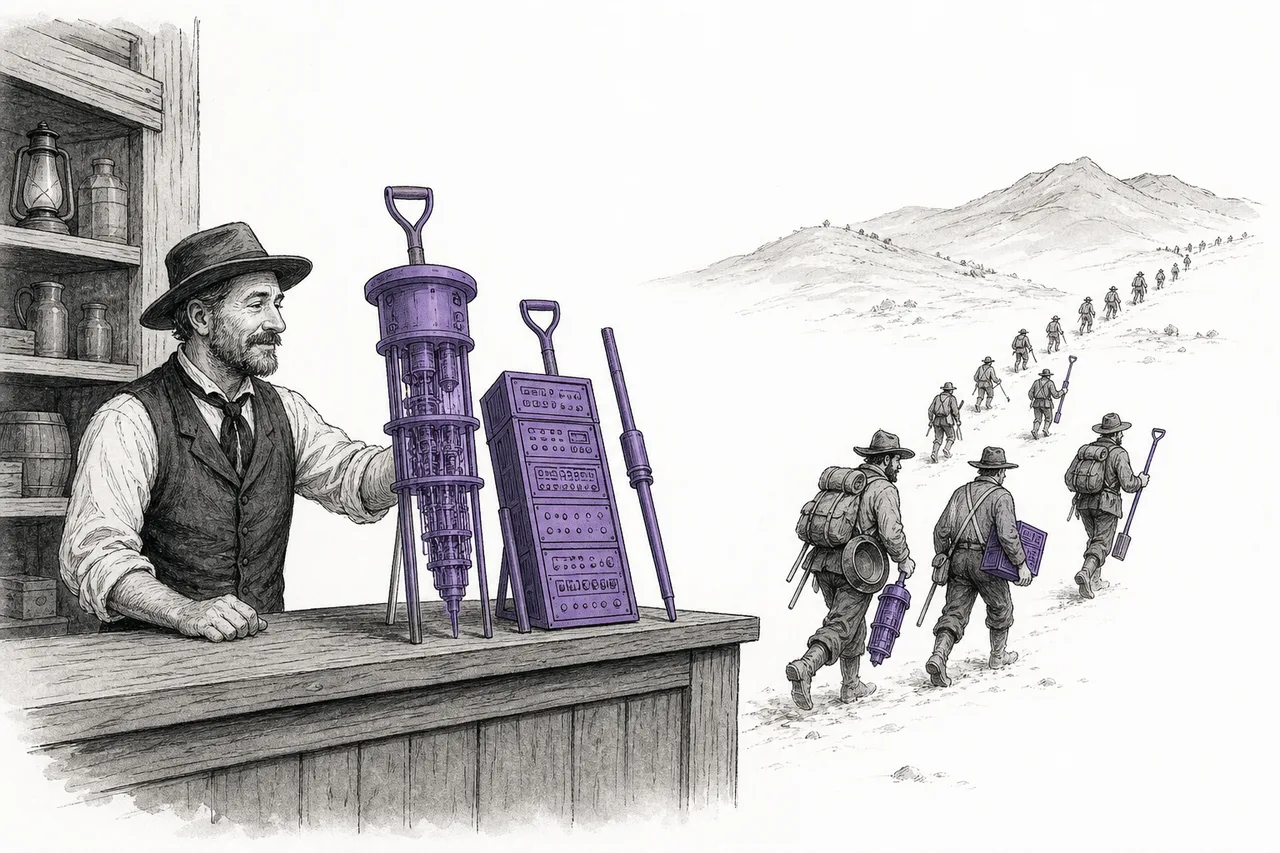
Nobody knows which kind of quantum computer will win — superconducting, ion, or atom. But whoever wins, every machine needs the same three things: a fridge colder than space, electronics to control the qubits, and lasers/optical fiber. The people who sell those are the "picks and shovels" of the quantum era — they get paid whether anyone strikes gold or not.
01What it is
When we talk about "quantum computers," we usually picture famous names like IBM and Google, or hot-stock startups like IonQ and Rigetti. But here's the hidden truth — no single company can build a quantum computer from scratch on its own. Every machine has to buy the "parts under the hood" from a separate group of specialist suppliers.
This node is exactly that group of suppliers — the companies that make the components no quantum computer can do without. There are three main groups:
- Cryogenics: the fridge called a "dilution refrigerator" that cools qubits to near absolute zero — colder than deep space
- Control electronics: the box that fires microwave signals to "command" the qubits and read the answers back
- Photonics / lasers: lasers, optical fiber, and special light sources used to control or connect certain kinds of qubits
Qubit = the unit of information in a quantum computer. Unlike an ordinary bit (0 or 1), it can be 0 and 1 at the same time — but at the cost of extreme fragility, breaking at the slightest disturbance · "Picks and shovels" = an investing phrase from the gold rush: instead of risking digging for gold (investing in companies that might go bust), you sell tools to everyone who digs — a surer way to get paid.
On the megatrend map, this node is a branch of Quantum Computing, and it's the deepest "infrastructure layer" — no matter how good a quantum computer someone builds, in the end they have to come buy the fridge and the control box from this group.
02Why "selling shovels" wins every way
The heart of this story is uncertainty. The quantum world is still arguing over the best way to make a qubit — superconducting circuits (IBM, Google), ions floating in a vacuum (IonQ, Quantinuum), or neutral atoms. It's like the early days of the automobile, when no one knew whether gasoline, electric, or steam would win. Betting on any single company is risky, because if its technology loses, you lose with it.
But component suppliers don't have to pick a side. The fridge Google uses is the same kind IBM uses; the same control box can run a different kind of qubit with just a firmware update. Put simply, whoever wins the qubit war, this group of suppliers gets to sell anyway — and the more people compete to dig, the better the shovel sellers do.

So how big is this market? Today it's still small, because the quantum computer itself is still an early-stage market (~$1.5 billion in 2025). But it's growing fast and has "real revenue" ahead of the computer itself. Take the fridge as an example: the dilution refrigerator market is around $150 million in 2025, and the cryogen-free segment alone is expected to grow to ~$800 million by 2034 (over 20% a year), with quantum research driving about 64% of demand.
03How it works (the stack that supports the qubit)
To see why these components matter, you first have to understand the problem: the qubit is the most fragile thing in modern technology. It can hold quantum information for only a fraction of a second, then "breaks" (decoheres) the moment it meets even a touch of heat, noise, or electromagnetic waves.
That tiny qubit in the middle can't do anything on its own. It needs "helpers" wrapped around it in three layers — and that's this whole node:
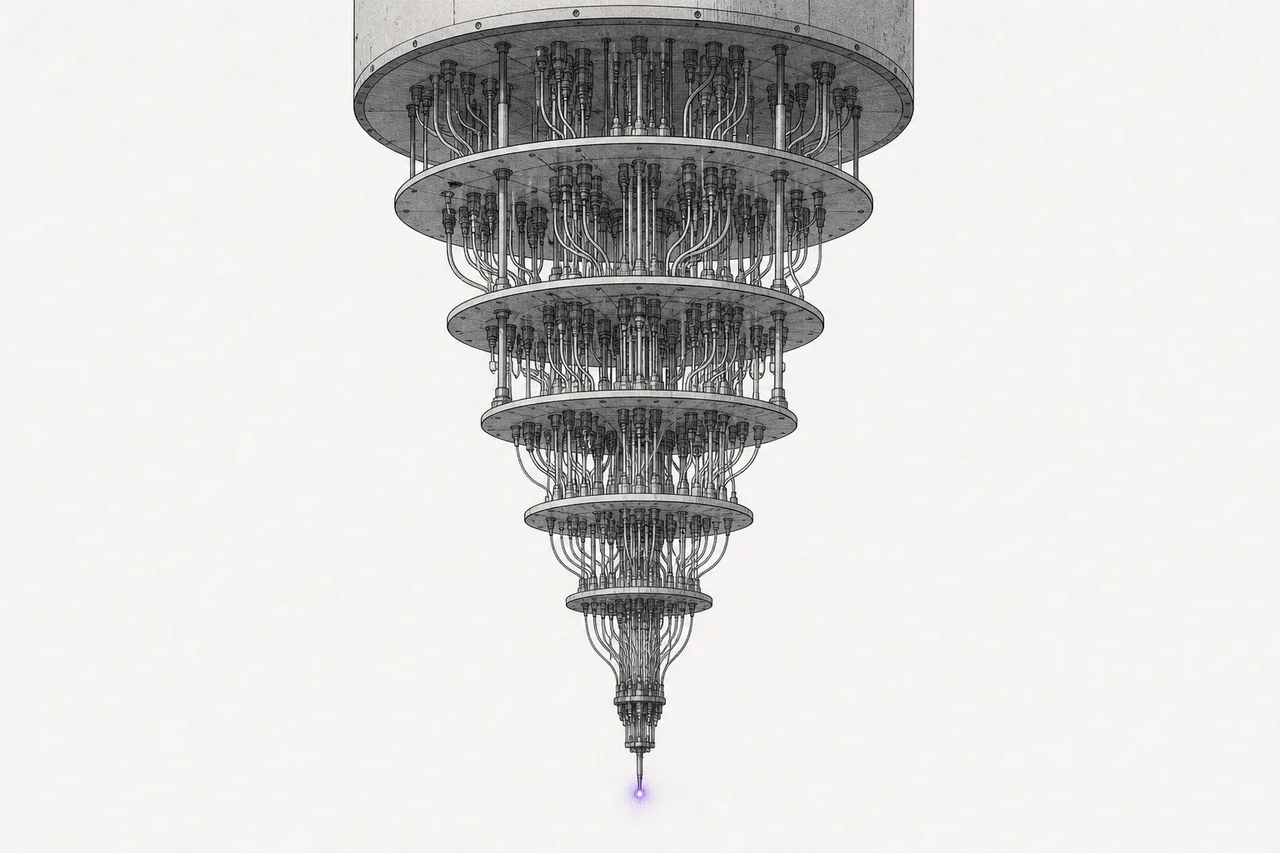
The innermost layer is the fridge (dilution refrigerator). It cools qubits to about 10–15 millikelvin — hundreds of times colder than deep space — to keep them still enough to work. These fridges stand as tall as a person, looking like golden chandeliers made of copper, costing over $500,000 each, with a 6–9 month wait to buy.
The next layer is the control electronics. Think of the qubit as a very delicate instrument; the control box is the "conductor" that fires nanosecond-precise microwave signals at each qubit and reads back the very faint answers. The more qubits, the more signal channels you need — newer systems support over 1,000 channels per rack.
Dilution refrigerator = a fridge that "mixes" two kinds of helium (He-3 and He-4) to pull heat out, reaching millikelvin-level temperatures · Millikelvin (mK) = one-thousandth of a kelvin — at 10 mK that's −273.14°C, nearly touching absolute zero (−273.15°C), the lowest possible temperature in the universe.
04How it connects in the ecosystem
This node is the "bottom layer" of all of Quantum Computing. It takes raw materials from upstream, then ships its goods to everyone who builds quantum computers:
- Feeds directly into Quantum Hardware — Pure-plays: these are the main customers. Every startup building quantum machines (IonQ, Rigetti, IQM, and so on) has to buy fridges and control systems from this node — the clearest "gold miner" and "shovel seller" relationship there is
- A cousin of Analog, Power & Discrete in chips: the control box is high-frequency (RF/microwave) electronics that uses the same skills as test equipment and analog chips — which is why a company strong in RF test like Keysight can step straight into this arena
- Relies on Semiconductor Materials and rare materials: the fridge needs helium-3, which is very rare (one company is even planning to mine it from the moon), while qubits and lasers need high-purity special materials — making this node sensitive to material supply chains
- Connects to Quantum Networking & QKD: the same photonics/laser layer is also the foundation of quantum interconnects and quantum-encrypted communication
05Where it stands now
First, to be blunt: the real players in this node are mostly private companies that aren't on the stock market. The world's number-one fridge maker, Bluefors, is private; the control-system leader, Quantum Machines, is private. That's the nature of a market still in its early days — but there are also several public companies with a hidden "quantum business line," and that's the route investors can actually reach.
On the fridge side, the market leader is Bluefors of Finland, which has shipped over 1,500 units worldwide, earned about €200 million in 2024, and holds roughly a quarter to a third of the global market — enough to call it a near-monopoly in fridges for quantum. In 2024 it opened a new plant in Syracuse, New York, to produce in the U.S. for the first time, and signed a long-term deal to lock in helium-3 against shortages.
On the control-system side, the market (superconducting segment only) is around $84 million in 2025 and is expected to grow to $211 million by 2034. The standout player is Quantum Machines (Israel, private, having raised over $96 million), whose OPX controller can run any kind of qubit, and Zurich Instruments (Swiss), bought by test-equipment giant Rohde & Schwarz — reflecting a trend of big test companies starting to swallow specialist quantum players. Zurich's new ZQCS system (launched in early 2026) was chosen for Fujitsu/RIKEN's 256-qubit machine in Japan.
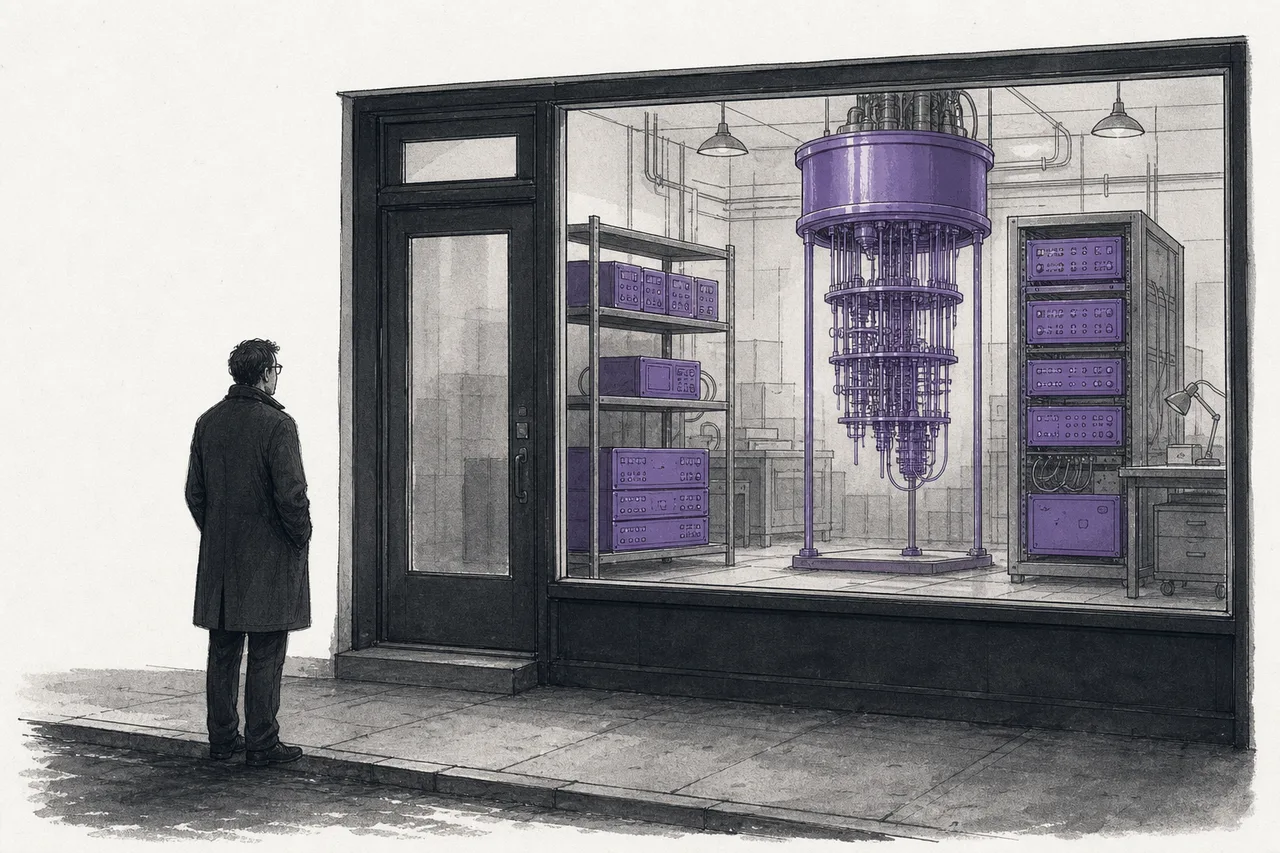
For investors, the truly reachable entry is the group of public companies whose revenue mostly comes from other businesses, but who have a growing quantum line on the side — like Keysight (test equipment), Coherent (lasers/photonics), FormFactor (probes and fridges for testing quantum chips), and Oxford Instruments. This is the charm of this node: it's a way to play the quantum theme "at lower risk," because these companies already have real revenue from their core business behind them.
06The road ahead
The first direction is clear: the more qubits a quantum computer has, the more component demand multiplies, because every qubit needs its own control channel and wiring. Jumping from a 100-qubit machine to thousands or tens of thousands doesn't just mean needing a "bigger fridge" — it means control systems that get exponentially more complex. This is the long-term growth engine of this node.
The second direction is consolidation. We've already seen Rohde & Schwarz buy Zurich Instruments; test-equipment companies and big chip giants are looking for ways to "capture" specialist quantum players. Over the next few years, it's likely that large public companies will gradually absorb these private suppliers — which will give investors more access to "the real thing."
The third direction is the "merging" of components. Right now the fridge, the control system, and the wiring are still separate pieces from different vendors. But the trend is moving toward an "all-in-one platform" that combines everything into a single system. Whoever builds such a platform first — and makes customers hard to switch away — will have far stronger pricing power.
07Challenges & risks
The charm of "selling shovels" comes with limits you need to understand fully.
The first risk is that the market really is still in its early stage. Even if it's safer than betting on the gold miners, if the whole quantum industry grows slower than hoped (and this technology has had its timeline pushed back many times), component demand grows slowly with it. Selling shovels does pay — but if no one comes to dig, the market stays small. Right now the world's fridge market is still in the hundreds of millions, not the tens of billions.
The second risk is that most of the real thing can't be bought. The true leaders like Bluefors and Quantum Machines are private, so retail investors can't reach them directly. And the public companies you can reach (Keysight, Coherent, FormFactor) have quantum as only a "sliver" of the whole business — meaning even if the quantum business explodes, the effect on the overall stock price may be diluted.
The third risk is concentration and material bottlenecks. With Bluefors holding a near-total grip on fridges and helium-3 so scarce that people are planning to mine it from the moon, the whole node has a few "fragile points" that, if they stumble, hit the entire industry. The same goes for control systems depending on FPGA chips from AMD/Intel, which are already in a demand fight with defense and telecom.
In short: if quantum computers are the new "gold rush," this node is the shovel-and-pick store of that era — a business less flashy than the gold miners, but one that usually gets paid first, carries less risk, and doesn't need to guess who strikes gold. It just needs people to come and dig.