Megatrend · Quantum Computing
Betting on a machine that isn't built yet
There's a group of public companies whose "entire business" is building a quantum computer — a machine that could one day crack codes, design drugs, and engineer materials beyond any computer on Earth. The catch: that machine isn't finished, no one yet knows which technology will win, and most of these companies have almost no revenue while their stocks have soared into the tens of billions of dollars. This is the story of the most dramatic race — and bubble — in tech.
01What it is (a pure bet)
The computer you're using — phone, laptop, AI server — all think in the same language: "bits" that can only be 0 or 1. A quantum computer plays a different game. It uses qubits (quantum bits) that can be 0 and 1 at the same time, thanks to the strange rules of atomic-scale physics — letting it try trillions of answers at once on certain jobs, like cracking codes, devising drug formulas, designing new materials, or finding the best answer to an enormously complex problem.
This node isn't about "quantum" in the broad sense — it zeroes in on one specific group of companies: the pure-play "real machine builders", companies whose entire business is building quantum hardware, with no other business to lean on. That's different from giants like Google or IBM, which run quantum as just one "division" inside an empire with massive revenue from elsewhere (that group is the sibling node Quantum Hardware — Hyperscaler).
This difference matters enormously to investors, because a pure-play is a pure bet. If quantum succeeds, the value goes through the roof; if it fails or comes too slowly, there's almost nothing left — unlike Google, which still has ads feeding the company even if quantum never works.
Superposition = a qubit can be 0 and 1 at the same time, letting a quantum computer explore many answers in parallel · Entanglement = several qubits link up so that one's state instantly fixes another's. These two properties are quantum's "superpower" — but they're also exactly what makes it so fragile (more on that in the next chapter).
On the megatrend map, this node sits under Quantum Computing and is the deepest "infrastructure layer" — because however brilliant the quantum software or algorithms get, in the end someone has to build the machine that can actually run them first.
02Why qubits are fragile (and why it's not built yet)
If quantum is that powerful, why isn't anyone using it seriously yet? The short answer: qubits are painfully fragile. The superposition state that makes them powerful can shatter from nothing more than heat, vibration, electromagnetic waves, or even a passing cosmic ray. This is called "decoherence" — the qubit "forgets" the information it's holding in a split second, turning into an error.
This is why many quantum computers have to be chilled to near absolute zero (colder than space) and wrapped in shielding against noise — all to stretch out the time a qubit can "stay still" long enough to compute.
The industry's way out is what's called "quantum error correction" — the idea is to take many error-prone qubits (called physical qubits) and bundle them into one more-stable qubit (called a logical qubit), like having many people help remember a single number: if one gets it wrong, the rest can fix it. The price you pay is that a single usable logical qubit may take hundreds to thousands of physical qubits.
The math here is brutal. The job investors are waiting for — say, cracking the codes that protect the world's banks — may need thousands of logical qubits, meaning a million physical qubits. Yet today's best machines have only hundreds of physical qubits. This gap is what explains why this node is "exciting" and "not ready" at the same time.
03The 5-way race: who will win?
The heart of this lesson, and why it's interesting for investors, is that no one yet knows which way of building a qubit will win. Unlike ordinary chips, where the world has settled on silicon transistors, the quantum world still has at least 5 "camps" competing, each with very different strengths and weaknesses. These are the 4 sub-nodes of this node, plus one more that's gaining momentum.
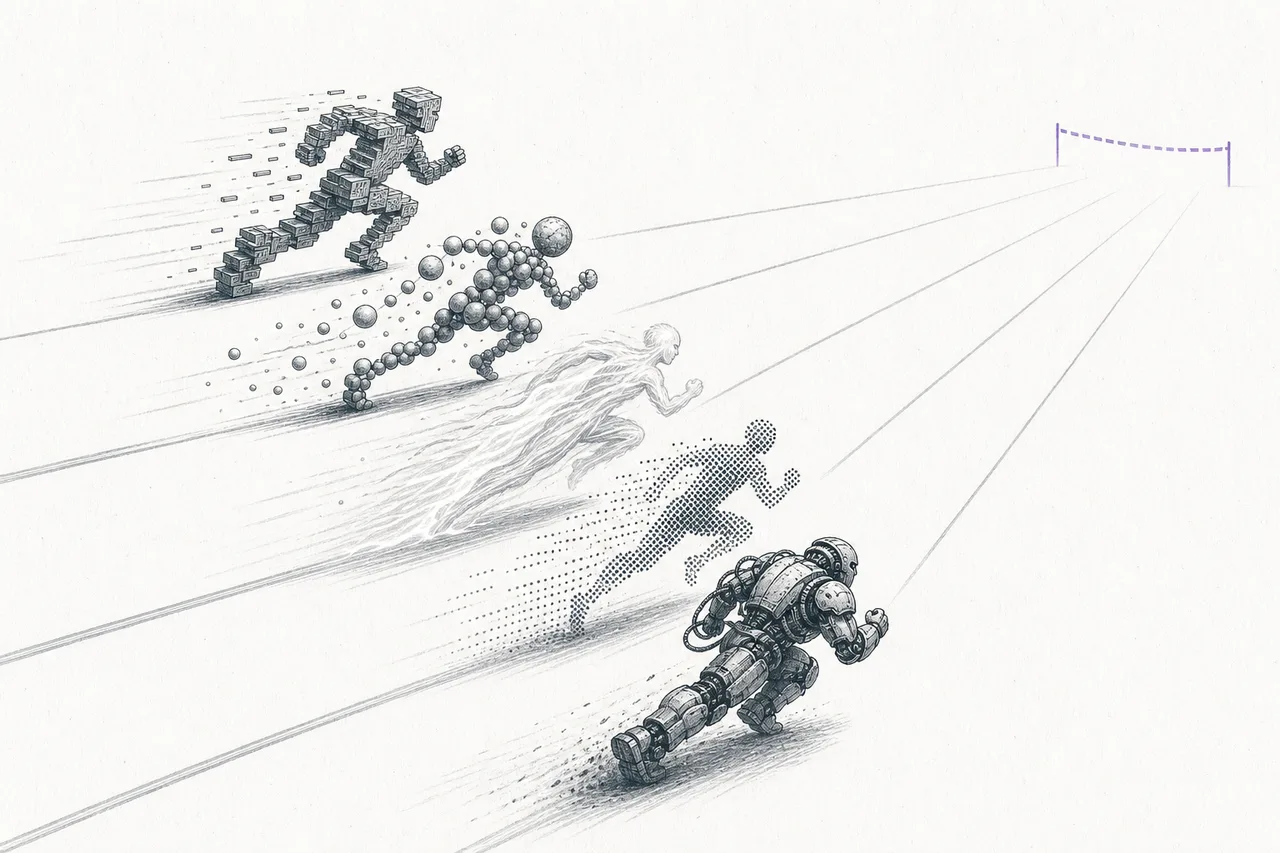
Let's go through each camp, which are the 4 sub-nodes of this node:
- Superconducting: builds qubits from tiny electrical circuits chilled until they have no resistance. It's the fast camp and can make the most qubits — the path Google (Willow chip) and IBM chose. On the pure-play side it's Rigetti. The weakness: it needs deep cooling with an expensive dilution fridge
- Trapped-Ion: uses charged atoms held still in an electromagnetic field as qubits. Its strength is being the most precise (highest gate fidelity), because every atom is exactly the same, with none of the manufacturing variation that circuits have. The leaders are Quantinuum and IonQ. The weakness: it runs slower and is harder to scale up in qubit count
- Photonic & others (photons / particles of light): uses particles of light as qubits. The big advantage is that it doesn't need deep cooling — it can use ordinary server-style cooling and be made on silicon-chip production lines. This camp also includes "other camps" like neutral-atom, which is easy to scale and gaining momentum. Pure-play examples are Xanadu (photonic) and Infleqtion (neutral-atom)
- Quantum Annealing: this is the camp that "plays a different game." It's not a general (gate-based) quantum computer but a specialized machine good at just one kind of job — finding the "best" answer to optimization problems (like routing logistics). The market leader here is D-Wave, the only pure-play with real commercial customers and high gross margins
Beyond the three main camps, there's also a "basket of alternative camps" — photonic (Xanadu, PsiQuantum), neutral-atom (QuEra, Pasqal, Atom Computing), silicon-spin (Intel), and topological (Microsoft Majorana) — most still private companies, playable indirectly through Big Tech (IBM/Alphabet/Microsoft) and Nvidia, which sells the "picks and shovels" no matter who wins (see more at Photonic & others).
Gate-based = a "general-purpose" quantum computer that can run many algorithms (Superconducting, Trapped-Ion, Photonic, Neutral-Atom are this kind) — this is the camp that will "crack codes / design drugs" in the future · Annealing = a specialized machine that can only do optimization problems but already works today — trading general-purpose flexibility for being ready to use.
The point for investors: choosing each pure-play stock is really betting on which modality will win. Buy Rigetti = you believe in superconducting; buy IonQ/Quantinuum = you believe in trapped-ion. And if you bet on the wrong camp, even if quantum overall succeeds, the stock you hold may not go anywhere.
04What it connects to in the quantum universe
Pure-play hardware doesn't stand alone — it's the "hardware" layer at the very bottom of the whole quantum ecosystem:
- The bigger rivals — Quantum Hardware (Hyperscaler): Google, IBM, Microsoft, Amazon, who run quantum as one division of a giant empire. They have unlimited money and no rush to earn revenue — both a rival and sometimes an ally of pure-plays
- Who they sell through — Quantum Software & Cloud: the machines they build need people to program them and a way to rent them out over the cloud. Today most of a pure-play's small revenue comes from exactly this — letting customers "rent time" on the machine via the cloud
- Who they depend on — Cryogenic, Control & Photonic Components (cooling / control / photonic parts): superconducting and trapped-ion machines need dilution fridges, lasers, and precise control gear — the "picks and shovels" that sell no matter which modality wins
- The big future customers — Cybersecurity and Biotech: the day the machines grow big enough, they'll be able to break the codes protecting the whole internet (which is why cybersecurity is rushing to develop post-quantum encryption), and they'll help simulate molecules to design drugs — these two fields are the "real reason" governments worldwide are pouring in huge money
What's worth noticing is that pure-play hardware is tied to AI in two directions: AI helps design and control quantum machines, while future quantum may help accelerate certain AI work. But in the near term, quantum does not compete with the GPU — they solve different kinds of problems. This is a common misconception in the market.
05Where things stand now + the real players
Let's look at the real situation in 2026, plainly. The good news: 2024–2025 brought real, important technical milestones. In late 2024, Google's Willow chip (105 qubits) pulled off something no one had managed before — as the qubit cluster grew (from a 3×3 grid to 7×7), the error rate went down instead of up. It's called going "below threshold" for the first time. This is among the first pieces of evidence that scalable error correction is actually possible. On the trapped-ion side, Quantinuum built as many as 48 error-corrected logical qubits (Helios) and holds the world record for fidelity.
But here's the reality that has to be said plainly: most pure-play players have almost no revenue, and a machine that "fully works commercially" is still years away. Let's look at their 2025 revenue figures — then you'll see why this story is both exciting and worrying.
The numbers tell three things: (1) IonQ leads on revenue — the first listed quantum company to hit ~$110M in revenue (+222% YoY), with about $3.5B in net cash backing it. (2) D-Wave's numbers are small but "pretty" — up 179% with 83% gross margin, because it's already selling annealing machines to real customers. (3) Rigetti's revenue shrank 34%, reflecting that superconducting pure-plays still earn very little from real products. Meanwhile Quantinuum just went public (ticker QNT) in mid-2026 with only ~$31M in revenue, but is seen as the real technology leader of the trapped-ion camp.
Another force changing the game in 2026 is government. The U.S. Commerce Department announced it will pour ~$2 billion into 9 quantum companies, with the government taking equity in exchange — D-Wave, Rigetti, and Infleqtion each got $100M, while IonQ wasn't in the first batch. This money helps keep loss-making companies breathing, but it also underscores that this industry still leans on subsidies more than it stands on its own revenue.
06The valuation gap: a quantum bubble?
This is the part that has to be said most plainly, because it's the biggest risk of this node. These companies' valuations don't come from revenue or profit that actually exists — they come from the story and expectations around a machine that isn't built yet.
Look at the clearest example: Quantinuum went public at a valuation of about $14 billion on just ~$31 million of 2025 revenue — a price-to-revenue ratio of over 450x. Compare that with a typical fast-growing tech company trading around 10–20x. This number reflects a market "paying in advance" for a future that may be years away.

Many in the industry call this phenomenon outright a "quantum bubble." This group's stock prices move on momentum and news more than on results. A single small milestone headline can push a stock up tens of percent in a day, and it can drop just as hard when the mood shifts — even some executives of these very companies have warned that the share price is "running far ahead of fundamentals."
This doesn't mean the technology is fake or worthless — quite the opposite, the scientific progress is real. But it means "real technology" and "a reasonable stock price" are two different things. Investors need to separate the two: it's possible for quantum to change the world and for the stocks today to be overpriced, both at the same time.
07The future & the risks
Looking ahead, the most important thing to understand is the timeline. Today's quantum market is still very small — about $1.6 billion in 2025 — and expected to grow to ~$7.3 billion in 2030 (~35% average annual growth). McKinsey estimates the long-term economic value could reach $72 billion by 2035. The number is big — but the key is that it sits "at the finish line," not today.
On the timeline for a "fully working machine" (fault-tolerant), research houses like BCG roughly frame it this way: the era of "small, still-error-prone machines (NISQ)" runs to about 2030, the era where quantum starts to beat ordinary computers on commercial work around 2030–2040, and a full fault-tolerant machine possibly after 2040. Companies themselves are more optimistic — IonQ targets ~1,600 error-corrected logical qubits by 2028. The truth is probably somewhere between these two views.
Now to the risks, which for this node are heavier and more specific than for a typical trend:
Risk 1 — pre-revenue and burning cash: most players are still loss-making, burning cash every quarter and surviving on raising more money (issuing new shares dilutes existing holders) or government subsidies. If capital markets cool and fundraising gets harder, some companies may not make it — in this group, "having plenty of cash on hand" (like IonQ and D-Wave) matters as much as the technology.
Risk 2 — betting on the wrong modality: because it's still unknown which camp wins, pure-play shareholders carry the risk that the technology their own company chose may not be the path the world takes — unlike giants like Google/IBM, who have deep enough pockets to try several paths at once.
Risk 3 — bubble and volatility: stock prices run on news and mood, not fundamentals. A milestone that's just slightly slower than expected, or a shift in sentiment, can send the price plunging fast. In this group there's no "cheap right now" — only "less expensive" or "more expensive."
In short: this node holds a "dream that could change the world" in one hand and "a reality that's not even half-ready" in the other. Quantum computers are real and genuinely advancing — but the companies building them are still early-stage bets whose prices run far ahead of fundamentals. Understanding the gap between "the machine in the news" and "the machine you can actually sell" is the most important thing for seeing this group of stocks for what it is, not for what the headlines want it to be.