Megatrend · whole-trend overview
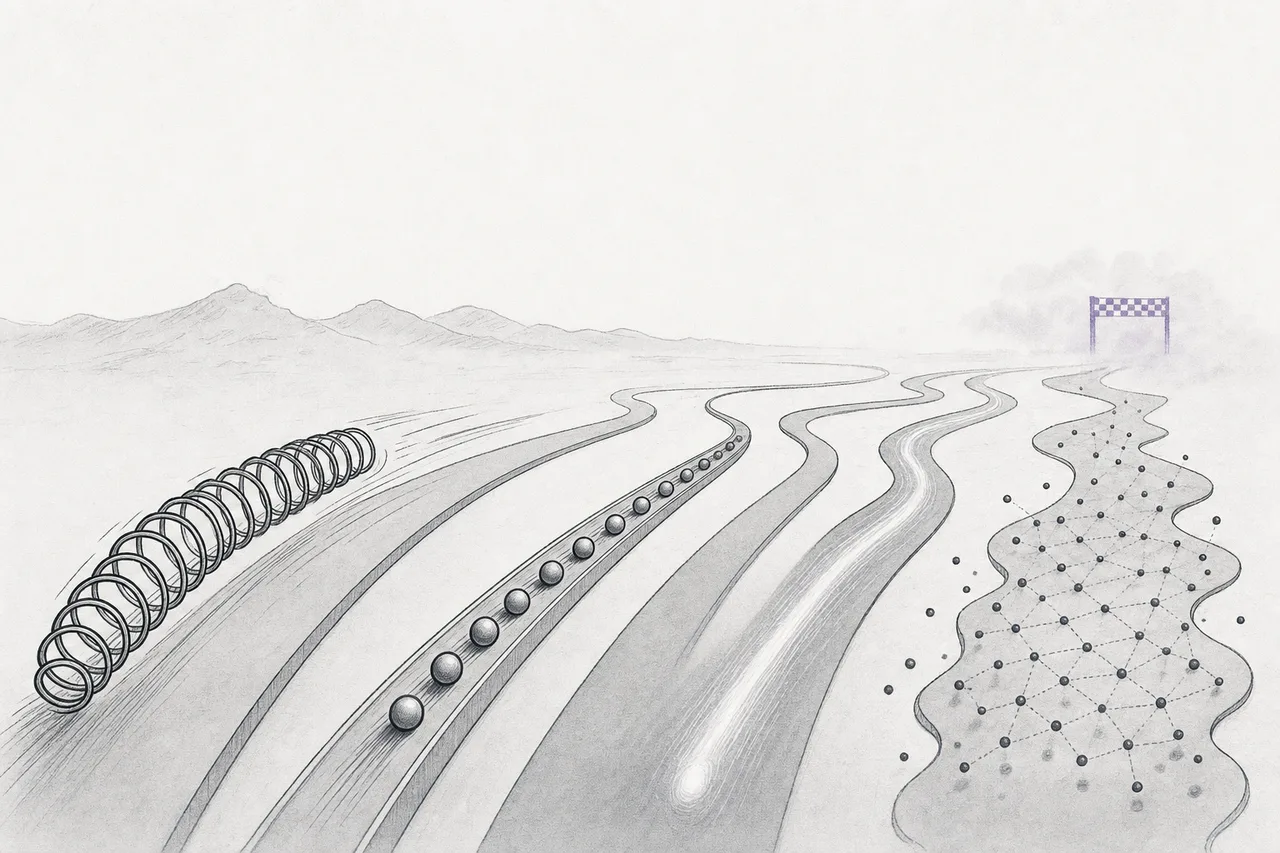
A race nobody has won — and nobody knows when anyone will
Quantum computing is the promise of solving problems that every supercomputer on Earth combined still can't — but as of 2026, it makes very little money, the machines break easily, and a "truly useful" one is still years away. This lesson is the map that strings the 6 categories of quantum together: who does what, who depends on whom, where the power (and the risk) sits — and why the one category that already makes money today isn't a quantum computer at all (each category has its own deep-dive chapter).

01The big picture: a bet not yet proven
The computer you're using — even the most expensive supercomputers in the world — runs on "bits" that can only be 0 or 1, one value at a time. Quantum computing changes that rule. It uses a qubit, which rides the strange laws of quantum physics: it can be 0 and 1 at the same time, and qubits can entangle with each other. The result is that, for certain problems, it explores a vast number of possibilities all at once instead of trying them one by one.
So the promise is huge: design new drugs and materials at the molecular level (connecting straight to Biotech), crack logistics and finance problems too complex for ordinary computers — and, on the dark side, the power to break the encryption that protects the entire internet. But here's the truth an honest lesson has to tell: as of 2026, quantum is still a "pre-revenue" technology. The machines are small, break very easily, and not one of them yet solves a real business problem better than a regular computer can.
So the market today is tiny — about $3.5 billion in 2025 (less than a single quarter's revenue at a big chip company). What pulls in money and governments worldwide is the "end state," which could be enormous. Many research firms expect revenue to grow to ~$20 billion by 2030, and McKinsey sees quantum technology generating around $72 billion in revenue by 2035.
Put another way — this is a trend you have to look at with a different eye than the others. We aren't asking "who makes the most money today," but "who's closest to a machine that actually works," and "if it succeeds, who captures the value." And that starts with unrolling the map.
02The map: what are the 6 sub-categories
The quantum field splits into 6 categories, which group into 3 "layers" like a tech stack — from hardware at the base, up to software and real-world uses. Each category has its own deep-dive lesson (tap to read):
Bottom layer — hardware and components (building the machine)
- Quantum Hardware — Pure-plays: companies whose core business is purely "the quantum machine" — IonQ, Rigetti, D-Wave. High stakes, still losing money, split by their different "way of making a qubit" (modality)
- Quantum Hardware — Hyperscaler / Diversified Embedded: quantum projects hidden inside tech giants — IBM, Google, Microsoft. Strategic R&D, not the company's whole P&L
- Cryogenic, Control & Photonic Components: the parts that make the machine work — dilution fridges, control electronics, lasers and photonics. The "picks & shovels" of the field
Middle layer — platforms and networks (using and connecting machines)
- Quantum Software, Algorithms & Cloud Access: software, compilers, algorithms, and the cloud that lets you "rent time" on a quantum machine — mostly still private or bolted onto the big clouds
- Quantum Networking & QKD: quantum networks and "quantum key distribution" (QKD) — still very early, mostly private, and overlapping with the Space Economy trend (QKD via satellite)
Top layer — defensive uses (protecting against the quantum threat)
- Quantum-Safe / Post-Quantum Cryptography: moving the world's encryption to a form that's "unbreakable by quantum" (NIST standards) — and the interesting part is that it already makes money today, because it's driven by the threat, not by a machine that isn't finished (big players like Palo Alto / Cloudflare sit in the Cybersecurity trend)
03How it all connects (the quantum stack)
The best way to understand this field is to see it as a layered "stack" — components and hardware at the base make the software and cloud in the middle possible, and all of that is what turns the threat (and the need for PQC) at the top into something real.
This relationship is the heart of the whole trend, and here's the clever twist: most categories (hardware, software, networking) are a bet on the future — they only make real money once the machines work. But PQC is the opposite: the scarier a quantum computer looks at "being able to break encryption," the more organizations worldwide have to switch their encryption right now — meaning PQC makes money from pure "fear," without even waiting for the machine to be finished.
Qubits can be built several ways from different physics — superconducting (super-cooled superconducting circuits, IBM/Google/Rigetti), trapped-ion (ions held by electromagnetic fields, IonQ/Quantinuum), photonic (using particles of light, PsiQuantum/Xanadu), and neutral-atom (neutral atoms in a laser trap, QuEra/Atom Computing). Each has different strengths and weaknesses, and nobody yet knows which one will win.
04Where the value and power sit
Because the machines don't make money yet, the question of "where is the value" is very different from other trends. As of 2026, the answer splits into three types:
1. Categories that already make money = PQC and components (picks & shovels) In a "gold rush," the first to make money are the ones selling shovels. PQC sells security that organizations have to buy now, and component makers (dilution fridges, lasers, control electronics) get paid no matter which modality wins — because every machine needs them.
2. A cheap "option" inside a giant budget = Hyperscaler IBM, Google, and Microsoft research quantum with money that's small next to the company's enormous revenue. If it works, they get a leader; if it doesn't, it barely matters — they're holding the lowest-risk "option" in the field.
3. Categories that are a pure bet = Pure-plays IonQ, Rigetti, and D-Wave are a straight bet on quantum's success — win and the value soars, lose and almost nothing is left. This is the category where the stock swings hardest and leans most on "the story."
The lesson for reading this trend: don't just ask "does this company do quantum," ask "does it make money from the present or bet on the future — and if the bet loses, what's left". PQC and component sellers harvest from the present, hyperscalers hold a cheap option, and pure-plays are a pure bet.
05Forces that hit the whole trend
Even though each category differs, three big forces move the whole field at once:
1. The chase for "error correction" — this is the biggest technical force. Qubits are extremely fragile; the slightest disturbance "breaks" them. To actually use one, you have to bundle thousands of real qubits together to build a single "error-corrected" qubit (a logical qubit). In late 2024, Google announced its Willow (105 qubits) chip, the first to cross the "threshold" — add more qubits and errors go down, a milestone physicists waited 30 years for. Every breakthrough like this shakes the whole field at once.
2. Geopolitics and state money — quantum is seen as a "national-security technology," because whoever has it first might decrypt a rival's codes. So governments worldwide are pouring in huge sums — about $55.7 billion committed since 2013, led by China with ~$15B in state money, then the EU and the US. This is the force propping up the field even while commercial revenue is still small.
3. "Harvest now, decrypt later" — this is the force that grows PQC immediately. Even though a real quantum computer that can break encryption hasn't arrived, hackers and foreign states are already stealing encrypted data today and storing it, waiting for the day a quantum computer is ready to decrypt it. Data that must stay secret for a long time (medical records, state secrets) has to be switched to quantum-resistant encryption before the threat arrives. That's why NIST released its PQC standards (FIPS 203/204/205) in August 2024 and set off a global migration wave — connecting straight to the Cybersecurity trend.
06Where it stands now + each category's champion
2025–2026 is when the field is "red-hot in the capital markets but not yet proven in the lab" — IonQ became the first quantum company to break $100M in revenue, Quantinuum just went public (June 2026 IPO at a ~$14 billion valuation on only ~$31M of revenue — reflecting that the market is pricing in pure "future"), and PsiQuantum raised $1 billion at a $7 billion valuation. Below are each category's "champions," showing that power is spread across many methods and many countries:
07The future and the risks
Looking ahead, everything hinges on a single question: when will a "truly useful" machine arrive — and the most honest answer is "still years away, and nobody knows for sure." IBM targets a large fault-tolerant machine in 2029, and PsiQuantum is aiming for a million-qubit scale late this decade, but these roadmaps are goals, not promises.

On the opportunity side: if quantum succeeds, it will unlock drug, material, and computational discoveries that were impossible before — value that BCG estimates as high as $450–850 billion by 2040. And the state money flowing in from around the world props the field up so it won't fall even while commercial revenue is still small.
On the risk side, there are three layers to watch especially closely — more than in an ordinary trend:
- Unresolved technical risk: nobody can guarantee which modality scales to a usable level. Error correction may hit a wall we can't yet see — this isn't just "behind schedule," it could be "never works"
- Price runs ahead of reality: when a company with ~$31M of revenue is valued at ~$14 billion, the price rides the story more than the fundamentals. Every time the hype flips, pure-play stocks swing violently — this is the category where the "expectation bubble" is clearest
- Betting on the wrong horse: even if quantum succeeds overall, the company you hold might have picked the losing modality — a risk that doesn't exist in trends where the technology has settled
And that's why this chapter keeps repeating the words "early stage and still a guess" throughout — quantum could be the greatest revolution of the century, or it could take far longer than everyone thinks. Both are possible at the same time. Understanding how it stacks up as a "stack," and which categories can truly harvest from the present, is the best tool for separating "the real" from "the expected" — tap into the deep-dive of whatever category interests you.