Megatrend · Semiconductors
The chips that don't 'think' — they let the real world talk to the digital one
While everyone's excited about the most cutting-edge AI chips, another group of chips works quietly behind everything — measuring temperature, hearing sound, sensing light, managing power, and driving motors. They're the 'senses and muscles' of every device. This group doesn't compete on nanometer-scale shrinking; it competes on being battle-tested, tough, and staying in the market for a decade or more — and it's the heart of every EV on the road.
01What it is (3 families)
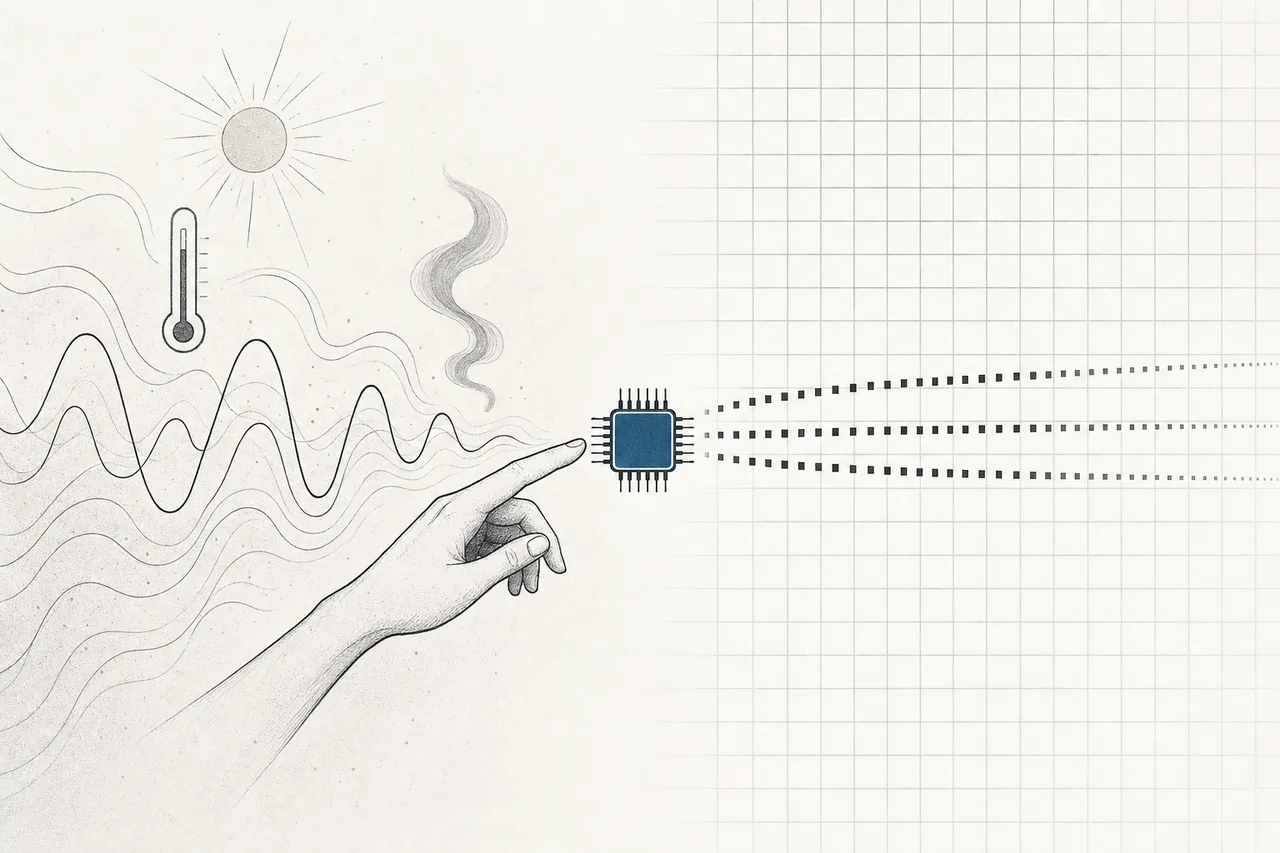
When we say 'chip,' most people picture the brain — CPUs, GPUs, AI chips that think and compute. But think about it: before the brain can think anything, it needs 'data from the real world' first. How hot is it, how loud, how bright, how much battery is left — the real world doesn't speak 0s and 1s, it speaks in continuous 'waves' that rise and fall. Who translates this language so the brain can understand it? The answer is the chips in this category.
The Analog, Power & Discrete category groups 3 chip families that work directly with the 'physical world' — not chips that think, but chips that sense, drive, and deliver power:
- Analog (the senses): chips that read continuous signals from the real world — sensors, microphones, amplifiers, signal converters (ADC/DAC). They're the 'ears, eyes, and skin' of a device
- Power (the muscles and heart): chips that handle energy — converting voltage, delivering power to every part, driving motors; in an EV, the chip controlling the flow of hundreds of volts from the battery to the wheels
- Discrete (single-function parts): a single basic device that does one job, like a power transistor (MOSFET, IGBT) or a diode — a 'single brick,' not a complex circuit, but indispensable in high-power jobs
Digital = a world of only 0s and 1s, on or off, present or absent — the language the brain thinks in · Analog = a world of continuous values that change smoothly, like 23.4°C, 1.7 volts, or a sound getting gradually louder — the nature of the real world · an analog chip is the 'translator' that turns the real world's continuous waves into digital numbers (and back) — without it, the brain can't see or sense the real world at all.
On our megatrend map, this category is a sub-branch under Semiconductors. The short definition is 'signal-chain, power management, and discrete devices, including SiC/GaN' — and what makes it utterly different from siblings like Foundry or Memory is this: it doesn't compete on nanometer-scale shrinking.
02Why it matters to the economy
This category's market is bigger than people think. The analog part alone is worth about $105–107 billion in 2025, and is expected to grow to around $175–180 billion in the early 2030s (about 6% a year). The biggest piece of that is Power Management IC, which takes about 34% of the whole analog market.
But the reason this category matters to the economy more than the market numbers is that it's in everything — a single appliance can have dozens of analog/power chips, while it has just one CPU. That's why, during COVID, when chips ran short, what forced car factories worldwide to halt their lines wasn't expensive AI chips, but cheap analog/power chips costing a few cents — just one missing and the whole car can't be assembled.
And this category's biggest accelerator is the electric vehicle (EV). Look at this number: an ordinary internal-combustion (ICE) car carries about $500–600 of chips per vehicle, but an EV crosses $1,500 per vehicle in 2025 and is expected to hit $2,000 by 2030 — a 3× jump. And almost all of that increase is power chips that manage the high-voltage flow from the battery.
03How it works (a bridge between two worlds)
The heart of this category is being the bridge between the 'real world' and the 'digital world'. Think of a music app or voice control: our voice is a continuously vibrating wave of air (analog), but the brain only understands 0s and 1s (digital). Who translates? A microphone catches the sound wave, then an ADC (Analog-to-Digital Converter) chip 'samples' that wave into numbers thousands of times a second and hands it to the brain to process; when it's done, a DAC chip turns it back into a sound wave for the speaker.
This is where this category's economics differ completely from other chip groups. AI chips or flagship phone chips have to chase the most cutting-edge nodes (2nm, 3nm), because smaller means faster. But analog/power chips instead stay on mature nodes like 180nm, 150nm, or even old 8-inch wafers — because their job is to 'handle voltage' and 'read signals accurately and durably,' not to 'think fastest.' Cramming transistors smaller doesn't help; it actually makes them worse at withstanding high voltage.
Factories that make chips on mature nodes have usually fully depreciated their equipment, so they produce cheaply with good margins. On top of that, each analog product's recipe has to be 'tuned' to its specific circuit, which makes customers reluctant to switch suppliers (sticky). A single analog product can keep selling for 10–20 years — Microchip once revealed it had shipped over 8 billion chips from mature nodes and stayed profitable every quarter for more than 30 years. This is a 'slow but tough' business — the opposite of the 'fast but brutal' race for cutting-edge nodes.
04SiC & GaN — the power chips of the EV era
If this category has a standout star, it's SiC (Silicon Carbide) and GaN (Gallium Nitride) — two chip materials set to replace ordinary silicon in high-power jobs.
Here's the story. Silicon (Si) transistors work well for general use, but when they have to handle the hundreds of volts in an EV, they start to 'run hot and waste power,' because energy is lost as heat each time the circuit switches on and off. SiC solves this — it withstands higher voltage, tolerates more heat, and switches faster with less loss.
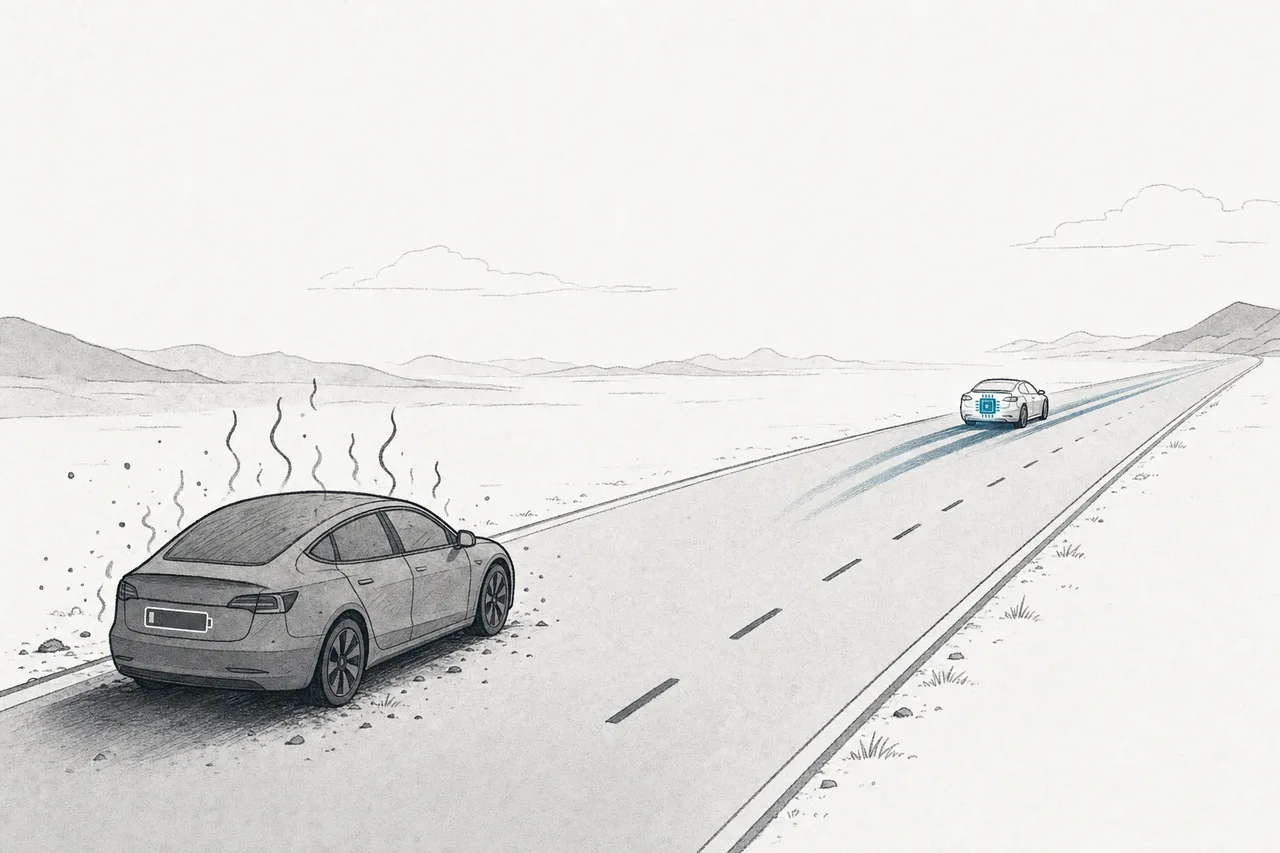
The real-world effect is this: an 800-volt EV drivetrain using SiC saves about 2–4% of energy compared with a conventional silicon (IGBT) system — that sounds small, but 2–4% means 'going farther on the same battery' or 'using a smaller, cheaper, lighter battery,' which is a huge deal for carmakers. That's why cars took about 62% of SiC demand in 2024 and are expected to hold around 70% of demand over the next 5 years.
Both are 'wide-bandgap' — materials that withstand far higher voltage and heat than silicon · SiC is good at high-voltage, high-power work — EVs, fast chargers, solar inverters, data-center power systems · GaN is good at high-frequency, small-size work — phone/laptop fast chargers half the size, server power delivery · put simply, SiC is the 'big muscle,' GaN is the 'nimble one.'
But the SiC market is brutal too. In 2025 an industry-shaking event happened — Wolfspeed, the American SiC pioneer, filed for Chapter 11 bankruptcy to restructure its debt, cutting it by about $4.6 billion (~70%). The cause: the company poured money into building huge factories ahead of time, but EV demand slowed more than expected — a lesson that even when a trend is strong, investing at the wrong moment can hurt badly.
05How it connects in the ecosystem
This category is the 'infrastructure layer' that almost every physical-world trend depends on — it doesn't directly feed the data-center AI era like Memory or Foundry, but it's the chip that lets 'AI come out and meet the real world':
- Opens the way for Electrification & Mobility (EVs): this is the hottest relationship — power/SiC chips are the heart of every EV drivetrain; the more the world shifts to EVs, the more demand flows back to this category
- Opens the way for Robotics & Physical AI: robots have to 'feel' the world through sensors (analog) and 'move' through motors (power) — no matter how smart the AI, it can't move its body without these chips
- Indirectly feeds AI and Cloud & Digital Infrastructure: AI data centers draw enormous power, and power chips (including GaN/SiC) handle high-efficiency power delivery to server racks — a new and growing demand
- Relies on its Semiconductors siblings: it needs SiC wafers and specialty materials from Materials & Specialty Chemicals, and depends directly on key raw materials
06Where it stands now
2024–2025 was a 'hurt then heal' phase for this category. After the COVID era, when customers hoarded more chips than they needed, real demand softened and everyone rushed to destock at once — shrinking the analog market about 9% in 2023 and another 2% in 2024 before starting to recover about 4% in the first half of 2025. This is the 'industrial/automotive cycle' that's natural to this category.
Now the recovery signs are clearer. Texas Instruments reported Q3 2025 revenue of $4.7 billion (up ~14% YoY), with the CEO saying the automotive market is improving as customer inventories fall and destocking ends. Analog Devices also returned to growth across every segment in 2025 after a hard 2024.
But the other side of the market has a looming shadow named China — Chinese factories are rapidly building mature-node capacity (28–40nm and older), the very same nodes used for analog/power/MCU chips, creating overcapacity. Utilization in the mature-node group has fallen below 80% and low-end prices are being pushed down — a squeeze on profits in this category's commodity segment.
07The road ahead
The first direction is clear: electrifying the world will keep driving demand for a long time. The combined SiC+GaN market is estimated to grow from about $2.9 billion in 2024 to over $22 billion in the early 2030s (about 25% a year) — not just EVs, but fast chargers, solar farms, and power delivery in power-hungry AI data centers.
The second direction is the move to bigger wafers. Both SiC and GaN are shifting from 150mm/200mm wafers to 300mm — Infineon announced it would make GaN on 300mm wafers and ship samples to customers from late 2025. Bigger wafers yield more chips per sheet, so the cost per chip drops — the key to making SiC/GaN cheap enough to replace silicon broadly.
The third direction is consolidation of power. After the Wolfspeed crisis and the volatile EV cycle, small players that invested heavily will be absorbed or collapse, leaving only the deep-pocketed giants (Infineon, STMicro, onsemi) standing — the global SiC market is already concentrated in about 5 players, and is likely to concentrate further.
08Challenges & risks
The appeal of this 'slow but tough' category comes with its own particular risks.
The first risk is the automotive-industrial cycle. Unlike AI demand that never stops climbing, this category's demand is tied to the real economy — car sales, factory investment, construction. When the economy slows or customers over-hoard, a destocking cycle sets in that can push sales negative for years, as we saw in 2023–2024. So investing here means knowing how to read the cycle's timing.
The second risk is EVs slowing more than expected + mistimed investment. The Wolfspeed case is a fresh, raw lesson — the SiC trend is right in the long run, but pour money into building factories ahead of time while EV demand hasn't arrived as expected, and you can be hurt badly enough to go bankrupt. The pace of the EV transition is this category's hardest variable to predict.
The third risk is China and a price war on mature nodes. China is pouring vast capacity into mature nodes, which overlaps exactly with the nodes used for analog/power/discrete, creating a glut and pushing down low-end prices. Leaders like TI/ADI/Infineon can defend themselves with IP and the stickiness of their products, but players selling general commodity products will face an ever-heavier squeeze on profits.
In short: Analog, Power & Discrete are the chips talked about least compared with AI chips, yet they're in more of the things around us than anything else — they don't compete on who thinks faster, but on who can 'translate the real world more accurately, deliver power more efficiently, and stay in the market longer.' And in an era when the world is turning everything electric and automated, this group that 'lets digital come out and meet the real world' may be the quietest yet broadest infrastructure of the next economy.