Megatrend · Critical Materials
The day Beijing turned down the tap on the elements chips can't live without
An AI chip worth thousands of dollars starts with cheap stuff you've never heard of — gallium, germanium, neon gas, and quartz sand from a tiny valley in North Carolina. Many of them come from almost a single source for the whole world. And in 2023–2025, China turned these "boring elements" into a trade weapon by controlling their exports. This is the story of the deepest pressure point in the chip economy — and of the West scrambling for a way out.
01What it is (through a geopolitical lens)
When we talk about "chip raw materials," there are two ways to see it. The first is as a business — who sells wafers, who sells photoresist, which companies make good money (that story is told in Semiconductor Materials & Specialty Chemicals, from the producers' side). But this lesson takes the other view — as "raw elements" that are a national-security pressure point.
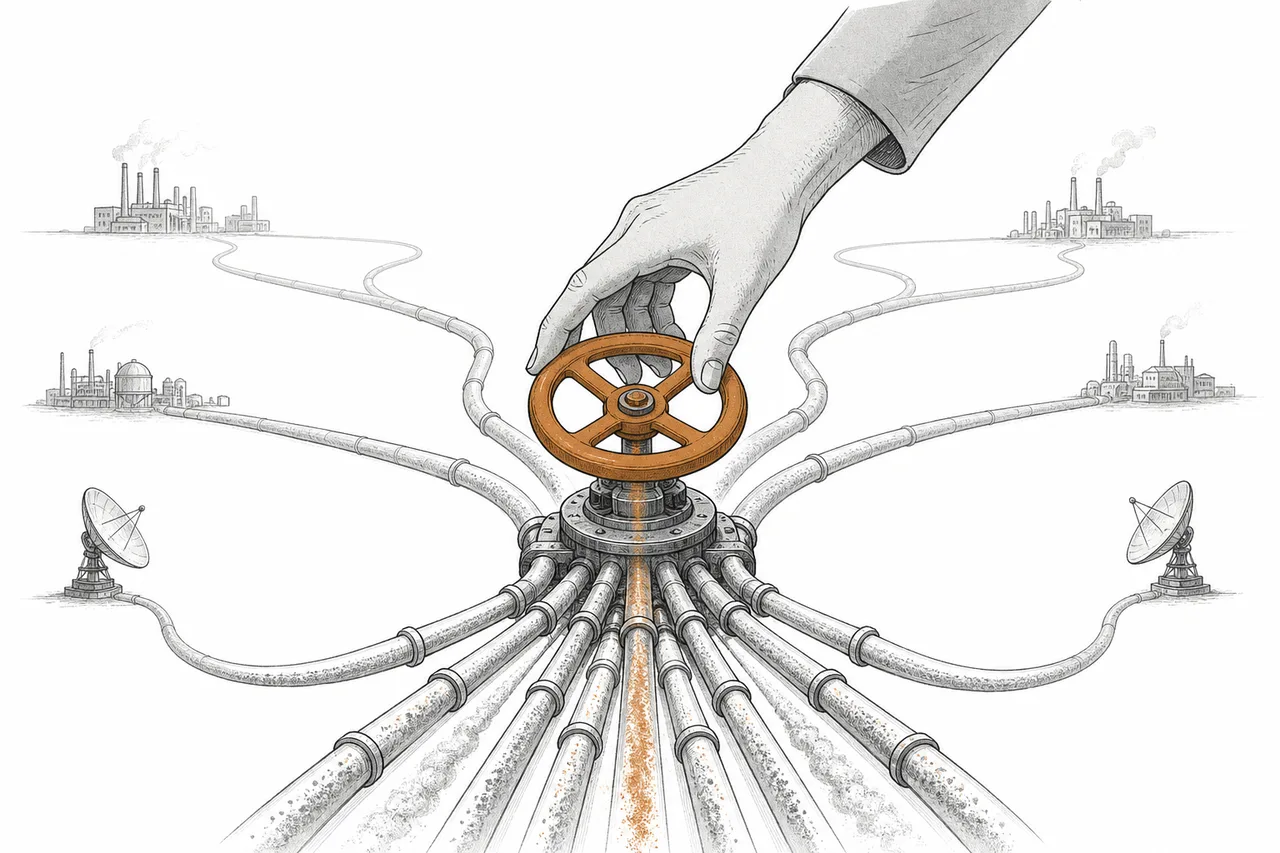
Because before there's a wafer, before there's a chemical, you first need the raw elements and ores — gallium, germanium, rare gases like neon, ultra-pure quartz sand, tungsten, antimony. They look dull, but they share a dangerous trait: many come from almost a single country or a single mine for the whole world. And the moment that someone decides to "shut the tap," the entire chip supply chain shakes.
A raw material that is (1) essential to a critical industry (chips, defense, energy) and (2) carries high supply risk — usually because it's concentrated in just a few countries. "Critical" doesn't always mean "scarce" in the earth's crust. There's plenty of gallium around; what makes it critical is that its refining and separation is concentrated almost entirely in China. This is a "who controls the refinery" risk, not a "is there enough in the ground" one.
On the megatrend map, this node is a sub-theme of Critical Materials & Supply Chain — sitting next to Rare Earths, copper, lithium, and uranium. It breaks into four sub-groups: silicon wafers/substrates, chemicals and photoresist, specialty gases, and compound semiconductors (GaN/SiC/GaAs) — but we won't treat it as a product catalog. We'll read it as a map of bottlenecks: which point is most fragile, and who holds the tap.
To make it concrete, the silicon wafer itself is a bottleneck — the whole world buys from just five makers (led by Japan's Shin-Etsu and SUMCO), who together control about 80% of the market (see → ?node=30070100).
02Why a handful of elements can shake the chip economy
Things got serious on July 3, 2023, when China announced export controls on gallium and germanium — two elements almost no one had heard of, yet the heart of high-frequency chips, radar, fiber optics, and thermal cameras. The reason it shook things so hard comes down to one thing: China controls almost the entire world.
China produces about 99% of the world's refined gallium and roughly 60% of refined germanium. When China started restricting, export volumes dropped immediately — Chinese gallium fell from 6,876 kg in July 2023 to just 227 kg by October, while germanium fell from 7,965 to 590 kg over the same window. Gallium prices jumped more than 68% within months.
That was only round one. At the end of 2024, China escalated to an outright "ban" on exporting gallium, germanium, and antimony directly to the US, and in February 2025 it added tungsten plus four more elements to the list. The dollar impact is clear: the USGS estimates the gallium and germanium bans alone could do about $3.4 billion of damage to the US economy, with nearly half hitting the semiconductor industry directly.
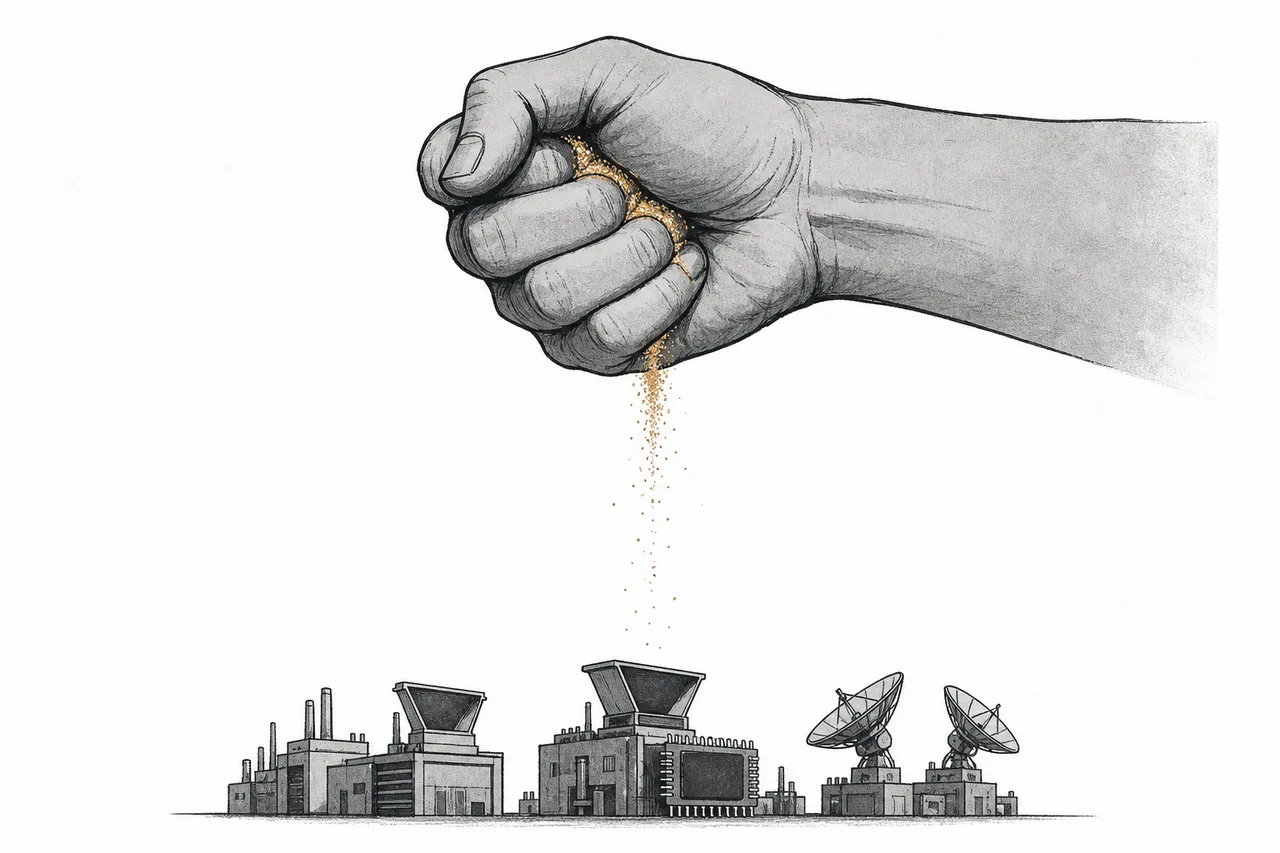
This is the core lesson of this node: the value of these elements isn't in their price per kilo, but in "can it stop a whole factory if it runs out". The world's entire annual gallium trade is worth only a few hundred million dollars — tiny next to the $600 billion chip market. But if it runs out, you can't make the GaN chips for radar and 5G base stations. That asymmetry is what makes it such a fine weapon.
03Four bottlenecks — how they work
The best way to understand this node is to walk through the four "entrances" that feed raw materials into chipmaking, and ask who controls each one. These four are also the node's four sub-groups — but we view them as four points where you can "turn down the tap".
Tap 1 — gallium & germanium (compound semiconductors): these two don't make ordinary silicon chips; they make compound chips that silicon does poorly — gallium combines with nitrogen (GaN) or arsenic (GaAs) into high-frequency chips that sit in phone power amplifiers, 5G base stations, radar, and electronic-warfare systems. Germanium is the heart of fiber optics, infrared lenses, and the thermal cameras in guided weapons — which is why China chose these two first: they touch both the economy and defense at once. This is the node's Compound-Semi Substrates (GaN/SiC/GaAs) sub-group.
Gallium and germanium barely have "mines of their own" — they're a by-product of aluminum smelting (gallium) and zinc smelting (germanium). That means whoever has the biggest aluminum/zinc smelters gets the gallium/germanium too. China dominates both kinds of smelting, so it automatically dominates these by-product metals — and that's exactly why the West can't simply "build new." You need the primary-metal smelter first.
Tap 2 — rare gases (neon): etching circuit patterns with light (lithography), DUV-style, needs lasers whose main ingredient is neon gas. And this is the bottleneck the world learned the hard way in 2022 — before the war, Ukraine produced about 50% of the world's purified neon (at times as high as 70%) through two main companies, Ingas (Mariupol) and Cryoin (Odesa). When Russia invaded, the Ingas plant was leveled and Cryoin halted production; neon prices spiked about 500% overnight. This is the Electronic & Specialty Gases sub-group.
Tap 3 — ultra-pure quartz: this is the bottleneck almost no one knows about — to "pull" silicon crystal into a round ingot, you have to melt the silicon in a crucible made of ultra-high-purity (HPQ) quartz. And most of the world's quartz at this grade comes from one tiny mine — Spruce Pine, in North Carolina. The Belgian company Sibelco controls roughly 70–90% of the HPQ market from that mine. If anything happens to this valley (like the 2024 hurricane), the whole world's wafer supply chain stumbles.
Tap 4 — electronics-grade silicon: silicon is abundant in the earth's crust, but only a few players can refine it to the "nine-nines" (99.9999999%) purity for wafers, and the feedstock (polysilicon, silicon metal) is also heavily concentrated in China. This is the Silicon Wafers & Substrates and Process Chemicals sub-group — the producer side is covered in Semiconductor Materials; here we focus on "who controls the raw upstream."
The chemicals/photoresist side isn't free of bottlenecks either — Japan holds over 95% of the most advanced EUV resist. In 2019, when Japan restricted exports of chip chemicals (including high-grade resist and HF) to Korea, it was the same "turn down the tap" move China made with gallium (see → ?node=30070200).
04Where it sits in Critical Materials
This node sits in the Critical Materials & Supply Chain family — the big trend about "things in the ground" the modern world can't do without. And it has some very similar-looking relatives:
- Its twin is Rare Earths: exactly the same story — China controls refining almost completely, then uses exports as a weapon. The only difference is the destination: rare earths go to "permanent magnets" (EV motors, wind turbines, missiles), while this node goes straight to "the chip itself." The two are two sides of the same geopolitical coin
- It feeds Semiconductor Materials & Specialty Chemicals one layer up: this node's raw elements are the "raw material of raw materials" — raw gallium becomes substrate, quartz becomes the wafer-pulling crucible, raw gas is refined into electronic gas. Once it reaches the actual chip plant, it becomes that node's story
- It feeds further up to Wafer-Fab Equipment and AI: ASML's DUV machines are worthless without neon gas, and the entire AI wave needs more chips = more of these raw elements. Demand flows back down to the deepest layer
- It's tightly entangled with Defense Sovereign Supply: this is what makes the node especially "hot" — gallium, germanium, antimony, and tungsten are all military materials (radar, thermal cameras, armor-piercing rounds). So export controls aren't just trade; they're national security in full
05Where it stands now
By the end of 2025, the story flipped again. After a new round of trade talks, China announced a "temporary suspension" of its bans on gallium, germanium, and antimony to the US — in effect through about November 27, 2026. It sounds like good news, but the key word is "temporary." The West has learned that this tap can be turned down at any moment, and lost trust doesn't come back easily. So the search for an exit hasn't stopped.
Price is the mirror of the tension. During the ban (August–December 2024), antimony prices jumped about 200% while shipments from China to the US fell 97%. Tungsten rose about 35% when China added it to the list in early 2025 (some special grades jumped over 40%). Stuff that used to be "boringly stable" became stuff whose price runs with political headlines.
The West is racing to build its own "backup taps." But the reality you have to accept is that it's slow and very expensive, because gallium/germanium are by-products — you need the primary-metal smelter first. A concrete example: Nyrstar (a European zinc-smelting group) announced about $150 million to build a gallium/germanium separation line at its zinc plant in Tennessee, while the US firm Indium Corporation refines and distributes to fabs and has price-floor deals to stop China from "dumping." But all of this is still a fraction of China's capacity, and it takes years.
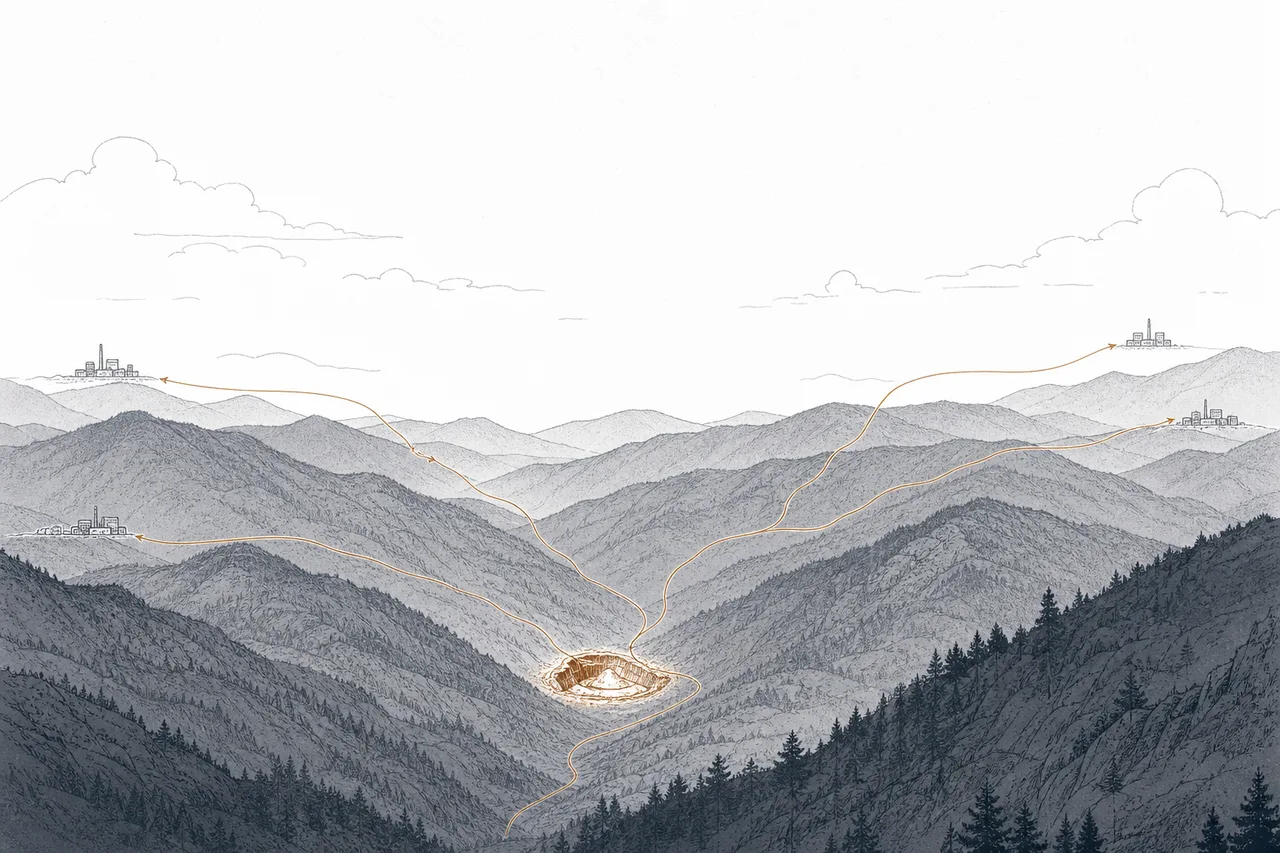
The quartz bottleneck is moving too — Sibelco announced about $200 million to double HPQ capacity at Spruce Pine after the 2024 storm warned the world how risky leaning on a single mine is. This is the picture of the era: everyone now knows where the bottlenecks are and is spending to spread the risk — but geography and chemistry won't let it happen fast.
06The road ahead
The first direction is the "friend-shoring" of raw elements. The US, Europe, Japan, and Korea will rush to build supply chains that don't run through China — by-product smelting (Ga/Ge), recycling from e-waste, finding backup quartz sources beyond Spruce Pine, and stockpiling strategic elements. But you have to understand the reality of by-product economics: if aluminum/zinc prices aren't attractive enough to build new smelters, getting gallium/germanium stays hard — so spreading the risk takes both state subsidies and years of time.
The second direction is demand growing from two sides at once — AI (more chips = more gas/wafers) and defense (GaN/germanium in radar and thermal systems). A more tense world only pushes up demand for elements that are both civilian and military materials, which makes the bottlenecks more important, not less.
The third direction is "stockpiling" becoming policy. With the 2023–2025 lesson hammering home that the tap can be turned down at any time, governments will hold more strategic-element reserves (like oil reserves), and chipmakers will hold thicker buffer stocks — shifting from a cost-focused "just-in-time" model to a security-focused "just-in-case," which pushes up costs across the whole chain.
07Challenges & risks
This is a node where "risk is the story" — not a footnote at the end of the chapter.
The first and most prominent risk is China's export controls. The late-2025 "temporary suspension" doesn't mean it's over — it just shut the tap and is waiting. Every time US–China tension returns, these elements are among the first cards China plays, because they hit a rival's economy and defense at once while China itself suffers little (small market, high leverage) — a risk that isn't going anywhere as long as refining stays concentrated in China.
The second risk is the single-source bottleneck that has nothing to do with politics — the one Spruce Pine quartz mine feeds almost all the world's wafer crucibles. When a hurricane hit the area in 2024, the whole industry held its breath. A natural disaster, accident, or labor problem at a single point can shake the chain — and building a new source of equal purity takes a decade.
The third risk is a war-driven gas supply shock. The 2022 Ukraine neon lesson is the real example — a critical material concentrated in a war zone or a risky region, then gone overnight. Even if the industry eventually adapts (finding new sources, recycling gas in the plant), the transition can bring disruption and cost spikes at any time.
In short: this node is the story of boring, cheap elements that suddenly become bargaining chips on the negotiating table between great powers. Gallium, germanium, neon, quartz — no one ever sees them in the phone or GPU they use. But if any one tap is turned down, those things can't be made. Understanding this layer fully means understanding why the deepest "things in the ground" are the most fragile spot of the chip era.