Megatrend · Defense & Geopolitical Fragmentation
When 'software' became the most expensive — and most profitable — weapon
For a hundred years, military power was measured in steel — ships, jets, tanks. But in modern war, what decides who wins is a 'digital brain' that pulls in data from thousands of sensors and tells a commander what to do in seconds. This is the story of an industry shifting its value from hardware to code — a high-margin, recurring-revenue business that investors around the world are watching.
01What it is
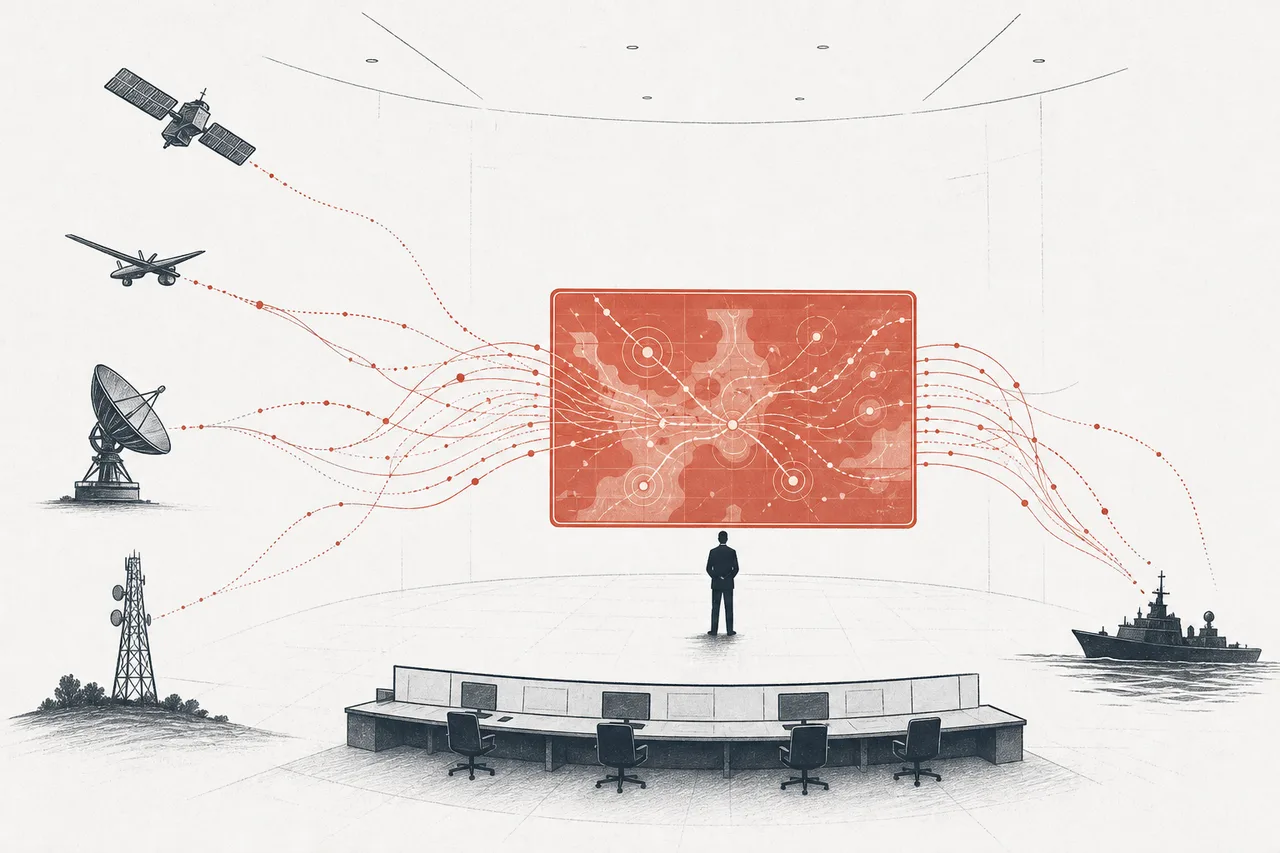
When we watch war on the news, we mostly see the big stuff — fighter jets, aircraft carriers, missiles. But there's another layer the cameras never catch, and it's what makes all of that 'smart.' It's the software that acts as the military's 'brain' — it takes in data from satellites, radar, drones, and thousands of sensors, then turns it into a single picture for a commander to decide on.
The field calls it by a scary-looking acronym: C4ISR. It sounds complex, but it's really just a list of the 'jobs' this brain does. Let's break them down one at a time:
C4 = Command, Control, Communications, Computers — the 'issuing and sending of orders' · ISR = Intelligence, Surveillance, Reconnaissance — the 'seeing and gathering of data.' Put together, it's the system that lets a military 'know what's happening' and then 'give orders instantly'. The heart of it isn't steel or guns — it's software that fuses data and helps people decide.
This node covers mission software that runs battle command, AI decision support (battle management) that helps prioritize what to do first, and the IT and cyber work for security agencies that has to clear high-level security vetting (cleared). What makes it interesting as a business is that it's long-term contracts, high margins, and recurring revenue — very different from selling a ship or a jet, which is a one-off.
On the megatrend map, Defense Software & C4ISR is a sub-theme under Defense & Geopolitical Fragmentation, and it's the 'application layer' — the top layer that makes all the hardware below it work together.
02Why it's a big deal
The story of this era fits in one line analysts love to use: 'software is eating defense'. For decades, the value of this industry sat with whoever could build the biggest, most advanced platform. But now the value is flowing to whoever can write the smartest software instead.
One reason is that the economics are simply better. Building a single warship takes years and gets stuck behind shipyards, steel, and labor — you can't scale it up fast. But software gets written once and copied to as many units as you want, so margins run sky-high. And once a military installs someone's system, swapping it out is brutally hard — it becomes 'recurring revenue' flowing in every year.
This margin gap is the heart of the whole story. A traditional defense IT contractor earns roughly 6–9% operating margin, which is good for a services business. But a modern mission-software company like Palantir posted (adjusted) margins of around 50% in 2025 — that's the difference pulling in enormous investment money.
And this isn't a small market. Globally, C4ISR was worth about $131B in 2024 and is expected to grow to roughly $191B by 2033. The US alone sits at about $58.6B in 2025 — and the fastest-growing slice of this pie is 'defense software,' pushed along by the lessons of the war in Ukraine and NATO's digital-overhaul goals.
03How it works (the digital brain)
The heart of C4ISR is solving a problem that sounds simple but is very hard: a military is drowning in data, yet 'can't see the whole picture'. A satellite sees one angle, a drone another, a ship's radar catches something else, the radio reports yet another way — all in systems that can't talk to each other. So the person deciding has to assemble the puzzle themselves, with only seconds on the clock.
C4ISR software acts as a 'central brain' that automates four steps: take in data from every sensor → fuse it (data fusion) into a single picture → let AI prioritize and offer options → send orders back out, with a human always making the final call.
What makes it a good business: sensors keep getting cheaper and anyone can make them, but very few can write software that fuses the data 'reliably and fast enough'. As AI gets better, value moves further from the sensors themselves toward the software layer in the middle — that's why defense-software companies hold far more bargaining power and higher margins than the hardware makers.
04Where it sits in the defense world
If defense hardware is the 'body,' this node is the 'nervous system and brain' that makes every part work in sync. Here's how it connects to its neighbors in the ecosystem:
- Sits on the hardware of the major US defense companies (primes): the jets, ships, and vehicles of Lockheed, Boeing, and General Dynamics all need mission software running inside. The interesting part is the fight now underway over whether the 'brain' belongs to the prime that owns the platform, or to an independent software company like Palantir
- Becomes the 'brain' for unmanned systems and drones: a swarm of drones only has value when software can command them to work together. That's why a company like Anduril builds both the drones and the command software on one platform
- Depends directly on AI: the 'decision support' capability comes from AI models that keep getting better — so the US Defense Department's AI budget flows straight into this node
- Inseparable from cybersecurity: the moment a military's 'brain' is software, it instantly becomes a target for cyberattack. So defending the system is part of this node too
05Where it stands now
The brightest star of this era is Palantir, the software company that became the symbol of the 'software eats defense' theme. For full-year 2025, total revenue hit $4.48B, up ~55%, with the government side (defense + security agencies) making up about 54% of revenue. And in Q4 2025, total revenue grew 70% year over year — a number that's very hard to find for a company this size.

A major push comes from the budget. In fiscal 2026, the US Defense Department set up a 'budget line' for AI and autonomous systems for the first time, totaling $13.4B. And the program to connect command across the services (CJADC2) is accelerating — the request jumps from ~$240M in 2026 to over $2B in 2027, with about $1.5B earmarked specifically to expand the use of Palantir's Maven Smart System.
Another player shaking up the field is Anduril, a private company that built a 'software-defined' model — instead of designing the hardware first and adding software later, it does the reverse: it builds a software platform called Lattice first, then plugs hardware into it. Its 2025 revenue was about $2.2B (doubling), and it just raised a new round at a $61B valuation in May 2026.
On the other side are the 'traditional defense IT contractors' like Leidos, Booz Allen, SAIC, and CACI, who've done the government's back-office work for decades. They're still huge and carry enormous backlogs (Leidos's backlog is about $49B), but they're under pressure to shift from 'selling people's hours' to 'selling software and platforms' at higher margins.
06The road ahead
The first direction is 'software-defined' becoming the standard. Instead of buying a whole new platform every time, many nations are starting to 'extend the life' of what they have through software upgrades — swapping mission systems and reworking sensor processing, all through code updates. This shifts revenue more and more from a 'one-time sale' to a 'continuous subscription.'
The second direction is AI moving from 'helping you see' to 'helping you decide'. In January 2026, the US Defense Department put out an AI strategy that launched several 'priority projects' — both AI-driven battle command and the use of generative AI across the whole organization. The job is to make the digital brain offer options fast and trustworthy enough that humans will actually rely on it.
The third direction is the fight between the 'platform owner' and the 'software owner'. The major defense companies don't want Palantir or Anduril to become the 'brain' that controls their hardware, while the software side wants to be the middle layer every platform has to depend on. This battle over 'who owns the brain' will decide where the value lands in the coming decade.
07Challenges & risks
This hot-looking theme has shadows you need to see in full.
The first risk is customer concentration. Over ~80% of Palantir's government revenue comes from the US government, and the big contracts are tied to budgets and politics. If policy shifts or budgets get cut, that 'stable'-looking revenue can wobble — and the huge long-term contracts also carry the risk of 'whether the revenue can actually be recognized on schedule.'
The second risk is a very expensive stock. The market valued Palantir at around $325B in mid-2026, a price-to-sales (P/S) ratio of roughly 65x — a level almost no company can match. With expectations set that high, even a slight slowdown in growth could trigger a sharp correction.

The third risk is competition and trust. This field is getting crowded — primes want to reclaim the software layer, new private companies keep popping up, and general big tech is starting to eye defense work. At the same time, letting AI help decide life-and-death matters raises intense questions of ethics and governance, along with the issue of data sovereignty — how far many countries are willing to entrust their military's 'brain' to a foreign company.
In short: this node is the lesson that modern war is decided by 'who knows and decides faster,' not who has more steel. And that has moved enormous value from hardware factories to invisible lines of code — making it one of the hottest, and most expensively priced, investment themes of the era.