Megatrend · Defense & Geopolitical Fragmentation
When a drone that costs as much as a motorcycle kills a tank that costs as much as a house
The war in Ukraine just proved something that shook the entire defense world: lots of cheap, "expendable" things are beating the few expensive ones — and as the economics of the battlefield flip upside down, defense budgets are starting to flow a new way. This is the story of unmanned weapons, the chase to shoot down cheap drones, and the upstart companies taking on the industry's old giants.

01What is it?
When we picture a modern military, we tend to picture fighter jets worth billions, or warships that take a decade to build. These things are genuinely great — and genuinely expensive. But they have an "economic weakness" that just got exposed: there are too few of them to lose. This node is the story of the other side — unmanned weapons cheap enough to be "expendable" in large numbers, and the technology to "hunt" those weapons down.
It splits into two intertwined worlds, which are the two sub-branches of this node:
- Loitering Munitions & Combat UAS (the attacking unmanned weapons): drones and "loitering munitions" that fly themselves, costing anywhere from a few hundred to a few hundred thousand dollars and made in large numbers — including "wingman drones" that fly alongside crewed aircraft (collaborative combat aircraft)
- Counter-UAS / Counter-Drone (the anti-drone systems): sensors, radar, jamming, and interceptors whose job is to "detect–track–stop" the other side's drone swarms
Attritable = "losable" — cheap enough that you can let it be destroyed without it hurting much, the opposite of an exquisite platform (a top-tier, expensive thing you cannot afford to lose) · Mass = "in large numbers." The idea of attritable mass is to win on quantity, not on the brilliance of a single piece · Loitering munition = an unmanned aircraft that can "loiter" over a target area for a while before it acts — half drone, half munition.
On the megatrend map, Autonomous Systems & Counter-Drone sits under Defense & Geopolitical Fragmentation, and it's the fastest-changing part of the defense industry in 2026. Important note: this is the "military" angle on drones. Civilian drones (agriculture, photography, delivery) live in a different node, Civil Drones & UAV — the base technology is similar, but the markets, players, and rules are completely different.
02Why it became a big deal
For decades, top militaries followed one formula: build the best weapon, even if it's expensive and you only have a few. A few hundred cutting-edge fighters could beat a weaker opponent. But the war in Ukraine, from 2022 on, revealed a truth that shook the textbook: when the other side has millions of cheap things, "best" may matter less than "most".
The number that tells this story best: Ukraine produces FPV drones (first-person-view drones costing a few hundred dollars each) at a rate of roughly 200,000 a month, aiming for several million a year — and at that scale, the battlefield shifts from "a clash of expensive platforms" to "a war of whichever factory can crank out cheap things faster."
The Pentagon has seen it, and responded with money that marks the change of an era. In its 2027 budget request, the US proposed allocating about $75 billion to drones and counter-drone systems, with a new organization called the Defense Autonomous Warfare Group (DAWG) getting the biggest share — jumping from just ~$226 million in 2026 to $54.6 billion in the 2027 request. A jump like that almost never happens in a defense budget, and it's the signal that "lots of cheap things" has been written into the doctrine for real.
Before DAWG, the Pentagon ran a pilot program called Replicator (launched in 2023) that aimed to deliver "thousands" of unmanned systems by mid-2025, starting at $300 million in 2024 and rising to about $500 million a year — but it actually delivered only "hundreds," and was folded into DAWG in late 2025. The lesson of Replicator: the will was there, but old-style procurement still couldn't keep up with the speed of war — exactly the problem the big 2027 budget is trying to fix.
And this is a market growing on both sides. The global military drone market sits at roughly $20 billion in 2026, and many research firms expect it to grow toward $40–66 billion around 2035. The "counter-drone" (counter-UAS) market is growing even faster — from about $6.6 billion in 2025 to roughly $20 billion in 2030, at a high average growth rate of ~25% a year.
03The economics flipped upside down
The heart of this node isn't the technical side of the weapons — it's the "cost equation" that just flipped over. Understand this equation and you understand why the whole industry is shaking.
Traditionally, militaries invested in "exquisite platforms" — expensive, crewed, few in number, but very capable. That model worked as long as the enemy played the same game. The problem is that cheap drones changed the rules. In Ukraine, an FPV drone costing about $400 has destroyed tanks worth millions of dollars over and over — a cost ratio worse than 4,000 to 1. And once cheap things number in the millions, the math clearly favors the "more" side.
The flip side of this equation is that the defending side falls into the same cost trap — using an expensive interceptor to shoot down a drone worth a few hundred dollars is "winning the battle but losing the cost war." So the question isn't "can you hit it," it's "is hitting it worth it." (The economics of the "shield" and how to solve it are explored in depth in Counter-UAS / Counter-Drone.)
The solution is to "solve the equation in reverse" — make the defender's cost per shot drop close to the cheap thing flying in, which is the new money-making field for the entire counter-drone side.
04How it connects in the ecosystem
This node is a "platform layer" that sits on top of several technologies and sends ripples across the whole defense system:
- Relies on AI at its core: what truly makes a drone "autonomous" is the AI brain that navigates, decides, and keeps working even when its signal is jammed — the heavier the jamming on the battlefield, the more it matters that it can fly itself without a human operator
- Paired with Defense Software & C4ISR: a drone is just a "body" — the "nervous system" that fuses sensor data from across the battlefield into a single picture and gives orders is the command software. This is where Palantir and Anduril come in
- Relies on key raw materials: a drone's motors, batteries, and magnets need rare earths, whose supply chain China controls — even making "lots of cheap things" still hits the same raw-material bottleneck as the whole industry
- Challenges the US defense primes: this is the most dramatic part — upstarts making lots of cheap things with software are taking on the old giants who are good at expensive things one at a time (more on this in the next section)
- Close to but not overlapping civilian drones: much of the base technology is shared, but the military side differs on durability, autonomy, and operating under jamming — and some companies cross between the two markets
05Where it stands now
The biggest story of this period is the rise of new players that don't come from a traditional defense background, led by Anduril, the private company that's become the symbol of the era. In mid-2026 it raised another $5 billion, pushing its valuation to $61 billion (double the ~$30.5 billion a year earlier), while 2025 revenue more than doubled to ~$2.2 billion.
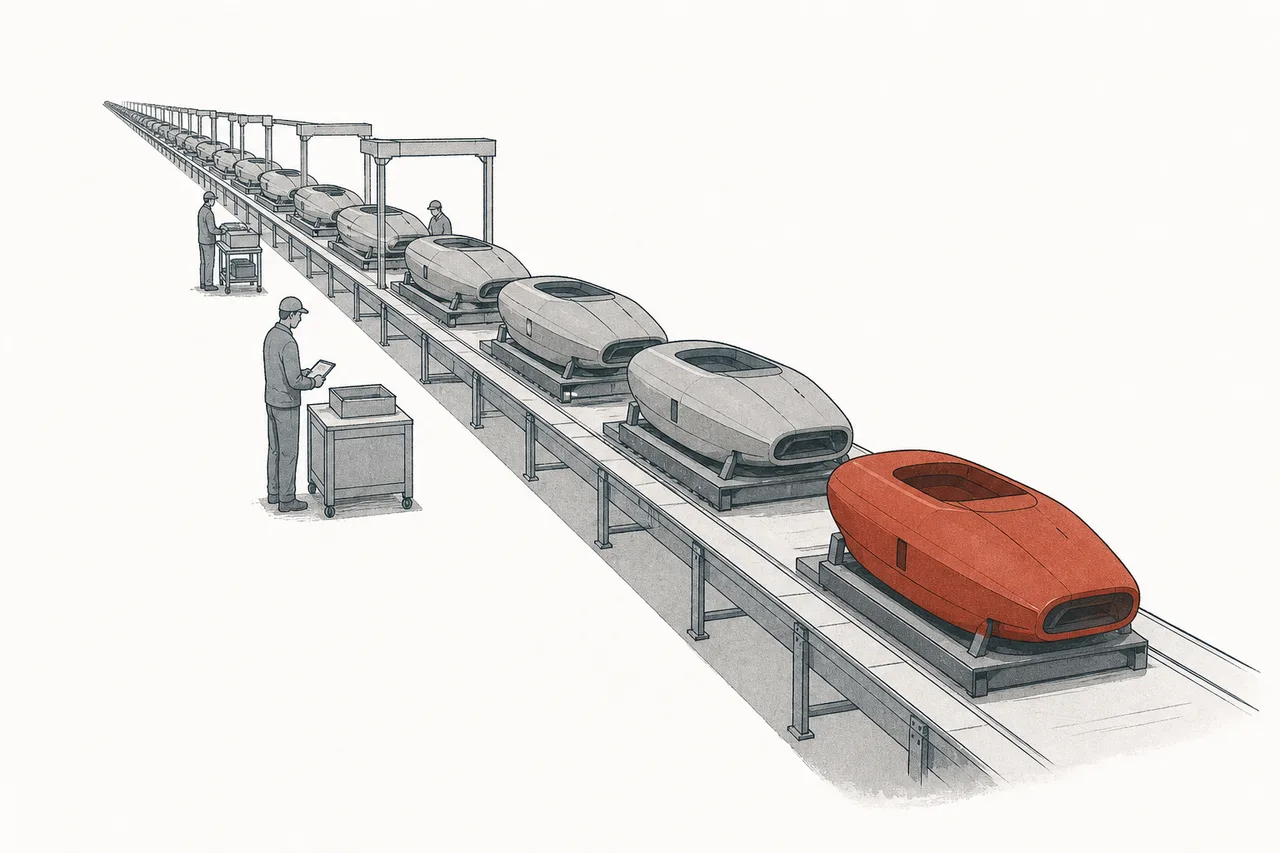
What makes Anduril interesting isn't just the numbers — it's its car-factory way of thinking. The ~$900 million Arsenal-1 factory is designed to build unmanned weapons with mass-production logic. The most-talked-about example is the low-cost Barracuda cruise missile, designed to be assembled in just ~30 hours with only 10 common hand tools — versus traditional weapons that use special parts and take far longer. This is the heart of "lots of cheap things."
The publicly listed companies are flooring it too. AeroVironment (AVAV), maker of the Switchblade — a loitering munition that's been through real combat — booked ~$821 million in FY2025 revenue with a Switchblade backlog of about $1.1 billion, and is expanding its factory to double output. Meanwhile Kratos (KTOS), a specialist in target drones and low-cost combat drones, booked ~$1,347 million in 2025 revenue and guided to ~$1,700–1,760 million for 2026.
Another hot field is the "brain of the drone." Palantir (PLTR) has expanded its Maven Smart System, which uses AI to help process battlefield imagery, with the contract ceiling climbing to about $1.3 billion through 2029, plus an enterprise deal with the Army that could be worth up to $10 billion over a decade. Meanwhile Shield AI (private), maker of the Hivemind autonomous-pilot software, rose to a ~$12.7 billion valuation in 2026 — Hivemind is being tested on both its own drones and other companies', a sign that "autonomy software" may sell like a platform.
And don't overlook the "shield" side — the defending side has players you can actually invest in too. DroneShield (DRO), an Australian pure-play counter-drone company, saw 2025 revenue jump about 276%; RTX owns the Coyote system; and Lockheed Martin leads with the HELIOS laser — the defensive field is growing as fast as the offensive one (deep dive in Counter-UAS / Counter-Drone).
06The road ahead
The first direction is "wingman drones" (collaborative combat aircraft) — instead of one expensive fighter, air forces are developing cheaper autonomous drones that fly alongside crewed aircraft, adding "numbers" without adding pilots. In 2025, prototypes from General Atomics and Anduril began test flights, and the US Air Force picked several developers for the next round — this is the arena where "old giants" and "new players" compete head to head.
The second direction is solving the defender's cost equation. When you can't afford expensive interceptors, the answer is directed-energy weapons (lasers/microwaves) with very low cost per shot, jamming that doesn't fire anything at all, and cheap interceptors that can be mass-produced — the counter-UAS market growing ~25% a year reflects that this is the hottest money-making field right now.
The third direction is the race to "make it fast and cheap". The lesson from Replicator is that the will was there but the old procurement system couldn't keep up. So the future is about who can speed up their production and procurement processes — and this is why companies that think like a car factory (mass production, fast software updates) have a chance to overtake incumbents who are good at big, long projects.
07Challenges & risks
This trend looks hot, but it has shadows you have to see in full.
The first risk is "the gap between budget and the real thing". The budget that jumps enormously in 2027 looks great on paper, but the lesson from Replicator warns that money doesn't always turn into the promised quantity on the promised schedule — procurement, testing, and certification are still real bottlenecks. The speed of "turning budget into hardware" is what to watch.
The second risk is new players vs. incumbents. From an investing angle, the big question is who wins — challengers like Anduril/Shield AI are still private companies with sky-high valuations that have yet to prove long-term profit, while the old giants are adapting and have deep ties to the Defense Department. The outcome isn't clear, and the fast-rising valuations on the private side carry the risk of expectations set very high.
The third risk is the ethics and regulation of autonomy. The more a system can "decide for itself," the heavier the questions about human control, international law, and accountability. Many funds already have policies against investing in weapons, and the autonomy issue could narrow this group's investor base and make it swing with the policy mood.
In short: this node is a lesson that sometimes what changes a war isn't the best weapon, but the one that's "cheap enough to have in large numbers." The world just discovered this in Ukraine, and it has ignited the biggest budget shift and competition the defense industry has seen in decades.