Megatrend · Semiconductors
The most important factory in the world — whose logo you've never seen
The chips in your phone, your car and the AI you use are mostly designed by one company but 'actually made' by another you may never have heard of. A foundry is the chip contract-manufacturing business that became the bottleneck of the entire global economy — and it's held almost entirely by a single company.
01What is a foundry
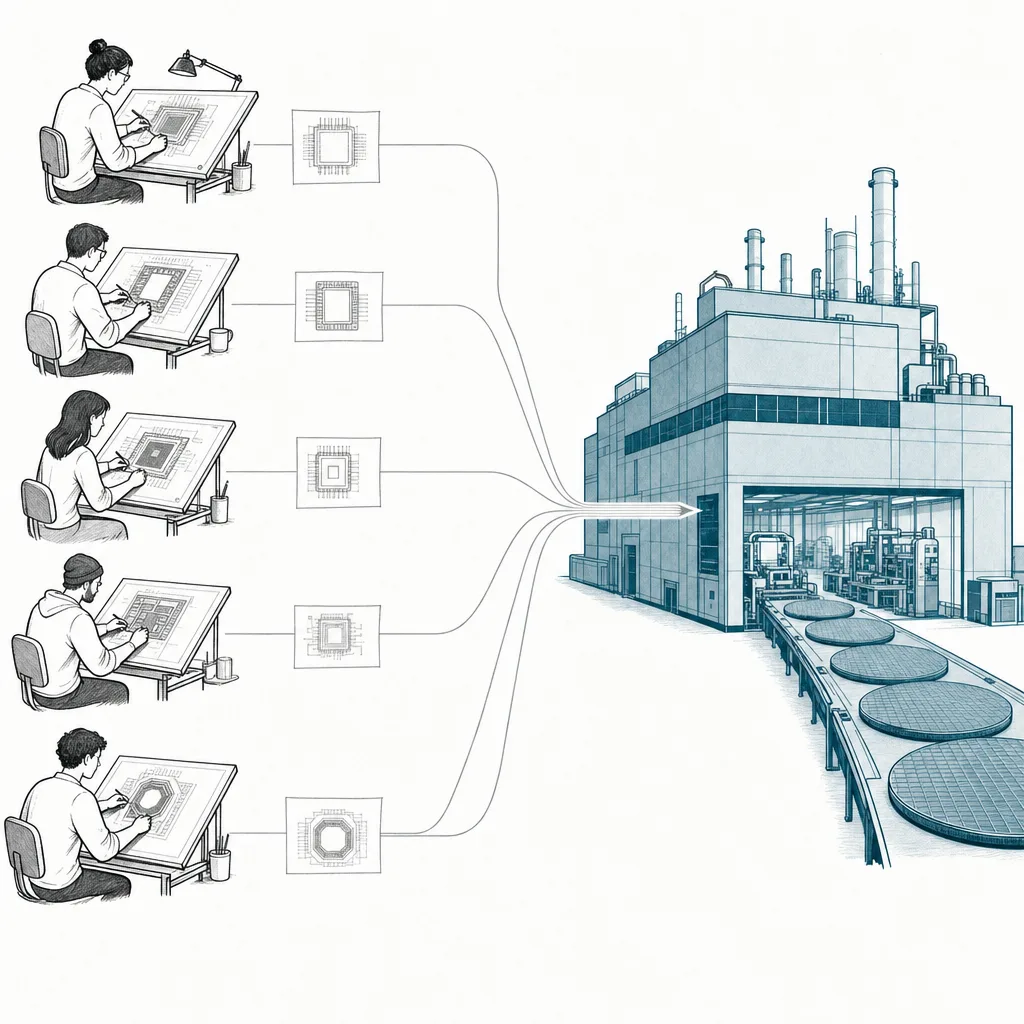
Think of NVIDIA, a company worth trillions from selling AI chips — but here's what many people don't know: NVIDIA doesn't own a single chip factory. Neither does Apple, or AMD, or Qualcomm. They design the chip, then send the 'blueprint' to another company to build it. That contract manufacturer is the foundry.
A foundry is a 'chip foundry' — a factory that doesn't design its own chips but builds them to order, exactly to the customer's design. Put simply: if the chip-design company is the 'architect,' the foundry is the 'general contractor' with the machines and expertise to actually build it — and only a few contractors in the world can truly build the most advanced stuff.
Fabless = a company that designs chips but owns no factory (NVIDIA, Apple, AMD, Qualcomm) · Foundry = a company that contract-manufactures for others (TSMC, GlobalFoundries) · IDM (Integrated Device Manufacturer) = a company that does both design and manufacturing itself (Intel, Samsung). But today even IDMs are starting to outsource to foundries or open up contract manufacturing of their own.
On our megatrend map, foundry is a sub-branch under Semiconductors, and it's the deepest 'infrastructure layer' — because no matter how brilliantly a chip is designed, in the end someone has to manufacture it into a real product.
02Why it's the world's bottleneck
The reason is that this business is alarmingly concentrated in one company's hands. A Taiwanese company called TSMC (Taiwan Semiconductor Manufacturing Company) holds roughly 70% of the global foundry market — and for the most advanced chips only (7 nanometers and below, the heart of AI chips and flagship phones), TSMC makes more than 90% of the world's supply.
This concentration means that if the foundry stumbles, the whole world stumbles with it. During COVID we saw that a mere chip shortage forced car factories around the world to halt their production lines. The stakes are even higher now, because the entire AI revolution — every NVIDIA chip powering ChatGPT and the data centers — is made almost entirely by TSMC in Taiwan. You could say the foundry is the tap that can turn the AI era on and off.
And it's a big, fast-growing market. The global foundry market sits at around $163 billion in 2025 and is expected to grow to about $508 billion by 2035 (about 12% annual growth), driven mainly by AI-chip demand that shows no sign of slowing.
03How it works (the fabless model)
The heart of this industry is 'separating design from manufacturing', a revolution that happened when TSMC invented this model in the 1980s. Before that, anyone who wanted to make chips needed their own factory — enormously expensive. TSMC offered a new option: 'You design, we manufacture, and we promise never to compete with you on products.' That model unlocked the door for anyone with a good idea to design chips without investing tens of billions in a factory.
So why can only a few do it? Because it's the hardest thing humans have ever made. Building billions of transistors a few nanometers wide (smaller than a virus) onto a silicon wafer so that every one of them works takes a factory thousands of times cleaner than an operating room, and the most expensive machines on earth.
A 'nanometer (nm)' is the unit that measures how advanced a chip is — the smaller the number (e.g. 2nm), the smaller the transistors and the more densely you can pack them, making the chip faster and more power-efficient. Making the most advanced ones requires an EUV (Extreme Ultraviolet lithography) machine, which prints circuit patterns with a special wavelength of light. Only one company in the world can build it — ASML of the Netherlands — at over $200 million per machine. That's why China, barred from buying EUV, struggles to make the most advanced chips.
04How it connects in the ecosystem
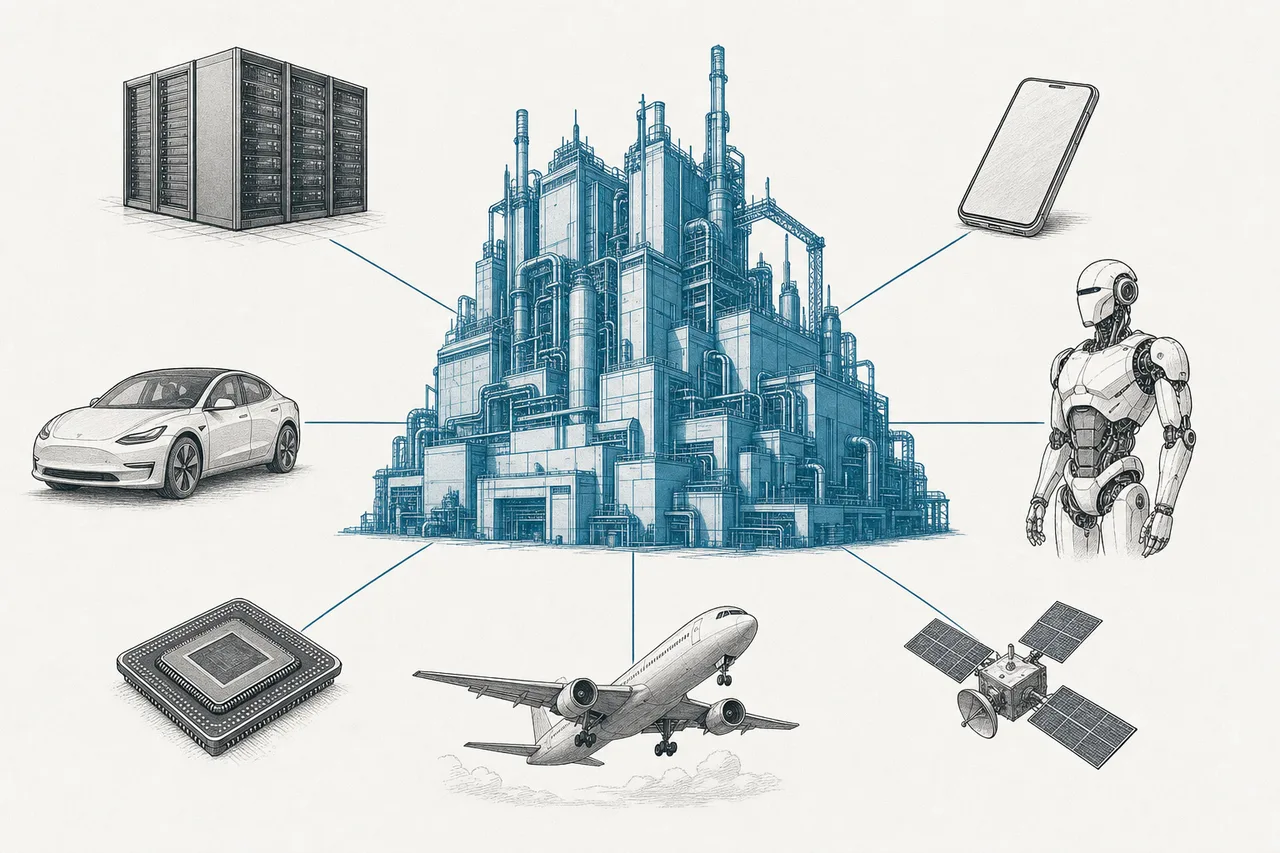
Foundry is the central point where everything in the chip world converges. It takes in 'raw materials' from upstream and ships the 'heart' out to almost every technology trend downstream:
- Feeds AI directly: this is the hottest relationship of all. The entire AI boom is the foundry boom — every NVIDIA chip is a TSMC order. Today HPC/AI work is TSMC's main growth engine (North American customers make up ~75% of revenue).
- Depends on its siblings within Semiconductors: a foundry can't manufacture without the machines from the Wafer-Fab Equipment branch (ASML, AMAT, Lam) and must 'package' the chips using technology from the Advanced Packaging/OSAT branch — especially CoWoS, used to join AI chips with HBM memory (now a new bottleneck).
- Opens the way for Cloud, electric vehicles, robots and Quantum: all of these trends need chips. The more digital the world becomes, the more demand flows back to the foundry.
- Relies on critical raw materials: from ultra-pure silicon to rare gases and chemicals — which makes the foundry sensitive to strains in the global supply chain.
05Where it stands now
2025 was a banner year for the top foundry. Riding the wave of surging AI demand, TSMC's revenue broke ~$115 billion (up ~26% year over year). At the same time the technology battlefield grew fiercer than it had in years — the '2-nanometer war'.
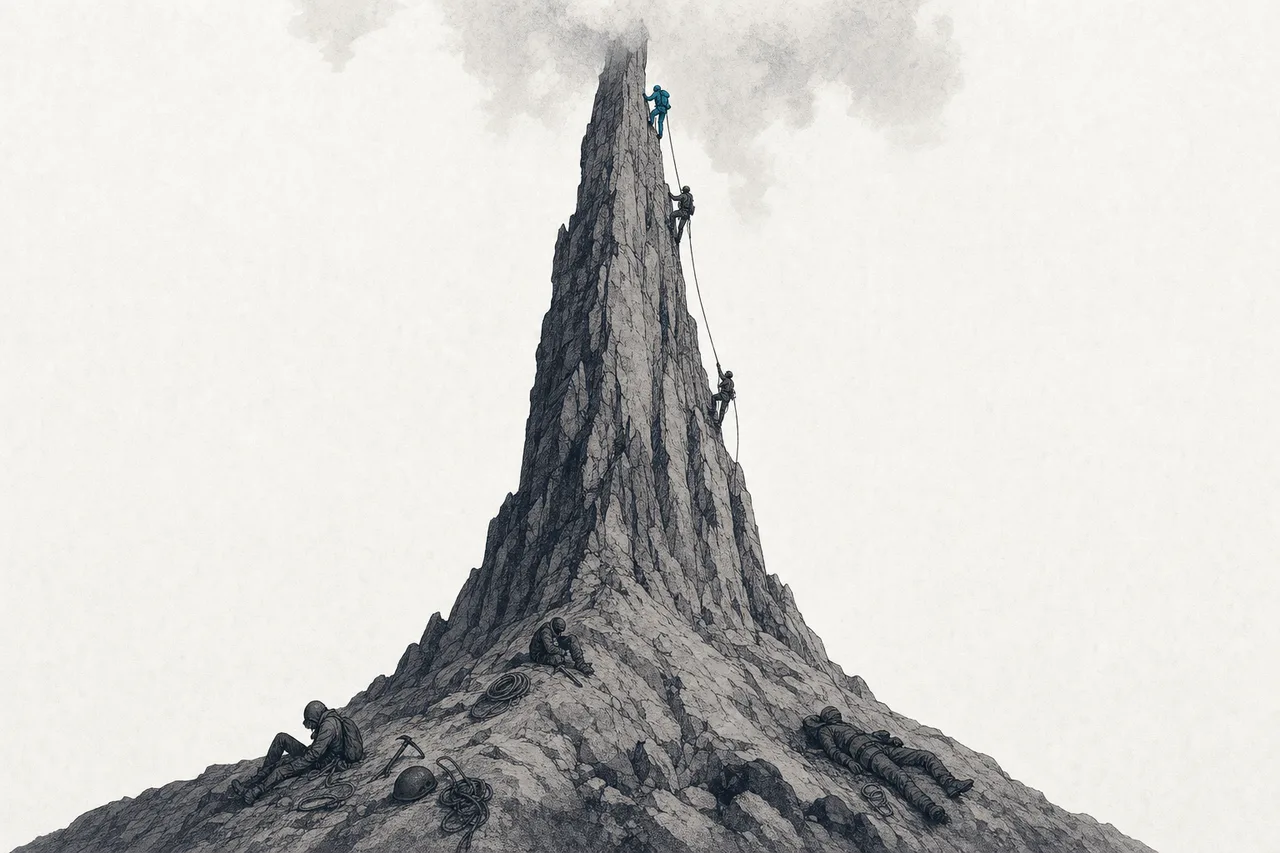
Reaching the 2nm node first and getting yield (the share of good chips per wafer) high is what decides who wins the next generation of AI-chip customers. And right now the gap between the leader and the followers is stark:
The other side is the story of enormous investment. For 2026 TSMC has set a record capital budget (capex) of $52–56 billion, most of it poured into the most advanced nodes and into expanding factories to the US (Arizona), Japan and Germany. There's also a new bottleneck called CoWoS — AI-chip packaging technology that TSMC is racing to scale from ~75,000 to 120,000+ wafers/month by the end of 2026 to fill NVIDIA's orders.
On the Chinese side, SMIC is making a remarkable push, managing to produce 7nm chips even though it's banned from buying EUV machines (using older DUV techniques in multiple repeated passes instead). But it pays for that with low yield (around 20–40%) and high costs, which limits how far it can expand capacity.
06The road ahead
The first direction is clear: AI demand will keep the foundry growing for years to come. TSMC's $50 billion-plus annual investment is a bet that AI-chip demand will last to the end of the decade. And the battlefield is shifting from 'who can make the smallest transistor' to 'who can best package chips together' (advanced packaging like CoWoS), which has become the new bottleneck and the new profit arena.
The second direction is spreading factories out from Taiwan. Backed by the US (the CHIPS Act), Japan and Germany, TSMC is building factories across several continents. Its Arizona plant has been making 4nm chips since early 2025. This will gradually redraw the world's risk map — but slowly, and expensively.
The third direction is the West's and China's attempts to claw it back. Intel is betting its comeback on the 18A and 14A nodes, while China is pouring in vast sums to achieve self-reliance. However it turns out, this is the competition that will set the world's balance of technological power for decades.
07Challenges & risks
The appeal of foundry comes with risks big enough to change the fate of the world.
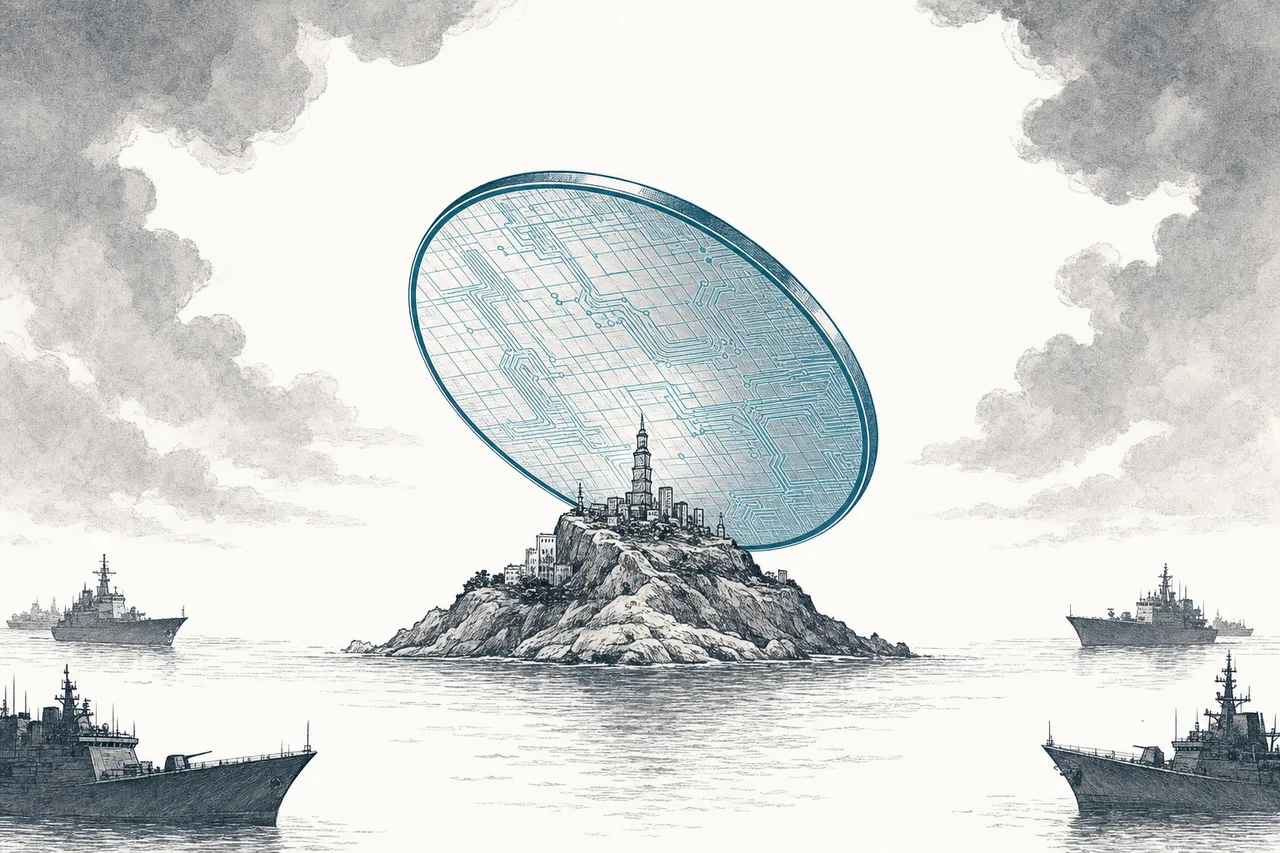
The first and biggest risk is geopolitical concentration. With almost all of the world's most advanced chips made on a single island (Taiwan), at the center of China–US tensions, it becomes 'the one point that, if it fails, takes the whole system down.' Analysts call the way this importance protects Taiwan a 'silicon shield' — but the shield is double-edged, because it makes Taiwan a target too.
The second risk is costs so high they create a natural monopoly. A single most-advanced-node factory costs $20–40 billion to build, and R&D per node keeps rising, until today only 2–3 companies in the world (TSMC, Samsung, Intel) can compete at the cutting edge. As the field narrows, the risk of one company dominating it entirely only grows.
The third risk is on the other side of the market — a price war in older nodes (mature node). China is pouring money into building many mature-node factories, creating a capacity glut. Utilization in this segment fell to ~70% in 2024, and profits of mature-node makers (except TSMC/Samsung) dropped by 23% — heavy pressure for players like UMC and GlobalFoundries.
In short: the foundry is the quietest yet most important heart of the digital economy. It's a story of the most astonishing engineering humans have achieved, mixed with a power game among the world's great nations — to truly understand the foundry is to understand why 'chips' have become a word on the negotiating tables of national leaders, not just in the lab.