Megatrend · Whole-trend overview
The map of the most important industry in the world
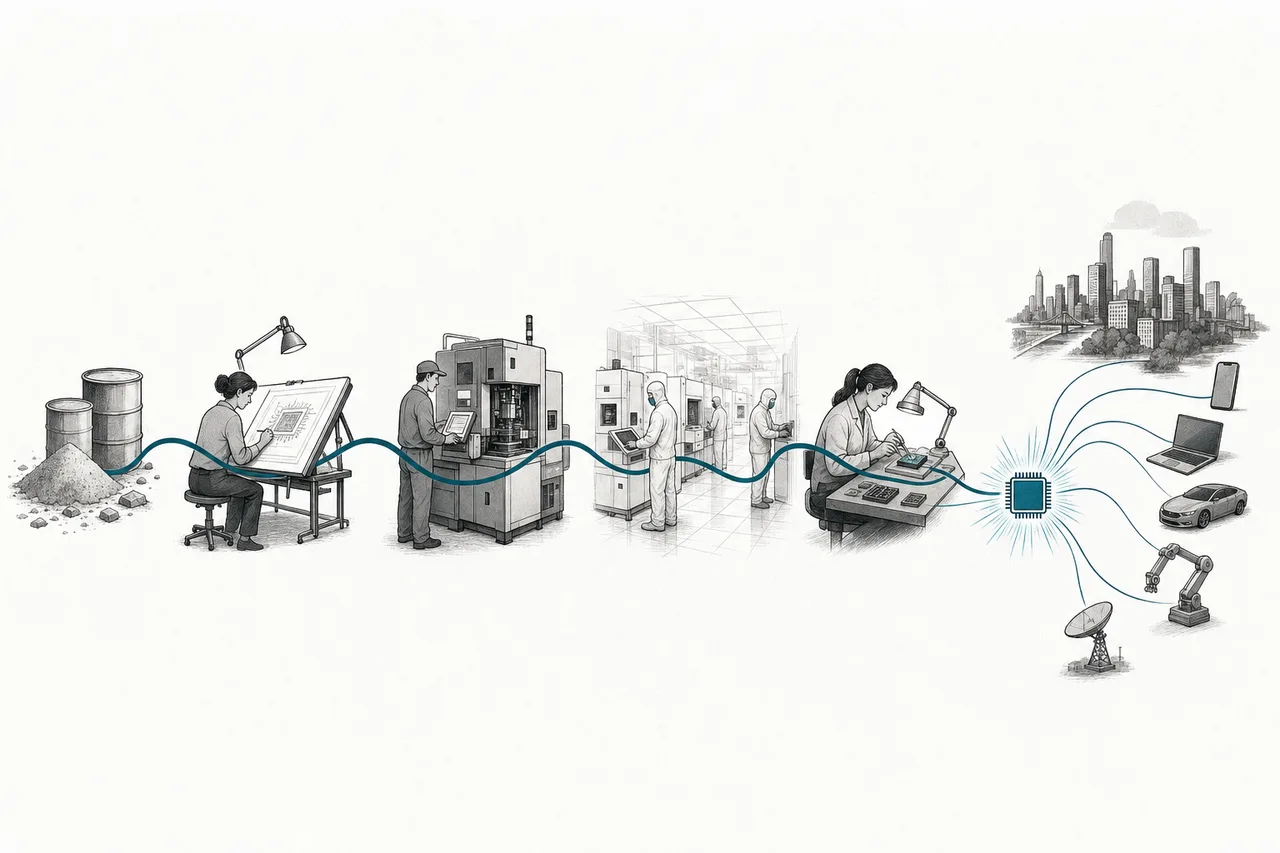
No chips, no AI, no smartphones, no EVs — nothing in the digital age works without them. But 'making a single chip' isn't done by one company. It's a long relay, handing the work off across dozens of specialists. This lesson is the map that strings the industry's 9 categories together — who does what, how they connect, and where the real power sits (each category has its own deep-dive lesson to read).
01The big picture: why chips are the heart of everything
Look around you right now — your phone, computer, car, appliances. They all work because of the tiny chips inside. And behind the AI wave reshaping the world? Chips again. So semiconductors aren't just 'another industry' — they're the foundation everything in the digital age sits on.
And the scale is surging. The global semiconductor market sat at about $627B in 2024, and many forecasters expect it to cross $1 trillion by 2030, driven mainly by AI — the AI-chip market alone is expected to grow from $53B (2024) to nearly $300B (2030).
But what makes this industry special isn't just its size — it's the complexity of the division of labor. No single company makes a chip end to end. It takes dozens of specialists, each one extremely good at just their own step. And that's the map we'll spread out for you in this lesson.
02The map: what are the 9 categories?
The semiconductor industry splits into 9 categories, which group into 4 'gates' in the order the work flows — each category has its own deep-dive (click in to read):
Gate 1 — Design
- EDA & Semiconductor IP: the software and 'ready-made blueprints' used to design chips — the tools everyone has to use (the US dominates this market almost completely)
- Logic, Compute & Processors: the 'brain' chips that do the computing, like NVIDIA's GPUs and CPUs — the heart of compute
- Analog, Power & Discrete: chips that handle real-world signals and electricity (sound, light, power) — unglamorous but indispensable
Gate 2 — Equipment and materials (Inputs)
- Wafer-Fab Equipment & Lithography: the machines that build chips — including ASML's EUV machine, the most expensive tool there is and the only one of its kind in the world
- Materials & Specialty Chemicals: the silicon wafers, gases and specialty chemicals fed into the fab
Gate 3 — Manufacture
- Foundry & Contract Fabrication 📘: fabs that manufacture chips on contract to others' designs (TSMC rules the world) — deep-dive available
- Memory — DRAM, NAND & HBM 📘: memory, including HBM, the star of the AI era — deep-dive available
Gate 4 — Assembly and interconnect (Assembly)
- Advanced Packaging & Test (OSAT): assembling and testing chips after fabrication — including CoWoS, which packs AI chips and HBM together (the new bottleneck)
- Interconnect & Passive Components 📘: the tiny parts and circuit boards that surround a chip — deep-dive available
03How it all connects (value chain)
What makes this industry remarkable is the handoff, step by step — design work flows to the fab, the fab depends on equipment and materials, finished chips go to assembly, and then out into real devices. Here's the overall flow:
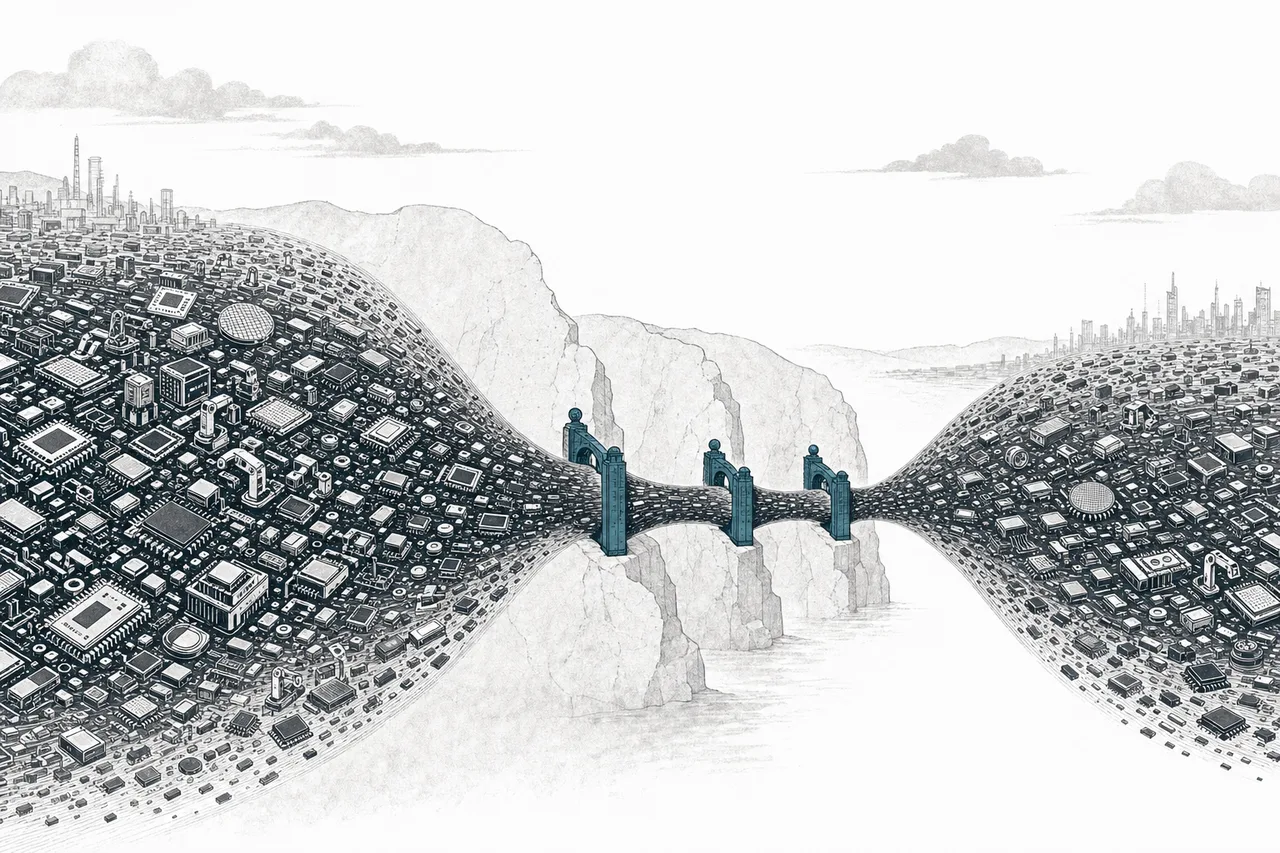
The most interesting part is the 'bottlenecks' — some steps have so few players that they become a single point the whole world depends on. Like the EUV machine only ASML can make, the most advanced fabs that TSMC almost completely controls, and the design software (EDA) the US has a lock on. If any one of these stumbles, the whole chain shakes.
04Where value and power sit
The key rule of this industry: value and profit pool at the 'bottlenecks'. The steps with the fewest players and the highest difficulty have the most pricing power and the fattest margins. The steps anyone can do (commodities) have to fight a price war.
This explains why companies like ASML (the world's only EUV-machine maker), TSMC (the most advanced foundry) and NVIDIA (AI-chip design) carry such enormous market caps — they stand on bottlenecks almost nobody can replace. Meanwhile, makers of commodity chips or generic components face a price war (especially against supply from China).
The lesson for reading this trend: don't just ask 'is this company in the chip business' — ask 'does it stand on a bottleneck, or is it in the price-war zone'.
05The forces that move the whole trend
Even though each category differs, three big forces hit the whole industry at once:
1. The AI wave — this is the biggest force. AI demand is 'lifting the whole board,' from processor chips to HBM memory to equipment and packaging. Every category is turning to ride this wave at the same time — a huge opportunity and a concentration risk both (if AI slows, the whole board shakes). The AI-chip market alone is growing in leaps:

2. Geopolitics — chips have become an economic 'weapon.' The US uses its grip on the bottlenecks (equipment + EDA) to ban exports to China, every country is racing to bring manufacturing back home (the CHIPS Act), and Taiwan — the center of the most advanced manufacturing — has become the single most fragile point in the global chain.
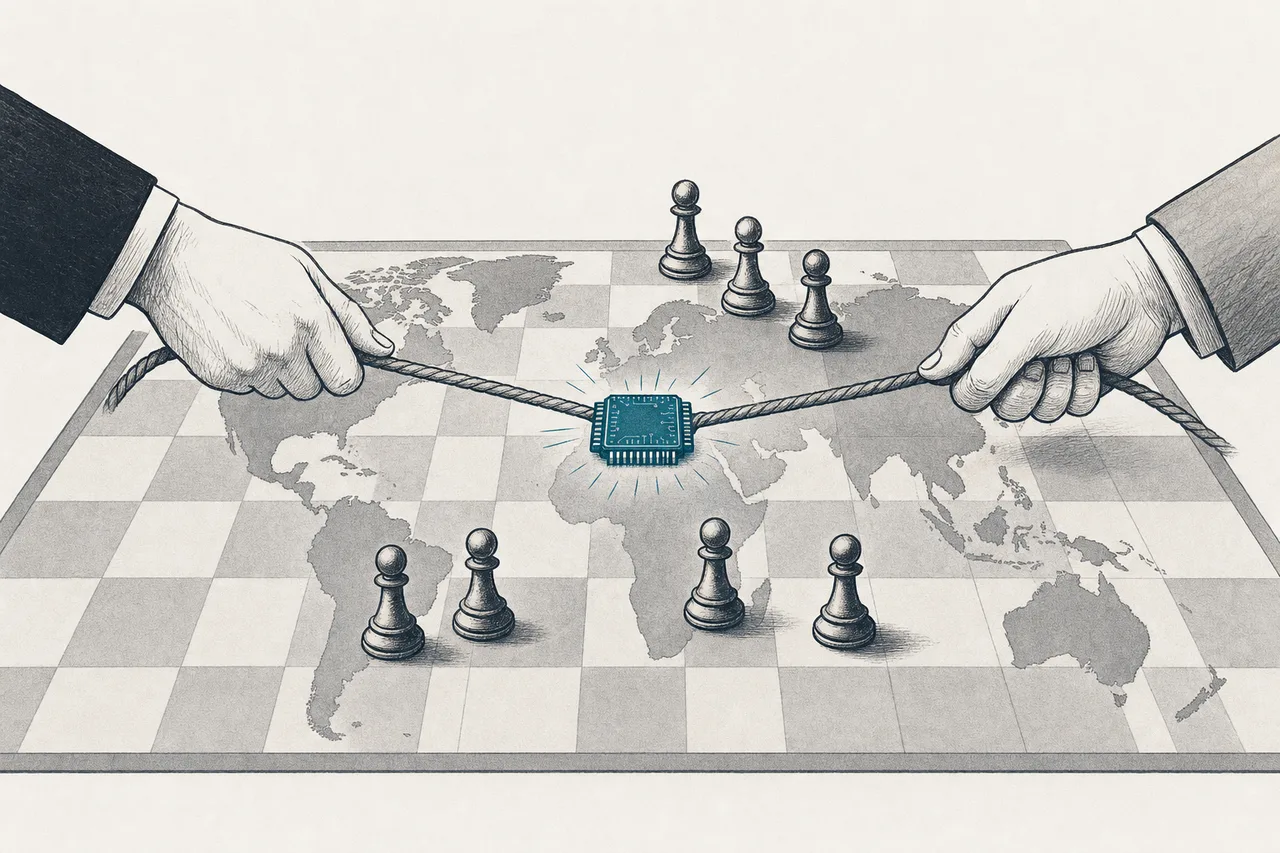
3. Enormous cost (capital intensity) — competing at the leading edge takes tens of billions of dollars per fab, which leaves only a handful of players who can truly compete in each category — the reason this industry is so concentrated and looks like a 'natural monopoly' at many points.
06Where things stand now + each category's champion
2025–2026 is a golden age for the industry — the AI wave is pushing nearly every category to grow and tighten at the same time, from fully booked foundries to surging memory prices to short supplies of equipment and packaging. Below are the 'champions' of each category, reflecting how power is spread across several countries (US/Taiwan/Korea/Japan/Netherlands):
07The future and the risks
Looking ahead, this industry has both tailwinds and risks you have to watch together.
On the opportunity side: AI demand still looks strong and spread across every category. Demand for the leading-edge node (2nm) is expected to grow over 130% through 2030, and new battlegrounds like advanced packaging and HBM are creating fresh value — whoever can control these bottlenecks holds strong bargaining power.
On the risk side, there are three layers to watch:
- Over-reliance on AI: with the whole board riding the same wave, if AI investment slows or overcapacity sets in, every category is at risk at once
- Geopolitics: the concentration in Taiwan and the US–China split are risks that don't show up in financial statements — they sit on the world map
- Cyclicality: many categories (especially memory and components) have a violently up-and-down nature — what's short today can glut a few years later
And that's why this lesson is a 'map,' not a 'deep-dive guide' — because the real value of viewing the whole trend is seeing that all the pieces string together into one story before you step in to explore each room in detail. So go ahead and click into the deep-dive of whichever category interests you.