Megatrend · whole-trend overview
The world's cars are getting a new "engine"
In 2025, roughly 1 in 5 new cars sold worldwide was electric — and in China, more than half already are. This isn't just a swap of vehicles. It's the whole automotive supply chain being rebuilt, from the combustion engine to the battery: the new heart that swallows most of a car's value. This lesson is the map that strings the 8 categories of electrification together — where the value moves, who controls the bottleneck, and why China leads across the board (each category has its own deep-dive chapter).
01The big picture: when a car's heart gets swapped
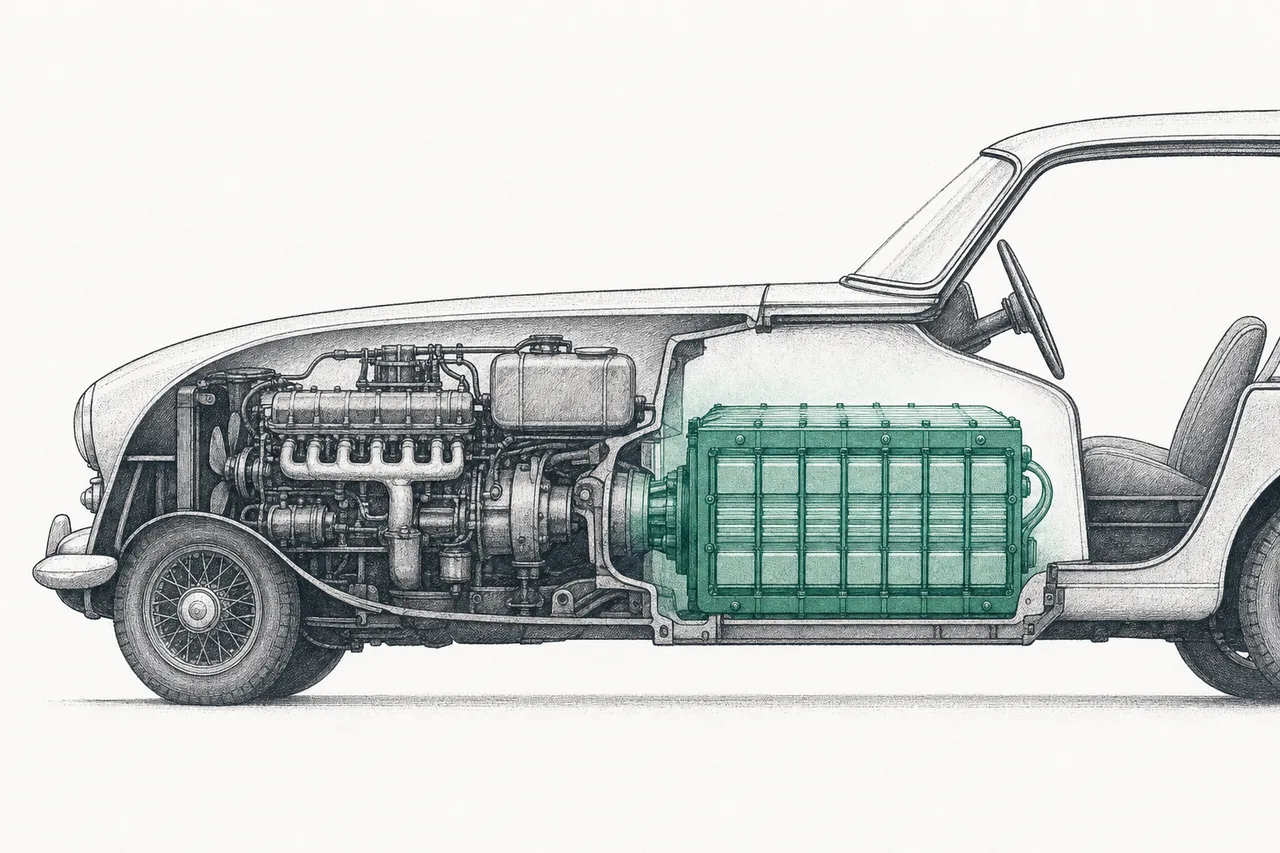
For over a century, the "heart" of a car was the internal-combustion engine — cast iron, pistons, a fuel tank, and a whole global industry built around it. Today that heart is being pulled out and replaced with something entirely new: a battery and an electric motor. And when the heart changes, everything connected to it changes too.
The scale of this shift is no small thing. In 2025, global EV sales hit about 21.6 million units, up ~20%, making up nearly 1 in 5 of all new cars. In China alone, more than half of new cars are already electric. This is one of the biggest industrial changeovers of the era.
But what makes this trend interesting isn't the sales numbers — it's the great migration of value. In a gas car, value is spread across the engine, transmission, and exhaust. In an EV, nearly 40% of the car's value piles into a single thing: the battery. And that opens the door for new players (especially from China) to challenge the legacy automakers that have owned the market for a century. This chapter is about "unrolling the map" of who does what in this new supply chain.
02The map: what are the 8 sub-categories
The shift to electric splits into 8 categories, grouped into 4 "layers" along the supply chain — from upstream raw materials to the cars on the road and the systems that feed them. Each category has its own deep-dive lesson (tap to read):
Upstream — raw materials and battery parts (supply chain)
- Battery Components & Materials: cathode, anode, electrolyte, and separator — the "insides" of a battery cell that set its price, range, and safety
- Battery Recycling & Circularity: recycling old batteries to pull back lithium, nickel, and cobalt — becoming an "urban mine" that cuts reliance on freshly dug ore
Midstream — the heart and the power box (infrastructure)
- Battery Cells & Pack Manufacturing: factories that make cells and assemble them into packs — the heart that eats nearly half a car's value (CATL and BYD rule the world)
- EV Powertrain & Power Electronics: motors, inverters, and the power semiconductor that turns battery electricity into wheel torque — the new "gearbox" of the electric age
Downstream — the cars that actually drive (application)
- Passenger EV OEMs (BEV / PHEV): electric passenger-car makers — the main battleground where BYD and Tesla slug it out, and where legacy names like Toyota and Hyundai are chasing
- Commercial & Heavy-Duty Electric Vehicles: electric trucks, buses, and delivery vans — slower to arrive than passenger cars, but a huge fuel saving when they run all day
- Two-wheeler & Micromobility: electric motorbikes, scooters, and e-bikes — the "fastest-electrifying" category, especially in Asia
Connect — charging (infrastructure)
- Charging Infrastructure & Networks: the charging stations and networks that put "fuel" into EVs — without enough chargers, the whole trend hits a bottleneck
03How it all connects (from ore to wheel)
The heart of what makes this trend remarkable is the hand-off, step by step, "from ore to wheel" — ore and materials turn into battery parts, feed cell factories, get assembled into packs, then combine with motors and power boxes to become a car. It hits the road backed by chargers, and when the battery dies, it loops back into a recycling plant. Here's the whole flow:
The most interesting part is that the core is the battery. In a gas car, no single part eats more value than the engine. In an EV, the battery alone takes nearly 40% of the car's value. Whoever can make cells at low cost controls the game across the whole chain — and right now, that's mostly Chinese companies.
04Where the value and power sit
The key rule of this trend is that value moves from the "engine" to the "battery" — and pricing power piles up with the cell makers, not the car-assembly plants the way it used to.
This explains why CATL (the world's No. 1 cell maker) wields as much influence as the big automakers despite not selling a single car — because nearly every maker has to buy batteries from it. And why BYD — which does it all itself, from ore to cells to chips to the whole car — can price so low that rivals can barely keep up. Meanwhile the work anyone can do — like assembling the body — is a price-war zone where margins are razor-thin.
Another place value is forming is the charging network — the gas stations of the electric age. Whoever grabs the locations and builds a user base first holds long-term leverage (Tesla opened up its NACS charging standard to others precisely to lock down this spot).
The lesson for reading this trend: don't just ask "does this company make EVs?" — ask "does it control the battery / chip / charging, or is it just assembling cars in a price-war zone?"
05The forces that hit the whole trend
Even though each category differs, three big forces hit the whole trend at once:
1. Batteries keep getting cheaper — this is the force behind everything. The price of an EV battery pack fell from hundreds of dollars per kWh a decade ago to about $99/kWh in 2025 (as low as ~$84 in China). As batteries get cheaper, EVs creep closer to gas-car prices — and in many markets they've started coming in cheaper.
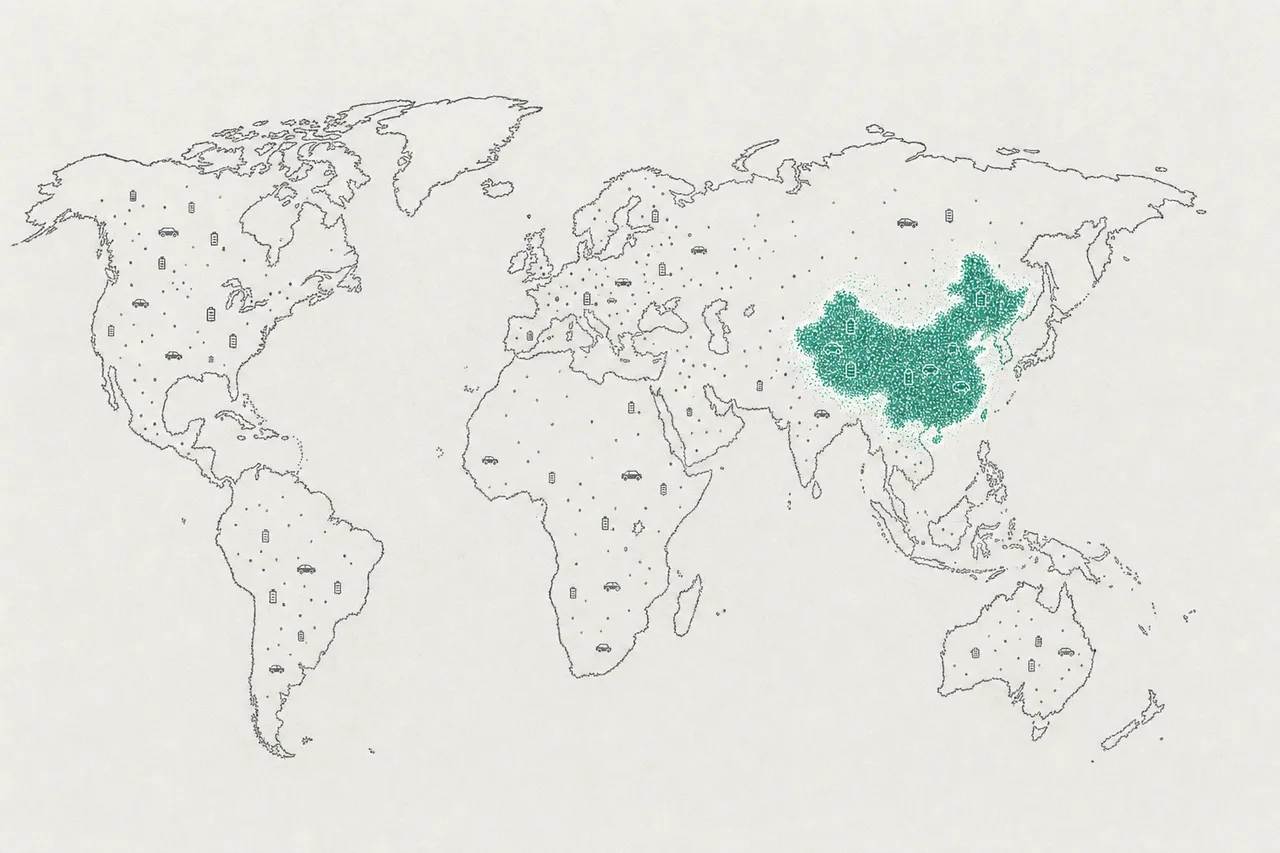
2. China owns the whole board — this is the unavoidable truth of the trend. China makes nearly 70% of the world's EV batteries (CATL and BYD alone are ~56% combined), controls over 65% of the world's public chargers, and is the source of nearly two-thirds of EV sales. Understanding this trend means accepting that its center is in China — not Detroit or Europe.
3. Charging has to keep up — EVs only run if there are enough chargers. In 2025 the world had about 7 million public charging points (up 33%), and that's expected to surge to ~40 million by 2030. As long as charger build-out lags vehicle sales (especially outside China), the "where do I charge?" worry stays a brake on the whole trend.
06Where we are now + the champion of each category
2025–2026 is a turning point — on the China side, sales surged until more than half of new cars are electric, while in the US and Europe a "wobble" (EV demand wobble) is showing from subsidy cuts and still-high prices. The year's big milestone was BYD overtaking Tesla to become the world's No. 1 seller of pure battery-electric vehicles (BEV) for the first time. Below are the "champions" of each category, reflecting how clearly the power in this trend tilts toward Asia (China / Korea / Japan):
07The future and the risks
Looking ahead, this trend has both strong tailwinds and risks you have to watch as a pair.
On the opportunity side: batteries will keep getting cheaper and better (new chemistries like LFP and sodium batteries). The fastest-electrifying category is electric two-wheelers (95% of sales are in China, India, Vietnam), followed by trucks whose prices are closing in on diesel, and a charging network set to expand nearly 8x by 2030 — whoever controls the bottleneck (cells, chips, SiC, charging) holds strong leverage.
On the risk side, there are three layers to watch:
- Demand wobble outside China (EV demand wobble): when the US and Europe cut subsidies and raise tariff walls, sales in those markets may slow more than expected — leaving automakers that invested heavily up front in pain
- Over-reliance on China + geopolitics: with batteries, parts, and chargers concentrated in China, the West is putting up tariff walls and trying to build its own supply chains — both a supply risk and a trade battlefield
- Price wars and overcapacity: China's battery and EV factories produce beyond demand, fueling a brutal price war that squeezes margins across the industry — cheaper is good for consumers, but poison for weaker makers
And there's a tech risk that sits outside this trend but hits it — self-driving (autonomy), which lives in the Robotics & Physical AI trend. If robotaxis arrive faster than expected, the whole "owning a car" model could shift, hitting private new-car sales over the long run. But that timeline is still uncertain.
And that's why this chapter is a "map," not a "deep-dive guide" — because the real value of seeing the whole trend is seeing that all the pieces string together from ore to wheel as one story before you walk in to explore each room in detail — just tap into the deep-dive chapter of whichever category interests you.