Megatrend · Psychedelic Medicine
An antidepressant that works in "hours," not "weeks"
Traditional antidepressants take months of daily use before you feel better — and for someone out of options and thinking about ending it, time is the one thing they don't have. Ketamine works in a completely different way from the old drugs, and it delivers results within hours. This lesson explains how it works at the level of the brain, why it's the only "psychedelic-style psychiatric drug" that's already FDA-approved and making real money in the billions — and the limits worth stating plainly.
01What it is
Ketamine is an old drug — used as an anesthetic in operating rooms and on battlefields since the 1960s, and it's even on the WHO's list of essential medicines. But what turned it into a node in an investment megatrend was a discovery no one expected: at low doses, it's the fastest-acting antidepressant ever found.
This node is a sub-theme under the megatrend Psychedelic Medicine (psychedelic/dissociative psychiatric drugs that have gone through FDA regulation) — and it's the only branch in this group that already has a product on the market making real revenue, while its siblings like Psilocybin and MDMA are still stuck in trials or waiting on the FDA.
From an investment view, this node splits into two worlds you must not mix up:
- Esketamine — the FDA-approved drug: ketamine has two sides, like a left and right hand (called enantiomers). Johnson & Johnson took just one of those sides and turned it into a nasal spray called Spravato, which passed full clinical trials and got approved. This is the "real thing" — with evidence and revenue
- Racemic ketamine — the generic used off-label: the original ketamine (with both sides) is a cheap generic whose patent expired long ago. Many clinics in the U.S. give it by IV "off-label" — legal because doctors can use their own judgment, but it has never gone through trials to win FDA approval for treating depression directly
When a drug is approved for disease A, a doctor can prescribe it for disease B at their own discretion — that's called "off-label." It's normal and legal in medicine. But the key difference is that an off-label drug hasn't been proven to the level the FDA certifies for that disease, so the quality and dosing depend on each individual clinic.
02Why it matters to the world
Start with the scale of the problem. Depression is one of the leading causes of disability in the world, and the main class of antidepressants used for 30-plus years (the SSRIs like Prozac and Zoloft) has two big weaknesses: it's slow and it doesn't work for everyone.
The numbers tell it clearly — about 63% of patients don't respond well enough to their first antidepressant after 6–12 weeks, and when at least two drugs have been tried without improvement, doctors call this treatment-resistant depression (TRD). In the U.S. alone there are about 2.8 million TRD patients — a vast "gap" that the old drugs can't fill.
More important than the number is the matter of time. SSRIs take 4–6 weeks to start showing results. For someone thinking about ending their life or at high suicide risk, waiting for months is dangerous. Ketamine changes that equation: in trials, symptoms improved within 24 hours. That's why the whole field is excited — not just "more effective," but "fast in a way that can save a life."
And because it "actually works," a real market has formed. The U.S. ketamine-clinic market is projected to grow from today's level to about $6.9 billion in 2030 (around 10.6% average annual growth), driven both by the FDA-approved drug and by off-label clinics popping up across the country.
03How it works — where fast and slow differ
This is the heart of the lesson, because ketamine's "speed" isn't an accident — it comes from the fact that this drug works on a completely different system than the old ones.
SSRIs work on serotonin — the neurotransmitter tied to mood. They slowly raise serotonin levels little by little, which is why you have to take them daily and wait weeks for the brain to gradually adjust. Like filling a tub one drop at a time.
Ketamine doesn't touch serotonin at all. It goes to the glutamate system — the brain's "main" neurotransmitter — by blocking a receptor called the NMDA receptor. That blockade triggers a chain reaction that makes the brain release a nerve-building protein (BDNF) and speeds up the growth of new connections between nerve cells (synaptic plasticity) — put simply, it helps "rewire" a brain that chronic stress has worn down, and it happens within hours, not weeks.
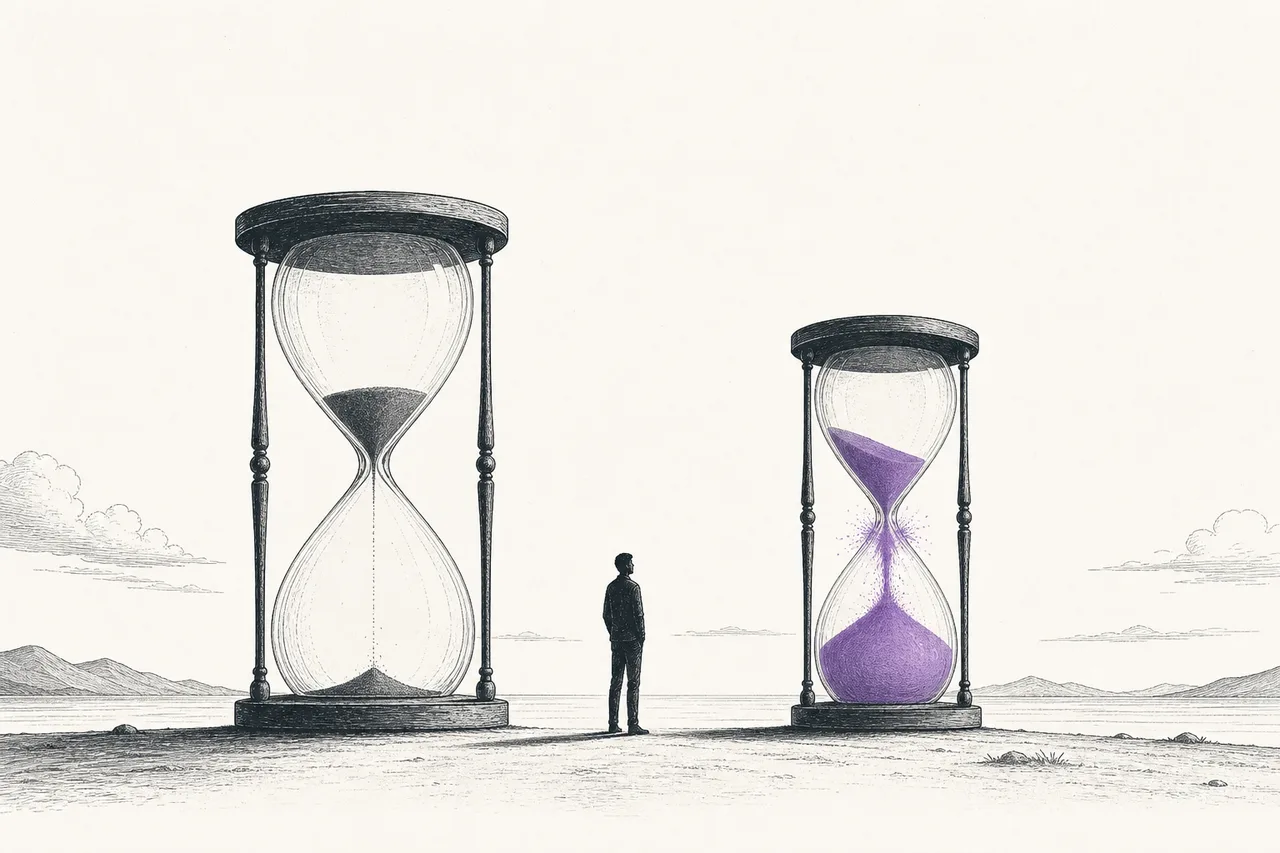
This difference in time is clear when you set them side by side: SSRIs measure progress in weeks, ketamine measures it in hours.
The brain learns and adapts by building and removing "connections" (synapses) between nerve cells. Chronic stress and depression cause these connections to wither in parts of the brain. Ketamine helps new connections sprout back quickly — many believe this is why it acts so fast, and it's the same mechanism the other psychedelics are trying to imitate.
04Where it sits in the field
On the map of the megatrend Psychedelic Medicine there are four sub-themes, and ketamine is the one "out in front" of them all in terms of the journey to market:
- Ketamine (this node): through the FDA, with a product (Spravato) making real revenue — the proof that this field can make money
- Psilocybin (the compound from magic mushrooms): the most advanced of the "classic" psychedelics, but still in Phase 3 trials with no product on the market
- MDMA-Assisted Therapy: for PTSD, it came near the finish line but stumbled after the FDA rejected it in 2024
- Novel / Next-Gen: LSD, DMT, 5-MeO-DMT, and next-generation compounds that strip out the hallucinations — the earliest stage of all
The most important relationship is that ketamine depends on the tools of Biotech & Genomic Medicine — the clinical-trial process, the approval filings, the drug manufacturing are all the same machine as the entire biotech field. So Spravato's success is the "template" that tells other psychedelic companies that the path from lab to prescription really is possible — if you have solid enough data.
05Where it stands now
The whole story comes down to one drug: Johnson & Johnson's Spravato. The FDA first approved it in 2019 (combined with another oral drug for TRD). Sales were slow at first, because it was cumbersome to use and required monitoring in a clinic. But then sales caught fire.
In Q4 2025, Spravato did $503 million in a single quarter — equivalent to a run-rate of over $2 billion a year, growing nearly 100% year-over-year from about $1 billion in 2024. This is a full-blown "blockbuster," and crucially, it's real revenue in a field that's still mostly selling hope.
The latest big milestone was January 21, 2025: the FDA approved Spravato as a monotherapy for TRD for the first time — meaning patients no longer have to take another antidepressant alongside it. In the trial, patients on Spravato alone reached remission at week 4 at about 22.5%, compared with 7.6% in the placebo group.
Beyond Spravato there's a "second world": off-label ketamine clinics giving the drug by IV on a cash-pay basis, which have sprung up by the thousands across the U.S. — plus telehealth services that deliver sublingual ketamine to your home (like Mindbloom). This market is growing fast but it's fragmented, with uneven quality, and it's where regulators are starting to keep watch.
06The road ahead
The first direction is expanding the indications. Now that Spravato has proven itself as a monotherapy, the next step is pushing into broader patient groups — and insurers agreeing to pay more will be a major accelerator for sales. The easier it is to use and the more it's covered, the bigger the market grows.
The second direction is the competition over convenience. Ketamine's biggest limitation is that "it has to be done in a clinic." So new competitors (like GH Research and Atai Beckley) are trying to make drugs that act just as fast but need less monitoring time in the clinic. If anyone pulls it off, they could take share from ketamine — the competition shifts from "does it work" to "how convenient is it."
The third direction is copying the mechanism. What makes ketamine special is that it stimulates synaptic plasticity. Now there's research trying to build "neuroplastogen" drugs that deliver the same brain-repair effect with the hallucinations/dissociation stripped out. If that really works, it would be a drug you could take at home with no monitoring — which would be both a huge opportunity and a threat to ketamine itself at the same time.
07Challenges & risks
Ketamine's appeal comes with limits that need to be stated plainly — not just the good side of the story.
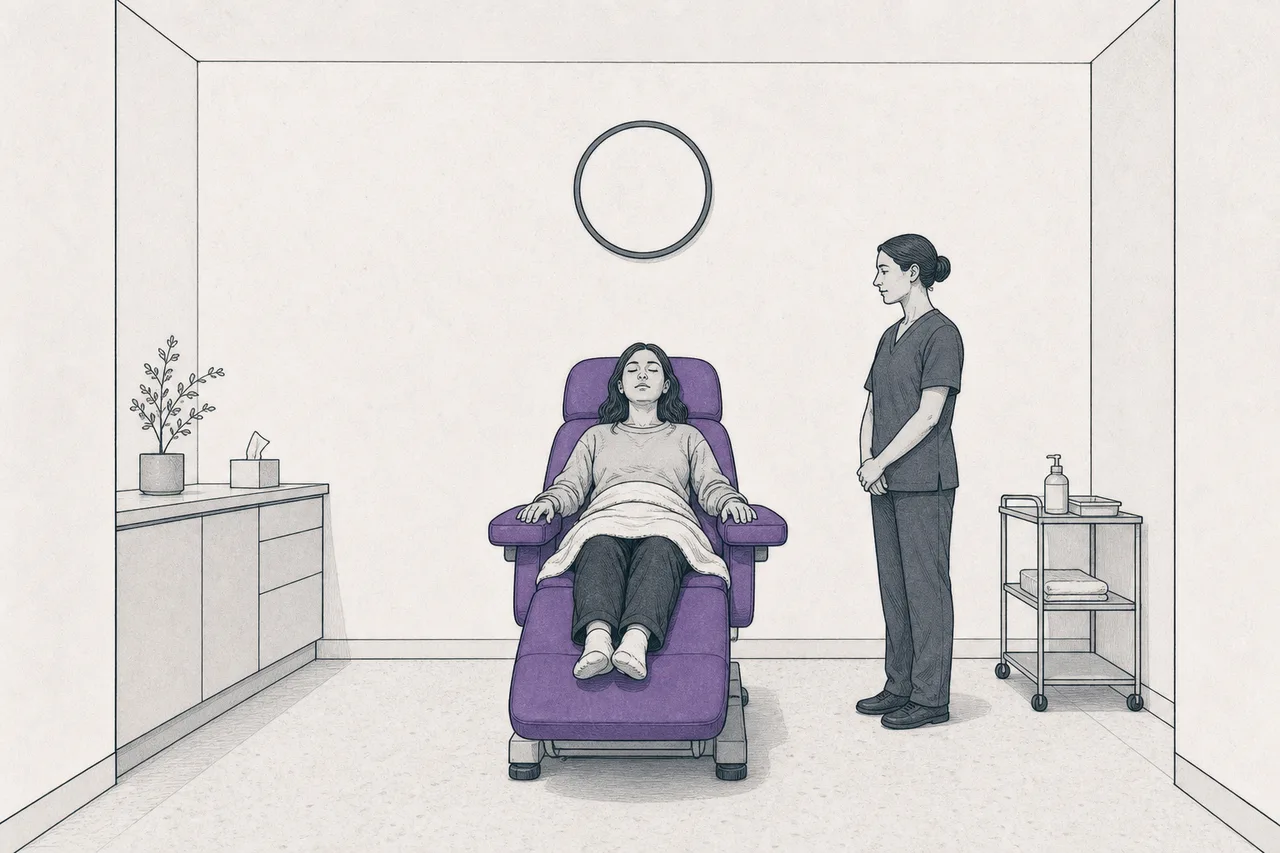
The first risk is side effects and the need for clinic monitoring. Ketamine causes dissociation — feeling floaty, like you've left your own body — and it makes you drowsy, so it has to be given in a clinic with at least 2 hours of observation every time. Spravato is under a special safety program (REMS) that bars patients from taking it home. This is a cost and a hassle that limits access, and a weak point competitors are aiming at.
When a drug is beneficial but also carries risk, the FDA may impose a "REMS" — special rules to control its use, like requiring it to be given at a registered facility, requiring patients to be monitored for a set time, and barring take-home prescriptions. For Spravato, this is why the drug is inseparably tied to the "clinic."
The second risk is the potential for addiction. Ketamine is classified as a Schedule III controlled substance and has a long history of misuse. Prolonged continuous use can lead to dependence and withdrawal symptoms. This is the fine line that makes regulators cautious, especially with off-label clinics that are harder to control.
The third risk is durability of the effect. Ketamine's effect often lasts only about 5–8 days per dose, so it has to be given repeatedly over time (maintenance) — it's not "cured in one treatment." There are also reports of tolerance with continued use. Some cost-effectiveness bodies (like ICER) still question whether the long-term benefit is worth the cost, because the long-term data isn't clear yet.
The fourth risk is the uneven quality of off-label clinics. Off-label IV ketamine grew fast because the drug is a cheap generic that can be prescribed at a doctor's discretion. But that means there's no central standard on dosing, patient screening, or monitoring — both a market opportunity and a reputational risk for the whole category if something goes wrong.
In short: ketamine is the story of an old drug rediscovered, and it became the proof that psychedelic-style psychiatric medicine isn't just selling a dream. It treats people the old drugs couldn't help — fast in a way that can save a life. But it comes with limits around clinic monitoring, addiction, and the durability of the effect. Understanding this node is understanding why "the revenue of a single drug" is the pillar that holds up the credibility of an entire megatrend branch.