Megatrend · Psychedelic Medicine
An antidepressant you might take just once — if it clears the FDA
Most people with depression take a daily pill for years. Some try drug after drug and still don't get better. But a group of drug companies is betting on a radically different idea: give the active ingredient of "magic mushrooms" as a standardized synthetic medicine, just once, under supervision in a clinic — and the antidepressant effect may last for months. This lesson is about turning a once-illegal psychoactive substance into an FDA-approved prescription drug — and why that's a clinical bet that's exciting and high-risk at the same time.
01What it is
Let's start by separating two words people often confuse, because this lesson is only about the second one. The "magic mushrooms" people use recreationally on their own are illegal in nearly every country, and are not our subject. What we're talking about is taking the active ingredient in that mushroom — called psilocybin — making it as a pure synthetic compound at an exact dose, testing it in clinical trials to the same standard as every other medicine, and seeking approval as a prescription drug for depression.
Psilocybin Therapeutics is the group of drug companies developing synthetic psilocybin mainly as a treatment for treatment-resistant depression (TRD) — patients who've tried at least two antidepressants and still haven't improved. On the megatrend map, this node is a branch under Psychedelic Medicine, and it's the line that has "come the furthest" among classic psychedelics, because its final-stage (Phase 3) trial data is already out.
The common definition is a patient with depression who has had at least 2 adequate antidepressants during their illness but still hasn't improved. Roughly 1 in 3 of all depression patients is thought to fit this — a group existing drugs can't help, which makes it a large "treatment gap" and the first target of this class of drugs.
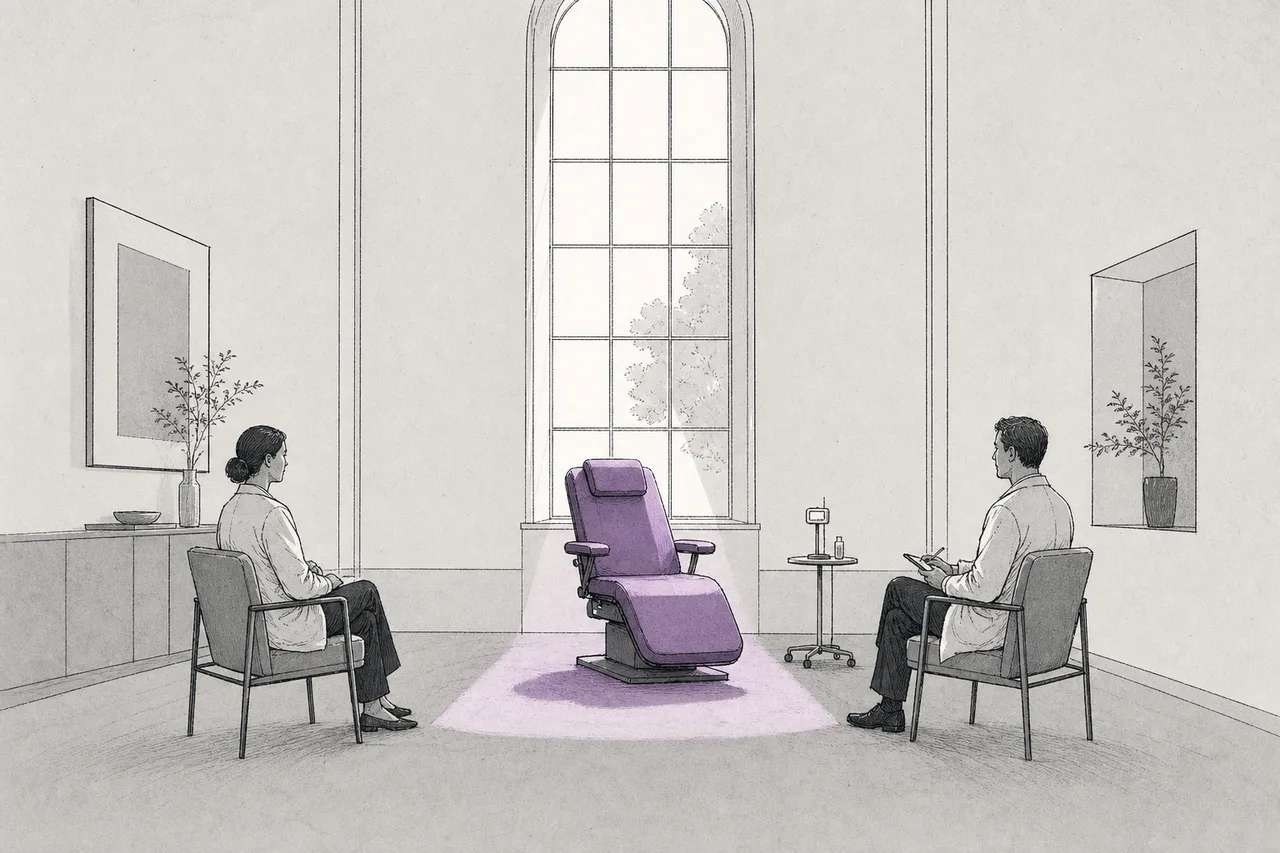
What makes this node unlike other drugs in the field isn't just the compound — it's the "way it's given". Psilocybin isn't designed to be taken daily like a normal antidepressant. It's given once (or a few times) in a clinic, with a trained guide sitting beside the patient through the several hours the drug is active, plus a prep conversation before and a review after — it's a "drug + therapy process", not just a pill in a bottle. And that's both its strength and the hardest part of the whole story.
02Why it matters — a once-only antidepressant
To understand why investors and psychiatrists are watching, you first have to understand the "problem" it's trying to solve. Today's daily antidepressants (the SSRI class, like Prozac) have two frustrating limits: they work slowly (often weeks of taking them before you see an effect) and don't work for everyone — the roughly 70% of patients who try two drugs and still don't improve are the "market" with no good enough answer yet.
That's why the numbers from the psilocybin trials catch the eye: in several trials the antidepressant effect started showing within the next day after a single dose, and in responders it could last for weeks to months — unlike having to take a pill every single day. If this is truly proven at scale, it would redefine depression treatment from a "daily maintenance pill" to an "occasional treatment."
On market size, the picture is still small but growing fast. The whole medical-psychedelics market was estimated at about $1.9 billion in 2024 and is projected to grow to about $3.8 billion by 2030 (CAGR ~11–12%), with TRD the largest indication (~38% of the market). The psilocybin-in-TRD slice alone has been estimated to potentially top $610 million by 2030 — with one key condition: it has to be approved first, which hasn't happened yet.
Let's be clear: these numbers are an estimate of a market that doesn't exist yet, unlike a drug already on sale. Because as of today, no psilocybin has been approved for sale as a medicine, the entire value rests on the assumption that the trials succeed and regulators give the green light. That's why stocks in this group swing violently on every trial-result headline.
03How it works (the mechanism in the brain)
The question everyone wonders is: why does a drug given once have effects lasting for months, when a normal antidepressant has to be taken daily? The answer lies in a fundamentally different mechanism — and it splits into two parts that have to go together: (1) the drug in the clinic, and (2) what happens in the brain.
The clinic side first: the patient gets a single dose of psilocybin in a prepared room, with a trained guide sitting beside them the whole time the drug is active (several hours), a prep conversation beforehand, and a review of the experience afterward — this is why it's called "drug + therapy," not just swallow a pill and go home.
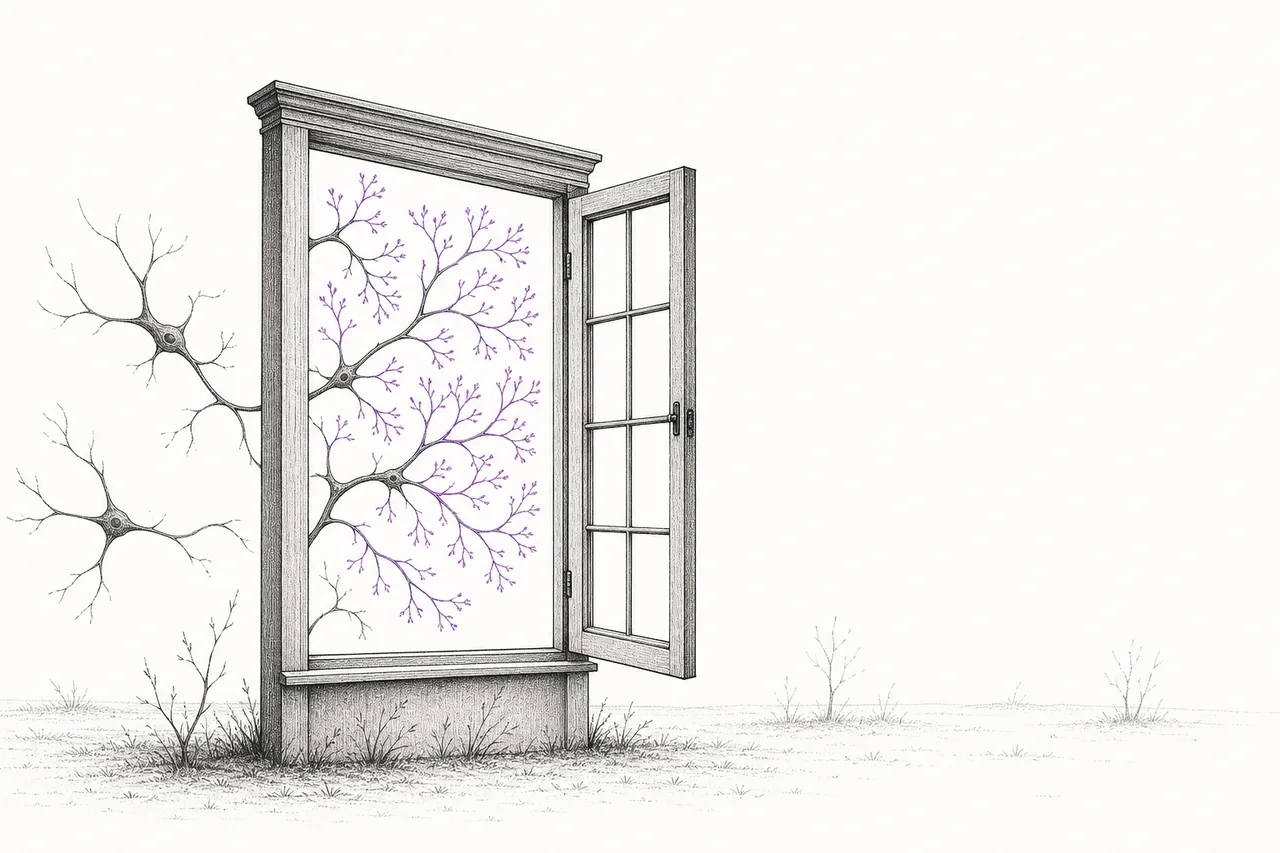
The brain side is the astonishing part: psilocybin binds to a certain receptor on neurons called 5-HT2A (a serotonin receptor) in the front of the cortex. This activation makes the neurons release more of the neurotransmitter glutamate and opens a temporary "window of neuroplasticity" — a stretch of time when the brain can form and rewire connections more easily than usual. Researchers believe it's during this window that brain circuits "stuck in the groove of depression" have a chance to be rewired, and the effect of that rewiring stays even after the drug has worn off.
04Where it sits in Psychedelic Medicine
Psilocybin doesn't stand alone. It's one of the "development lines" of the Psychedelic Medicine megatrend, with several compounds and several indications running in parallel. The best way to understand its position is to see how it differs from its "siblings":
- Ketamine & Esketamine: the line that "already reached the market" — esketamine (Spravato) has been FDA-approved since 2019, used as a nasal spray in clinics for TRD. It's proof that a "give-it-in-the-clinic-and-bill-for-it" drug can actually work — both a template and a competitor for psilocybin
- MDMA-Assisted Therapy: the line focused on PTSD (psychological trauma) rather than depression — and an important cautionary tale, because the FDA rejected the first MDMA drug in 2024, partly over trial-design problems (we'll cover it in the risks chapter)
- Next-gen compounds: several companies are trying to design compounds that act faster and shorter than psilocybin (like the 5-MeO-DMT group, whose effect may last only about 15 minutes instead of several hours) to solve the "long supervision" problem
This node is also directly and deeply connected to the Biotech & Genomic Medicine megatrend — because in the end, Psilocybin Therapeutics is ordinary biotech drug development: it has to pass Phase 1-2-3, win FDA approval, burn enormous cash before any revenue, and carry the "trial failure" risk like every other drug. What makes it special is the history of the compound (it was once an illegal controlled substance), which adds a layer of legal and regulatory risk on top of the usual clinical risk.
An easy way to remember psilocybin's place in the big picture is that it's the "furthest-along among the classic psychedelics" line — ketamine reached the market but is a different class of compound, MDMA stumbled at the FDA, and psilocybin is the one with complete Phase 3 data, lining up to file for approval first in the classic-psychedelic group.
05Where it stands now
Let's be as clear as possible first, to avoid any misunderstanding: as of 2026, no psilocybin has been approved by the FDA for sale as a medicine. All of it is still in the "clinical stage" — but the leading line has just passed its most important milestone.
The clear front-runner is COMPASS Pathways. Its drug, COMP360 (synthetic psilocybin 25 mg given with psychological support), has come a long way. It started with a Phase 2b trial published in the New England Journal of Medicine in 2022 — 233 TRD patients, where a single 25 mg dose significantly lowered depression scores (p<0.001), and about 29% of the 25 mg group entered remission at week 3.
Then in 2025–2026 came the Phase 3 data — the final gate before filing for approval — and both pivotal trials hit their primary endpoint:
- COMP005 (the first Phase 3 trial) — 258 patients across 32 U.S. sites. A single 25 mg dose vs. placebo, with a highly significant reduction in symptoms (p<0.001), −3.6 points different from placebo at the primary timepoint
- COMP006 (the second Phase 3, results in early 2026) — comparing two doses, 25 mg vs. 1 mg, three weeks apart. A significant difference (p<0.001), −3.8 points apart, with the effect in responders lasting at least through week 26
And in Phase 3, both trials confirmed the same direction — the 25 mg dose reduced symptoms much more significantly than the comparison group (p<0.001 in both), measured as a difference of ~3.6–3.8 points on symptom severity:
On the regulatory side, COMP360 has had FDA Breakthrough Therapy status since 2018 (a status the FDA gives to drugs that may be clearly better than existing options, to speed up the process), and the FDA has recently allowed it to file its approval paperwork in stages (a rolling NDA), with the company aiming to complete the filing by Q4 2026 — meaning the actual approve/don't-approve decision will likely come after that.
Breakthrough Therapy = a special status the FDA grants to "speed up" the development of a drug that looks more promising than what exists — a positive signal, but not a guarantee of approval · primary endpoint = the measure of success a company declares in advance before the trial begins — "hitting the primary endpoint" is the best news a single trial can deliver, but the FDA still looks at the whole picture (safety, data quality, design) before deciding.
Besides COMPASS, there are other players in the field worth knowing — but almost all of them are small, clinical-stage companies still burning cash with no drug revenue yet, so their share prices swing hard on trial news:
06The future — if it passes
The "if" in this heading is there on purpose, because this node's future splits clearly into two roads, depending on the FDA's decision.
If COMP360 is approved, it would be the first psilocybin to become a real drug and open the road for the whole group — just as esketamine (Spravato) proved the "give-it-in-the-clinic + bill-for-it" model can work. The directions to watch are expanding indications (from TRD to general depression, anxiety, or treating addiction) and making it scalable — like group therapy (one estimate says doing it in groups could save about 35% of physician time for psilocybin-depression) or new compounds with shorter action.
Another tailwind that has just emerged is a more open policy stance in the U.S. toward research on medical psychedelics, which eases the regulatory resistance that used to be a big wall — though it still has to pass the same safety and efficacy bar as every drug.
But don't forget the other scenario. If the FDA doesn't approve, or asks for more data over several years (as happened with the MDMA drug in 2024), the value of companies in this group could shrink sharply, because all the revenue is still just expectation. This is the classic profile of clinical-stage biotech stocks: one piece of news can change the value severalfold, up or down.
07Challenges & risks
This is the most important chapter for looking at this node with a clear head, because even though the data looks good, its risks are real and very specific.
1. The "trial failure / FDA rejection" risk — this is the most basic risk. Hitting the primary endpoint is not the same as winning approval. The FDA still looks at the whole picture, and this drug group has a fresh lesson: in August 2024, the FDA rejected MDMA for PTSD even though the trial results were positive, partly over trial-design problems.
2. The "can't stay blinded" problem (functional unblinding) — this is the biggest scientific weakness of the whole psychedelic group. A good drug trial has to be "blinded" — the patient doesn't know whether they got the real drug or a placebo. But with psychedelics, the patient knows immediately they got the real drug because they feel the effect, which means the results may be contaminated by expectation (the placebo effect). And this was one of the main reasons the FDA rejected MDMA.
In a standard drug trial, neither the patient nor the doctor should know who got the real drug (double-blind), to remove bias. But with psychedelics, the patient who got the real drug clearly feels the effect, so they can guess which group they're in — "the blinding doesn't really work." That makes it harder to tell whether the good result came from the drug itself or from expectation — a methodological problem no one has fully solved.
3. The durability risk — the data says the effect lasts up to ~26 weeks in responders, but the question is: what happens after that? How often do you have to re-dose, how many people relapse — the real long-term data is still limited, and it directly affects the drug's economic value.
4. The scalability risk — this is the heaviest business problem. Each dose takes several hours, needs at least one to two trained guides per patient, and requires a dedicated room — unlike a pill you make a million at a time and ship straight out. The "drug + a lot of physician time" model makes the cost per patient high and scaling slow.
5. The reimbursement risk — following from #4: if the cost per session is high, who pays? How far insurers and public health systems will agree to reimburse it isn't clear yet, and the standards for certifying "which guide is qualified enough" barely exist.
6. Small-cap volatility — almost all the players are small companies with no drug revenue, relying on fundraising. So their value swings hard on every piece of trial news, and there's the "how long will the cash last" (cash runway) risk — a factor you always have to watch alongside the clinical data.