Megatrend · whole-trend overview
When a once-illegal drug starts walking toward FDA approval
This is the attempt to turn "psychedelics" — magic mushrooms (psilocybin), MDMA, and ketamine — into legal, prescription psychiatric medicines. The stakes are huge, because the world has tens of millions of people with depression and PTSD that existing drugs can't reach. But the risk is extreme too — in 2024 the FDA rejected Lykos's MDMA, even though many thought it would pass. This lesson is the map that strings the field's 4 categories together: how the drug, the clinic, and the approval gate connect, where the real money is, and why almost every company is still an "all-or-nothing" bet (each category has its own deep-dive chapter).
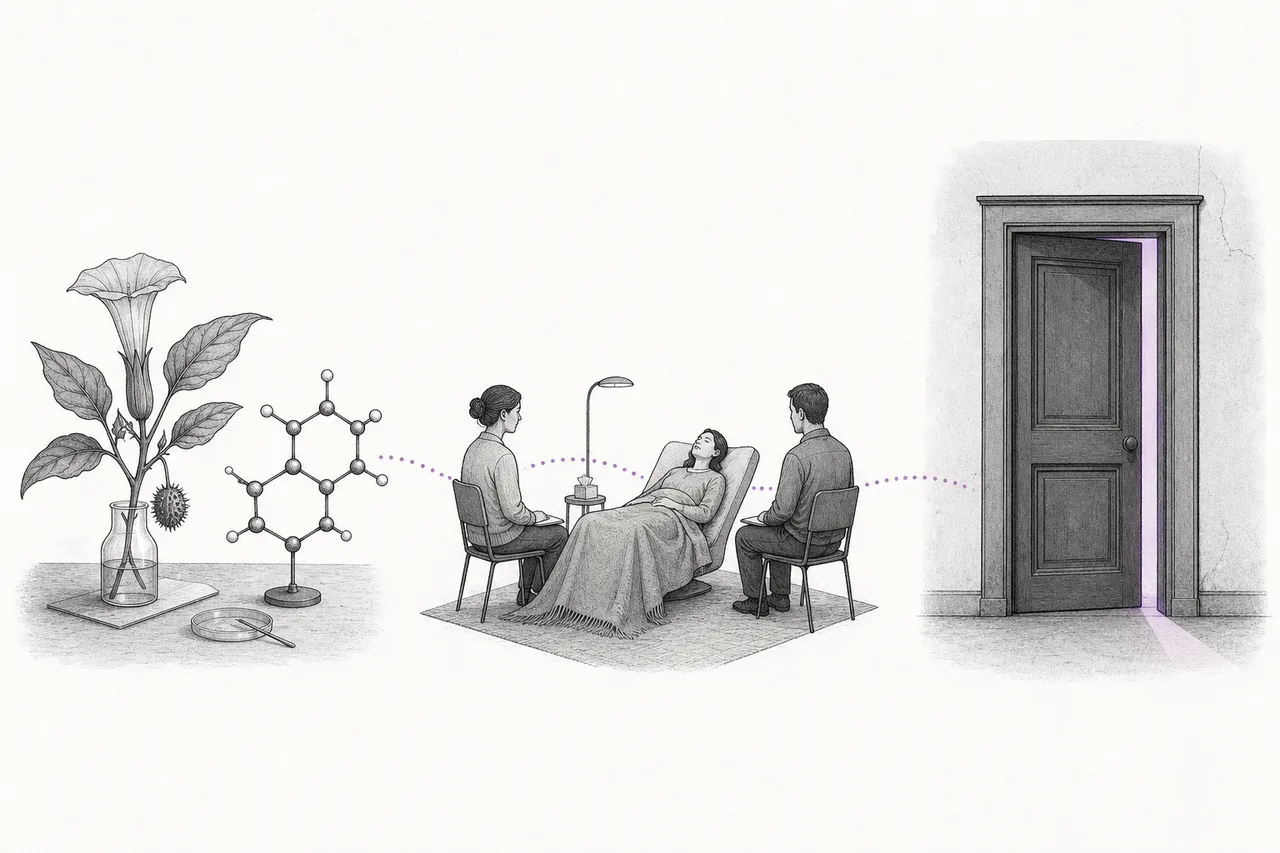
01The big picture: a forbidden drug turning into medicine
Start with the most important line. This lesson isn't about using psychedelics recreationally — it's about the medical effort to turn substances like psilocybin (the compound in magic mushrooms), MDMA, and ketamine into drugs that pass clinical trials, get FDA approval, and can be prescribed by a doctor, just like any other drug — under tight supervision.
Why does the world care? Because the problem it could solve is enormous. In the US alone, there are about 2.8 million patients with depression that doesn't improve even after taking drugs (treatment-resistant depression, or TRD), and the economic burden of TRD runs to roughly $43.8 billion a year. PTSD affects about 13 million Americans a year. These people are the market existing drugs (ordinary antidepressants) can't reach — and that's exactly the gap psychedelic medicine is trying to fill.
Depression that hasn't improved after trying at least 2 antidepressants — the "hardest group," and the main target of these drugs. If something works for people other drugs failed, that's a reason to accept the risk of a more complicated treatment.
Market size is still hard to estimate, because the "real thing" has only just started selling in a handful of cases. But many research shops agree it will grow several-fold this decade. The midpoint is roughly $4.5 billion in 2024 → ~$8.3 billion in 2030 (about 10–11% average annual growth), with some shops seeing as high as $13 billion if new drugs win approval.
But what makes this field special (and dangerous to invest in) isn't market size — it's the fact that almost all of it is "pre-revenue" companies whose fate hangs on trial results and FDA decisions. Only one is actually selling for real money. And that's the map we're about to lay out.
02The map: what the 4 sub-categories are
The easiest way to understand this field is to split it by "the substance" (which drug it uses), because each one carries very different levels of risk and progress — some are near the finish line, some are still at the starting blocks. Each category has its own deep-dive lesson (tap to read):
The group that already sells for real
- Ketamine & Esketamine: ketamine and its derivatives — the only category with real revenue, led by J&J's nasal spray Spravato, which does about $2 billion a year and is the "proof" that this model can sell
The group with strong trial data (near the finish line)
- Psilocybin Therapeutics: synthetic versions of the magic-mushroom compound, for TRD/PTSD — the most "de-risked" group among the classic psychedelics, led by Compass Pathways, which has already passed both of its Phase 3 trials
The group that stumbled at the regulatory gate
- MDMA-Assisted Therapy: MDMA used together with psychotherapy, for PTSD — once the field's number-one hope, until the FDA rejected it in 2024 (the leader is Lykos, a private company). It's the field's clearest lesson in regulatory risk
The early-stage group (highest risk)
- Novel Psychedelic & Next-Gen Pipeline: next-generation substances like LSD, DMT, 5-MeO-DMT, and ibogaine, plus "neuroplastogens" designed to be non-hallucinogenic — the earliest stage, mostly micro-cap companies, but also where the real innovation is happening
03How it connects (drug → clinic → approval gate)
A psychedelic drug's chain differs from an ordinary pill in one way: the "drug" alone can't be sold — it has to come with a "place and people to supervise it," because the patient must use it under control for hours. Look at the flow of this chain: from the (1) drug / developer that invents the substance → the (2) clinic dosing model that supervises during use → the (3) approval and reimbursement gate, which is the real bottleneck.
The most important point of this map is that the bottleneck is at the last gate, not at the drug itself — even if trial results are good (Lykos's MDMA really did reduce PTSD symptoms in trials), if the FDA doesn't approve, the company is left with almost nothing. That's the "all-or-nothing" nature that makes these stocks swing so violently.

04Where the real money is
The first rule for looking at this field is to separate "real revenue" from "hope". Today almost all the revenue comes from one category — ketamine, specifically Spravato (esketamine), J&J's nasal spray, FDA-approved since 2019. It did $503 million in Q4 2025 (an annual run-rate past $2 billion), and analysts expect it to hit ~$2.3 billion for full-year 2026, with Jefferies seeing it possibly reaching $3 billion in 2027 and $5 billion at peak.
Why does Spravato matter beyond its own numbers? Because it proves the "drug + supervised clinic" model can actually scale commercially. The number of sites certified to administer Spravato jumped from 2,800 (2024) to over 7,000 (2026), and more than 200,000 patients worldwide have now been treated — proof that the healthcare system is willing to build the infrastructure for this kind of treatment, which is good news for psilocybin and the others that follow.
For the rest of the field — psilocybin, MDMA, the next-gen substances — the value is still an "option," not "revenue". That is, the stock price reflects the probability of passing the FDA × the market size if it passes, not actual cash flow that exists. The lesson for reading this trend: don't just ask "is this company in the psychedelic field?" — ask "does it have real revenue, or is it a one-shot bet on a trial result?"
05Forces that move the whole trend
Even though each category uses a different substance, four big forces move the whole field at once:
1. The mental-health crisis = enormous demand — this is the most fundamental force. The number of depression and PTSD patients that existing drugs can't reach is large and growing (in the US alone, TRD ~2.8 million, PTSD ~13 million a year). So demand for new treatments is high, and real.
2. The FDA's stance, flipped after the Lykos case — this is the most powerful and least predictable force. In 2024 the FDA rejected Lykos's MDMA (citing durability of effect, safety, and trial bias), which shook the whole field — but by 2026 the stance clearly flipped positive. Under the new administration, FDA Commissioner Marty Makary declared reviewing psychedelics a "top priority," an executive order pushed to speed up review of this drug class, and the FDA granted a "national priority voucher" to 3 projects (psilocybin for TRD/MDD and methylone for PTSD) — this political force lifts the whole board at once.
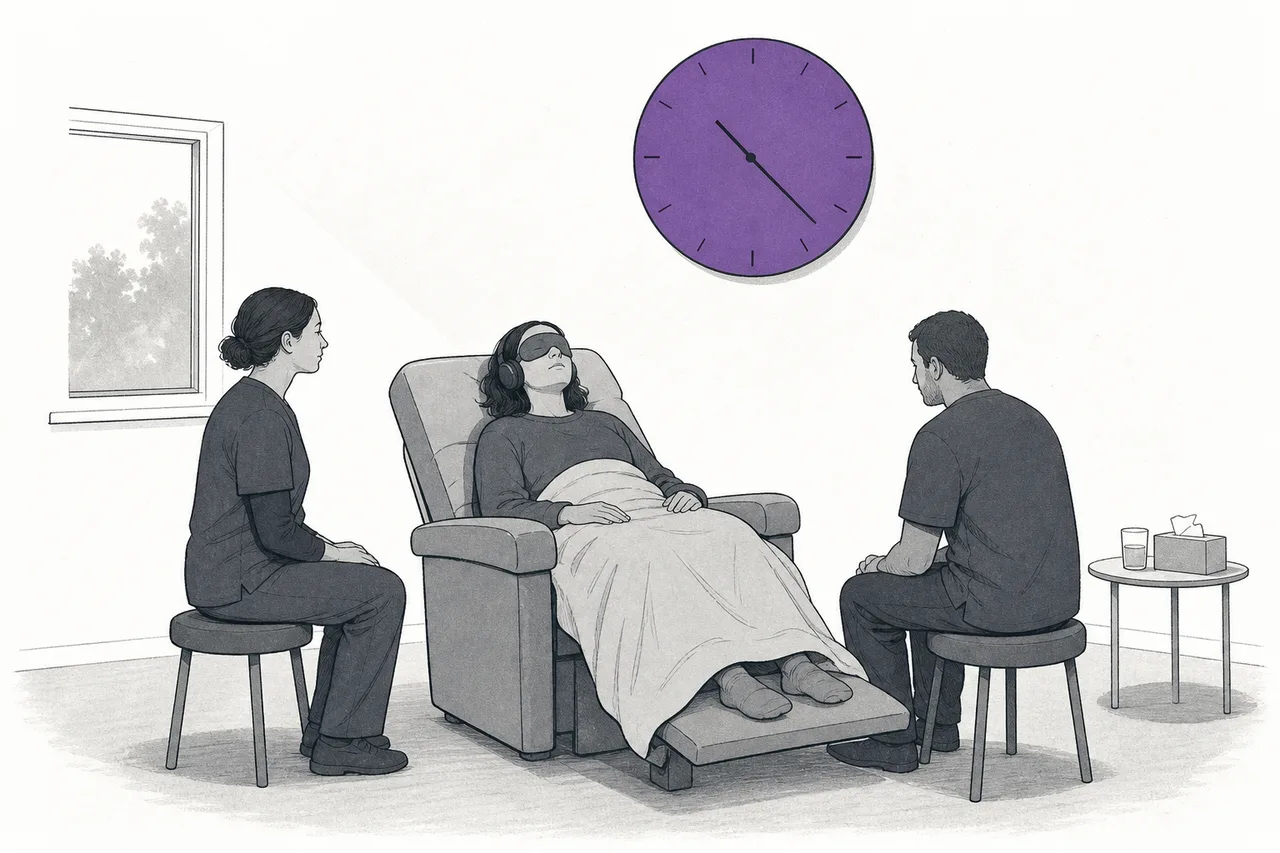
3. The cost problem of supervised dosing — unlike a pill you take yourself at home, these drugs have to be used under a therapist's supervision for hours at a time, pushing the cost per session as high as ~$3,000. And because many are still Schedule I (illegal at the federal level), insurance still can't reimburse them. So "scaling it to everyone" is a hard problem — not just a question of whether the drug works.
4. Legalizing for recreation ≠ making it a medicine — several US states have loosened their psilocybin laws (Oregon, Colorado, for example), but that's a different road from making it an "FDA-approved drug." Decriminalization could create a gray market that competes with properly trialed drugs — both an opportunity (society growing more open) and a risk (standards getting muddled).
06Where it stands now + the champion of each category
2025–2026 is a fork in the road for this field — on one side bad news (Lykos rejected), on the other big good news (Compass passing both Phase 3 trials + the FDA's stance flipping positive). Below are the "champions" of each category — a reminder that almost all of them are still pre-revenue companies whose stock prices swing violently with trial results and FDA decisions, except J&J, a pharma giant for which Spravato is just a small part of the portfolio:
07The future, and the risks worth stating plainly
Looking ahead, this field has both real tailwinds and risks worth laying out honestly, side by side.
On the opportunity side: three streams are converging right now — (1) Spravato proved this model sells and is growing into a blockbuster, (2) Compass passed both Phase 3 trials of psilocybin, making a psilocybin NDA realistic for the first time, and (3) the FDA's stance flipped to actively supportive in 2026. If psilocybin actually gets approved, it would be a major "door-opener" that de-risks the whole field that follows.
On the risk side, there are several layers to watch especially closely, because this is not an industry guaranteed to grow:
- Binary (all-or-nothing) risk: most companies are pre-revenue, with their fate hanging on a single trial result and an FDA decision — the 2024 Lykos case is the reminder that good trial results don't guarantee approval
- Cash and dilution: clinical-stage companies burn cash constantly and have to keep raising money; existing shareholders risk being diluted — watching the runway (how many years of cash is left) matters as much as watching the trial results
- Dosing cost and reimbursement: even if a drug passes, if insurance won't pay and treatment costs $3,000 a session, the real market could be far smaller than the dream
- Political swings: the FDA's positive stance in 2026 comes from political force, which can reverse when the administration changes — a risk that doesn't show up on the financial statements
And that's why this chapter is a "map," not "trading advice" — the real value of seeing the whole trend is spotting that the drug, the clinic, and the approval gate are strung together as one story, and seeing where the real risk lies, before you go explore each room in detail — just tap into the deep-dive chapter of whichever category interests you.