Megatrend · Climate Adaptation & Water
Every 2 minutes, a water pipe breaks somewhere in America — and this is the business that sells to the people who fix it
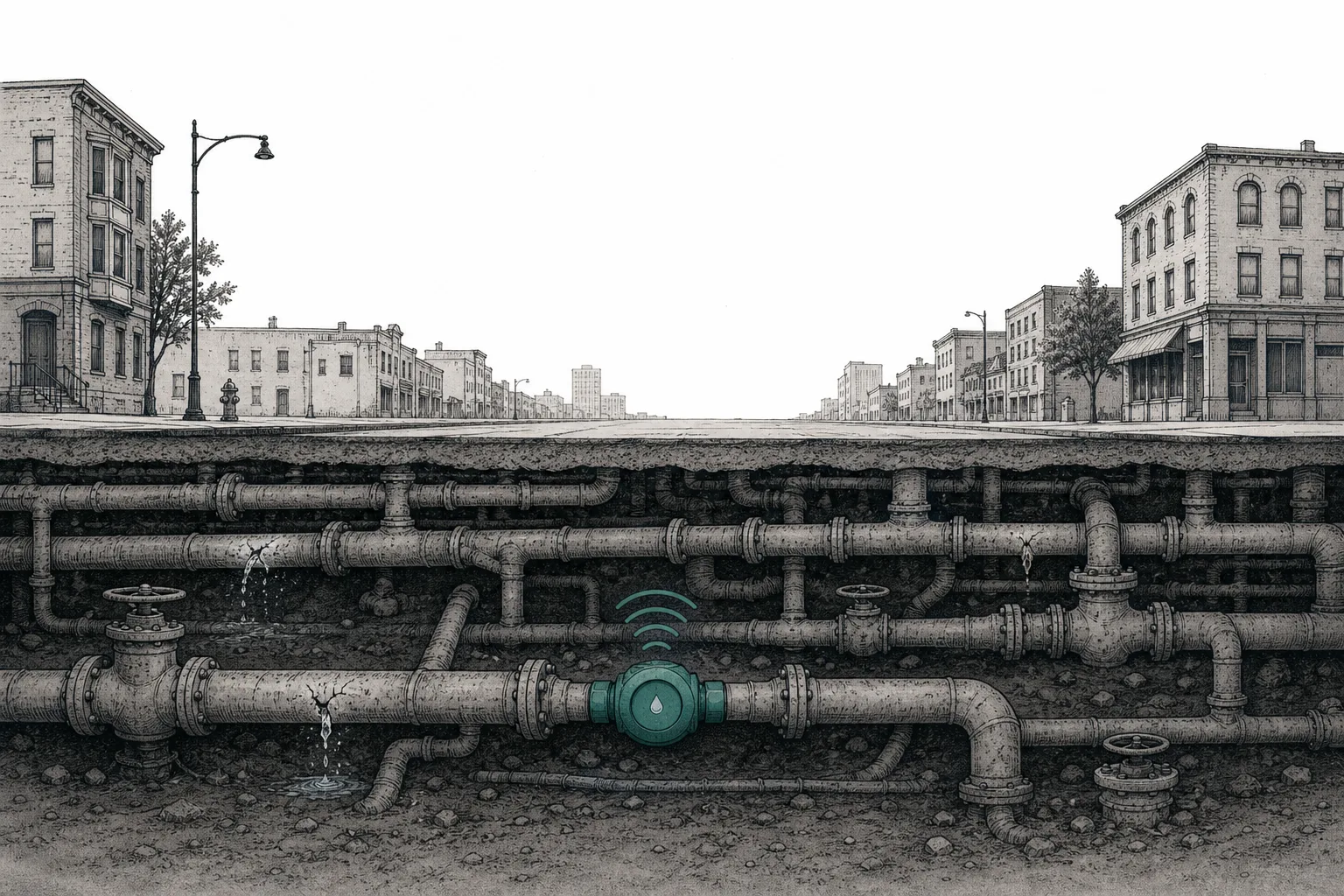
Under every street is a network of pipes, valves, and meters that keeps a whole city alive. But most of it was buried 50–100 years ago and has started to crack and leak — the US loses ~6 billion gallons of treated water a day to leaks. This node is the "physical body" of the water system: pipes and valves (the network) · stormwater systems (handling the heavier rains of a warming planet) · and smart meters (finding leaks and billing accurately). It's the hardware that gets replaced and upgraded as the old structure ages and the climate gets more extreme.
01What is it? (pipes · stormwater · meters)
This chapter's parent node — Water Utilities & Infrastructure — tells the story of the whole water system: "finding, treating, moving, and metering" water. This node focuses on the actual hardware of the moving-and-metering stages — the steel, plastic, and electronics buried underground that get replaced when they age, or when a city wants them to work better. The story splits into three legs that run one after another:
- Pipes and valves (the network): the underground pipe network that carries water, plus valves that open, close, and control pressure, and fire hydrants — these are the "blood vessels" that get replaced one line at a time as they break, leak, or turn out to be lead pipes that have to be ripped out
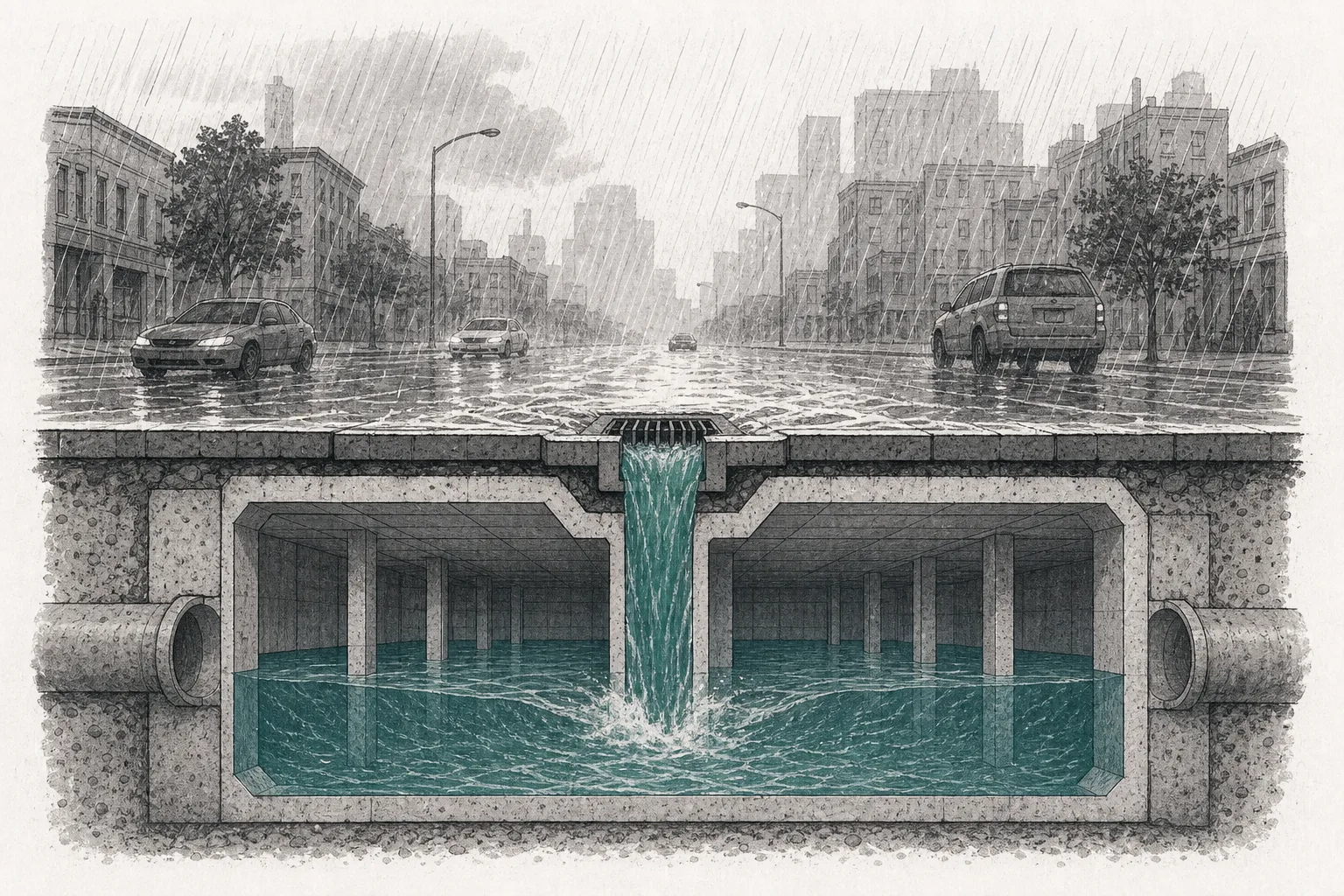
- Stormwater systems: drains, retention basins, and infiltration-filtration systems that handle rainwater — increasingly urgent as the climate brings heavier rain and more flash floods
- Smart metering (AMI): a new generation of water meter that sends readings over radio or cellular, detecting leaks on its own, billing accurately, and letting a whole city "see" the flow of water in real time
Its neighbors are Regulated Water & Wastewater Utilities (the companies that own and run a whole city's system) and Water Treatment & Flow Technology (the pumps, filters, and membranes that make water clean) — if those two siblings are the "owner of the city" and the "one who makes the water clean," this node is the "one who lays and fixes the blood vessels," selling the heavy stuff (pipes and valves) and the smart stuff (meters) to both.
AMR (Automatic Meter Reading) = a meter you can read without walking house to house · AMI (Advanced Metering Infrastructure) = the next step up — it sends readings two-way throughout the day, so you can see hourly usage and catch a leak almost instantly · Non-revenue water (NRW) = water that's been treated and pushed into the system but never billed, most of it from leaking pipes — every piece of hardware in this node is aimed at shrinking this number.
02Why it matters — the old stuff that's failing
Why this boring hardware matters comes down to three words: it's all failing at once. The US has about 2.2 million miles of underground water pipe, most of it laid 50–100 years ago and all "expiring" together. The result is a pipe breaking roughly every 2 minutes, and water that took real effort to treat leaking away — up to ~6 billion gallons a day, or about 2.1 trillion gallons a year that's never billed at all.
This isn't just in a report — it's already been translated into money that's locked in. The EPA estimates it'll take $625 billion over the next 20 years just for drinking-water systems. And there are new rules that mandate replacement: the LCRI rule orders about 9.2 million lead pipes replaced within 10 years — at an estimated $90 billion total (~$4,700 per line on average). This is demand "locked in by law," not just a forecast.
The third leg comes straight from the climate. Abnormally heavy rain and flash floods are getting more frequent, forcing cities to invest in stormwater systems built for "storms stronger than anything designed for before" — the US stormwater management market sits around $8.25 billion in 2025, growing to ~$15 billion in the early 2030s (some firms that include construction work put it as high as ~$54.5 billion in 2030). Add up all three legs — old pipes + heavier rain + smart meters — and this is genuinely a node with "20 years of overflowing work" ahead.
03How it works (the three "legs" of the network)
The easiest way to understand this node is to see it as three legs holding up the same network. Water leaves the treatment plant and enters the pipes and valves that carry it across the city · along the way, stormwater systems catch the storm's excess water to prevent flooding · and at the home, smart meters measure usage and send a signal back to catch leaks. The diagram below traces all three legs at once.
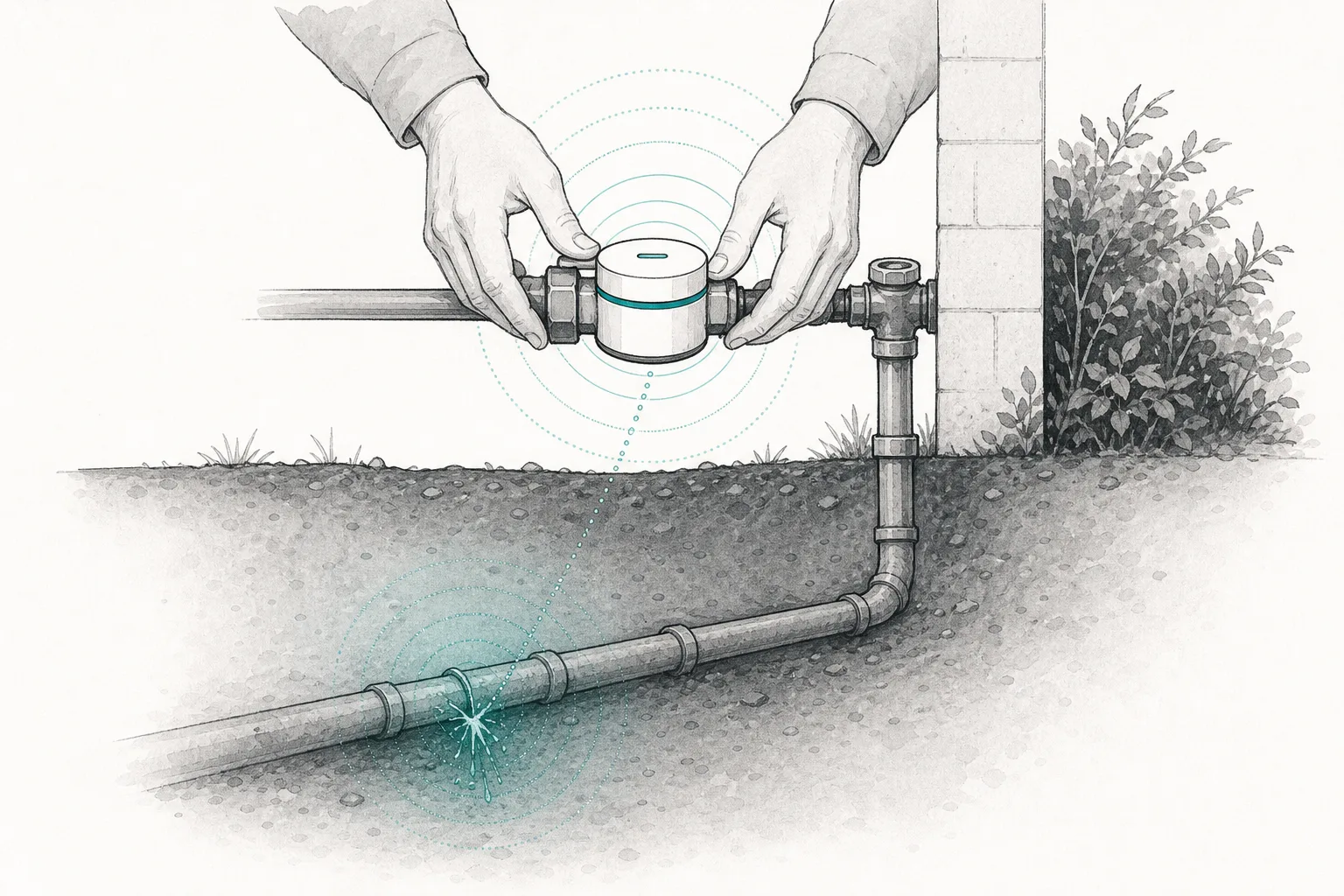
What makes these three legs "smarter" is that smart meters turn a network that used to be invisible into one with data. It used to be that you didn't know a pipe was leaking until the water bubbled up onto the street — but technology like Mueller's EchoShore, which "listens" for the sound of leaks inside the pipe, and AMI meters that see abnormal hourly flow, let you catch a leak before it spreads. That's why the "smart stuff" has become the fastest-growing branch of the node.
04How it connects in the ecosystem
This node doesn't work alone. It's the "hardware layer" that locks together with its neighbors in the same trend and ties inseparably into other trends.
- It's the "body" for Regulated Water & Wastewater Utilities: the water companies that monopolize a whole city are this node's main customers — every dollar a utility invests in replacing pipes and installing meters is a sale for these hardware makers. And because a utility's profit is tied to a growing "rate base," they have every incentive to keep investing
- Paired with treatment tech, Water Treatment & Flow Technology: if treatment tech makes water "clean," this node is the one that "moves" that clean water to the home without losing it on the way — the two branches are each other's upstream and downstream (the treatment side's pumps push water into this side's pipes)
- Meets IoT / edge devices, Edge AI & On-Device Intelligence: smart meters and leak-listening sensors are "edge devices" that process and send data themselves — pieces of the IoT world that have come down underground. The cheaper low-power chips and wireless get, the smarter and cheaper meters become
- Driven by climate threats: heavier rain and worse floods are exactly why stormwater budgets are surging — which makes this node the "hardware of adaptation" within the parent trend Climate Adaptation & Water directly
05Where it stands now
These past few years are when "real" demand started flowing into earnings. Mueller Water Products, the market leader in valves and hydrants, reported FY2025 sales up 8.7%, with its water-management side (which includes hydrants, leak detection, and meters) up 12.2% — a sign that municipalities are rushing to replace gear and buy more "smart stuff."
The smart meter side is especially hot. Badger Meter hit record revenue of ~$917 million in 2025, with software revenue (the BEACON SaaS platform) growing ~28% a year over five years, and it just bought SmartCover to strengthen drain/stormwater monitoring. Meanwhile Itron, which runs AMI across water, electricity, and gas, did about $1.8 billion in the first nine months of 2025 — both benefiting from North American water AMI having only just hit ~40% of the installed base, with plenty of runway left.
On the "heavy stuff" side there's plenty of work too. Advanced Drainage Systems, the market leader in plastic pipe and stormwater systems, did about $2.9 billion in FY2025 (with its Infiltrator brand for on-site treatment), while Core & Main, the water distributor that every pipe-replacement job runs through, did about $7.65 billion, with municipal customers ~44% — numbers that show the "dig and replace" wave is really starting.
06The road ahead
The first direction is smart meters becoming the standard. North American water AMI has only just hit ~40% of the installed base, and the number of endpoints is expected to nearly double to ~77.8 million by 2030 — meaning more than half of homes are still waiting to switch to smart meters. And when a meter is sold as "hardware + a yearly software fee," the recurring revenue keeps supporting players like Badger Meter and Itron.
The second direction is stormwater becoming a rising-star branch. As long as rain keeps falling abnormally hard and flash floods get more frequent, cities have to invest in drains, retention basins, and infiltration-filtration systems designed for "stronger storms than before" — the US stormwater management market is expected to grow from ~$8.25 billion (2025) into the tens of billions by the early next decade, a tailwind coming straight from the climate.
The third direction is a decade of "ripping out lead pipes." The LCRI rule, which mandates replacing ~9.2 million lead pipes within 10 years, is a huge job with a legal deadline — work that supports pipe makers, contractors, and distributors like Core & Main for years to come. It also opens the door for pipe condition assessment technology, which helps prioritize which lines to rip out first, to grow alongside it.
07Challenges & risks
Water-system hardware may look "solid," but it carries specific risks you need to understand.
The first risk is the municipal budget cycle. This node's main customers are cities and water companies spending tax money and water rates, so investment is tied to budgets and local politics. When the economy is tight or politics holds water rates down, a municipality may delay a pipe-replacement project — long-term demand is certain, but the timing of the spending can swing from year to year (clearly visible in ADS's pipe sales, which swing with the construction cycle).
The second risk is raw-material cost and supply chain. Pipes are made from cast iron, copper, and polymers (plastic resin), and meters need chips and electronic components — raw-material prices and chip shortages hit cost and margins directly. Makers that rely on plastic resin are also especially sensitive to oil and natural-gas prices.
The third risk is competition and dependence on a few customers. On the smart-meter side, big players like Badger Meter, Itron, and Xylem/Sensus compete on communication standards and software, and picking the wrong standard can cost a whole city's deal. On the heavy-stuff side, big deals tend to concentrate in a few large municipal projects — if one of them slips, revenue takes the hit right away.
In short: this node is the physical body of the water system — the pipes and valves that carry, the stormwater systems that hold off floods, and the meters that make it all smarter. It's the hardware that keeps getting replaced and upgraded as the old structure ages and the climate gets more extreme — and its very boringness is the reason its demand is one of the most certain in the economy.