Megatrend · Climate Adaptation & Water
The most boring business in the world — and global warming is turning it into gold
Finding water, cleaning it, moving it, metering it. It sounds like work nobody wants to talk about. But it's a natural monopoly with fairly predictable revenue, it can raise prices with inflation, and it's about to have 20 straight years of overflowing work — because pipes worldwide are so old they leak away more than 30% of the water they've already treated, and the droughts and floods of a warming planet are forcing every country into the biggest reinvestment in a century.
01What is it? (and its 3 branches)
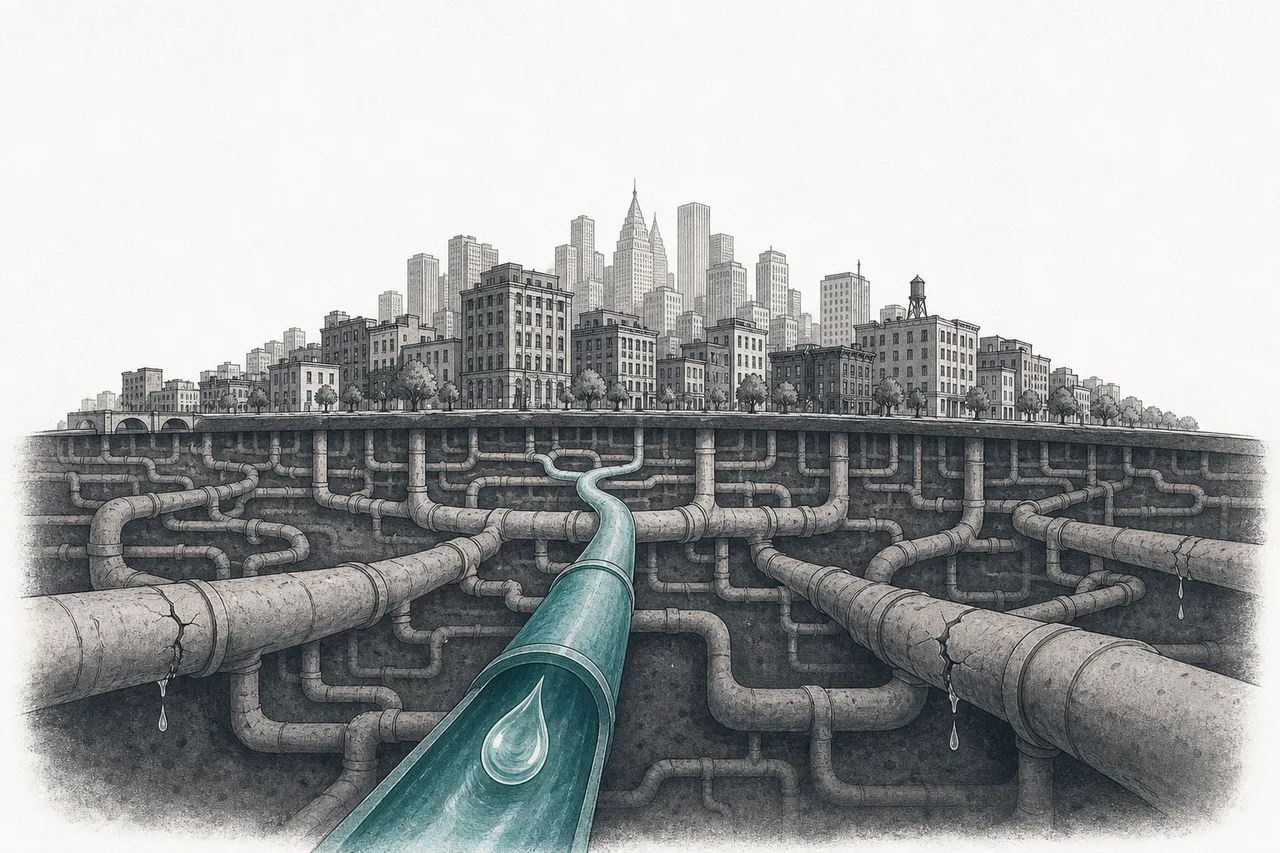
Think about what happens when you turn on the tap. The water that comes out has traveled through one of the largest, oldest systems humans have ever built — pumped up from a source, treated clean, moved through hundreds of kilometers of underground pipe, then metered so you can be billed for what you use. That's the whole of what this node is about: the business of moving, cleaning, and measuring water.
It's a sub-theme under the Climate Adaptation & Water megatrend, and you can think of it as the "core utility of adaptation." When warming turns water into a problem — worse droughts, more frequent floods — the system that manages water well is a city's first line of defense.
The whole story splits into 3 branches that run together as a single conveyor belt — and this lesson tells all three at once, because they're parts of the same machine:
- Water utilities (regulated utility): the company that owns and runs a whole city's water and wastewater system, and bills your home. This is the Regulated Water & Wastewater Utilities branch
- Treatment and flow technology: the pumps, filters, membranes, and chemicals that turn dirty water into something you can drink. This is the Water Treatment & Flow Technology branch
- Pipes, stormwater, and smart meters: the underground pipe network, the stormwater systems, and the meters that read themselves and catch leaks. This is the Pipe, Stormwater & Smart Metering branch
Water is a "natural monopoly" — nobody is going to lay two sets of pipes under the same street so you can pick a brand of water. So the government lets one company hold a local monopoly, in exchange for water prices having to be approved by a regulator. The company invests to build the system, then earns an approved percentage on that investment as profit — and this model is the heart of why this group's revenue is so steady.
02Why something boring turns to gold
Investors care about this group not because it's sexy, but because it's a textbook "defensive compounder" — a business that grows slowly but very surely. Good economy or bad, people still need water and pay for it, and water rates can usually rise with inflation, which makes the revenue tough through any conditions.
But what turned this group from "boring" into "interesting" is the huge wave of investment coming. Most developed-world water systems were laid down 50 to 100 years ago, and now they're all "expiring" at once. In the US alone, the EPA estimates it'll take $625 billion over the next 20 years just for drinking-water systems — wastewater not included.
Europe is no different. In the UK, the regulator Ofwat approved a new round of investment (called AMP8, 2025–30) worth ~£104 billion — nearly double the previous round (~£51 billion). Severn Trent alone got the green light for £14.9 billion over five years. And the global water and wastewater treatment market is growing from ~$372 billion in 2025 to ~$691 billion in 2035 (about 7.5% a year).
The key to all this is the "rate base". The more a water company invests in building and fixing its system, the bigger that base grows — and because the regulator lets the company earn a percentage on that base, the enormous investment about to happen translates directly into predictable, growing profit. Twenty years of overflowing work = growth you can see the end of.
03How it works (the journey of water)
To see where the money and the business sit, you have to follow the water from source to tap. A single drop passes through 4 stages, and at each stage a different group of companies makes money — the diagram below is the whole "water value chain."
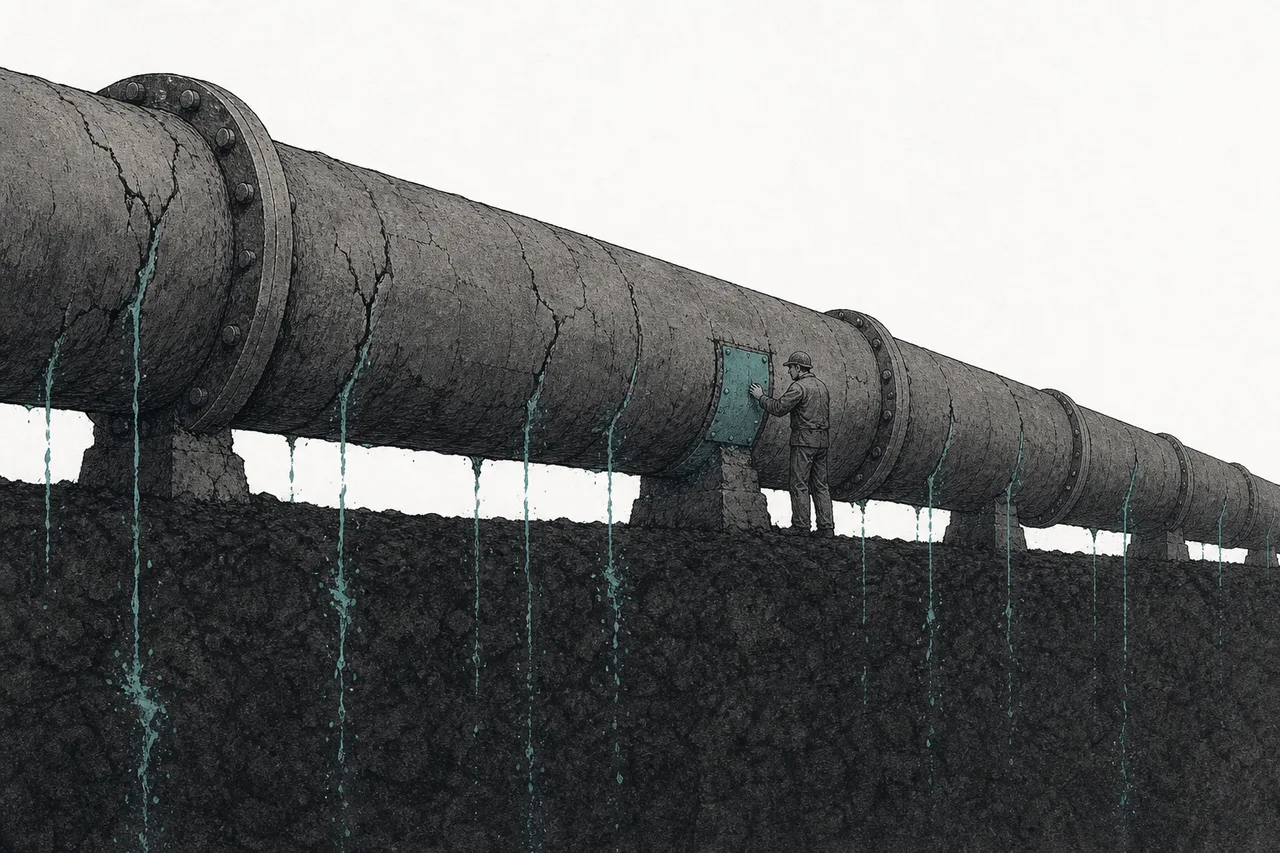
The most interesting part of this diagram is the dark box in the middle — stage 3, "move it through pipes." This is where the water you went to all that trouble to treat leaks away — about 30% of it — before it reaches your home. Think about how strange that is: a water company spends money and energy pumping water up, kills the germs until it's clean, then lets a third of it seep into the ground through cracked and leaking pipes. This isn't just a problem — it's the single biggest business opportunity in the whole node, because every drop you stop from leaking is water you can sell without producing any more.
Short name: NRW — water that's been treated and pushed into the system but never billed. Most of it comes from leaking pipes (physical loss); the rest from meter errors and water theft. Worldwide this number sits around 30–34%, and in cities with very old systems it can top 50%. In the US alone, this water loss costs operators about $6.4 billion a year — and all of that is the market for leak-detection tech and smart meters.
04Inside the 3 branches: pipes · treatment · meters
Now let's look up close at what each stage in the diagram actually is, and who owns the money — because even though all three sit on the same belt, their "business personalities" are very different.
Branch 1 — Regulated Water & Wastewater Utilities
This is the "owner of the city" — the company that owns the entire system, from treatment plant to pipe, and sends you a water bill every month. Revenue is certain because of the local monopoly, and profit is regulated by the state. The appeal is stability and dividends, not flashy growth. The clearest example is American Water Works, the largest regulated water utility in the US, serving over 14 million people and planning to invest $40–42 billion over 10 years to upgrade its system — every dollar spent is a bigger profit base.
Branch 2 — Water Treatment & Flow Technology
If the first branch is the "owner of the city," this branch is the "equipment seller" — the pumps, valves, filters, membranes, and chemicals that turn dirty water into drinking water. This business is not a monopoly and isn't price-regulated, so it grows faster and can profit from innovation. The global players are Xylem (sales around $8.9–9 billion in 2025, focused on pumps and treatment systems), Veolia, the French giant (total revenue €44.4 billion in 2025, the largest private water operator in the world), and Ecolab, strong in water-treatment chemicals for industrial plants. This is also the home of desalination (turning seawater into fresh water), a market growing from ~$24 billion (2025) to ~$58 billion (2033).
Branch 3 — Pipe, Stormwater & Smart Metering
This is the branch that answers the "30% pipe-leak problem" head-on. It splits into two sides. The "heavy stuff" side is new pipe, replacing old lead pipes, and stormwater/flood-management systems (increasingly important as warming brings abnormally heavy rain) — replacing about 9.2 million lead pipes in the US alone is estimated at ~$90 billion. The "smart stuff" side is the smart meter that reads itself and detects leaks in real time. This is the fastest-growing of the three branches (~12.5% a year). The players here are companies like Xylem (which bought Sensus to make meters) and pipe-laying contractors like Ferguson and MasTec. On the "smart" side are smart-meter leaders like Badger Meter and Itron, whose software revenue (AMI/SaaS) is growing fast, while Mueller Water Products and distributors like Core & Main take the big pipe-and-valve replacement jobs — North American water AMI has only just hit ~40% of the installed base, so there's a long runway (see → Pipe, Stormwater & Smart Metering).
05How it connects in the ecosystem
This node sits under the Climate Adaptation & Water megatrend and is a sibling of other adaptation nodes like Drought, Wildfire & Flood Resilience and Waste Management & Circular Economy — because managing floods and droughts, and treating wastewater for reuse, are the same story seen from a city's point of view.
But what's interesting is the lines it draws to other trends:
- Partner to Energy Transition & Power Demand: pumping and treating water eats enormous amounts of electricity — water systems are among a city's biggest power users. So the two trends are tightly linked (it's called the "water-energy nexus"), and cheaper power from clean energy lowers a water company's biggest cost
- Meets Smart City / Autonomous Infrastructure at the meter: smart meters and leak-detection sensors are pieces of the smart city — real-time water data flows into the same city-management system
- Depends on Critical Materials & Supply Chain: pipes, pumps, and filtration membranes need steel, copper, and special polymers — raw-material prices hit the cost of building the system directly
- Competes with Carbon Removal (DAC) to be the answer: both are "adaptation/climate-fix technologies" fighting over investment budgets and attention — but water systems have the edge of being directly essential to daily life
06Where it stands now
These past few years are when "boring" became big news. In the US, the deal that shook the industry was American Water Works announcing a merger with Essential Utilities (late 2025), creating the largest regulated water utility, with a combined rate base of about $29.3 billion — a sign that this business is consolidating to meet the investment wave that's coming.
The UK has formally entered the AMP8 investment round (2025–30). Companies like Severn Trent and United Utilities are starting to spend the biggest sums in their history — but amid strong pressure over sewage overflows and rising water bills. On the tech side, Xylem and Veolia are selling well, riding the surging investment budgets of utility customers worldwide.
The players in this group are spread across the world with clearly divided roles — and we arrange them by their role in the value chain (who controls which branch) rather than raw market cap, because many of them are conglomerates doing several things:
07The road ahead
The first direction is a decade of "dig and replace." The investment wave the EPA and Ofwat have approved ($625B in the US, ~£104B in the UK) will be spent gradually over the next 5–20 years — meaning pipe-laying contractors and equipment makers have a long backlog of work, while utilities see a predictably growing profit base. This is the "boring but stable" that becomes the selling point.
The second direction is water becoming a data business. Smart meters and leak-detection sensors are turning an "invisible" water system into a network with real-time data. Cutting leaks from 30% to 15% without building a single new treatment plant is the biggest pool of "free water" you can find — and it's the fastest-growing branch.
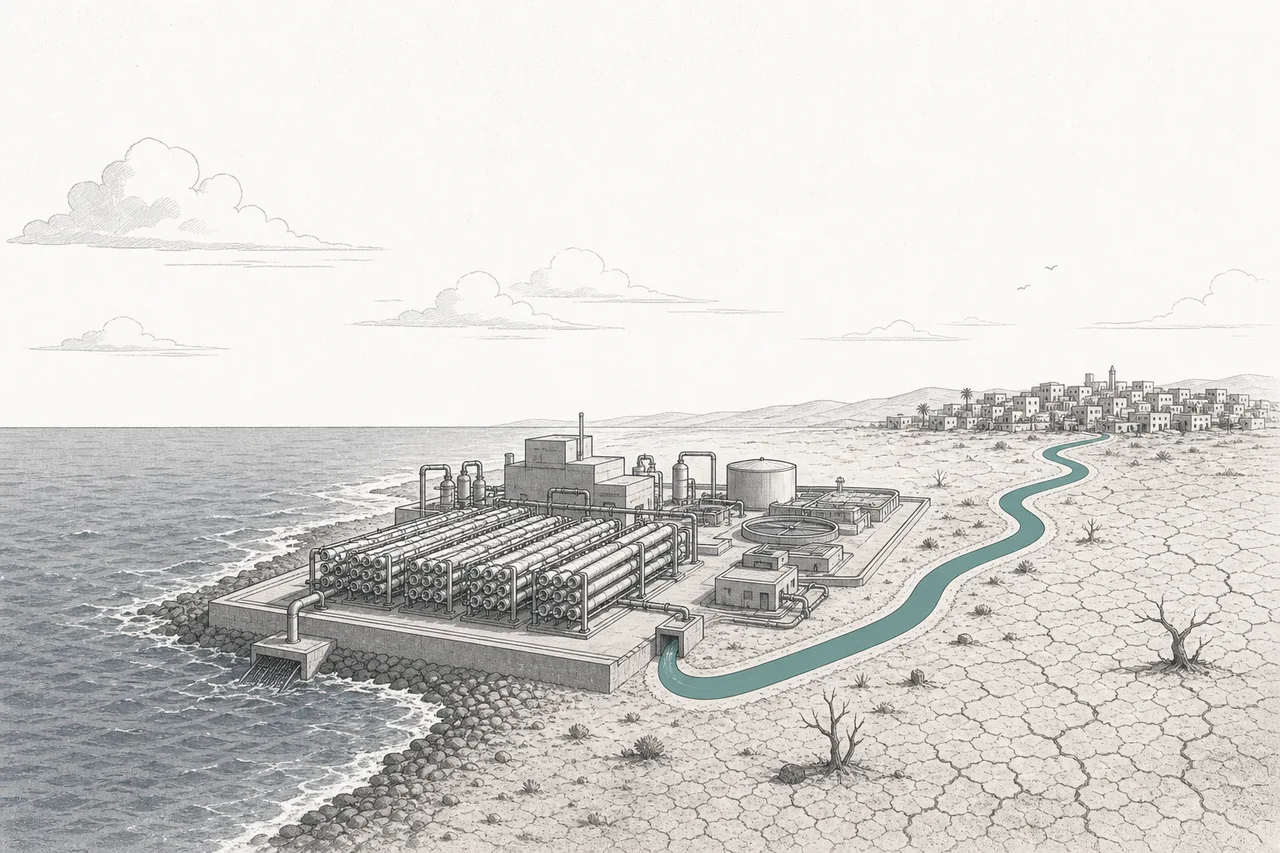
The third direction is creating new water from where there was none. As warming-driven droughts get worse, water-short cities will turn more and more to desalination (distilling seawater) and water reuse (treating wastewater to use again, including for drinking). These two technologies used to be too expensive, but their cost is steadily coming down — and in some regions (the Middle East, Singapore, California) they've already become a primary water source.
08Challenges & risks
The stability of the water group comes with its own specific risks you need to understand.
The first and biggest risk is regulatory / rate-case risk. A water utility's profit depends on the regulator approving rate increases and a return on its investment. If cost-of-living politics push the state to hold rates down, a company may have already invested but can't recover it as expected. The UK is a clear lesson — anger over sewage overflows and expensive water put the whole industry under political pressure.
The second risk is heavy capital intensity. This is a business that has to invest enormous sums up front, years before the profit comes back. When interest rates are high, the cost of these big borrowings rises and squeezes returns — so a utility carrying a lot of debt is especially sensitive to where rates go.
The third risk is drought and extreme weather — a double-edged sword for this group. On one hand, warming creates demand to invest; on the other, severe drought makes people use less water (sales fall) even as the company has to invest in costlier new water sources, and severe flooding damages infrastructure beyond what it was designed for.
In short: water is a business nobody wants to talk about until the tap runs dry — but in a world that's getting hotter, with aging pipes and growing cities, moving, cleaning, and saving water is becoming one of the biggest and most essential infrastructure jobs of the century. Its very boringness is the reason it's so durable.