Megatrend · Climate Adaptation & Water
How dirty water becomes drinking water — and who sells the "machines" that make it happen
The water utility owns the pipes and sends the bill to your house. But they don't build the pumps, membranes, or UV lamps that actually clean the water — they buy those from a different group of companies. This is the "picks and shovels" of the water world: the technology that actually cleans and moves the water. It's a market worth hundreds of billions of dollars a year, growing on PFAS "forever chemical" rules, water recycling, and desalination — and unlike utilities, it isn't price-regulated, so it can profit from innovation.
01What it is
In the Water Utilities & Infrastructure lesson, we split the water business into three arms. This node is the second arm — treatment and pumping technology. To picture it clearly, split the roles like this: the water utility (arm 1) is the "city owner" that owns the system and sends the bill home · pipes and meters (arm 3) are the "veins and gauges" · but this node is the "machine" that actually cleans and moves the water.
More precisely, it's the companies that build and sell four main groups of "equipment + services" to water utilities, factories, and municipalities worldwide:
- Pumps & valves (pumps & flow): the heart of the word "flow" — what moves the water across the whole system, from pumping it out of the source, pushing it through the treatment plant, to pumping wastewater back. No pump, no water goes anywhere
- Filtration & membranes: multi-layer filters and membranes with nano-tiny pores. The core is reverse osmosis (RO), which pushes water through a membrane to filter out even salt and contaminant molecules
- Disinfection: the step that makes water "germ-free" — both UV light that destroys microbes' DNA and treatment chemicals (like chlorine and conditioners)
- Analytics: sensors and instruments that constantly measure water quality — is it clear, is there contamination, are the values within range
This node sits in the "supply-chain layer" — it makes the tools that everyone else uses. Its two siblings on the same conveyor belt are Regulated Water & Wastewater Utilities (the regulated water providers — this node's biggest customer) and Pipe, Stormwater & Smart Metering (pipes, stormwater systems, and meters) — if the utilities are the "ones who run the system," this node is the "one who builds the machines" that hold that system up.
A membrane is a filter sheet with pores just a few nanometers wide — small enough to block even particles and salt · Reverse osmosis (RO) is using a high-pressure pump to push water through that membrane — dirt, salt, and contaminants are blocked, and only pure water gets through. It's the same technology used to turn seawater into fresh water, and the reason "pumps" and "membranes" almost always come as a pair — RO uses about 2.5–4 units of power per cubic meter of water, versus 10–15 units for old-style boil-distillation.
02Why it matters — the picks and shovels of the water world
There's a classic line in investing: in a gold rush, the ones who get rich aren't the miners, but the people selling picks and shovels. The water world is the same. No matter which city's utility makes a big investment, no matter which chip plant or data center needs pure water, no matter which drought-hit city turns to desalination — everyone has to buy the pumps, membranes, UV lamps, and chemicals from this node first. It's the layer that sells picks to everyone on the water field.
The size of the market reflects this clearly. The global water and wastewater treatment market was about $372 billion in 2025, and is expected to grow to ~$691 billion by 2035. The heart of this node is filters, which hold the largest share (~28% of the equipment market), with membrane technology at the core of about one in three installations worldwide.
But what makes this node more interesting than the utilities is that it isn't price-regulated. While a water utility has to get its rates approved by the government (profit capped), water-treatment technology companies sell in a free market — the better and more energy-efficient the product, the better the price it can command. The result: this group grows faster and at higher margins — in exchange for sales being more tied to customers' "investment cycles." That's why investors see this node as the "growth accelerator" of the water sector, not the "defensive play."
03What it is (treatment & flow technology)
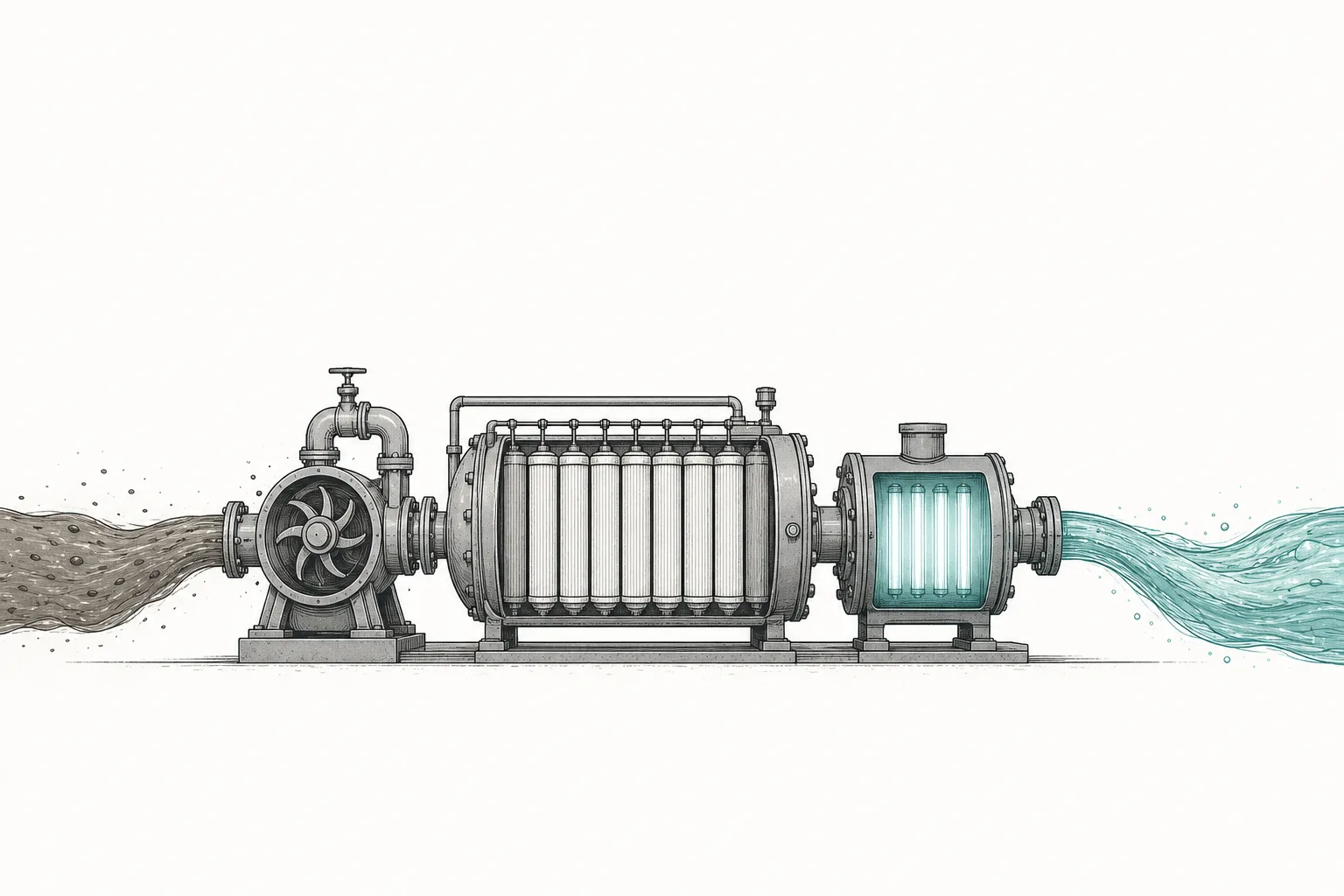
Most people think "cleaning water" is a single step. But really it's a treatment train — a set of machines connected like a conveyor belt. Raw water flows in one end, passes through several stages, and comes out clean water at the other, with pumps driving the water through every stage. Let's follow it step by step to see how one drop of murky water becomes drinking water.
The dark box in the middle — stage 3, the RO membrane — is the heart of modern water technology. It's the stage that turns water that's "merely clear" into water that's "truly pure," filtering out even salt and molecular-level contaminants. And because RO needs a high-pressure pump to push water through the membrane, it's the reason "pumps" and "membranes" are practically the same business — whoever is good at both controls the heart of the treatment train from end to end.

04Where it sits in the ecosystem
This node is the "machine seller," so it works inseparably with its neighbors both inside and outside the water sector.
- Sells to the regulated water providers as its main customer: when a water utility gets the green light to invest in system upgrades (like the U.S. $625 billion plan or the U.K. £88 billion plan), part of that money flows directly into orders for this node's pumps, membranes, and treatment systems — the utility's capex = our sales
- Pairs with pipes, stormwater, and meters: the treatment gear cleans the water, the pipes carry it, the meters measure it and catch leaks — these three arms make up one system. They also meet at the "real-time water data" that analytics sensors and smart meters feed into the same system
- Depends on Materials & Specialty Chemicals: RO membranes are made from special polymers, and water treatment uses large amounts of high-purity chemicals — so this node depends directly on specialty materials and chemicals. Chemical companies like DuPont, Toray, and Asahi Kasei are both membrane suppliers and players in the water market themselves
- Supplies pure water to Semiconductors and data centers: chip plants use enormous amounts of "ultrapure water," and AI data centers need cooling water — both are the fastest-growing industrial customers of water-treatment technology right now
05Where it stands now
The biggest story in this field over the past few years is the PFAS revolution — the "forever chemicals" that contaminate water sources worldwide and are very hard to remove. In April 2024, the U.S. EPA issued the first-ever drinking-water standards regulating PFAS, requiring about 4,100–6,700 water systems serving 83–105 million people to install PFAS filtration technology by 2029 — a whole new block of demand landing on this node.
At the same time, the industry is consolidating in a big way. The lead player of this node is Xylem, which in 2023 bought Evoqua for $7.5 billion, becoming the largest "pure-play" water technology company in the world, complete with pumps, treatment, and meters — with 2025 revenue around $8.5 billion, growing steadily on the capex of utility customers worldwide.
Another move is the spin-off to focus on water. In late 2023, Danaher spun Veralto out as an independent company, built around its "water quality" businesses (Hach for water-quality measurement, Trojan UV for disinfection, ChemTreat for chemicals) — with 2025 revenue around $5.5 billion, over 60% of it from the water side. Meanwhile Ecolab, the king of water-treatment chemicals, posted water-group revenue of $7.48 billion in 2025, growing strongly from "high-tech" customers (chip plants/data centers) that need pure water.
06The road ahead
The first direction is desalination and water reuse going mainstream. As climate-driven droughts get worse, water-short cities turn more to desalination and water reuse (treating wastewater to use again) — both of which use this node's RO technology directly. The desalination market is growing from ~$24 billion (2025) to ~$58 billion (2033) at about 11.6% a year, with RO holding over half the share because it's 3–4× more energy-efficient than boil-distillation.
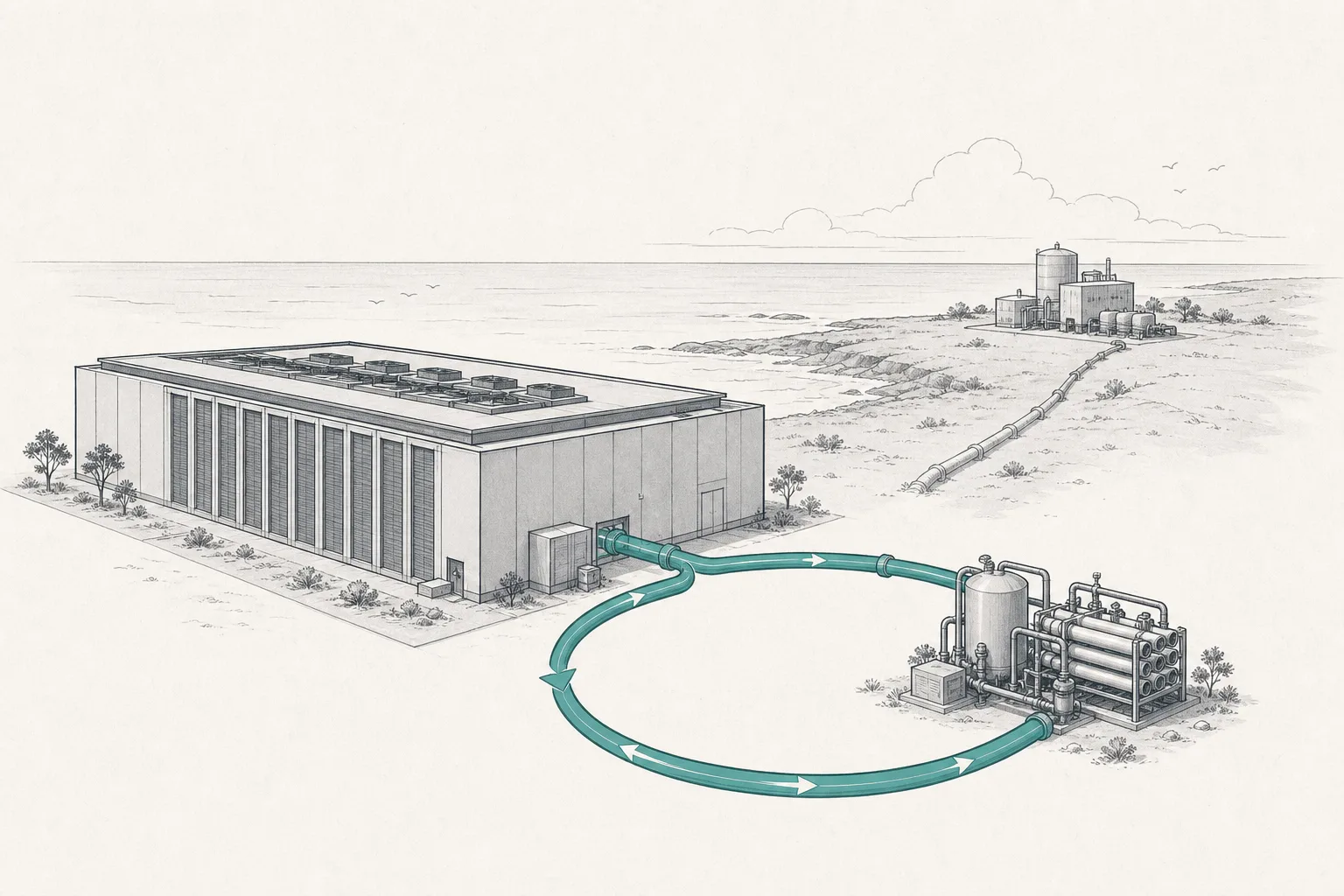
The second direction is industrial water and data centers becoming a new engine. Chip plants use enormous amounts of ultrapure water, and AI data centers need cooling water — but water stress is pushing the tech giants to recycle their own water harder. AWS, for example, is targeting 800 million gallons of recycled water a year by 2030. Every recycling system like this is more orders for membranes, pumps, and treatment systems.
The third direction is water becoming a matter of data and AI. Water-quality sensors and analytics software (the side that Veralto/Hach and Xylem invest in heavily) are making treatment plants run more precisely and efficiently — auto-adjusting chemical doses, catching anomalies before water goes bad, and predicting which membrane is about to clog. "Services" and "digital" are becoming the highest-margin and fastest-growing part of many companies in this group.
07Challenges & risks
The first risk is the customer capex cyclicality. Unlike utilities with steady revenue, this node sells big-ticket items that customers buy in cycles — municipal capex rises and falls with politics and budgets, and industrial customers slow their orders when the economy weakens. You saw it in 2025, when Pentair's Water Solutions revenue shrank, against a growing pool side — so revenue is more volatile than a utility's.
The second risk is competition and raw-material costs. This market isn't a monopoly; it has many players, from global giants to specialist membrane makers. Price competition can push margins down. On top of that, membranes and pumps need special polymers, metals, and energy — volatile raw-material prices and electricity costs hit costs directly (and RO is itself an energy-hungry technology, so the energy bill is both a cost to the customer and a selling point for whoever can build the more efficient machine).
The third risk is regulation as a double-edged sword. Rules like PFAS create enormous demand — but they depend on political will. If standards get delayed, eased, or rolled back (as the EPA once proposed extending the compliance window), the big block of demand the market expected may arrive later than thought. So investors need to separate "demand already mandated and real by rule" from "demand still waiting on a political decision."
In short: this node is the machine that actually cleans and moves the water. In a world where clean water is getting scarcer, rules are getting stricter, and industry is thirstier for pure water, the ones who sell the water's "picks and shovels" sit in a good spot — with demand pushed up by both climate change and regulation at once.