Megatrend · Climate Adaptation & Water
The business where investing more means bigger profits — and the government guarantees it
Regulated water and wastewater companies are the strangest "defensive monopoly" in the stock market — slow-growing, boring, recession-proof, but with a special mechanism: every dollar they spend replacing old pipe gets approved by the government into a "capital base," and they're guaranteed a fixed percentage return on that base. Put simply, the more they invest, the more predictably their profits grow. And right now there are lead pipes to replace, PFAS to filter, and small systems to consolidate — decades of work piled up ahead.
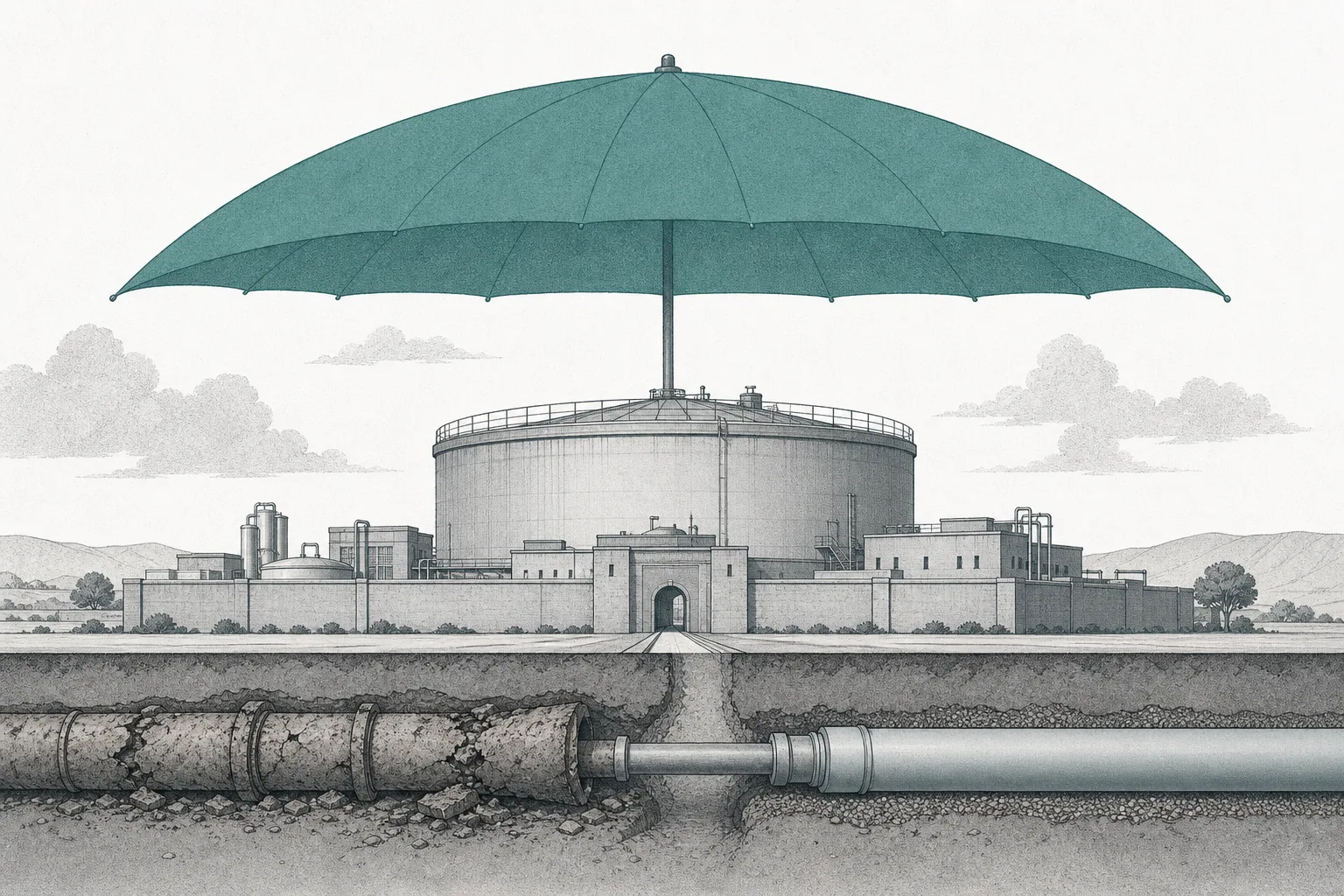
01What it is
When you turn the tap and clean water flows out, or flush the toilet and the wastewater disappears into the pipe — behind both is the same company. The company that owns and runs the whole city's water and wastewater system — from pumping up raw water, treating it, sending it through hundreds of kilometers of underground pipe, all the way to collecting the wastewater back for another round of treatment, then mailing you a water bill every month. That's everything this node is about.
It's a leaf under Water Utilities & Infrastructure in the Climate Adaptation & Water megatrend — and it's the branch that truly "owns the city." What sets it apart from an ordinary business is one word: "regulated". Nobody is going to lay two sets of water pipes under the same street so you can pick a water brand. Having a single provider is therefore a "natural monopoly" — the government allows the local monopoly in exchange for every penny of the water rate needing regulatory approval.
Importantly, you have to clearly separate it from its two sibling branches next door — this branch doesn't sell equipment or sell technology, it sells the whole "water service" system. It's the big customer that buys pumps, valves, and membranes from Water Treatment & Flow Technology, and buys pipe and smart meters from Pipe, Stormwater & Smart Metering, to assemble its own system — this lesson focuses on that "system owner."
A utility business where the government grants a local monopoly but controls its prices and profits. The company invests to build the system, and the regulator (in the U.S., each state's Public Utility Commission; in the U.K., Ofwat) allows it to earn a set percentage on its investment, rather than letting it price freely. This model trades a "profit ceiling" for "revenue certainty" — and it's the heart of this entire lesson.
02Why it matters — a monopoly that holds up in any climate
The reason investors call this group a "defensive compounder" starts from one simple truth: water is something people can't stop using. Good economy or crashing one, people still drink, bathe, and flush. The water bill is a small charge no one cancels. The result is that this group's revenue barely moves with the economic cycle — which is very rare in the business world.
But what changed it from "boring" to "interesting" is the massive wave of investment coming. Most of the developed world's water systems were laid 50–100 years ago and are now "expiring" all at once. For U.S. drinking-water systems alone, the EPA estimates $625 billion of investment over the next 20 years — and that doesn't even include two big jobs the law just mandated: replacing lead pipes and filtering out PFAS.
New 2024 rules crank it up further — the EPA mandated replacing the nation's lead pipes within 10 years (estimated cost around $80 billion) and set the first-ever standard limiting PFAS, the "forever chemicals," in drinking water. Neither is optional — they're "must-dos" — and every water company has to invest to comply. Under the rate-base model, this mandated investment is exactly the fuel for growth.
The U.K. tells the same story with numbers just as big. The regulator Ofwat approved a new round of investment (called AMP8, covering 2025–2030) totaling ~£104 billion — nearly double the previous round (~£51 billion). Severn Trent alone got the green light to invest £14.9 billion over five years — "piled-up work" is the most accurate description of this industry right now.
03How it works (the rate-base machine)
This is the heart of the whole lesson, and the mechanism that makes this business strange in a good way — because it flips ordinary business logic on its head. Normally, "invest more = more risk." But for a regulated water utility, "invest more = guaranteed bigger profit." Let's walk through, step by step, how this cycle turns.
The key is the dark box in the middle — rate base (the capital base). It's the value of all the assets the company has invested in and are "used and useful" in providing service. The regulator allows the company to earn a set percentage on this base — called the allowed return on equity (ROE), which in the U.S. lately runs around 9.5–10%. So the business equation is startlingly simple: however much the rate base grows, profit grows by that same percentage.
Rate case = the process where a company files with the regulator to request a change in water rates and get its return approved. It takes about 12–18 months, with the company's witnesses, government staff, and consumer representatives all hashing it out · Allowed ROE = the percentage return on equity the government "approves it to collect" — this number matters enormously, because a difference of just 0.5% in ROE on a rate base of tens of billions can mean tens of millions of dollars of profit a year.
This explains why "20 years of piled-up work" is good news for this business, not bad — because the wave of investment to replace pipe, filter PFAS, and fix systems is the huge rate base about to be approved into the capital base. The clearest example is American Water Works, which has laid out an investment plan of $40–42 billion over 10 years and expects to push its rate base to grow 8–9% a year — which translates directly into earnings-per-share growing at a similar pace.
04Where it sits in the ecosystem
If you see the whole water value chain as one conveyor belt, this branch is "the owner of the belt" — the one that owns the whole system and decides what to buy to assemble it. So it's the big customer feeding money to its two sibling branches, and it connects out to other trends as a user.
- Buys technology from Water Treatment & Flow Technology: pumps, valves, membranes, filters, and the PFAS filtration systems that turn dirty water into drinking water — this branch doesn't make it all itself, but buys from specialists like Xylem or Veolia to assemble
- Buys pipe and meters from Pipe, Stormwater & Smart Metering: new pipe, lead-pipe replacement, and smart meters that catch leaks on their own — the utility's wave of investment is this branch's revenue directly. So the two branches feed each other
- Partner with Energy Transition & Power Demand: pumping and treating water eats enormous amounts of electricity, and the power bill is one of a water company's biggest costs (it's called the "water-energy nexus") — interestingly, water utilities are financial "cousins" of electric utilities, because both use the exact same rate-base model
- Depend on Critical Materials & Supply Chain: pipe, pumps, and membranes need steel, copper, and special polymers — raw-material prices hit the cost of building rate base directly
05Where it stands now
The deal that shook the industry most happened in late 2025 — American Water Works announced a merger with Essential Utilities, the two largest regulated water companies in the U.S., combining into one company with a market cap of about $40 billion, serving 4.7 million connections across 17 states, with a combined rate base of about $29.3 billion. This is a clear signal that this business is "consolidating" to absorb the wave of investment coming (the deal is expected to close in early 2027).
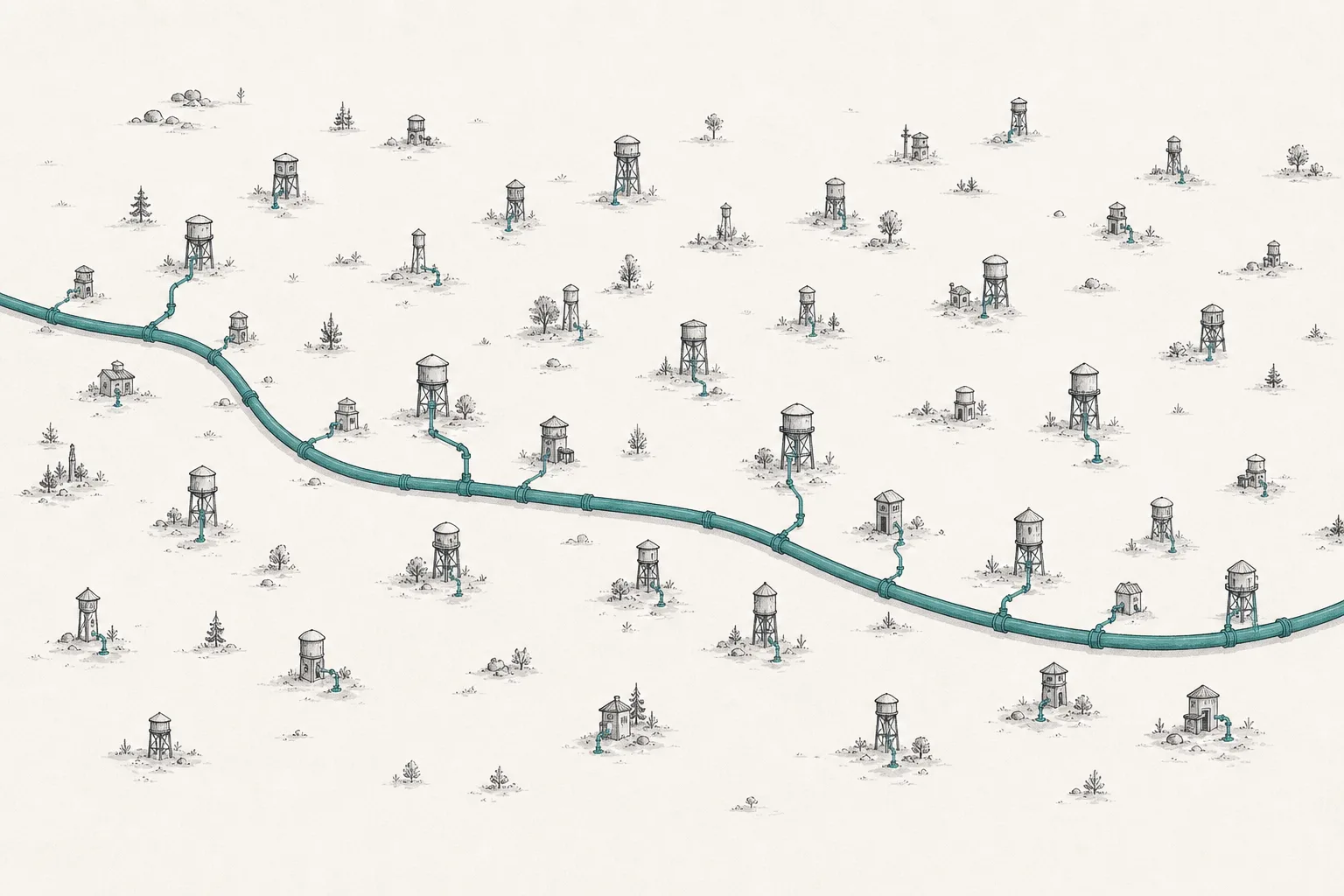
Why is consolidation a big deal? Because the U.S. has about 50,000 scattered community water systems, most of them small municipalities where more than half serve fewer than 500 people. These small systems don't have the money or expertise to replace lead pipes or install PFAS filtration on their own — compared with the U.K., which has only ~32 water companies serving 64 million people. This gap is why big players like American Water keep buying up small systems into their portfolio, and the PFAS/lead-pipe rules push small systems to "sell out" even faster.
The U.K. has officially entered the AMP8 investment round (2025–2030). Severn Trent, United Utilities, and Pennon are starting to spend the largest sums in their history — United Utilities raised its investment plan to about £11.5 billion — but amid political pressure over sewage overflows and rising water bills. Meanwhile a global player like Veolia (total revenue €44.4 billion in 2025, supplying drinking water to 110 million people worldwide) is the largest private water operator, showing this model is big and can cross continents.
The U.S. also has a group of "Dividend Kings" that have raised their dividend for over 50 years straight — American States Water (70+ years, the longest on the market), California Water Service, and SJW Group — proof that this business's "boring but stable" really does pay steady returns across many decades and many crises.
06The road ahead
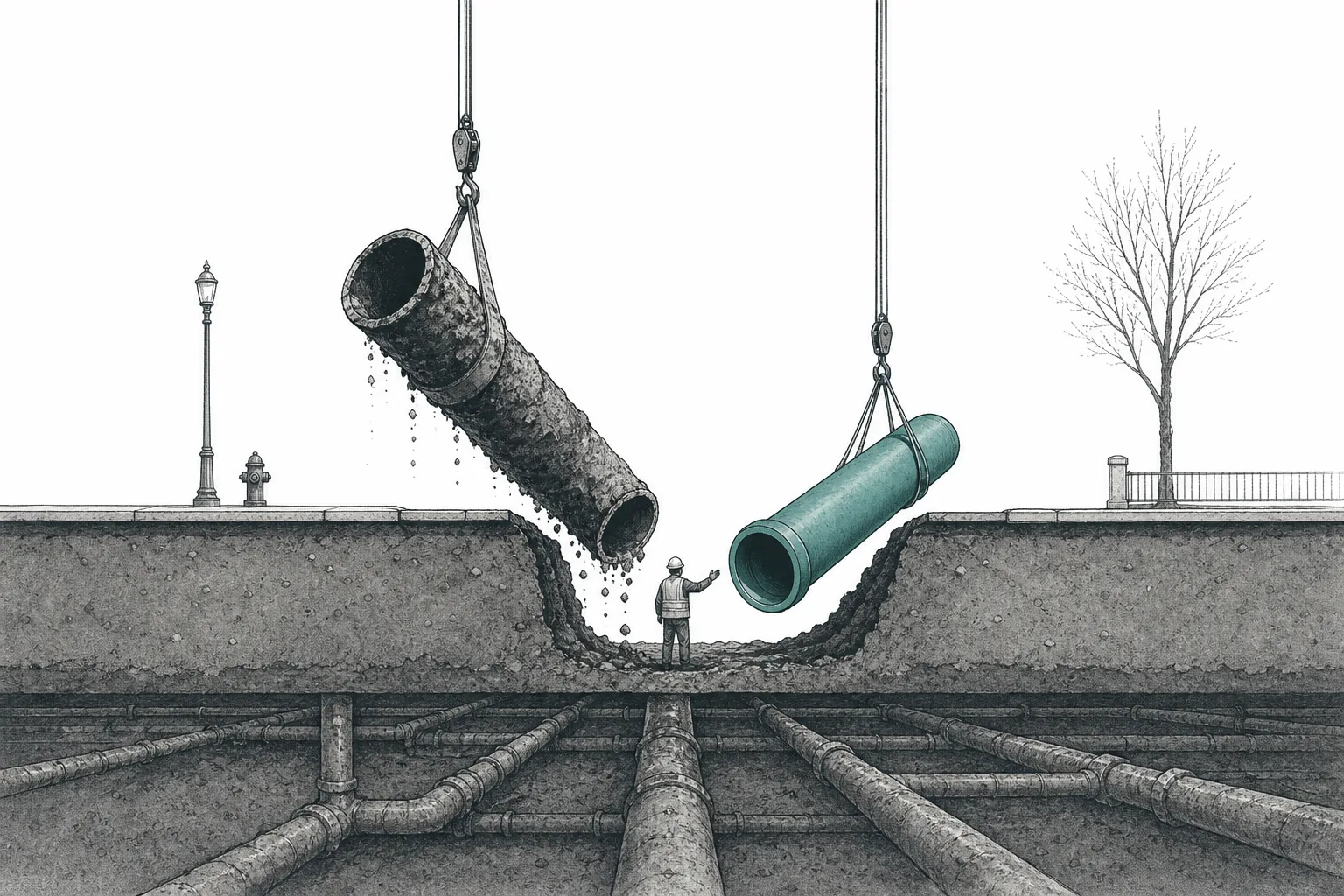
The first direction is a decade of "dig and replace." Replacing roughly 9 million lead service lines across the U.S. within 10 years (the 2024 LCRI rule) is huge rate base about to be approved into the capital base, state by state. It isn't optional — it's the law — which means water companies see "work waiting for them" and a profit base that can grow predictably for a decade.
The second direction is PFAS becoming a new investment engine. The standard limiting "forever chemicals" in drinking water forces water companies to install advanced filtration systems (like granular activated carbon). Every system that tests above the PFAS threshold has to invest — and on the other side, many water companies are suing the upstream chemical makers for damages, which, if they win, helps ease the cost burden.
The third direction is consolidation of small systems accelerating. The tens of thousands of small municipal water systems without the money to comply with PFAS/lead-pipe rules will gradually "sell out" to professional operators with the capital and expertise — this is a growth path beyond investing in existing systems, letting big players grow two ways at once: investing to fix the systems they have, and buying new systems in.
07Challenges & risks
This group's stability comes with its own particular risks you need to understand, and almost all of them circle back to one word: "regulation."
The first and biggest risk is rate-case risk (regulatory risk). All the profit hinges on the regulator approving rate increases and a reasonable ROE. If cost-of-living politics make the government hold rates down, or approve a lower ROE than requested, the company may have already invested but can't recover it as expected — and while waiting out the 12–18-month rate case, the company has to carry the increased costs up front (regulatory lag).
The second risk is sensitivity to interest rates. This is a business that has to borrow large sums to invest upfront, years before the profit comes back. When rates are high, borrowing costs more, squeezing returns, and it also makes a dividend stock like this look less attractive versus bonds — so utilities with a lot of debt move clearly in line with interest-rate direction.
The third risk is the politics of water rates. Rates that rise to pay for massive investment are inevitably unpopular. The U.K. case is the clearest lesson — anger over sewage overflowing into rivers and surging water bills put the whole industry under heavy political pressure and Ofwat scrutiny, showing that a "monopoly license" comes with very high public expectations. Get it wrong, and trust (and the share price) shakes.
In short: this business is the most boring fortress in the stock market — it isn't flashy, isn't sexy, and grows slowly. But in a world where pipes are aging, rules are tightening, and people still need water every day no matter what the economy does, that "government-guaranteed boredom" is exactly why it endures through every crisis.