Megatrend · Digital Finance
The companies whose only mission is to "buy as much Bitcoin as possible"
Picture a public company that sells nothing, mines nothing, and spends all day on one thing — issuing new stock, issuing debt, and using the money to buy Bitcoin for its balance sheet. Their shares become a "geared-up" version of Bitcoin that trades on the stock market — and often costs more than the Bitcoin they actually hold. This is the Pure Bitcoin-Treasury Vehicles group — the money flywheel Michael Saylor invented, and in 2026 it's being tested on whether the wheel can spin backwards too.
01What it is
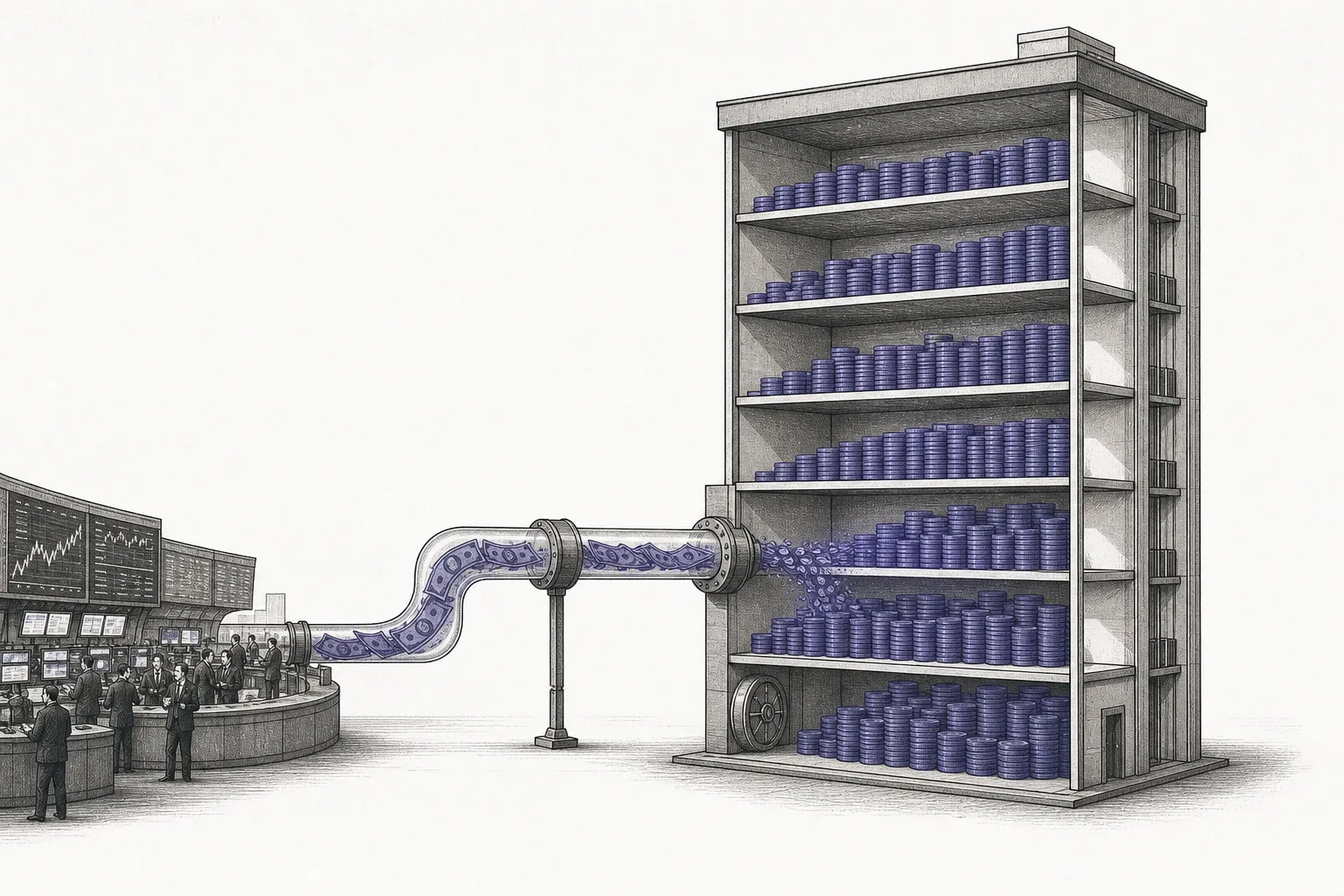
In 2020, a twenty-something-year-old software company called MicroStrategy was growing slowly, its stock flat for ages. Then one day a CEO named Michael Saylor announced something that sounded crazy — "from now on, all of our company's cash goes into buying Bitcoin." Five years later that company (renamed Strategy) holds more than 843,000 Bitcoin and has become the template for a whole new industry.
This node — on the megatrend map it sits under Bitcoin / Crypto Treasury & Store-of-Value Proxies, inside the big trend Digital Finance & Tokenization — is the most narrowly defined group: public companies whose "core mission" is to hold Bitcoin on the balance sheet. They don't sell products, they don't mine (that's a different sibling node). The original business, if any is left, barely matters anymore — what the company does all day is raise money to buy more Bitcoin.
Why wrap Bitcoin in the shell of a "stock"? Because it turns Bitcoin into something you can trade on a normal stock exchange — buy one of these shares and you get a set amount of Bitcoin the company holds for you, plus a "debt trick" that makes it swing harder than plain Bitcoin. That's why it's called geared-up Bitcoin.
Treasury vehicle (sometimes called a "DAT" — Digital Asset Treasury) = a company whose mission is to "hold an asset" on its balance sheet, not sell goods/services · Bitcoin-per-share (BPS) = the Bitcoin a company holds ÷ its total share count — the single most important metric for this group. Management's goal is to keep pushing this number up (some companies call this increase "BTC yield" — but it's not interest, just Bitcoin-per-share growing)
02Why it matters — a doorway into Bitcoin on the stock market
If anyone can just buy Bitcoin directly, why go through a stock? The answer is the huge group of people for whom buying Bitcoin directly is inconvenient or impossible — pension funds, investment accounts whose rules ban holding crypto directly, institutions bound by internal mandates, or people who want the "gearing" that plain Bitcoin can't give. Treasury stocks open a doorway for this big money to flow into Bitcoin indirectly, through the brokerage accounts they already use.
The scale of this is bigger than you'd think. By mid-2026, public companies worldwide held roughly 1.16 million Bitcoin combined — more than 5% of all the Bitcoin that will ever exist — and almost all of it is concentrated in this small group of treasury companies. This is no longer a toy in a small corner of the market; it has become one of the largest Bitcoin sinks in the world.
More important than size is the pricing puzzle — these stocks usually trade at a price higher than the value of the Bitcoin they actually hold. At its peak, the market once valued Strategy at 2–3x the Bitcoin in its hands. People were paying $2–3 to buy $1 of Bitcoin sitting inside the company. It sounds irrational — but this gap is the fuel for the whole model, and it's the thing you need to understand before we look at the flywheel in the next chapter.
It's "the company's market cap ÷ the value of the Bitcoin it holds" · mNAV = 2.0x means the market values the company at twice the Bitcoin in its hands (a premium) · mNAV = 1.0x means the share price exactly matches the Bitcoin · mNAV below 1.0x means the stock is cheaper than the Bitcoin it holds (a discount) — and this is the point where the flywheel breaks, as is happening in 2026
03The money flywheel — the core mechanism
Now let's put all the pieces together into the "engine" Saylor built. In finance it's called a flywheel — a self-feeding loop. Its heart is the premium: as long as the stock is worth more than the Bitcoin it holds, the company can issue new shares and book a profit instantly.
Do the math slowly: the stock trades at mNAV 2x, so the company sells a share the market values at $2 of Bitcoin and gets $2 of real Bitcoin — but existing shareholders only "lose" $1 of Bitcoin value (because the new share dilutes the old portfolio by only half the money raised). That $1 gap becomes extra Bitcoin-per-share, handed to everyone for free. This is "pumping" Bitcoin-per-share out of thin air — as long as the premium holds.
The flywheel's fundraising tools · ATM (At-the-Market) = selling new shares into the market bit by bit at the going price — fast, but only works well when the premium is high · Convertible debt = bonds creditors can later convert into shares; the company borrows cheap to buy BTC — but it's "real debt" that must be repaid · Preferred stock = shares paying a fixed dividend. Strategy has issued several series (STRK/STRF/STRD/STRC) as a funding source that doesn't directly dilute common stock — this is where "leverage" enters the picture
The key to remember is that this flywheel works both ways. When Bitcoin rises and the premium is high, it spits out enormous profits; but when Bitcoin falls and the premium shrinks, it can destroy itself just as fast — because issuing shares when the stock is cheaper than BTC means existing holders lose Bitcoin-per-share, yet the debt borrowed on the way up still has to be paid. Finance calls this "accelerate up, accelerate down" behavior reflexivity.

04How it differs from mining
People often confuse this group with "Bitcoin miners" because both hold a lot of Bitcoin. But they're actually a different animal — two lines of the parent node you need to tell apart.
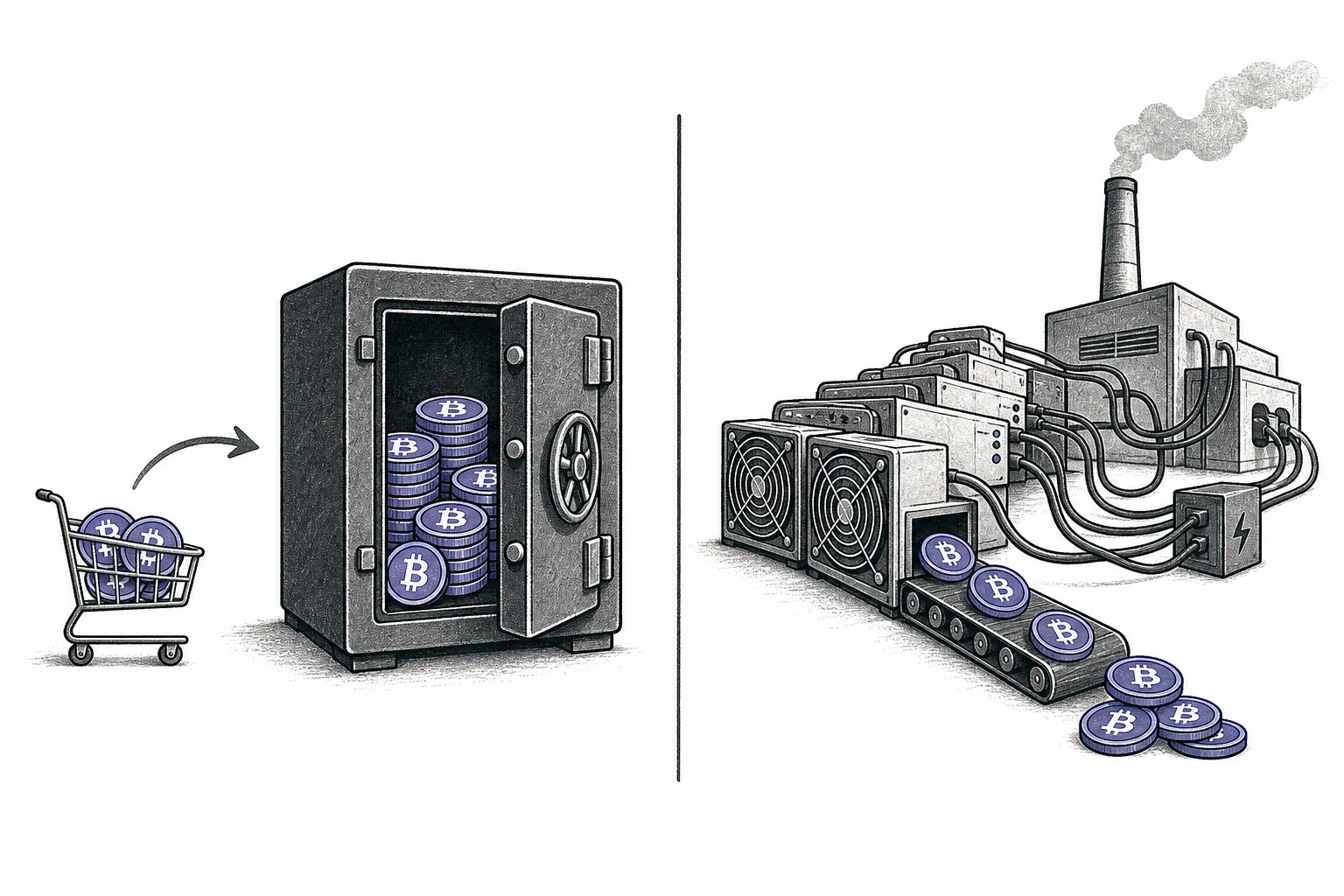
This node is the Pure Treasury Vehicle line — companies that don't produce Bitcoin themselves. They simply buy Bitcoin on the market with money raised from stock and debt. No factory, no mining rigs, no electricity bill — just Bitcoin in the wallet and debt to manage. In short, it's pure leverage: the share price is tied almost 100% to Bitcoin, plus gearing from debt and the premium.
The other sibling line is Miner-Treasury Hybrids — companies that already mine Bitcoin, with power plants and real rigs, that then choose to "keep" the Bitcoin they mine on the balance sheet instead of selling it immediately. They have a real business holding them up (cash flow from mining), but they face a double squeeze: the Bitcoin price + an ever-rising cost of mining.
And this whole ecosystem connects to other nodes in Digital Finance — it stands on the Stablecoin & crypto issuers and crypto infrastructure that serve as the channel to safely buy and store tens of billions of dollars of Bitcoin. If the digital key is lost, the Bitcoin is gone in an instant.
05Where it stands now
Mid-2026 is the most honest time to tell this story, because it isn't a bull market where everything looks beautiful — it's the moment the engine started to stutter — and that's the most valuable lesson of all. The original, Strategy, holds about 843,700 Bitcoin (at an average cost of around $75,700 per coin). But the premium that once reached 3x has shrunk steadily — by early 2026 it was around 1.16x, and around June the stock dropped to trade below the value of the Bitcoin it holds (a discount) for the first time.
When the premium vanishes, the once-most-powerful tool — issuing new shares (ATM) — turns toxic, because issuing shares when the stock is cheaper than BTC only hurts existing holders. So Saylor switched to leaning on preferred stock instead. Strategy now carries about $6.7 billion of convertible debt and roughly $15.5 billion of preferred stock (four series: STRK/STRF/STRD/STRC) — a "shift of gears" from raising money via common stock to tools that don't directly dilute existing shares, but at the cost of a fixed dividend obligation every year.
The most interesting challenger to watch is Japan's Metaplanet (Tokyo market) — the "MicroStrategy of Asia," which climbed from a small hotel company to the world's #3 Bitcoin holder (~40,000 coins) in under two years. It reported a "BTC yield" (Bitcoin-per-share growth) of about 2.8% in early 2026 — but it's also one of the most heavily shorted stocks on the Tokyo market, reflecting the whole group's contradiction: one side believes wholeheartedly, the other bets the wheel will break.
Next is Twenty One Capital (XXI) — a company built from day one specifically to hold Bitcoin, which rose to the #2 holder spot (~43,500 coins). And Semler Scientific — a classic case study of "a real-business company (medical devices) that turned itself into a treasury vehicle," following Strategy's path. It was recently being acquired by an investment group interested in its Bitcoin stash — a signal that the discount cycle is starting to "consolidate" the weaker players.
06The road ahead
The first direction is the shakeout of the copycats. Strategy's success sparked a wave of imitator companies worldwide — some switching from their old business to holding crypto overnight. Many lack the discipline or staying power of the original. When the premium vanishes and Bitcoin dips, companies whose stock trades below NAV for long can't raise money and are likely to be acquired or fade away (as Semler just was). This cycle is the "trial by fire" that sorts the real from the imitation.
The second direction is the competition with ETFs. There are now Bitcoin ETFs that hold Bitcoin directly, with no debt and no premium/discount headache, tracking Bitcoin 1:1. For someone who just wants to "hold Bitcoin through a brokerage account" without leverage, an ETF is the cleaner path. So pure-treasury stocks have to prove that their "leverage + Bitcoin-per-share pumping" is worth the extra risk — and if the premium doesn't come back, their reason to exist gets questioned harder.
The third direction is entering indices and expanding to other crypto. When a big company like Strategy enters a major stock index, index funds end up "holding Bitcoin indirectly" without meaning to — a new channel pulling in institutional money. And some companies are starting to hold Ethereum or other coins instead of Bitcoin on the same model — the treasury model is expanding from pure Bitcoin into other crypto.
07Risks — leverage and the death spiral
Let me say this as plainly as possible: this is one of the riskiest nodes on the entire megatrend map. Its charm (the gearing on the way up) is its risk directly — because it's the most naked bet on the Bitcoin price, with no other business in front to shield it.
The first risk is leverage + reflexivity. These stocks are designed to swing harder than Bitcoin both ways. When Bitcoin rises 10%, the stock might rise 30–50%; but when it falls 10%, the stock falls 30–50% too. And the debt and preferred stock raised on the way up don't go anywhere — they sit waiting for their interest/dividends to be paid, whatever the Bitcoin price does.
The second risk is premium collapse. The whole model rests on the assumption that the market will keep paying a premium. But the premium isn't a law of physics — it's market sentiment. Once confidence is lost, the premium can shrink from 3x to below 1x (as Strategy saw in 2026). When that happens the engine stalls, issuing new shares only hurts existing holders, and the flywheel that once spat out profits turns into one that eats itself.
The situation analysts fear most: the stock trades below NAV for a long time → it can't raise new money → it has to sell Bitcoin to pay debt/preferred dividends → that selling pushes Bitcoin and the stock down further → even further below NAV → it spirals downward. Companies with thin staying power can genuinely collapse, and if several collapse at once, it could spill over into selling pressure on the Bitcoin market itself
The third risk is Bitcoin's own volatility. Don't forget that underneath everything is an asset that can move 50–80% in a single year. Every risk above is amplified by this fact — this node isn't just a "bet on Bitcoin" but a "bet on Bitcoin × leverage × the market's mood toward the premium," three layers stacked on top of each other.
In short: this is the story of one of the boldest financial ideas of the crypto era — turning an ordinary company into a self-feeding Bitcoin-accumulation machine. But it's also one of the best reminders that leverage never gives anything for free. The thing that accelerated your profit on the way up is the same thing that will accelerate the pain on the way down — and in 2026, the market is learning that lesson in real time.