Megatrend · whole-trend overview
When "money" and "assets" move onto a new set of rails
Dollars running on a blockchain, government bonds turned into tokens, public companies that have become "bitcoin piggy banks," banks with not a single branch — these are all the same story: finance is moving onto programmable digital rails. This node is the map that ties the 8 categories of Digital Finance together — how they split into two big streams, who feeds whom, and where the real power and value actually pile up (each category has its own deep-dive chapter).
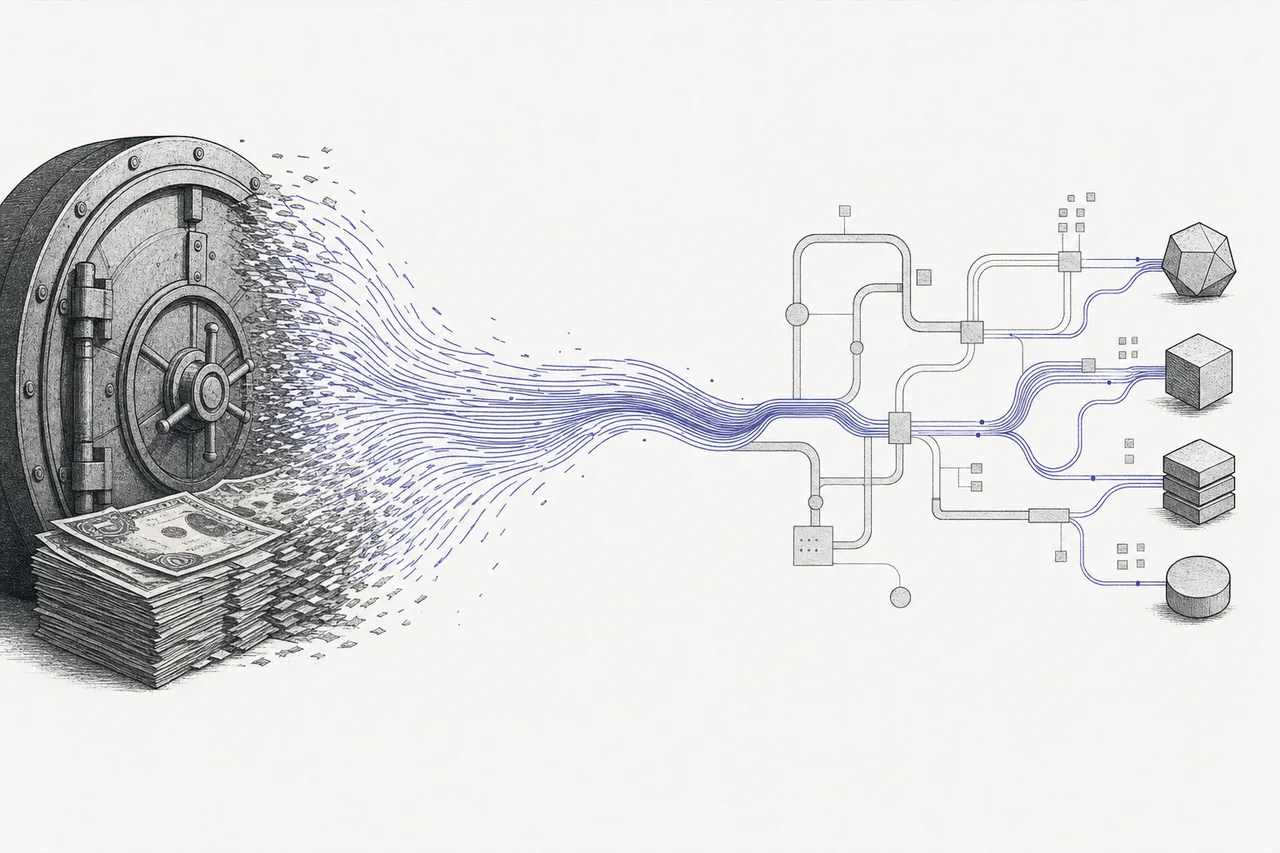
01The big picture: money switches rails
Picture an old-style cross-border transfer — you hit send on Friday, it lands the following Tuesday, you pay fees at several layers, routed through a chain of intermediary banks. That's the financial "rail" we've used for decades: slow, expensive, and only open during business hours. Digital Finance means laying a new rail where money and assets can run 24 hours a day, almost for free, and be programmed to act on their own.
And this is no longer a small thing. Look at just one piece — stablecoin, or dollars running on a blockchain — there's now around $320,000 million of it in the system, and in a single quarter more than $28 trillion flowed through it — more than Visa and Mastercard combined.
Taking any asset — dollars, bonds, stocks, buildings, gold — and turning it into a digital "token" that runs on a blockchain, so it can be transferred, split, and traded instantly, around the clock. It's like turning something heavy and hard to move into a file you can pass along in a single second.
But Digital Finance isn't only the crypto side. It has two streams running toward each other: one is a brand-"new" rail built from blockchain (stablecoin, asset tokenization, crypto exchanges, companies that hold bitcoin). The other is the "overhaul" of the existing rail — digitizing traditional finance (next-gen payments, branchless banks, automated investing). This node lays out both streams to show how they thread into a single map.
02The map: 8 categories in 2 streams
Digital Finance splits into 8 sub-categories, which group into two big "streams" — the crypto/token stream (building new rails) and the fintech stream (overhauling the existing rail). Each category has its own deep-dive chapter (tap to read):
Stream A — the "new" rail from blockchain (Crypto & Tokenization)
- Stablecoin Issuers & Distribution: the people who issue "digital dollars" pegged 1:1 to real money (Circle's USDC, Tether's USDT) — this is the "blood" that feeds the whole system
- Real-World Asset Tokenization: taking real assets — bonds, funds, debt, stocks — and turning them into tokens on-chain (like BlackRock's BUIDL fund)
- Crypto Exchanges, Custody & Infrastructure: licensed exchanges + digital-asset custodians + the on/off ramps between real money and crypto (like Coinbase)
- Bitcoin / Crypto Treasury: public companies that put bitcoin on their balance sheet, until their stock becomes a "leveraged proxy" for the BTC price (like Strategy/MSTR)
Stream B — overhaul the "existing" rail into digital (Fintech)
- Payments Modernization & Rails: next-gen payment networks — real-time, cross-border, and settling in stablecoin (like Visa, Mastercard, PayPal)
- Digital Banking & Neobanks: banks born digital from day one, with no branches at all (like Nubank, Revolut) — not old banks that simply bolted on an app
- Digital Wealth & Robo-Advisory: digital brokers and automated investing that let ordinary people invest for themselves through an app (like Robinhood, Schwab)
- Digital Lending & Alt-Credit: lending on digital platforms — buy now, pay later (BNPL), marketplace loans, and credit scoring with AI / alternative data (like Affirm, SoFi, Upstart) · the digital-lending market was about $507,000 million in 2025, and AI already drives over 40% of credit scoring
03How it connects (the new financial rail)
The heart of this map is the word "rails" — money needs a rail to run on, assets need a place to trade, and all of it needs someone to safely hold it. So the 7 categories don't sit apart; they link into a single chain. Look at this flow:
The most important point on this map is that stablecoin sits in the middle — it's the "cash" of the digital world that everything settles in. When you buy a bond token, trade on an exchange, or send money cross-border the new way, stablecoin is the go-between. Meanwhile exchange & custody is the door where real money flows in and out of the system, and the place big institutions trust to hold their assets.

04Where the value and power are
The key rule of this trend is that value pools at the "payment rail" and "trust" — not at pretty coins or apps. Whoever controls the rail money must pass through, and whoever institutions trust to hold their assets, has the power to set prices and earn enormous profits.
The clearest example is Circle, the issuer of stablecoin USDC — almost all of its revenue (about 94%) comes from interest on the $77,000 million of reserves backing USDC, parked in US Treasuries. Put simply, Circle holds other people's money and earns interest just for holding it — a model that prints enormous profits as long as interest rates stay high.
In the same way, Coinbase stands on trust too — it holds a record $245,700 million of assets for institutions, because big funds want a custodian that's licensed and auditable. Meanwhile the category that looks the most "pure crypto" — companies that hold bitcoin — is the one whose value swings purely with the BTC price: a bet on direction, not a toll booth.
The lesson for reading this trend: don't just ask "is this company about crypto?" — ask "is it taking a toll on the rail (earning fees / interest reliably), or is it just betting on an asset's price (rising and falling with the market)?"
05The forces that move the whole trend
Even though the 8 categories differ, there are 3 big forces moving the whole trend at once:
1. The law opened the door (GENIUS Act) — this is the force that changed the game the most. In 2025 the US passed the GENIUS Act, requiring stablecoins to be backed 1:1 by real money, to be audited monthly, and barring them from paying interest to holders — it sounds like a restriction, but it's really a "stamp of credibility" that lets banks and big institutions dare to come in. The moment the law passed, Visa, Mastercard, BlackRock, BNY Mellon, and Stripe started using USDC in real operations.
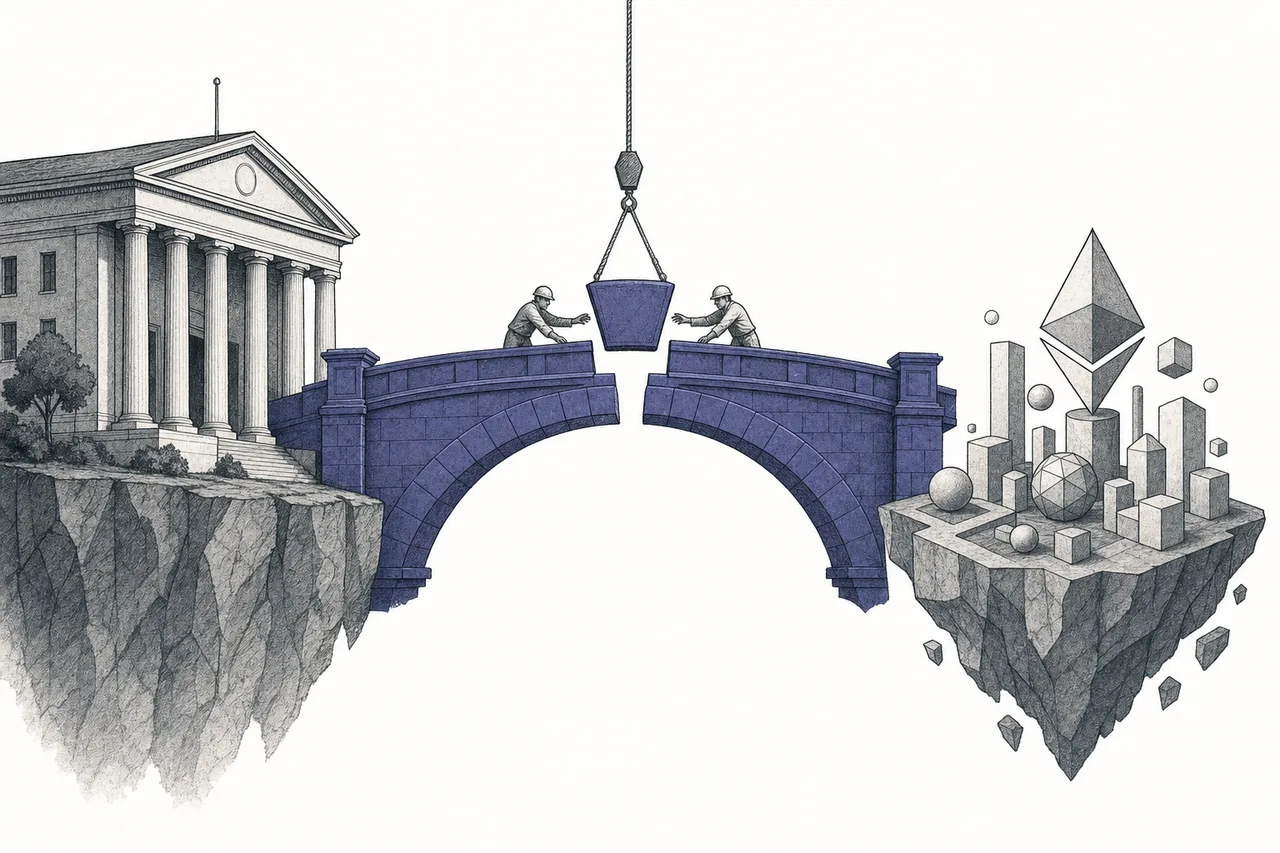
2. The big institutions are coming in themselves — crypto used to be the domain of small retail speculators, but now the biggest players in traditional finance are stepping onto the board themselves. BlackRock, the world's largest asset manager, is tokenizing money-market funds (its BUIDL fund touched $2,400 million) — when a giant like that moves, it signals that tokens are no longer a toy.
3. Tokenize "everything" — the third force is the belief that every kind of asset will eventually be turned into a token. For now it's starting with the easiest, safest things (bonds, money-market funds). The value of real-world assets on-chain has broken past $33,000 million (up 200% in a single year), and many shops see this as just the beginning — McKinsey estimates $2 trillion by 2030, and BCG with Ripple looks as far as $18.9 trillion by 2033.
06Where it stands now + the champion of each category
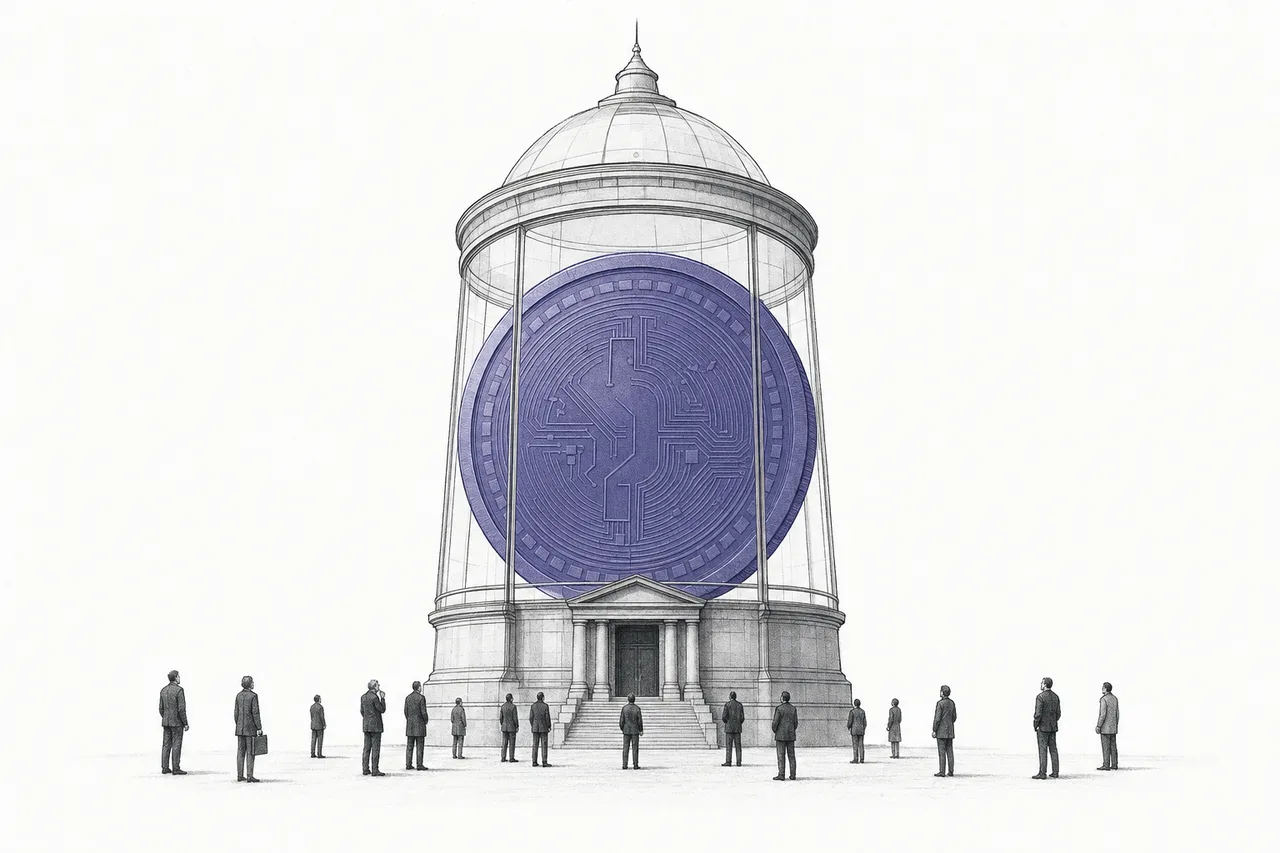
2025–2026 is when the two streams really began to converge — the law opened the way, institutions came in, and fintech now has a user base in the hundreds of millions. Below are the "champions" of each category, reflecting how power is spread across both the crypto world and the traditional-finance world:
07The future and the risks
Looking ahead, this trend has both tailwinds and risks you have to watch together.
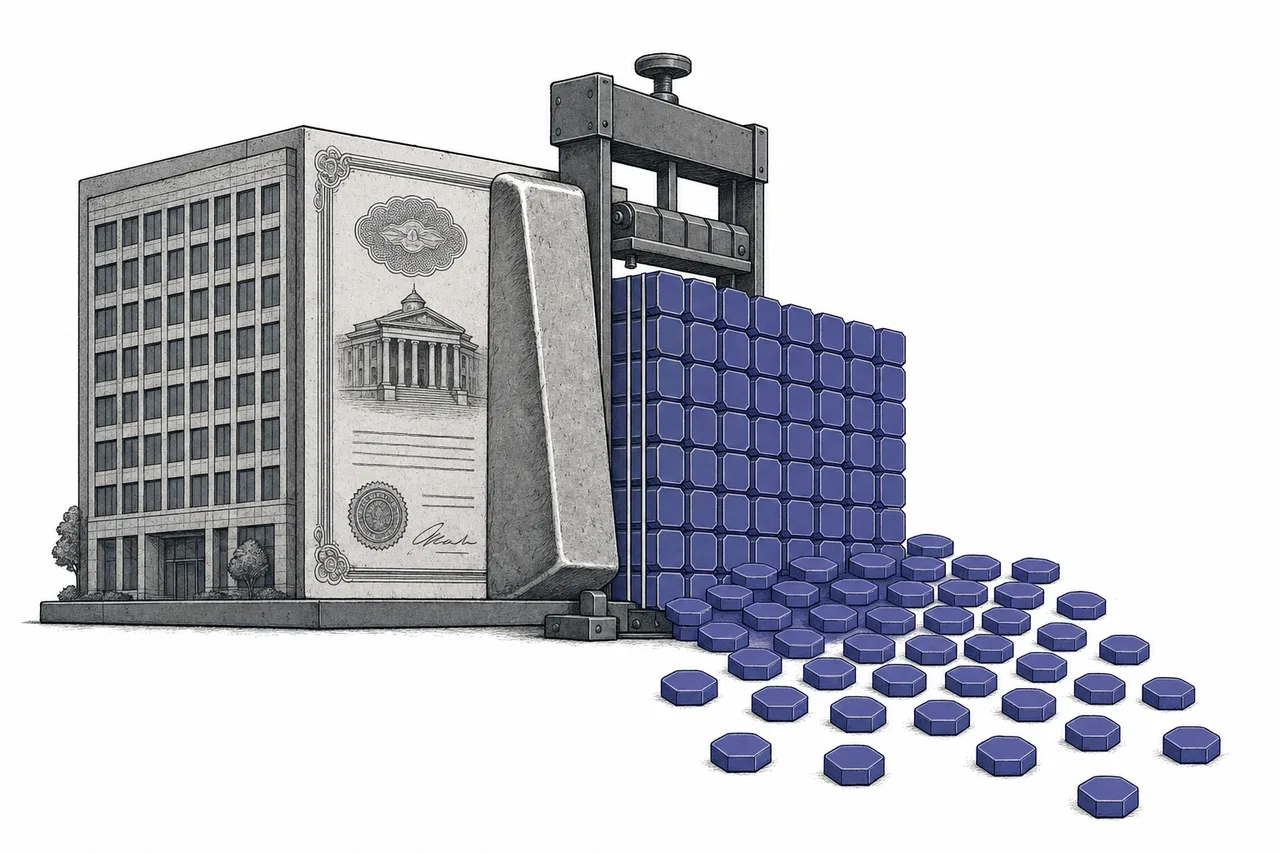
On the opportunity side: the big direction is fairly clear — money and assets will keep running on digital rails more and more. Stablecoin is becoming real payment infrastructure, tokenized assets are still growing from a very small base (just touched $33B in a market that could be in the trillions), and fintech keeps expanding into emerging markets where people still can't reach a bank — Nubank keeps pushing into new markets.
On the risk side, there are three layers to watch:
- Crypto volatility: categories like bitcoin-treasury companies and exchanges are tied to the BTC price — you can see it in Coinbase's trading volume, which vanished by half (from $401B to $202B in Q1) when the market cooled. Violent up-and-down cycles are the nature of this stream
- Law that hasn't settled: the GENIUS Act opened the door, but it also set strict rules (like barring interest payments to stablecoin holders) — rules that can change at any time are a risk that doesn't show up on the financials, but sits in the regulators' hands
- Fragile trust: the whole system rests on the belief that stablecoins really are backed 1:1 and that custodians are holding the assets in full — if something shakes that trust (a coin loses its peg, a custodian fails), the impact spreads across the whole map, because stablecoin is the "blood" in the middle
And that's why this chapter is a "map," not a "deep-dive guide" — the real value of seeing the whole trend is seeing that digital dollars, bond tokens, bitcoin companies, and banks-in-an-app are all pieces of the same story, before you walk in to explore each room in detail — just tap into the deep-dive chapter of whichever category interests you.