Megatrend · Digital Finance
The mine that digs Bitcoin by day and runs AI on the same power by night
A group of companies invested in the scarcest thing of the AI era before anyone realized — vast amounts of cheap electricity, and data centers already built. They used to point all of it at mining Bitcoin and stacking the coins on their balance sheet. But when AI started fighting the whole world for power, they found themselves sitting on a goldmine — just swap the miners out for GPUs and the revenue is several times higher and steadier. This lesson looks at the companies with "two engines" in one: the price of Bitcoin, and the AI wave.
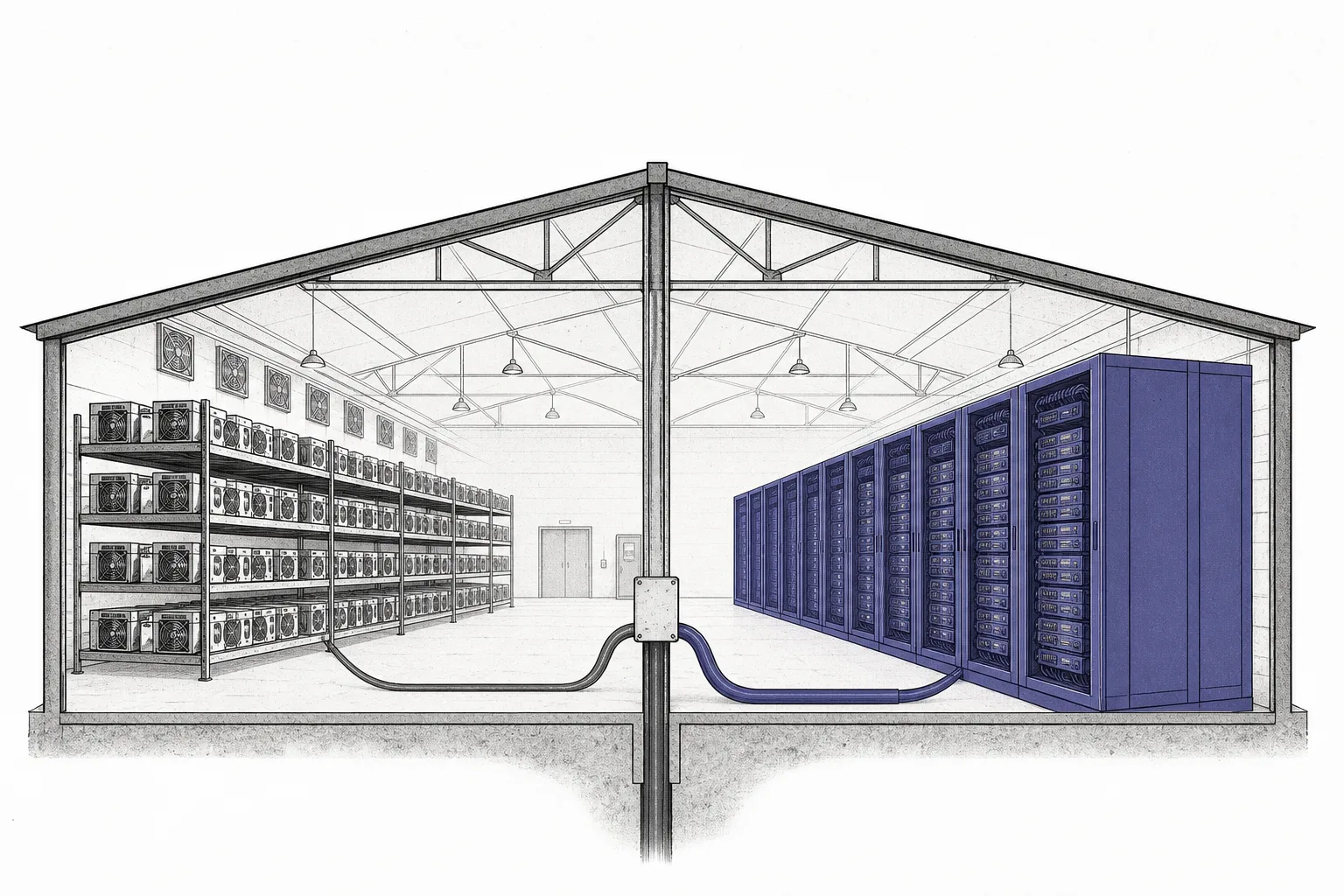
01What it is
Picture a company with machine warehouses the size of several football fields, packed inside with specialized computers running 24 hours a day to "mine" Bitcoin. The heart of this business isn't the machines, it's vast, cheap electricity — they set up where power is cheapest in the world (dams, wind, sun, or waste gas), because mining Bitcoin is turning "power" straight into "coins." Whoever has cheaper power wins.
This node — on the megatrend map it sits under Bitcoin / Crypto Treasury & Store-of-Value Proxies within the big trend Digital Finance & Tokenization — is the group of Bitcoin miners that do two things at once: (1) produce Bitcoin themselves, and usually choose to hold the coins they mine on the balance sheet rather than sell them right away, becoming a "Bitcoin treasury" in their own right; and (2) start pointing the same power and data centers at AI/HPC (high-performance computing) work, which pays far more than mining. So they're not just "a bet on the price of Bitcoin" — they own the infrastructure the entire AI world is fighting over.
Hashrate = a mine's total mining power (the higher it is, the better the chance of getting Bitcoin; measured in EH/s) · ASIC = a specialized miner that can do only one thing, mine Bitcoin (very fast, but useless for anything else) · HPC (High-Performance Computing) = in this context, running NVIDIA GPUs to train/run AI models and renting them out to other companies, which pays far more per unit of power than mining.
The sibling sitting right next to it under the parent node is Pure Bitcoin-Treasury Vehicles — companies that don't mine, but borrow money and issue shares to buy Bitcoin outright (the original is Michael Saylor's Strategy). The key difference: pure players get their Bitcoin with "debt," while this group gets its Bitcoin with "power and miners" they own themselves — backed by a real business and real assets, not a naked bet on the coin price.
02Why it matters — double exposure
The appeal of this group sums up in one phrase: double exposure — hold one stock, and you're betting on the two biggest waves of the era at once: the price of Bitcoin and the AI boom. The first engine is mining and the Bitcoin held on the balance sheet (which moves with the coin price). The second engine is pointing power at AI to rent to tech companies (which moves with the exploding demand for data centers).
Why can miners do both when other companies can't? Because they happened to invest in the scarcest thing of the AI era years in advance — every AI data center needs two things: vast electricity, and land + buildings already connected to the power grid. Both take 3–5 years to build and get scarcer by the day. But Bitcoin miners already have them, because that's exactly what they've been accumulating all along to mine coins — all that's left is to pull out the miners and roll in the GPU racks.
The reason this is urgent right now is the halving. Every 4 years, the reward a mine gets per block of mining is automatically cut in half. The latest was April 2024, dropping the reward from 6.25 to 3.125 Bitcoin per block — half the mine's main revenue gone in a single night. Add rising power costs and fiercer competition, and mining margins get squeezed until miners have to find a "second leg" — and AI arrived right on cue.
For the global economy, this group matters because it's one of the largest sources of ready-to-use power that AI can get fastest — while hyperscalers (Microsoft, Google, Amazon) queue for years to get power from utilities, renting power from a mine already on the grid is a shortcut. The AI/HPC contracts the listed mining sector has announced now total over $70 billion — more than the value of the Bitcoin many of them hold.
03How it works — from miner to GPU
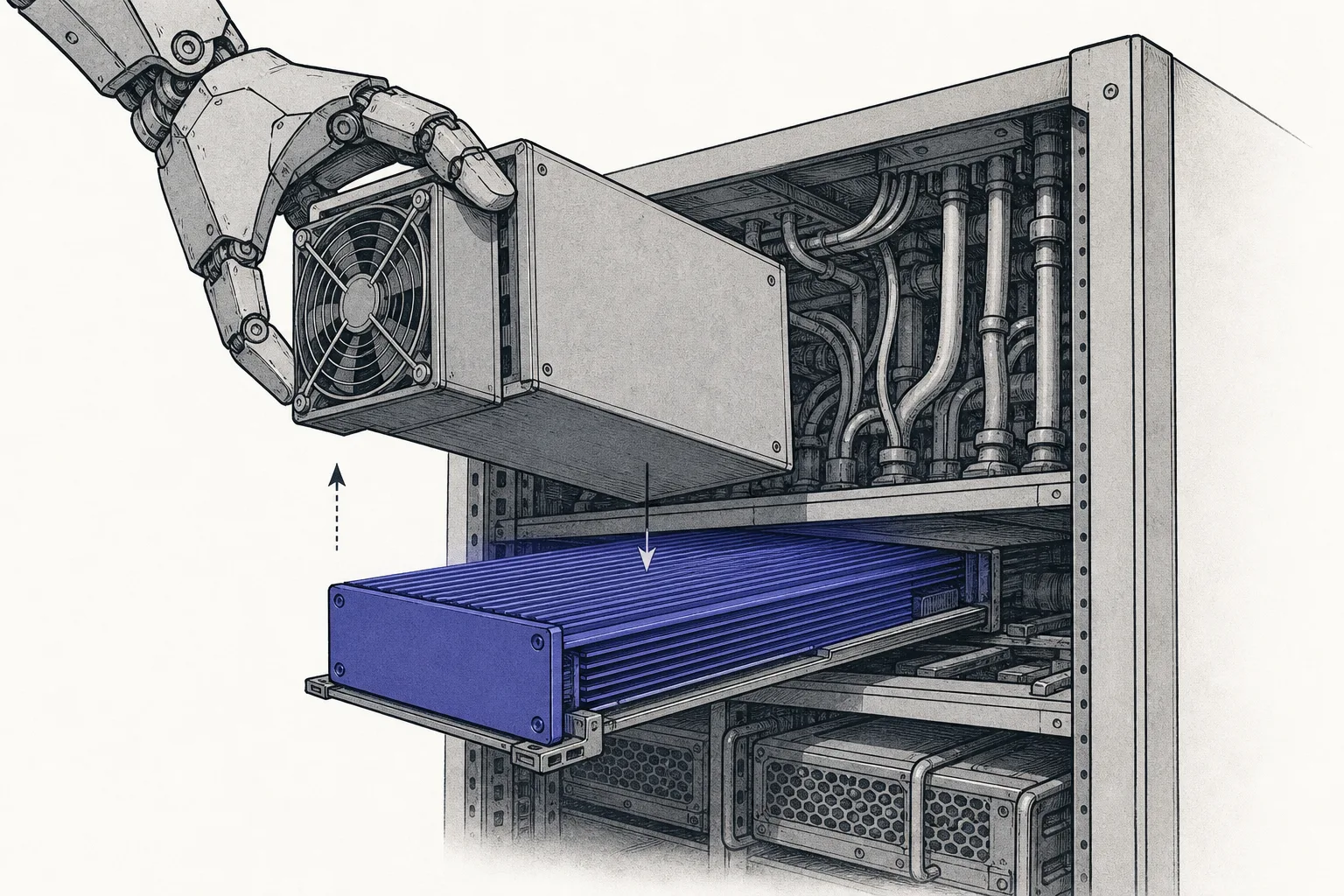
The heart of this model isn't the miners or the GPUs — it's power and location, the single starting asset, and the company gets to choose which business to "feed" that power into. Let's trace step by step how the money travels.
What makes this model interesting is the "power shift" — the dashed arrow in the diagram. Since power is a limited resource, every megawatt moved from mining to AI trades "revenue that swings with the coin price" for "revenue under multi-year lease contracts that's steadier and higher." That's why many companies have even started selling the Bitcoin they held to fund GPUs and build AI data centers — turning the "coin treasury" into a "cash-generating machine."
04How it differs from its neighbors
The best way to understand this node is to place it next to its neighbors in the ecosystem — it straddles exactly between "the crypto world" and "the AI data center world."
- Unlike Pure Bitcoin-Treasury Vehicles, it has "real assets": pure players don't mine — they borrow / issue shares to buy Bitcoin, so the stock is tied almost 100% to the coin plus leverage from debt. This group, by contrast, has real miners, power, and data centers as assets — with cash flow from mining and AI backing it, not a naked bet on the coin price
- It's walking straight into being AI Colocation & Data Center: when a mine rents its site to AI companies to run compute, it becomes half a "data center landlord" — this is the destination node this group is pivoting toward, and the source of the billion-dollar contracts we'll see in the next chapter
- It sells the same thing as AI Power & Cooling: what's scarce in the AI era isn't chips, it's power and cooling — and that's exactly what miners have spent their whole lives accumulating. So they own the very "bottleneck" the entire AI industry is short of
- It's still a member of Digital Finance & Tokenization: as long as they hold a big chunk of Bitcoin on the balance sheet, their stock is still a "Bitcoin proxy" — just a proxy with an AI business attached
05Where it stands now
2025–2026 is the period this group transformed the fastest. Right now the AI revenue of listed miners totals around 30% of revenue, and analysts expect it to surge to about 70% by the end of 2026 — a complete flip from a business that was nearly 100% "Bitcoin mine" just two years ago. Some even call this phenomenon "miners ceasing to be miners and becoming AI companies."
The most famous case is Core Scientific — a mine with about 1.3 gigawatts of power. It signed a contract for the AI cloud company CoreWeave to run AI work on its sites, and in the end CoreWeave offered to buy the whole company in a stock-for-stock deal worth about $9 billion. But the plot twist — in October 2025, Core Scientific shareholders voted the deal down (203 million against, 21 million in favor), because they believed their own power and location were worth more than the offer and wanted to push ahead as an AI provider themselves — a clear sign the market has started pricing "a mine's power" much higher.
On the other side, IREN (formerly Iris Energy) is the case where the pivot paid off most clearly. It signed a deal with Microsoft worth ~$9.7 billion (5 years), running new NVIDIA GPUs at its Horizon data center in Texas — its AI cloud revenue climbed to $33.6 million last quarter, targeting $500 million a year in AI revenue. TeraWulf has locked in HPC contracts totaling about $12.8 billion. And big miners like MARA, Riot, and CleanSpark are timing it differently — some sell Bitcoin to fund AI investment, others still mine mainly but are hunting their first AI customer.
06The road ahead — mines becoming AI companies
The first and clearest direction is AI becoming the main business while mining becomes secondary. If the mining sector's AI revenue really climbs from 30% to 70%, within a few years the market will see these companies as "AI data centers that happen to have a mine attached" rather than "mines that do AI on the side" — and that changes how the stock is valued entirely, from guessing the price of Bitcoin to evaluating multi-year compute leases like data center real estate.
The second direction is "selling coins to buy chips" becoming more common. When the AI opportunity is bigger and more certain than just holding Bitcoin, many companies will gradually sell off the coins they've accumulated to fund building AI data centers — some (like Cipher) have even announced selling off a third of their Bitcoin reserves to pivot fully to HPC. This means many companies' "double exposure" may gradually tilt toward AI, with less Bitcoin left.
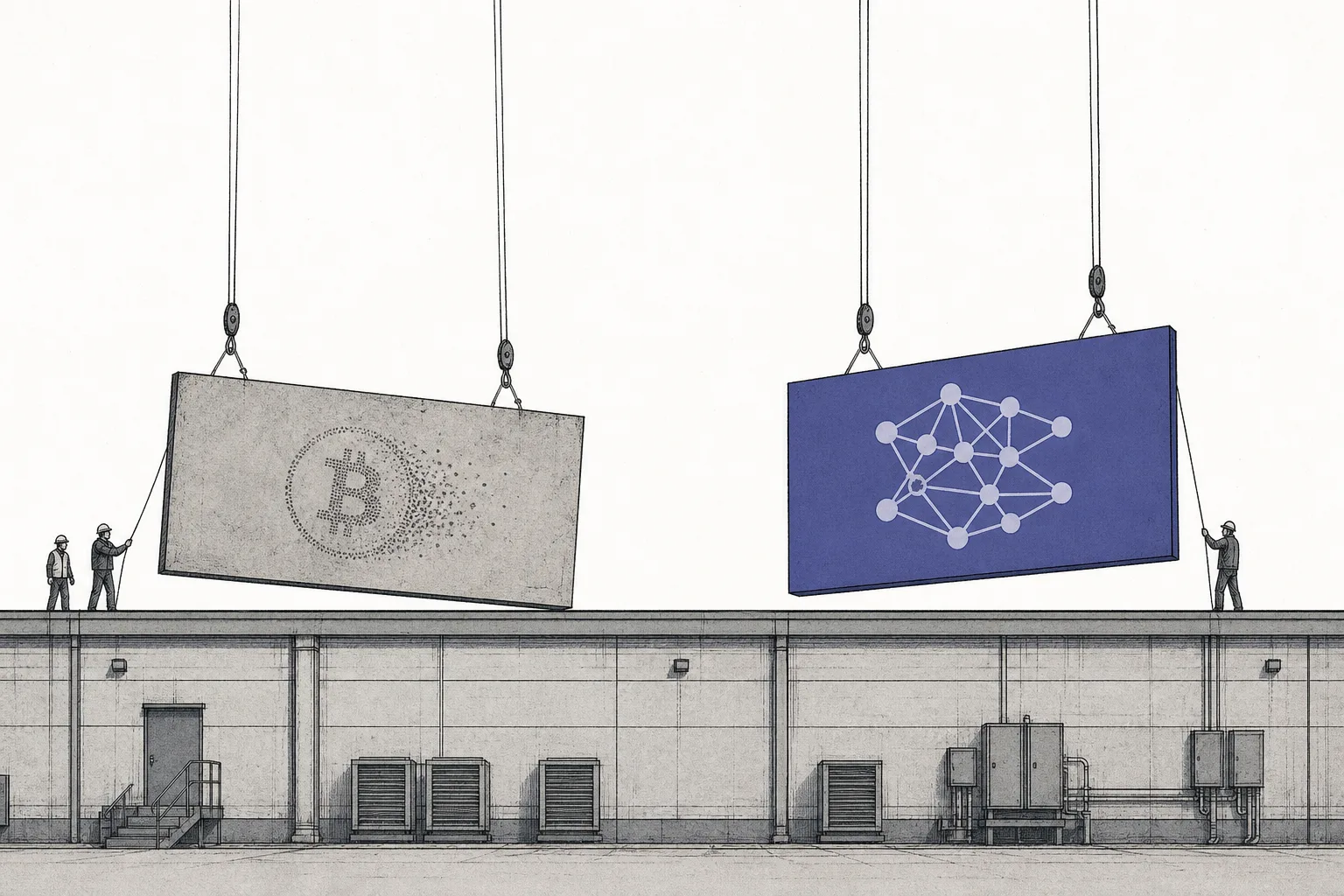
The third direction is separating the real from the fake. Not every mine will pivot successfully — running hyperscale-grade AI requires liquid cooling, high-speed networking, and reliability at a level customers like Microsoft will accept, which is far harder than mining. Mines with capital, an engineering team, and well-located power will grab the big contracts, while small players who just "announce they'll do AI" without the real thing get left behind.
07Challenges & risks
Double exposure sounds great, but "two engines" also means "two sets of risks" — and both are about equally volatile.
The first risk is the halving squeezing mining margins continuously. The mining reward is automatically halved every 4 years, while power costs and hashrate competition keep rising. Mines with high power costs or old machines get squeezed into losses — mining is a business where "the floor shrinks every cycle." If AI hasn't grown in time, companies that rely on mining alone get hurt first.
The second risk is the Bitcoin price swinging the whole balance sheet. As long as they hold a big chunk of coins, the company's value still rises and falls with a Bitcoin price that can swing 50–80% in a single year. When the price drops, miners are often forced to sell coins at the worst possible time (to pay debt or power bills) — in the 2026 downturn, several sold off more Bitcoin than they mined in a single quarter, showing the "coin treasury" can become as much a burden as an asset.
The third risk is the pivot to AI is not easy and the competition is fierce. Miners are good at "finding cheap power," but being a world-class AI data center requires being good at liquid cooling, networking, and guaranteeing stability — a completely different skill set. On top of that, they have to compete with hyperscalers and better-capitalized neocloud providers. Some companies will spend enormous sums building AI data centers and land contracts that don't pay off.
The fourth risk is share dilution. Buying GPUs and building AI data centers takes enormous money. Most miners don't yet have enough cash flow, so they have to issue new shares or take on debt to invest — IREN just raised $3.65 billion backed by GPU assets to expand for the Microsoft deal. Issuing new shares over and over shrinks existing shareholders' stake, and if the investment doesn't deliver as hoped, it's the existing shareholders who take the damage.
In short: this node is the story of companies that happened to accumulate exactly what the AI era needs most — power and location — before anyone realized. So they have a shot at pivoting from "a mine squeezed by the halving" to "an AI compute provider" that genuinely grows. But that path is full of the volatility of both the coin price and AI competition — whoever keeps power costs lowest and can build data centers will be the real winner.