Megatrend · Digital Finance
Stocks designed to be 'Bitcoin with the gas pedal floored'
There's a group of listed companies whose actual business barely matters anymore — what they do is borrow money and issue stock to 'buy Bitcoin' onto their balance sheet, until their own stock becomes a geared-up version of Bitcoin. The original company, Strategy, invented a money flywheel that spins itself — beautiful on the way up, brutal on the way down. This lesson walks through how it works, the risks, and why by mid-2026 the wheel has started spinning the other way.

01What it is
Picture an old software company — unremarkable sales, slow growth, a stock price flat for years. Then one day the CEO announces: 'From now on, every dollar of the company's cash goes into buying Bitcoin.' It sounds crazy, but this is exactly what Michael Saylor did with MicroStrategy (now renamed Strategy) starting in 2020 — and it became the template for a whole new industry.
On the megatrend map, this node sits under Digital Finance & Tokenization, and it's the group of listed companies that pile Bitcoin (or other crypto) onto their balance sheet as a primary asset — until the company's stock effectively becomes a 'proxy' for Bitcoin. Buy one share of these stocks and you're buying a certain amount of Bitcoin the company holds for you — but with a 'debt' twist layered on, which makes it not plain Bitcoin but geared-up Bitcoin.
Treasury company (here often called a 'DAT' — Digital Asset Treasury) = a company whose main mission is to 'hold an asset' on its balance sheet, not to sell goods or services · Store-of-value proxy = a 'proxy for a store-of-value asset' — a stock whose price tracks Bitcoin, used in place of holding Bitcoin directly (for example, by some institutions barred by their rules from holding crypto, but allowed to hold 'stocks').
Why go through a stock at all, when you could just buy Bitcoin directly? The answer is the group of people for whom buying Bitcoin directly is inconvenient or impossible — pension funds, tax-advantaged retirement accounts, investors bound by internal rules, or anyone who wants the 'gearing' that plain Bitcoin can't give. These stocks open a door for big money to flow into Bitcoin indirectly.
02Why the stock is worth more than the Bitcoin it holds
This is the puzzle at the heart of the whole story. Say a company holds $40 billion of Bitcoin. By logic, the whole company should be worth around $40 billion, right? Yet at the peak, the market valued Strategy at 2–3× the Bitcoin it held — people paid $2–3 to buy $1 of Bitcoin sitting inside the company. It sounds irrational, but there's a reason for it.
This gap is called the 'mNAV premium,' and it's the fuel for the whole wheel. The market pays the premium because it believes three things: (1) the company will use that premium to keep 'pumping up' Bitcoin-per-share over time; (2) the stock gives leverage that plain Bitcoin can't; and (3) it's a way in for people who can't buy Bitcoin directly.
It's 'the company's market cap ÷ the value of the Bitcoin it holds' · mNAV = 2.0x means the market values the company at twice the Bitcoin in hand (a premium) · mNAV = 1.0x means the share price exactly matches the Bitcoin · mNAV below 1.0x means the stock is cheaper than the Bitcoin it holds (a discount) — and that's the point where the wheel breaks, as is happening in 2026.
Why does the premium matter that much? Because as long as the stock is worth more than the Bitcoin it holds, the company can issue and sell new shares for an instant profit — sell a share the market values at $2 of Bitcoin, take the money and buy $2 of real Bitcoin, but existing shareholders only 'lose' $1 of Bitcoin value. The difference becomes more Bitcoin-per-share for everyone. This is 'printing' Bitcoin-per-share out of thin air, as long as the premium holds.
03The money flywheel (the core mechanism)
Now let's put all the pieces together into the 'engine' Saylor built. It's a wheel that feeds itself round after round — in finance language, a flywheel.
Its loop goes like this: the stock trades at a premium (mNAV > 1) → the company issues shares or convertible debt to raise money → it uses that money to buy more Bitcoin → Bitcoin-per-share rises and it's good news → the premium climbs higher → it can issue shares even more expensively → it can buy even more Bitcoin. Round and round it goes, as long as Bitcoin's price and the premium keep cooperating.
The two main fundraising tools of the wheel · ATM (At-the-Market) = drip-selling new shares into the open market at the going price — quick and easy, but only works well when the premium is high · Convertible debt = bonds creditors can later convert into stock; the company borrows at a low rate (sometimes 0%) to buy BTC — but it's 'real debt' that must be repaid. This is where 'leverage' enters the picture.
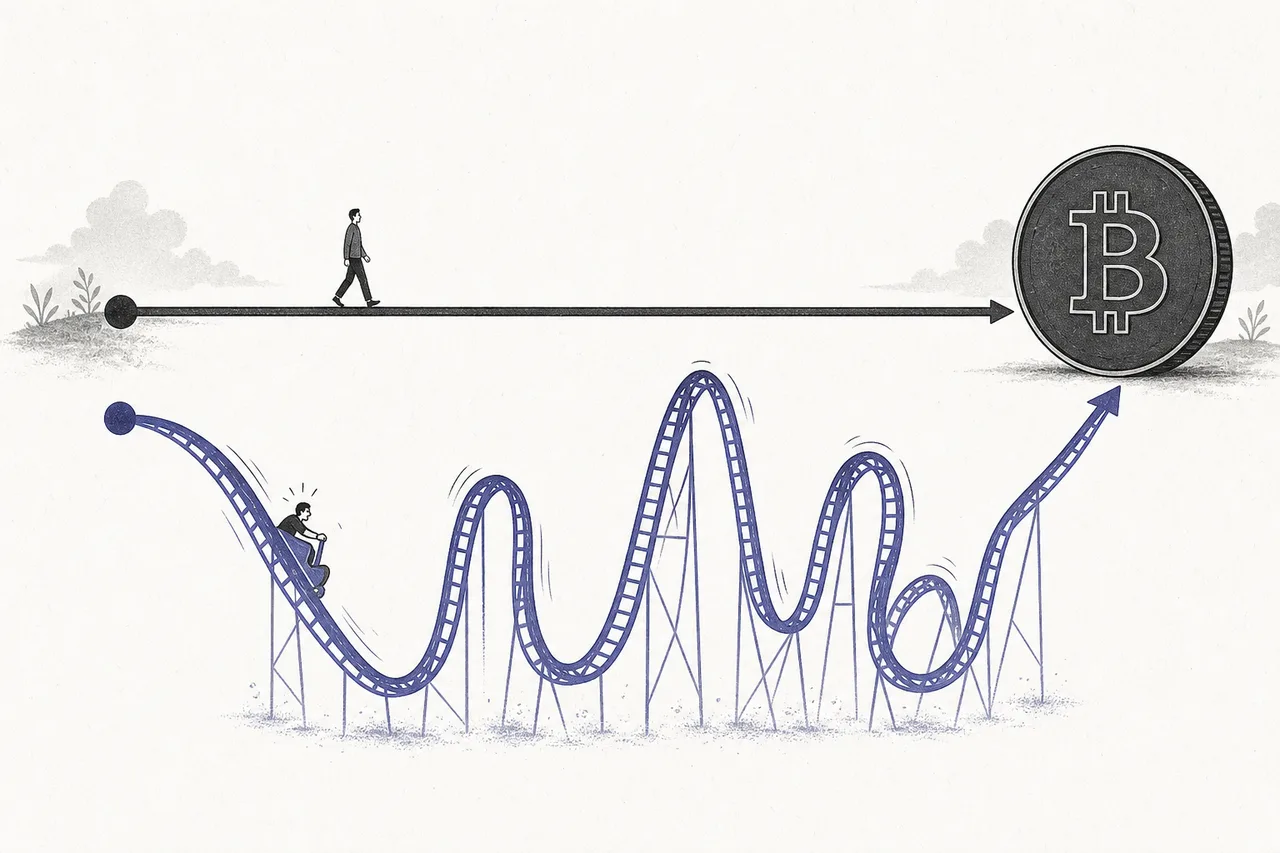
The key to remember is that this wheel works both ways. When Bitcoin rises and the premium is high, it spits out enormous profit. But when Bitcoin falls and the premium shrinks, it can destroy itself just as fast — because issuing shares when the stock is cheaper than BTC means existing holders lose Bitcoin-per-share, and the debt taken on during the rally still has to be paid. Finance calls this 'accelerates up, accelerates down' behavior reflexivity.
04The two faces of this group
If you split the companies in this group by where their money comes from and what they do, two clear lines emerge — and both are members of this node, from different angles.
The first is Pure Bitcoin-Treasury Vehicles — companies whose only mission is to hold Bitcoin. The old business (if any) barely matters; the money comes purely from issuing stock and debt. Examples are Strategy (the original), Japan's Metaplanet, and Twenty One Capital — this group is the 'pure money flywheel,' with the share price tied almost 100% to Bitcoin, plus leverage from debt.
The second is Miner-Treasury Hybrids — miners that became Bitcoin vaults. These companies already mine Bitcoin: they have facilities, power, real mining rigs. They then choose to 'keep' the Bitcoin they mine on their balance sheet instead of selling it right away, becoming companies with both a mining business and a Bitcoin vault in one. Examples are MARA (formerly Marathon), Riot Platforms, CleanSpark, and Hut 8.
And in 2026, the turning point for the miner line isn't just Bitcoin's price — many are redirecting the power and data centers they've built toward AI/HPC work that pays far more than mining, becoming a Bitcoin + AI 'double exposure' (see → ?node=24040200).
Both lines share the same DNA — 'the stock = Bitcoin in gear' — but the gear comes from different places. The pure line gets its gear from debt and premium; the miner line gets its gear from the fixed cost of mining (BTC ticks up a little and miner profit jumps, but ticks down a little and the losses are heavy).
05Where it sits in Digital Finance
This node is one piece of the Digital Finance & Tokenization puzzle — the megatrend about 'moving money and assets onto digital rails.' It's the demand side of Bitcoin: a pipe that sucks money from the stock market into crypto. Meanwhile its sibling nodes each play a different part of the same ecosystem:
- Stands on Crypto Exchanges & Custody: these companies hold tens of billions of dollars of Bitcoin — they need an institutional custodian to keep the keys safe. This is indispensable infrastructure; lose the keys and the Bitcoin is gone instantly
- Sibling to Stablecoin Issuers and RWA Tokenization: all three are different ways to 'put assets on-chain' — Stablecoin = dollars on-chain, RWA = bonds/real estate on-chain, while Treasury proxy = tying traditional-market stocks to crypto. Bridges in different directions
- Relies on Cybersecurity & Digital Trust: the company's entire value is Bitcoin in a digital wallet, so security is a matter of life and death
06Where it stands now
Mid-2026 is the most honest time to tell this story, because it isn't a rally where everything looks beautiful — it's a downturn where the engine starts to stall, and that's the most valuable lesson. Bitcoin's price has pulled back to around $62,000 from its highs, and when Bitcoin pulls back, this whole group falls several times harder, because leverage works both ways.
The original, Strategy, now holds a colossal ~843,700 BTC (at an average cost of about $75,700 per coin). But because Bitcoin's price dropped below that cost, on top of the premium vanishing, MSTR stock has fallen roughly 58% over the year. And most important of all — mNAV has dropped to ~0.83×, meaning the stock is now cheaper than the Bitcoin the company holds. The engine is dead, because issuing shares now would only hurt existing holders. So Saylor has had to lean on issuing debt instead of stock.
The most-watched challenger is Japan's Metaplanet (Tokyo market) — the 'MicroStrategy of Asia,' which climbed from a small hotel company to the world's #3 Bitcoin holder (~40,000 BTC) in under two years. But it's also one of the most heavily shorted stocks on the Tokyo market — one camp of investors believes wholeheartedly, the other bets the wheel will break, neatly mirroring the whole group's tension.
The miner side hurts in a different way — in the downturn, several miners began selling the Bitcoin they'd hoarded to pay debt (see the deep dive at ?node=24040200).
And this is where the 'cleaner' option comes into focus — the Bitcoin ETF, especially BlackRock's IBIT, with roughly $65 billion in assets under management. The ETF holds Bitcoin directly: no debt, no premium/discount to fret over — the price tracks Bitcoin 1:1. For anyone who wants to 'hold Bitcoin through a brokerage account' without leverage, the ETF is a direct competitor to treasury stocks, and it's pulling in more institutional money.
07The road ahead
The first direction is the shakeout of the copycats. Strategy's success sparked a wave of imitators worldwide — some switched from their old business to holding crypto overnight. Many lack the original's discipline or staying power. When the premium vanishes and Bitcoin pulls back, companies whose stock trades below NAV for long can't keep raising money, and may be acquired or fade away. This round is the 'trial by fire' that separates the real from the imitators.
The second direction is competition with the ETF. As long as Bitcoin ETFs offer clean 1:1 exposure at a low fee, treasury stocks have to prove that their 'leverage + pumping up Bitcoin-per-share' is worth the extra risk. If the premium doesn't return, their reason to exist will be questioned ever harder.
The third direction is diversifying into other crypto and other businesses. Companies are starting to hold Ethereum or other coins instead of Bitcoin (such as treasury groups tied to ETH/SOL), and many miners are pairing up with AI/data centers to have real cash flow underneath — so it isn't purely a bet on a coin's price. It's an attempt to find a 'second leg' to stand on even if crypto goes quiet.
08Risks — leverage and reflexivity
Let me say it as plainly as possible: this is one of the riskiest nodes in the entire megatrend map. Its charm (the accelerator gear on the way up) is its risk, directly.
The first risk is leverage + reflexivity. These stocks are designed to swing harder than Bitcoin in both directions. When Bitcoin rises 10%, the stock might rise 30–50%; but when it falls 10%, the stock falls 30–50% too. And the debt taken on during the rally doesn't go anywhere — it's waiting to be repaid, whatever Bitcoin's price does. So holding these stocks is like holding Bitcoin you 'borrowed someone else's money to buy' — sometimes without even realizing it.
The second risk is premium collapse. The whole model rests on the assumption that the market will keep paying a premium. But the premium isn't a law of physics — it's market sentiment. Once confidence fades, the premium can shrink from 3× to below 1× (as Strategy found in 2026). When it does, the engine stalls, issuing new shares only hurts existing holders, and the wheel that once spat out profit turns into one that eats itself.
The scenario analysts fear most: the stock trades below NAV for a long time → it can't raise fresh money → it's forced to sell Bitcoin to pay debt → that selling pushes Bitcoin and the stock down further → it drops even further below NAV → spiraling downward. A thinly capitalized company can genuinely fail, and if several fail at once, it could spill into selling pressure in the Bitcoin market itself.
The third risk is Bitcoin's own volatility. Don't forget that underneath everything is an asset that can swing 50–80% in a single year. Every risk above is amplified by this one fact — this node isn't just a 'bet on Bitcoin,' it's a 'bet on Bitcoin × leverage × market sentiment toward the premium,' three layers stacked on top of each other.
In short: this is the story of one of the smartest and boldest financial ideas of the crypto era — turning an ordinary company into a self-feeding Bitcoin-accumulation machine. But it's also one of the best reminders that leverage never gives anything for free. The thing that accelerates your gains on the way up is the very same thing that accelerates the pain on the way down — and in 2026, the market is learning that lesson in real time.