Megatrend · Digital Finance
The companies that print their own "dollars" — and pocket all the interest
Every time someone swaps one real dollar for one digital coin, a company takes that dollar, buries it in U.S. Treasuries, and keeps all the interest for itself — while the person holding the coin gets nothing. This is the business of stablecoin issuers — the ones who mint USDC, USDT, and PYUSD and hold the reserves behind them. In 2025, one company made over $10 billion this way with just a few hundred employees. And in July 2025, the U.S. passed the GENIUS Act, making this business "fully legal" for the first time — but that same law also locks in its secret.
01What it is — the people who mint digital dollars
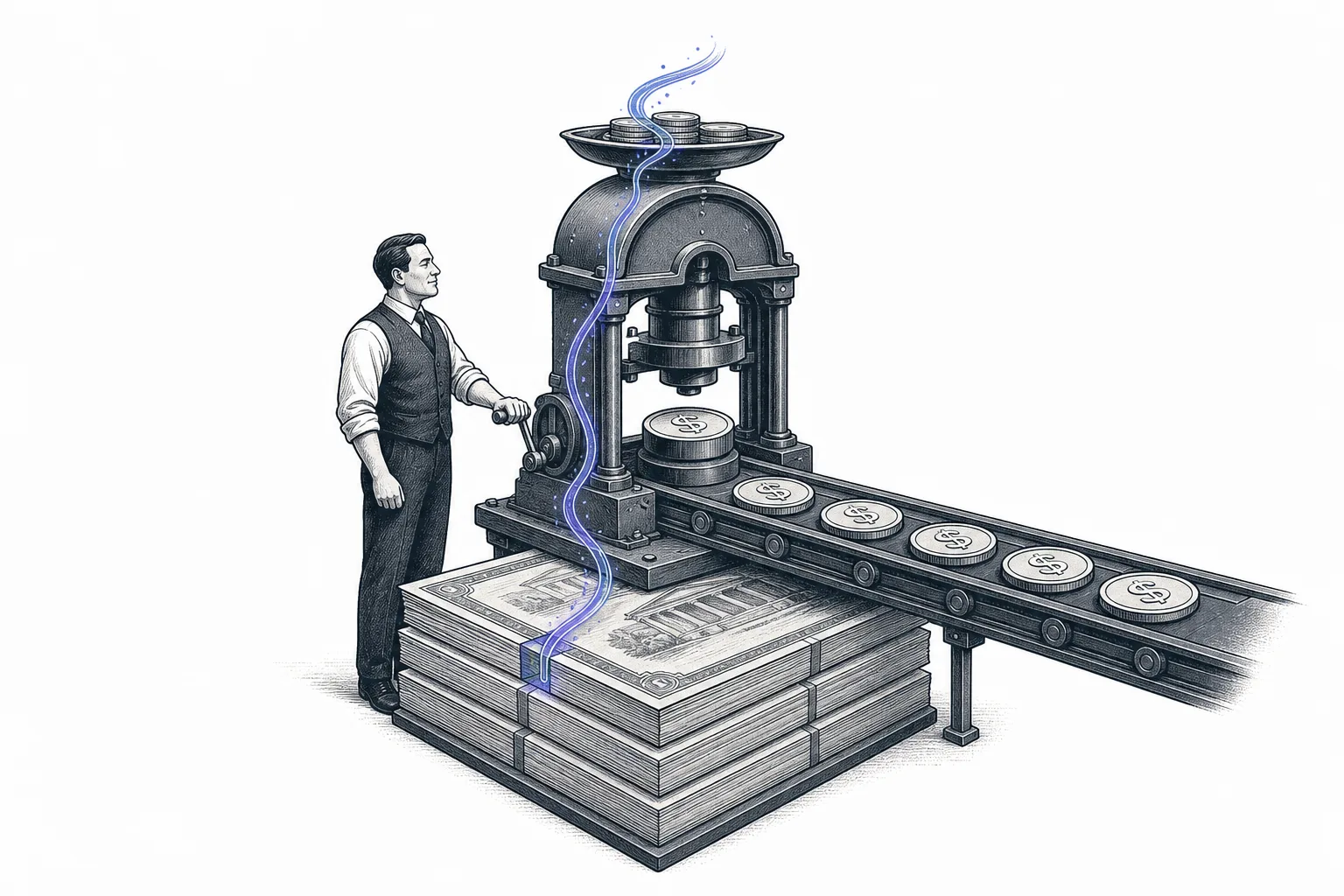
Picture a mint — the factory a government uses to print banknotes and stamp out coins. This node is the same kind of "private mint," except what it stamps out is digital dollars running on a blockchain. These companies are called stablecoin issuers — the ones who "create" coins like USDC, USDT, and PYUSD, then hold a pile of reserves to back each coin so it's worth a real $1.
The heart of this node sums up in one line: mint the coin → hold the reserve → eat the interest from that reserve. When you hand an issuer one real dollar, they "mint" (mint = produce a new coin) one coin and send it back to you, keeping your $1 in reserve. When you want your real money back, you send the coin back; they pay out the dollar and "burn" that coin — it disappears from the system. So the number of coins in circulation always equals the number of dollars in the vault. That's the job of the digital mint.
Mint = "stamping out a new coin" when someone brings real money to exchange · Burn = "destroying a coin" when someone redeems back to real money (so the coin count matches the money in the vault exactly) · Reserve Float = "the yield from the reserve" — the pile of money the issuer holds doesn't sit idle, it's invested in bonds, and all the interest earned goes to the issuer. This is the main revenue source of the business.
On the megatrend map, this node is a branch under Stablecoin Issuers & Distribution within the big trend Digital Finance & Tokenization, and it drills specifically into the "coin issuer" side — the ones who mint coins and hold the reserves. The sibling right next door is Distribution & Revenue-Share Partners, the ones who "put the coins in users' hands" (exchanges, wallets, payment networks) and get a share of the interest back. This lesson focuses on the mint owner, not the people who sell the coins.
02Why it matters — the bridge between crypto and real finance
The first reason issuers matter is that they hold the "blood" of the entire crypto world. Almost every trade on the crypto markets is paired with a stablecoin, and right now the whole stablecoin system has a combined circulating value of around $300–310 billion (early 2026). All of it is minted by just a handful of issuers — whoever controls the issuance controls the rails that all the world's digital money runs on.
But the deeper reason is that stablecoins have become a direct bridge connecting the crypto world to traditional finance. In countries with weak currencies or high inflation (Argentina, Turkey, Nigeria), ordinary people want to hold dollars to preserve value, but opening a dollar bank account is very hard. The coins issuers mint let them "hold dollars on their phone" instantly. And the money flowing in to buy these coins ends up in U.S. Treasuries — meaning stablecoin issuers have quietly become some of the world's largest buyers of U.S. government debt.

And here's the part that catches investors' attention: the "float = profit" model. Issuers get their reserves interest-free, because coin holders choose to hold them for convenience without earning any interest. So issuers put the whole pile into bonds yielding 4–5% a year — almost pure profit. The biggest company in this space made about $10 billion in profit a year with just a few hundred employees, one of the highest profit-per-head figures in the history of financial business.
03How it works (the mint–hold–redeem–burn cycle)
The heart of the digital mint is a four-beat cycle that turns nonstop. Let's walk through it step by step — how one coin is born, makes a profit, and disappears — and which beat lets the issuer "print money."
The point to grasp is that all the profit comes from the fourth beat alone — interest from the reserve. Minting and burning are just accounting mechanics to keep the coin count matching the real money. Issuers don't charge a fee on transferring coins (that's revenue for the blockchain, not the issuer). So the revenue of these companies is tied to just two numbers: (1) how many coins are in circulation (= how big the reserve is) and (2) what percentage the bond interest is. More coins circulating + higher interest = profit jumps.
And this is why the reserve numbers matter so much. In Tether's case, over 94% of Circle's revenue in Q1 2026 came from "reserve income" — interest from the reserve alone — showing that almost the entire company is a machine that eats interest off one pile of T-bills.
04How it connects in the ecosystem
Issuers don't stand alone — a mint needs both "a vault that grows interest" and "someone to distribute the coins." So this node is inseparably entangled with its neighbors in the ecosystem.
- Putting the reserve into Tokenized Treasuries & Money Funds: the $1-per-coin reserve doesn't sit idle — it's put into U.S. Treasuries and money market funds, which today are themselves being "tokenized" on the blockchain. This is the destination of the interest that feeds the whole business — the issuer's float is the yield that comes from right here
- Paying distribution to Distribution & Revenue-Share Partners: issuers can mint coins, but they need someone to "put them in users' hands" — exchanges, wallets, payment networks. And because distribution has value, issuers have to share the interest from the reserve with their distribution partners (like the Circle–Coinbase deal) — this is the single biggest cost eating into the issuer's profit
- Relying on Cybersecurity & Digital Trust and Cloud & Digital Infrastructure: every coin runs on a blockchain running on the cloud, and all the trust rests on security — if the system is hacked or the reserve is called into question, the "digital dollar" could stop equaling a dollar overnight
05Where it stands now
The event that changed everything is the GENIUS Act, which the U.S. passed in July 2025. Before this, stablecoin issuers lived in a legal gray zone, but the GENIUS Act made them legal with clear rules for the first time: hold reserves 1:1 in cash or short-term Treasuries only, disclose the composition of the reserve every month, and be a licensed institution. And in December 2025, the OCC granted "national trust bank" licenses to Circle and Paxos among the first group.
But that same law has a condition that locks in the business's secret: the GENIUS Act bans issuers from paying interest to coin holders — meaning the law itself writes "float = the issuer's profit" into the rules. Coin holders will legally never get interest. All the interest stays with the issuer (or is shared with distributors) as before.
The game right now splits clearly into two poles. Tether (the USDT coin) is the largest giant — circulating value past $186 billion, a private company making enormous profits: in 2025 it earned over $10 billion in net profit (even after falling ~23% from the prior year as interest started to ease) from holding over $122 billion in U.S. Treasuries directly. Because it's private, Tether has no shares to buy — anyone who wants to invest in this trend on the stock market has to look to its rival.
The other pole is Circle (the USDC coin) — smaller (circulating value around $77 billion in early 2026), but it leads with "transparency and legality" as its selling point and became the first stablecoin issuer whose parent company went public (ticker CRCL on NYSE, June 2025). In 2025 USDC grew over 70%, and in Q1 2026 Circle posted total revenue including reserve income of ~$694 million, with 94% coming from reserve interest alone. The third player is PayPal's PYUSD (Paxos mints and holds the reserve, PayPal distributes). Still small at ~$4 billion, but backed by PayPal's user base of billions.
06What's ahead — when the banks rush in
The first direction is the clearest: banks and financial giants are coming in to become "issuers" themselves, because the GENIUS Act opened the door for licensed banks to issue stablecoins through subsidiaries. We're already seeing the moves — Japan's giant banks (MUFG, SMFG, Mizuho) plan to issue a coin together, and Stripe acquired the stablecoin infrastructure company Bridge for $1.1 billion to leap in as an issuer itself. This could fragment the market into "each company's own coin" and intensify competition for the two incumbent giants.

The second direction is the flow out of "crypto trading" toward "real payments", especially cross-border transfers. The more coins are actually spent, the more circulating value grows = the bigger the reserve = the richer the interest. This is a structural tailwind for issuers. Citi estimates that by 2030 the total value of stablecoins could reach ~$1.9 trillion in the base case (and up to $4 trillion in the bull case) — a multiple-fold expansion from today.
The third direction is the question of who gets the float. Right now issuers keep almost all the interest, but as competition heats up and distributors (like Coinbase) gain more bargaining power, the pressure to "share more of the interest with distributors" will rise too — gradually thinning the issuers' enormous profits, even though the law bans paying interest directly to coin holders.
07Challenges & risks
The appeal of the issuer business comes with risks embedded in its very mechanics.
The first and biggest risk to "profit" is dependence on interest. Because float is almost all the revenue (94% of Circle's revenue), the whole business is tied purely to bond interest. Tether made $10 billion in 2025 because interest was high — but that profit also fell ~23% from the prior year as interest started to ease. If the U.S. Federal Reserve cuts rates sharply, every issuer's revenue shrinks immediately. This is a business that's "rich when interest is high, poor when interest is low."
The second risk is losing the peg (depeg) — the issuer's worst nightmare. A real lesson came in March 2023, when Circle revealed that about $3.3 billion (~8% of the total) of USDC's reserves were stuck in the failed Silicon Valley Bank. The result: USDC broke its peg and dropped to $0.86 overnight, before regaining its footing once the government guaranteed deposits. The event drove home that the quality of a "mint" rests entirely on its reserve — the moment the reserve wobbles, that's the moment the coin breaks its peg.
The third risk is competition and regulation. With the GENIUS Act opening the door for banks and Stripe to become issuers, the two incumbent giants (Tether, Circle) have to face rivals that already have user bases and credibility. At the same time, market leader Tether has long been questioned over the transparency of its reserves and may have to adapt heavily to fit U.S. market rules. In the long run, if central banks worldwide issue their own central bank digital currency (CBDC), private issuers could end up competing directly with an "official digital dollar."
In short: the issuer is the owner of a digital mint who mints dollars and keeps the interest from the reserve for itself. The "float = profit" model has made this one of the highest-earning-per-head businesses of the era — and now that the GENIUS Act has made it fully legal, the field is shifting from "a game of a few crypto startups" to "a war where banks and financial giants worldwide want to control the mint themselves."