Megatrend · Longevity & Life Extension
Clearing out the "zombie cells" that slowly poison us as we age
As we get older, some cells stop dividing but refuse to die. They linger in a half-alive, half-dead state and spew out inflammatory chemicals that harm the neighbors around them. Out of this comes an idea that could upend aging — if you could kill and clear these "zombie cells," the body might age more slowly and get sick less. But the road from lab mice to a real drug turned out crueler than anyone expected, and the most expensive lesson comes from a company that was once the field's great hope.
01What a zombie cell is
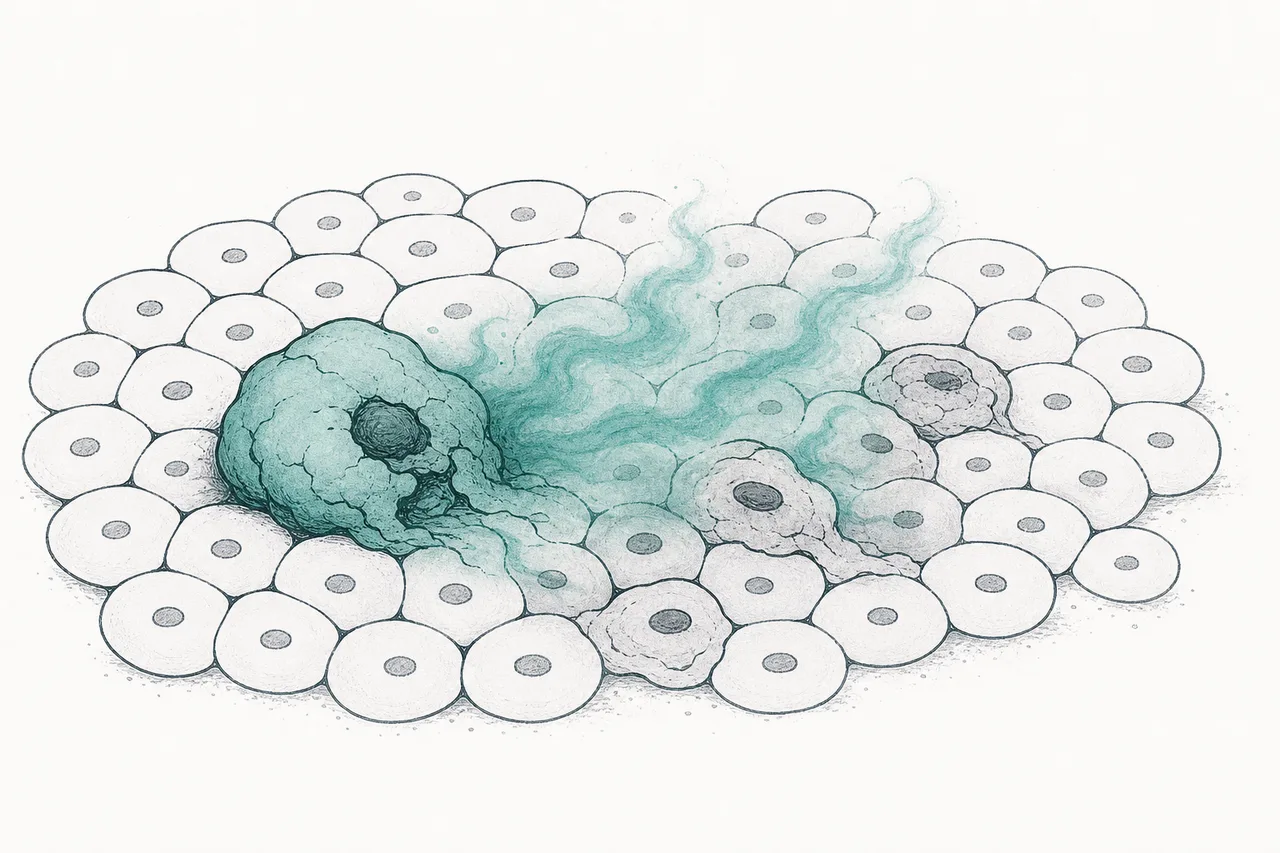
Normally, cells in our body cycle one of two ways: if they're still fine, they keep dividing; if they're damaged beyond repair, they "commit suicide" in an orderly way (called apoptosis) to make room for new cells. But there's a group of cells that get stuck right in the middle of these two paths — they stop dividing and also refuse to die. Scientists call them "senescent cells", but the nickname that sticks better is "zombie cells".
They're called zombies because they really are like the undead — no longer useful (they've stopped doing their job) but never quite dying, and on top of that they walk around harming the cells nearby. A cell entering this state isn't entirely a bad thing; it's actually a cancer-defense mechanism — a cell damaged enough to scramble its DNA won't turn into a tumor if it stops dividing. The problem is that as we age, these zombie cells pile up more and more, because the immune system that used to clear them out gets weaker with age.
These are the two main strategies of this node · Senolytics = drugs that "kill" zombie cells off entirely, picking out only the zombies and leaving healthy cells alone · Senomorphics = drugs that don't kill, but "silence" them so they stop spewing toxins, leaving them to sit there quietly. Each has its trade-offs — killing them off is decisive and effective, but risks hitting healthy cells; silencing them is safer, but you have to keep taking the drug because the cells are still there.
On the megatrend map, this node sits under Longevity & Life Extension — the group trying to "slow or reverse aging at the cellular level." Its definition is straightforward: clear out senescent cells, or cut the inflammatory chemicals they release, to slow the decay of tissue.
02Why it matters for aging
What got scientists excited about this idea came from mouse experiments at Mayo Clinic. In 2011 and 2016, the teams of Jan van Deursen and Darren Baker built special mice that could "kill on command" only the zombie cells. The results were striking: mice that had their zombie cells periodically cleared had hearts, kidneys, and fat tissue that decayed more slowly, got cancer later, and — the part that made headlines worldwide — average lifespan extended by up to ~35%, with no obvious side effects.
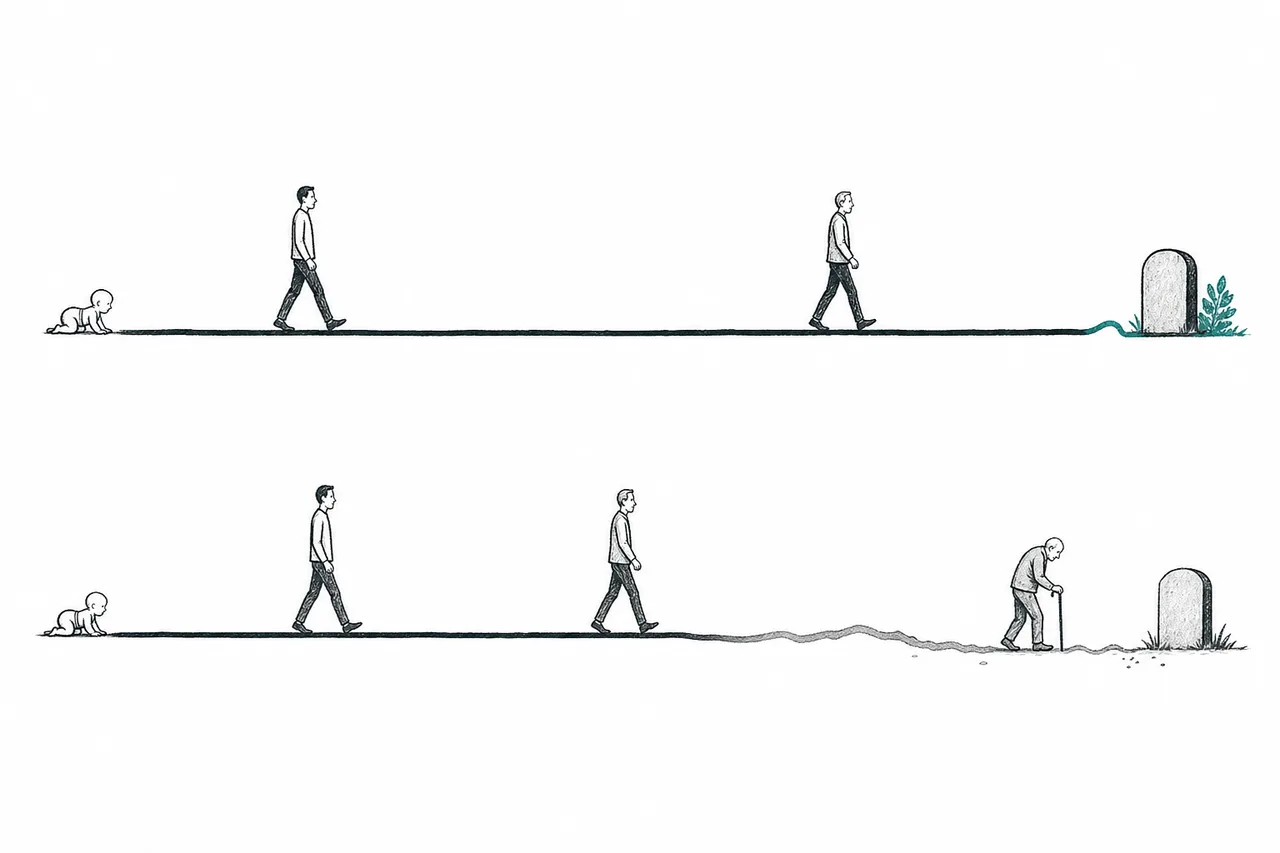
But the heart of the story isn't "living longer" — it's "living better". Researchers draw a serious line between these two words · Lifespan = how many years you live · Healthspan = how many of those years you spend healthy and free of illness. Worldwide there's a "gap" between these two figures averaging around 9–10 years — meaning people spend about the last decade of life with chronic disease and decline. The real goal of senolytics isn't to make people live to 150, it's to narrow that gap — to let people grow old in good health right to the end.
The money circling this idea isn't small either. The broader market — "anti-aging pharmaceuticals" — was estimated at about $4.1 billion in 2024 and projected to grow to ~$6.4 billion by 2030. The slice that's "true senolytic drugs" alone is still tiny (hundreds of millions), because not a single senolytic drug has been approved for sale yet — so almost all of the market figure is "expectation," not real sales.
03How it works (the mechanism)
The reason just a few zombie cells cause enormous damage lies in what they release. Scientists call it SASP — short for senescence-associated secretory phenotype, or in plain terms, the "toxic smoke" a zombie cell puffs out. It's made of inflammatory chemicals (cytokines), enzymes that dissolve tissue, and a host of faulty signals.
The problem is this toxic smoke doesn't stay put. It drifts off and does two things: (1) it sparks slow, creeping chronic inflammation throughout the body (called inflammaging — inflammation from aging), and (2) it goes and "infects" healthy neighboring cells with zombiehood, turning them into zombies too. Just like a real zombie movie — one bites another, one at a time, until it spreads across the whole neighborhood. That's why chronic inflammation is tied to nearly every disease of old age, from osteoarthritis to diabetes, heart disease, and dementia.
So how does a "zombie-killing drug" work? The trick is that zombie cells rely on special machinery to keep themselves from dying (they leave the anti-suicide switch flipped on permanently). A senolytic drug flips that switch off, finally getting the zombie cells alone to "agree to die." The most famous combination is dasatinib + quercetin (D+Q) — an old cancer drug (dasatinib) paired with an antioxidant found in fruit (quercetin). Another that's been studied a lot is fisetin, a natural compound in strawberries. What makes senolytic dosing different from ordinary drugs is that you don't have to take it every day — you kill zombies in batches, then leave a gap (the "hit-and-run" strategy).
SASP = the mix of inflammatory chemicals and enzymes that zombie cells secrete — the culprit that lets just a few cells cause wide-reaching damage · Inflammaging = the low-grade chronic inflammation that slowly builds up with age, which SASP fuels heavily — the common thread linking nearly all diseases of old age together.
04Where it sits on the Longevity map
Senolytics is one of the "many paths" scientists use to attack aging under the Longevity & Life Extension umbrella, and each path has a different philosophy:
- Senolytics (this node) = "clear out the waste" — remove the old cells that have become a problem. A "cleanup" approach
- Cellular Reprogramming & Rejuvenation = "rejuvenate the cell" — instead of killing old cells, "reset" them to be younger (using Yamanaka factors). More ambitious but also riskier — these two are almost always discussed together
- NAD+ & Metabolic Aging = "recharge the cell" — focuses on the cell's energy and metabolism
- Aging Clocks = "measure your true age" — build tools to measure how far you've aged at the cellular level, which senolytics relies on to prove the drug actually works
In terms of cross-trend connections, senolytics is built on the foundation of Biotech & Genomic Medicine — it's a biopharmaceutical that has to go through drug discovery, clinical trials, and FDA approval just like any other drug. And what's interesting is that AI is starting to play a role in "finding new drug targets on zombie cells" — companies like Rubedo use their own AI platform to design molecules that kill only zombie cells more precisely.
Finally, it directly "complements" the Aging Population trend — the world is aging fast, and the more old people there are, the higher the bill for treating the chronic diseases of old age. If senolytics can truly help people "age in good health," it would be both a huge business opportunity and a way out for the public-health system.
05Where it stands now
This is the part that has to be said without dressing it up, because senolytics is a classic case of "the science is exciting, but the road to a real drug is brutal." The first fact to accept is — so far, not a single senolytic drug has been approved to treat any disease. Everything is still in trials.
The most expensive and famous lesson comes from Unity Biotechnology, once the field's "star" — it went public in 2018 on sky-high hopes. Its lead drug was UBX0101 for treating osteoarthritis of the knee. But in August 2020, the Phase 2 results came back a failure — the drug didn't relieve pain any better than a placebo. Unity's stock crashed ~66% in a single day, and the company had to drop its lead program entirely. It's a reminder that "works in mice" and "works in humans" are completely different things.

After that, Unity "changed battlefields" to eye disease instead, with the drug UBX1325 (foselutoclax) for treating diabetic macular edema, which looked more hopeful — in a 2025 Phase 2b trial the drug produced durable improvement in vision. But it still missed its main statistical bar (it couldn't prove it was "non-inferior" to the standard drug aflibercept on every measure). With cash running thin, Unity had to halt the trial and seek a strategic exit, and in the end the company was delisted from Nasdaq in 2025–2026 as a "shell company" with no operating business, and the board approved a plan to wind down. From star to expensive lesson in under eight years.
But Unity falling doesn't mean the science is wrong. It means "harder than expected," and other trials are still moving forward — at Mayo Clinic, the D+Q combo was tested in patients with idiopathic pulmonary fibrosis (IPF) and found to be safe and feasible (though the trial group was still very small, ~12–14 people, focused on safety more than efficacy). And fisetin is being tested in frail elderly patients (frailty) in a Phase 2 trial with results trickling in over 2026–2027.
So the picture of the players right now is a clear blend: small, highly volatile public companies plus a great many early-stage private startups not yet on the stock market — this isn't an industry dominated by big players like Memory or Foundry, it's a testing ground where no winner has been found yet.
06The road ahead
The first direction is "a new generation of molecules that are more precise." The big problem with first-generation senolytics (D+Q, fisetin) is that they're fairly "crude" — old compounds repurposed, not designed specifically to kill zombie cells. The new generation that companies like Rubedo are building uses AI to design molecules that latch onto zombie cells specifically, cutting side effects on healthy cells — and if it really works, it changes the whole game.
The second direction is "choosing diseases more wisely." The lesson from Unity is that chasing "slow aging across the whole body" is too hard to prove (you have to wait decades to see results). So the field has turned to diseases that show results fast and are easy to measure first — eye disease, lung disease, joint disease, or frailty in the elderly. If a drug can prove itself in a specific disease, it can expand to slowing aging later.
The third direction is "the tools to measure." One of the biggest obstacles is that it's still hard to measure how many zombie cells a drug actually killed, and whether it truly made someone "age more slowly." This is where senolytics has to lean on Aging Clocks and new biomarkers — if you can measure results accurately and faster, trials get cheaper and faster too.
07Challenges & risks
This node is one of the trends that's both "the most scientifically exciting" and "the highest-risk" at the same time.
The first risk is "a history of clinical failure." Unity's story wasn't a one-off accident; it reflects the reality that most drugs that look good in mice fail in humans. The fact that not a single senolytic has cleared the approval gate means this whole node still "hasn't proven itself" as a real treatment — all the confidence still rests on hope.
The second risk is "the measurement problem." Unlike a blood-pressure drug whose effect shows in a few weeks, proving a drug "slows aging" takes a very long time and a reliable biomarker is hard to find. That makes trials expensive, long, and at high risk of producing unclear results.
The third risk is "the volatility of small-cap stocks." Most of the public players in this field are clinical-stage biotechs with no revenue yet. Their share prices swing hard with each trial result — good news and the stock jumps, bad news and it halves in a single day (as Unity went through). This isn't a group for anyone who can't stomach risk, and don't forget that the "real winner" might still be a private company whose shares you can't even buy.
The fourth risk is "fake supplements." Because fisetin and quercetin are natural compounds, plenty of supplements advertise themselves as "senolytic" with no clinical evidence to back it up — consumers have to watch out for marketing that runs far ahead of the science.
In short: zombie cells are a beautiful idea with solid evidence in animal studies — clear out the cells that poison their neighbors, and the body might age more slowly. But Unity's lesson reminds us that the distance from "mice living 35% longer" to "a drug a doctor can actually prescribe" is long and littered with the wreckage of companies that fell before. Understanding this node means understanding both the hope of the science and the cruelty of turning research into a drug — two sides you must always look at together.