Megatrend · Longevity & Life Extension
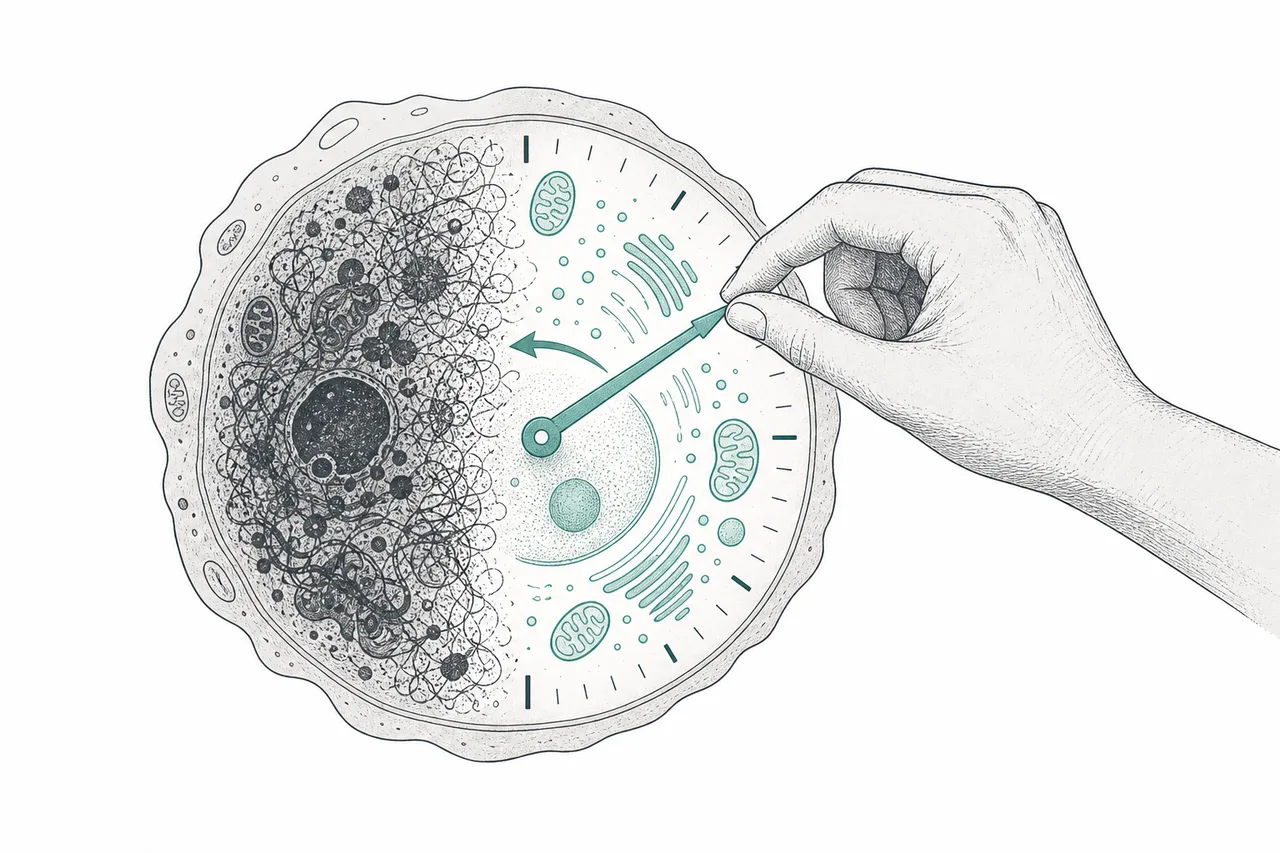
What if we could turn a cell's "age clock" backwards?
This is the most ambitious science of aging in the world — not just to "slow" aging, but to try to reverse it, using four genes that once turned skin cells into embryonic cells, now applied as just a "light touch" to reset a cell's age younger — while the cell still "remembers" who it is. It sounds like science fiction, and most of it is still in lab mice — but in 2026 it just stepped into its first human trial.
01What it is
Start with something that sounds impossible. In 2006, a Japanese scientist named Shinya Yamanaka discovered that if you put just four genes into the skin cell of a fully grown mouse, that cell would "step back" into an embryonic cell that can become any organ — like pressing a rewind button to return the cell to "infancy." The discovery was so big that Yamanaka won the 2012 Nobel Prize, and those four genes — Oct4, Sox2, Klf4, c-Myc — were named after him: the Yamanaka factors (OSKM for short).
But the more interesting question came next: if you put these genes in at "full blast," the cell steps all the way back to infancy and forgets who it used to be (a skin cell, an eye cell, a nerve cell). So what if you applied them with just a "light touch" — switched on briefly, then quickly off? Could the cell get a little younger so it works better, but still remember what kind of cell it is?
The answer — at least in mice — is "yes." And that's the heart of this node. It's the branch of the megatrend Longevity & Life Extension called partial / epigenetic reprogramming — the effort to "reset the age" of a cell without erasing its identity.
Our DNA is like the "hardware" that barely changes over a lifetime. Epigenetics is the "software" layer that sits on top of the DNA — tiny chemical marks (like methylation) that tell which genes to switch on and which to switch off. This is what makes an eye cell different from a liver cell even though the DNA is exactly the same. Reprogramming doesn't edit the DNA — it works on this software layer.
Let me underline the key word right from the start, because it's the line between hope and danger: "partial" is everything. Reprogram too much, and the cell becomes an embryonic cell that grows out of control — that's a tumor. So this whole field is about touching "just the right amount."
02Why it matters — reversing age, not just slowing it
Almost every anti-aging drug and technology today is trying to do one thing: slow the decline. Good food, exercise, anti-inflammatory drugs — all of it is "pressing the brake on aging." But reprogramming asks a different, much bolder question: can we go backwards? Not slow the clock, but turn its hands back.
Why is this even possible in theory? The most powerful explanation comes from Harvard scientist David Sinclair, called the "information theory of aging." The gist: our cells don't age because the DNA breaks, but because the epigenetic software layer gradually gets "cluttered" over time. The on/off marks on genes get smudged, so the cell forgets how to work as well as it did when young. It's like a song whose original master file is still intact, but the copy you play has been copied over so many times that it's full of noise — if the original information is still "there," reprogramming is like recalling the clean version.
That's why enormous money is flowing into this field. If it really works in humans, it won't be "one drug" but a way to treat the root of a whole pile of age-related diseases — from failing eyes to the heart to the brain. Research firms estimate the market for cellular reprogramming for anti-aging drugs specifically will grow from about $1.8 billion in 2025 to ~$12 billion in 2034 (CAGR ~24%) — and this is still just a sliver of the whole $85 billion longevity-biotech market.
But let me be blunt right now: these "market" numbers are a forecast of a future that hasn't happened yet. Today there's almost no approved drug people can actually use — this is a very long-term bet, not a business that's already making money.
03How it works (turning the clock)
Picture one old cell. Its epigenetic software layer is cluttered with "noise" — smudged on/off marks on genes piled up over decades. So the cell works half-asleep, below its real capacity.
Partial reprogramming works in three beats: (1) deliver the Yamanaka factors (often just the three, OSK, dropping the cancer-risk c-Myc). (2) switch them on briefly so the cell starts to "erase the noise" and turn the age clock backwards. (3) switch them off quickly, before the cell steps back so far it forgets its identity. The result is a cell of the same kind, younger and working better.
The evidence that convinced people it works in the actual body (not just in a culture dish) comes from a 2020 study by David Sinclair's team in the journal Nature. He made old mice and mice blinded by glaucoma see again by delivering OSK genes into the optic-nerve cells. The optic nerve regrew up to ~5× more, and the pattern of gene activity returned to that of young mice. This was one of the first demonstrations that we might safely "reset the age" of a complex tissue like nerve cells.
In 2013, a researcher named Steve Horvath built a way to measure a cell's "true age" from the pattern of chemical marks on its DNA — called the epigenetic clock. It matters enormously because it's the "ruler" that lets us measure how many years reprogramming actually makes a cell "younger" — not just feeling like it's better.
04Where it sits in the Longevity universe
This node is the "most ambitious star" in the Longevity & Life Extension group. But it doesn't stand alone — it has siblings attacking aging from different angles:
- Reprogramming (this node): the most ambitious — trying to reverse a cell's age. But also the riskiest and the furthest off
- Senolytics (clearing out senescent cells): a more "conservative" approach — it doesn't reverse a cell's age, it removes the old, degraded cells that leak inflammatory molecules. Much closer to the clinic
- Metabolism & geroprotectors / NAD+: uses drugs and compounds to make the cell's energy engine work better — focused on "slowing," not "reversing"
- Aging clocks: the measurement tool every approach uses in common, to prove it actually works
Put simply: if Longevity is a war on aging, reprogramming is the "most powerful but most dangerous experimental weapon," while Senolytics is the "clean-up crew" that's ready to fight first.
And this node also runs deep lines to other big trends:
- Stands on the shoulders of Biotech & Genomic Medicine: delivering OSK genes into cells needs technology from the gene-therapy world — AAV viruses, mRNA, vector design, all borrowed from biotech's arsenal
- Close to Regenerative Medicine: both want to repair / rebuild tissue. The difference: regenerative medicine often implants new cells, while reprogramming tries to "restore the existing cells" that are still there
- Leans heavily on AI: figuring out "how much is just the right amount to touch" is a problem with enormous variables — the leading companies use AI models to search for the safest recipe and timing (Retro Biosciences claims AI made its reprogramming ~50× more efficient)
- A hope for the aging society: if it works, it would change the entire economics of senior care
05Where it stands now
This is the part that needs the most blunt honesty, because it's where the excitement and the reality are furthest apart.
The big news of 2026: partial cellular reprogramming just stepped into its first human trial in history. The company Life Biosciences got the green light from the U.S. FDA to test the drug ER-100 in humans — delivering OSK genes (dropping the cancer-risk c-Myc) to restore optic-nerve cells in patients with glaucoma and ischemic optic-nerve damage, building directly on Sinclair's mouse work. This is a genuinely important step — but note that it's a Phase 1 trial whose main goal is only to "see whether it's safe." It's still years away from being a real, usable drug.
Just as important, and a market fact investors need to understand: this field is almost entirely private companies not yet on the stock market. The real players are raising "billions of dollars" from billionaires and VC funds, not from retail investors on the exchange. The biggest money in the science of aging right now sits outside the stock market.

The picture as of 2026: the science is genuinely exciting, with solid evidence in mice and the first step into humans just taken. But from an investing angle, there's almost nothing to buy in the market as a "pure play" on this trend — the real money is inside private companies.
06The road ahead
The first direction is "from the eye to the whole body." It's no accident everyone starts with the eye — it's an organ where you can deliver a drug to a single spot, it's isolated from the rest of the body (so if a problem arises, you can contain it), and you can measure the result clearly: you can see or you can't. The far harder next step is reprogramming the whole body safely — a problem no one has solved yet.
The second direction is more precise control with AI and new delivery vehicles. The heart of the problem is "how much is just the right amount to touch" — and this is a problem AI can help with, alongside better ways to deliver the genes (mRNA, new carriers like vesicles) that can switch on and off more precisely and stay better contained.
The third direction is better aging clocks. If we can measure "biological age" accurately and fast, we'll know immediately how many years a treatment is worth — no need to wait decades to see whether people actually live longer. That would speed up trials across the whole field.
But the honest timeline is this: even with Phase 1 in humans underway, a broadly usable reprogramming drug is probably still a decade or more away. This is a very long-term bet. So for retail investors, the most realistic "way in" today is indirect — through biotech / gene-therapy companies and the makers of tools and vectors (AAV, mRNA) who sell picks and shovels to the gold miners rather than mine the gold themselves.
07Risks — and why you still can't invest directly
Let me close with the unvarnished truth, because this field is far too easy to sell as a dream.

The first and most serious risk is cancer. The line between "reprogramming just enough so the cell gets younger" and "reprogramming too much so the cell forgets its identity and grows out of control" is very thin. In the 2016 experiment, mice given too many Yamanaka factors lost weight sharply, developed tumors, and died early. This isn't a small side effect — it's a risk baked into the very mechanism of the method. The reason most companies drop c-Myc (leaving OSK) is that it's the factor that accelerates growth and is linked to cancer.
The second risk is delivering the drug to the right place and switching it on and off precisely. "Touch then switch off" sounds easy on a slide. But in a real body, delivering the genes to the right cells, in just the right dose, switching them off in time — and without triggering the immune system to attack the carrier (AAV) — is a very hard engineering problem.
The third risk is the timeline and clinical uncertainty. Almost all the exciting evidence is still in mice. Things that work in mice failing in humans is utterly normal in the drug world. Having just entered Phase 1 means we don't even know yet whether it's safe in humans, let alone whether it works.
In short: if it works, cellular reprogramming could be one of the most important technologies in human history — reversing aging, not just slowing it. But that "if" is still very big. And as an investor, understanding that "the real thing is still outside the market, and still mostly in mice" matters just as much as understanding how exciting it is.