Megatrend · Synthetic Biology
Teaching plants to make their own fertilizer
The nitrogen fertilizer the whole world runs on is made from natural gas, and it releases an enormous amount of carbon. So what if we coated "microbes" onto seeds and let them pull nitrogen out of the air to feed the roots instead? That's the promise of this era — and the reason it hasn't been as easy to pull off as everyone hoped.
01What it is
Modern farming rests on just a handful of chemicals — nitrogen fertilizer to grow the plants, and pesticides and fungicides to keep pests away. All of it works and it's cheap. But it comes with a hidden cost: it's made from fossil fuels, it releases carbon, and it runs off into the water and pollutes it. The question that sparked this whole industry is: can we use "living things" instead of "chemicals" to feed and protect plants?
Agri-Biotech & Microbial Inputs is about using the tools of synthetic biology to design a new kind of "farm input" — living things, or substances made by living things — instead of pure chemistry. Roughly, it splits into three groups:
- Nitrogen-fixing microbes (microbial nitrogen): bacteria that pull nitrogen from the air and feed it to plant roots, letting the plant make part of its own "fertilizer" and cutting chemical-fertilizer use
- Biological crop protection (biologicals): covers biopesticide (microbes/natural substances that fight pests) and biostimulant (substances that help plants grow better, resist drought, and take up nutrients more efficiently)
- Precision gene-edited traits (gene-edited traits): using tools like CRISPR to edit a plant's genes for disease resistance, drought tolerance, or better yield — without inserting genes from a different species the way old-school GMO did
An umbrella term for farm products whose active ingredient is "a living thing or something made by one" — as opposed to synthetic chemicals. It breaks into biofertilizer (microbes that help deliver nutrients), biostimulant (boosts growth/resilience), and biopesticide (fights pests). The strength is that it's friendly to the environment and the soil. The weakness is that it "works inconsistently" — because it's a living thing that depends on the local weather. That point is the heart of this whole lesson.
Within Synthetic Biology (non-pharma), this node is about taking synthetic biology onto the "field" — not making food in a fermentation tank like Alt-Protein, but living with real plants in real soil.
02Why it matters
To understand why the world wants to stop leaning on chemical nitrogen fertilizer, you have to know how it's made — through the Haber-Bosch process, which combines nitrogen from the air with hydrogen from "natural gas" under high heat and pressure. Put simply, nitrogen fertilizer is a direct product of fossil fuels.
The numbers hit hard: this process eats about 3–5% of the world's natural gas, and the synthetic-nitrogen-fertilizer chain emits roughly 1.13 billion tons of CO₂ a year ≈ 2.1% of global emissions — more than the entire commercial-aviation industry. Worse still, the nitrogen plants don't use up flows into rivers and the sea, creating "dead zones" so low in oxygen that nothing can live there.
Add three more pressures on top — wildly volatile fertilizer costs (prices spiked after the Ukraine war), tightening regulation (the EU aims to halve chemical-pesticide use and curb nitrogen runoff), and the soil-health movement — and demand for biologicals keeps growing. The global market for biological farm inputs sits at around $18.4 billion in 2025 and is expected to reach ~$35 billion by 2030.
03How it works
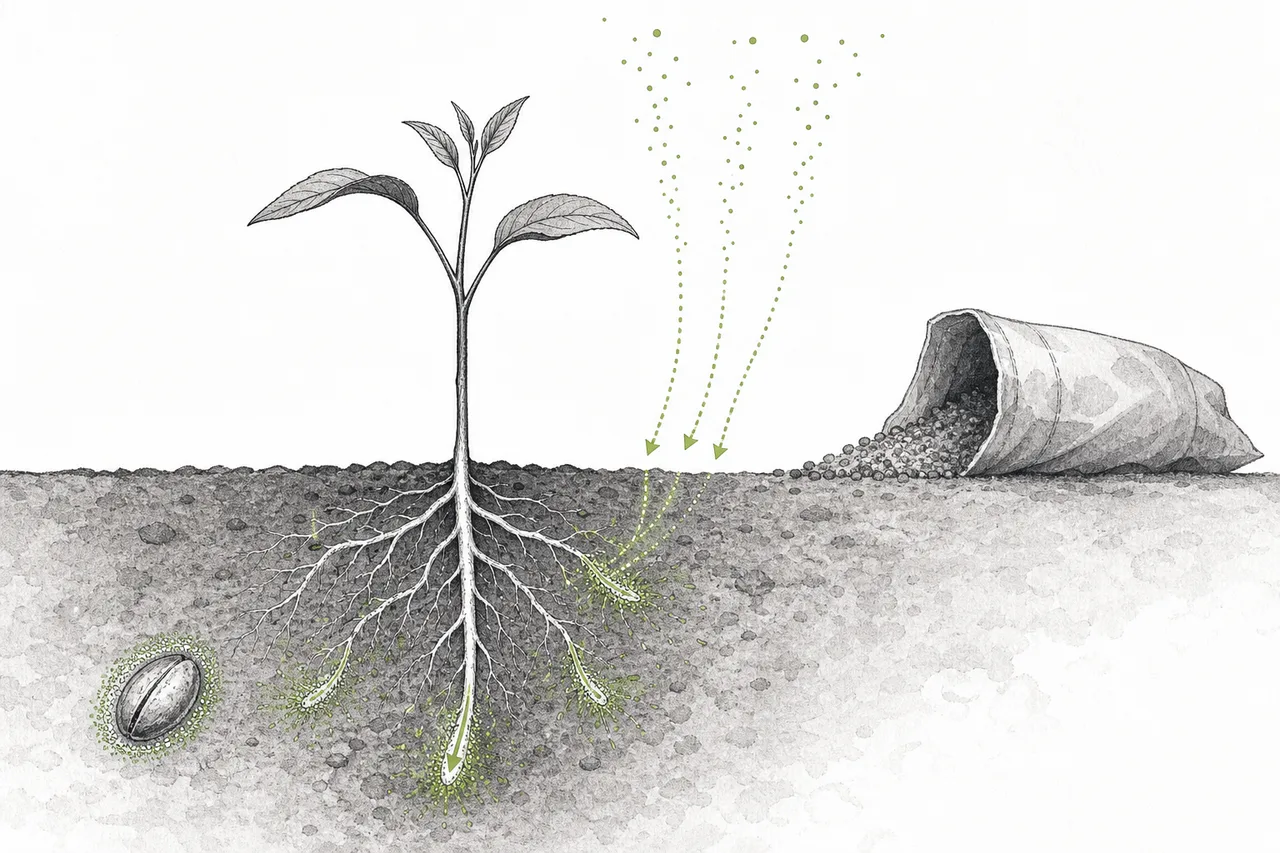
The heart of this trend is easy to grasp with a single example: nitrogen-fixing microbes. The air we breathe is 78% nitrogen — but plants can't use it directly. They need nitrogen in the form of "ammonia," which we normally make in a Haber-Bosch plant and then spread on fields as fertilizer. The idea behind agri-biotech is to move that factory right down to the plant's roots — in the form of bacteria.
In reality, this technology hasn't replaced all fertilizer yet — it replaces "part" of it. 2025 field data from Pivot Bio (the leader here) shows its PROVEN G3 product in corn replaced synthetic nitrogen by an average of 33 pounds per acre, while raising yield by an average of 2.1 bushels, and the company claims the product is about 60% cheaper than nitrogen fertilizer. Biopesticides/biostimulants work differently — some are fungi or bacteria that eat the pests, others are substances that help the plant build immunity or handle stress better.
04Where it sits in SynBio
This node is one of the "field" branches of Synthetic Biology (non-pharma), and it connects to its relatives in the same family in ways that make sense:
- Running parallel to Alt-Protein & Precision Fermentation: both use microbes as "machines" — that side ferments protein in a tank, this side releases microbes into real soil. Different arenas, but the same biotech foundation
- Extending into Bio-Based Materials: the skill of designing microbes to make a desired substance works for both biofertilizers and bio-materials — same platform, different destination
- Directly backing Climate-Resilient Agriculture: drought- and disease-tolerant plants and healthier soil are the heart of farming that can withstand a volatile climate — biologicals are one tool in that box
- Depending on AI: selecting and designing microbial strains that "actually work in many different soils" requires analyzing huge amounts of genomic and field data. AI and computational biology speed this up
05Where it stands now
To tell this story honestly, we have to be clear: the promise is huge, but proving it in the field is still hard — and the market has already punished several players who promised too much.
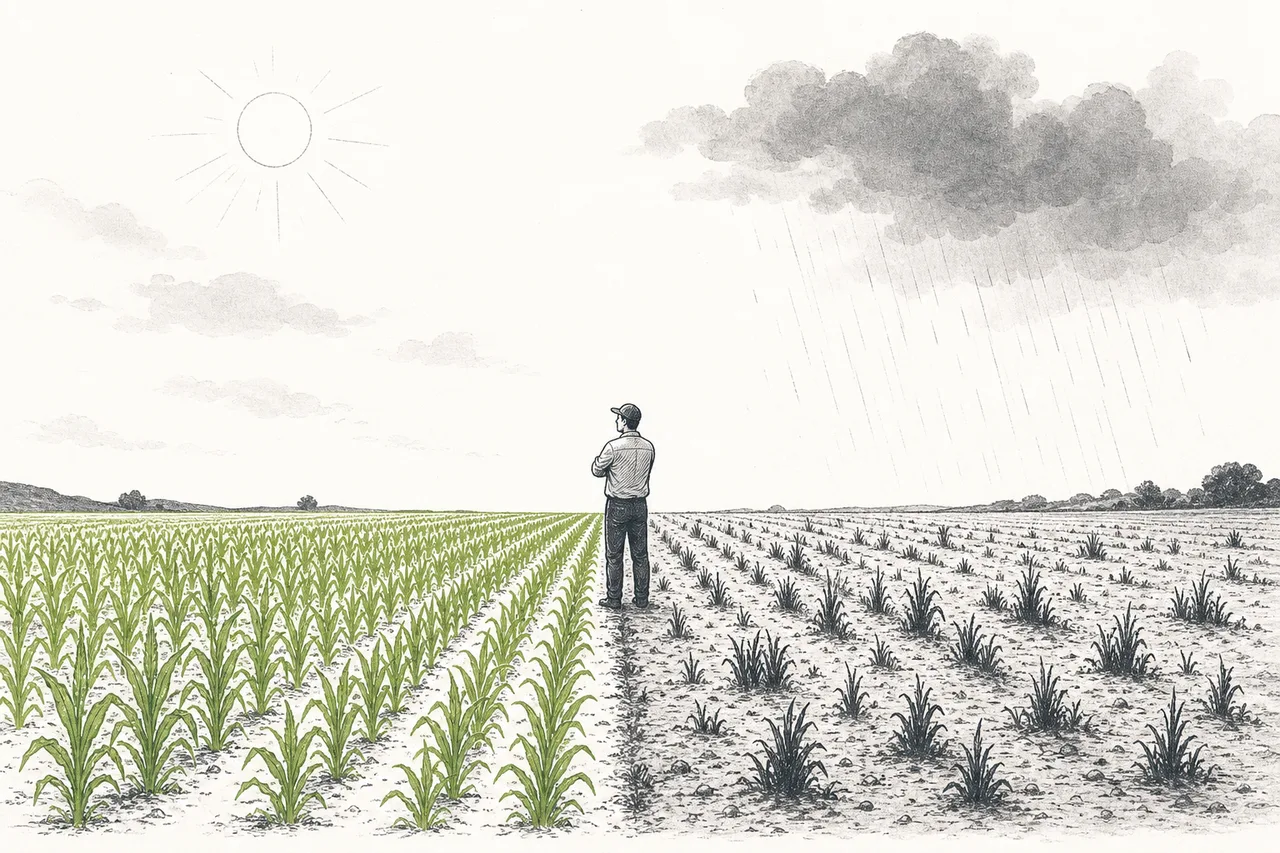
The heart of the problem is that biologicals don't work consistently. Chemicals act the same everywhere, every time, but microbes are living things whose effect depends on soil temperature, moisture, and the microbes already in that particular soil. Surveys show 41% of ag retailers and farmers name "lack of confidence in performance" as the number-one barrier to adopting biologicals, and many of the benefits (soil health, stress tolerance) come gradually and are harder to see than the instant effect of chemicals. So adoption is slow, and the products have to fight chemistry that's cheap and proven.
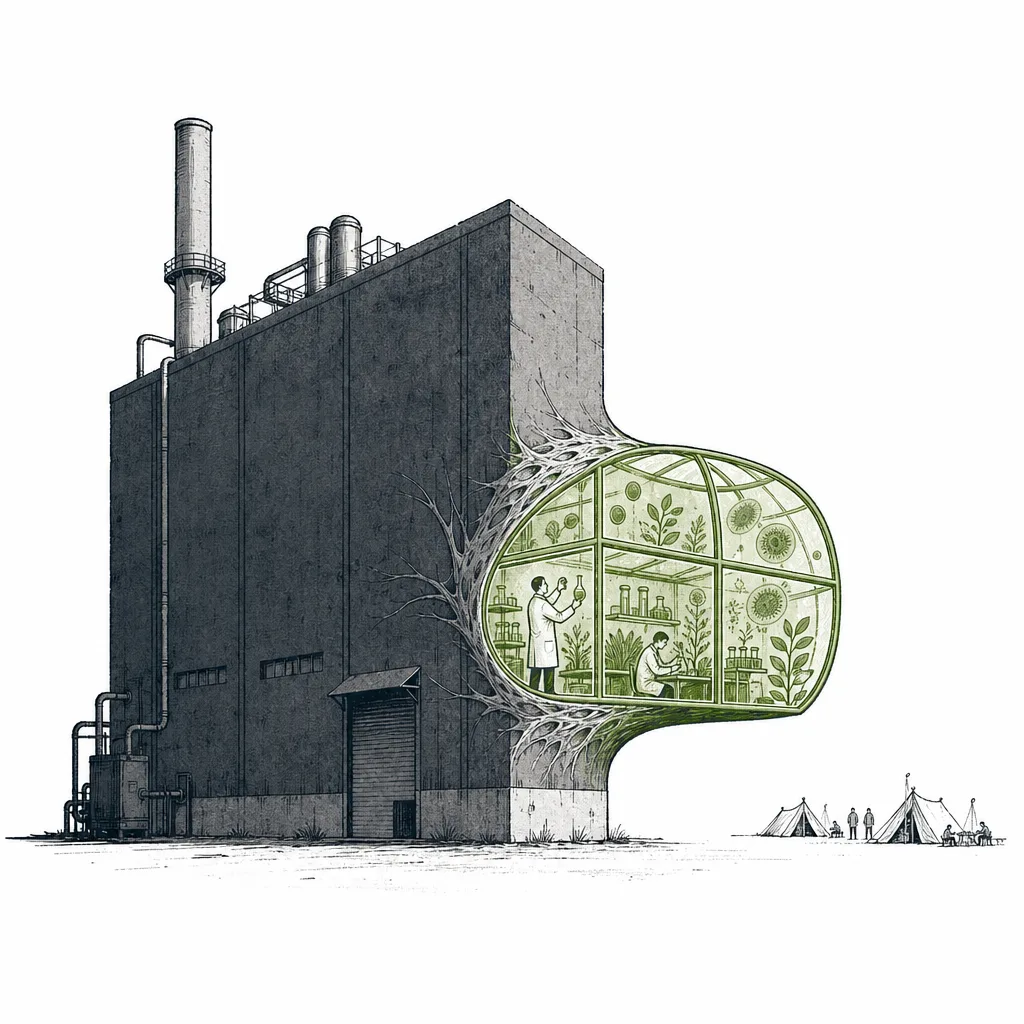
This difficulty is reflected in the wreckage of once-hot companies: Benson Hill went public via SPAC at a valuation of about $2 billion, then ultimately filed for Chapter 11 bankruptcy in March 2025; the stock collapsed from $10 to ~$0.01 and was delisted · Indigo Ag was once the world's most highly valued agtech startup at $3.5 billion, but its latest funding round valued it at about $200 million (down ~94%) · AgBiome, which had raised $230 million, laid off its entire staff in late 2023 and then sold off its brands.
But this isn't the end — it's a "sorting." Money and hope are moving from cash-burning startups to patient incumbents with distribution channels. Corteva poured in to buy Stoller ($1.2 billion) and Symborg, building one of the world's largest biologicals units · Bayer keeps pushing deals to buy bioinsecticide technology · and Novonesis (born from the merger of Novozymes + Chr. Hansen) is a microbe giant that's already profitable — a different league from still-loss-making startups. The most-watched private player, Pivot Bio, just closed a $430 million Series D (led by DCVC and Temasek) but still hasn't gone public.
06The road ahead
The first direction is that "consistency" is the deciding battlefield. Whoever can make biologicals work predictably across many soils and climates will unlock an enormous market. That's exactly why AI and field data matter — the goal is to move from "sometimes it works" to "it definitely works if you use it on the right field."
The second direction is the "supplement," not "replace," model — instead of quitting chemical fertilizer entirely, farmers cut it by 20–40% and top it up with microbes. This picture is far more realistic and easier to sell than "go 100% chemical-free," and it lets the products seep gradually into real fields.
The third direction is that the incumbents will be the quietest winners. The lessons from Benson Hill and Indigo Ag taught the whole industry that reach to millions of farmers + deep R&D budgets + the patience to wait several seasons for results matter more than the cool technology in the hands of a startup that runs out of money first — which is why Corteva, Bayer, and Novonesis are well positioned to harvest the market as it matures.
07Challenges & risks
The first and biggest risk is inconsistent field performance. As long as biologicals "work sometimes and not others" depending on the weather, farmers hesitate to bet a whole season's harvest on them — 41% say they don't trust the results. This is the real wall to adoption.
The second risk is that it has to fight cheap, proven chemistry. Chemical fertilizers and pesticides act instantly, cost little, and farmers have known them for decades. So biologicals have to be genuinely better or cheaper, not just "environmentally friendly" — and when chemical-fertilizer prices fall, the incentive to switch shrinks even further.
The third risk is slow adoption and the startup graveyard. The cycle for this technology is long (you have to test it over several seasons), while startup capital is limited, so many run out of money before proving the model — Benson Hill, Indigo Ag, and AgBiome are living witnesses. Investors who chase "hot agtech startups" without looking at the path to profit usually get badly hurt.
The fourth risk is regulation that can be both a tailwind and a headwind. The EU clamping down harder on pesticides and nitrogen helps boost demand for biologicals — but on the other side, registering biological products and gene-edited plants carries high uncertainty, varies country by country, and can shift with politics.
In short: Agri-Biotech is the effort to teach plants to make their own fertilizer and protect themselves, to free farming from fossil-based chemistry — a powerful idea the world needs. But because it's "a living thing in real soil," not a chemical formula in a bottle, it moves slowly, stumbles often, and punishes the impatient. Understanding this tension is understanding why a "necessary" trend is still littered with the wreckage of companies that failed.