Megatrend · whole-trend overview
When the factory is a fermentation tank, not an oil well
Picture "programming" tiny microbes to make meat, jet fuel, plastic, or fertilizer — the things we make today from petroleum, animals, and mining. That's the heart of synthetic biology on the non-pharma side. But this is also a trend that just lived through a burst bubble — flagship stocks like Ginkgo and Amyris fell more than 75%. This lesson is the map that strings the 5 categories together and helps you tell what's real and making money from what's a promise that hasn't arrived yet (each category has its own deep-dive chapter).
01The big picture: program living things to make stuff
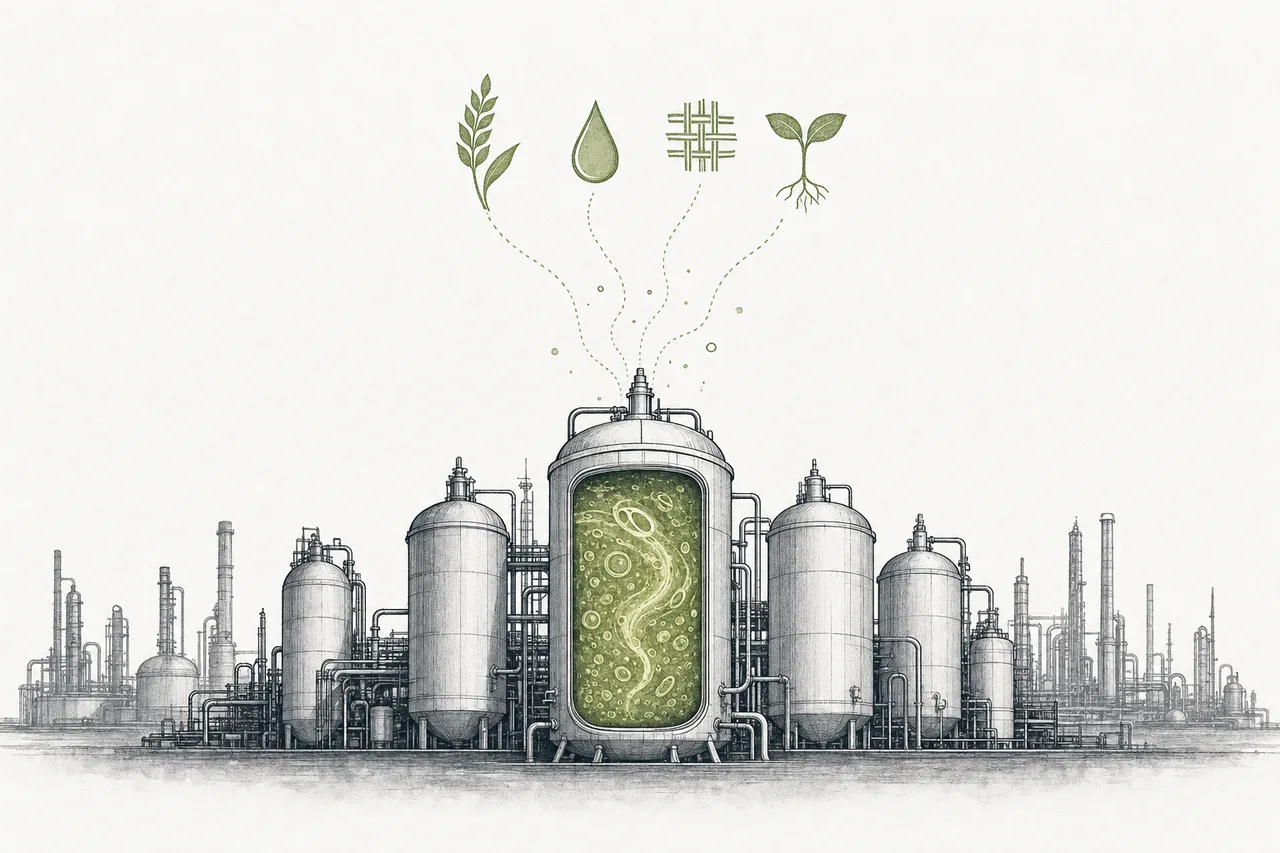
Almost everything around us today comes from three places — dug from the ground (minerals, metals), refined from oil (plastics, chemicals, fuel), or raised from animals (meat, milk). Synthetic biology is the attempt to remake all of this from living things instead — by "programming" the genes of microbes, yeast, or algae so they become tiny factories that make what we want.
The word "non-pharma" matters a lot in this chapter — we're talking about food, materials, chemicals, fuel, and agriculture, not human medicines (those live in the Biotech & Genomic Medicine trend, a completely different thing with a completely different business model). The split matters because the pharma side has high margins and can charge a lot, while this side has to fight the cheapest things on Earth — crude oil and soybeans.
The total market is growing fast. Many research houses peg the overall synthetic biology market at around $12–22 billion in 2024, reaching roughly $60–65 billion by 2030 — about 20% growth a year. The "industrial" side (materials/chemicals/fuel) is the fastest-growing segment (~23% a year).
But to understand this trend, you have to see it right — it isn't one block, it's one "platform layer" that feeds several "application" categories, and that's exactly what we'll map out.
02The map: what are the 5 sub-categories?
The best way to see synthetic biology is to split it into one "tools layer" (platform) at the base, feeding 4 "application" categories (applications) above it — each category has its own deep-dive chapter (tap in to read):
Base layer — platform and tools (everyone has to use it)
- DNA Synthesis & Synbio Platform Tools: the "DNA print shop" and the tools to design and test living things — whether you're making meat, fuel, or fertilizer, you have to order DNA and tools from this layer first (these are the industry's "picks and shovels")
Application layer — what you do with it (4 categories)
- Alt-Protein & Precision Fermentation 📘: making protein, milk, eggs, and fat by fermenting microbes instead of raising animals — the food side (has a deep-dive lesson)
- Bio-Based Materials & Industrial Chemicals: bioplastics, chemicals, and materials made from biomass instead of petroleum
- Sustainable Aviation Fuel & Bio-Fuels: sustainable aviation fuel (SAF) and biofuels — the category with "mandated demand" from the law
- Agri-Biotech & Microbial Inputs: bio-fertilizers, bio-pesticides, and microbes that help crops grow while cutting chemical inputs
03How it all connects (platform + applications)
The heart of this map is the "shared tools." The 4 application categories look completely unrelated (meat, plastic, jet fuel, fertilizer), but they actually use the same process: design genes → order synthetic DNA → put it into microbes → ferment in tanks to make the product. The only difference is the "program" you put in and the "stuff" that comes out.
This is why the base layer matters most — it's the common point every application has to pass through. Just as everyone in AI has to buy GPUs, everyone here has to order synthetic DNA. And this trend also depends directly on AI — designing living things that actually work increasingly leans on AI models to figure out gene sequences, which cuts the trial-and-error cycle dramatically.
04Where the value and power sit
This is the most important chapter, because this trend just taught investors worldwide an expensive lesson — the value is not in "the company that promises to design living things to make anything" (that's the side where the bubble burst). It's in two places that are far more tangible.
Place 1 — the tools layer (picks and shovels). Just like the gold rush, the ones who get rich for sure aren't the gold diggers but the people selling shovels. Here, that's whoever sells synthetic DNA and tools. The DNA synthesis market sits at around $2–3.6 billion in 2024 and is expected to grow to $15–28 billion by the mid-2030s — growing every year no matter which application survives.
Place 2 — SAF fuel with "mandated demand." Unlike synthetic meat, where you have to hope people will buy it, sustainable aviation fuel (SAF) has a law forcing people to buy it — the EU requires airport fuel to blend at least 2% SAF in 2025, rising to 6% in 2030. This is demand that's "definitely coming" — no betting on consumer behavior.
Meanwhile, the applications that have to "fight on price" directly — especially synthetic protein, which has to compete with very cheap soybeans and cow's milk — are the hardest spot. Because even if the technology works, if the cost is still higher than the old product, the market won't move.
The lesson for reading this trend: don't just ask "does this company do synthetic biology?" Ask "does it sell the tools (sure to profit), does it have a law behind it (demand definitely coming), or does it have to fight on price against the cheapest things on Earth (the hardest of all)?"
05The forces moving the whole trend
Three big forces are moving this whole trend at once:
1. The post-bubble reset (the great reset) — this is the force that defines everything. In 2020–2021, huge amounts of capital poured into synthetic biology on the promise that "we'll design living things to make anything." But reality was harsher — scaling from a small lab tank to a real factory turned out to be much harder and much more expensive than expected. The result: flagship stocks fell hard:
Amyris even filed for bankruptcy in 2023. This reset doesn't mean the technology isn't real — but it forced the market to stop pricing "promises" and start looking at "real cash flow," which changed the entire landscape of this trend.
2. Environmental regulation as a tailwind — unlike AI, where demand comes from the market, here a big chunk of demand comes from the law. Both ReFuelEU, which mandates SAF blending (2% → 6% → up to 70% in 2050), and Europe's Farm to Fork policy, which aims to cut agricultural chemicals by 50% by 2030 — push bio-fertilizers and bio-inputs into mandated demand too.
3. AI-designed biology — the force that could flip the game over the long run. Designing genes that actually work once took thousands of rounds of trial and error. But AI models are starting to predict which DNA sequences give the desired result, cutting development time and cost dramatically — one reason this trend depends_on AI directly, and why people believe the next round will "actually scale" better than the last.
06Where things stand now + the champion in each category
2025–2026 is the "post-bubble" era — money has stopped flowing to promises and is flowing to businesses with real revenue. What's striking is that most of this trend's "champions" aren't flashy startups but big companies that already have factories and real cash flow — refineries, enzyme makers, food companies. Below are the champions of each category (and we'll say it plainly — which names are the group that just got de-rated):
07The future and the risks
Looking ahead, this trend has both tailwinds and risks you need to watch together — and watch through eyes that have "already been fooled once."
On the opportunity side: costs are genuinely coming down. Precision fermentation to make protein once cost around $100/kg; it's now down to ~$25–30/kg, and the leaders aim to reach $8–12/kg by 2027–2028, which starts to go toe-to-toe with the real thing. If this cost curve really comes down, categories that were once "too expensive" could come back to life. And the mandated demand on the SAF and agriculture side will keep growing with the law, no matter what the economy does.
On the risk side, there are three layers to watch:
- The "scale" wall: this is what brought down the last round — what works in a small lab tank often can't be made in a big tank at a competitive price. This risk is still here and hasn't gone away
- Fighting commodity prices: many applications (especially food and materials) have to compete with the cheapest crude oil and soybeans on Earth — when oil prices are low, biofuels and bioplastics instantly get harder to compete
- Dependence on the law: the big demand for SAF and bio-agriculture comes from the law — which can reverse. If policy changes, targets soften, or a mandate gets delayed, the demand that's "definitely coming" can stumble too
In short: this is a trend where "the real thing" and "hope running ahead" are mixed together — and it just lived through an expensive lesson that pulled those two apart. Understanding how it's built as a "platform + applications" is the best tool you have for telling which part is a money-making business and which part is a promise still to be proven — tap into the deep-dive of whichever category interests you.