Megatrend · Synthetic Biology
Brewing plastic in a vat instead of pumping oil and refining it
Almost everything around us — plastic bottles, clothing fibers, house paint — starts out as crude oil. The big question of this era is: can we "feed microbes to ferment the same raw materials" instead of drilling for them? The answer is yes — but this road is littered with the wreckage of companies that died because they couldn't beat the price of oil. And that's the heart of the whole story.
01What it is
Look around you right now — your water bottle, phone case, the fibers in your shirt, the paint on the wall, the laundry detergent. Almost all of it begins at the same place: crude oil that's pumped up, refined, and cracked into the starting materials for thousands of kinds of products. The petrochemical industry is the invisible backbone of the material world.
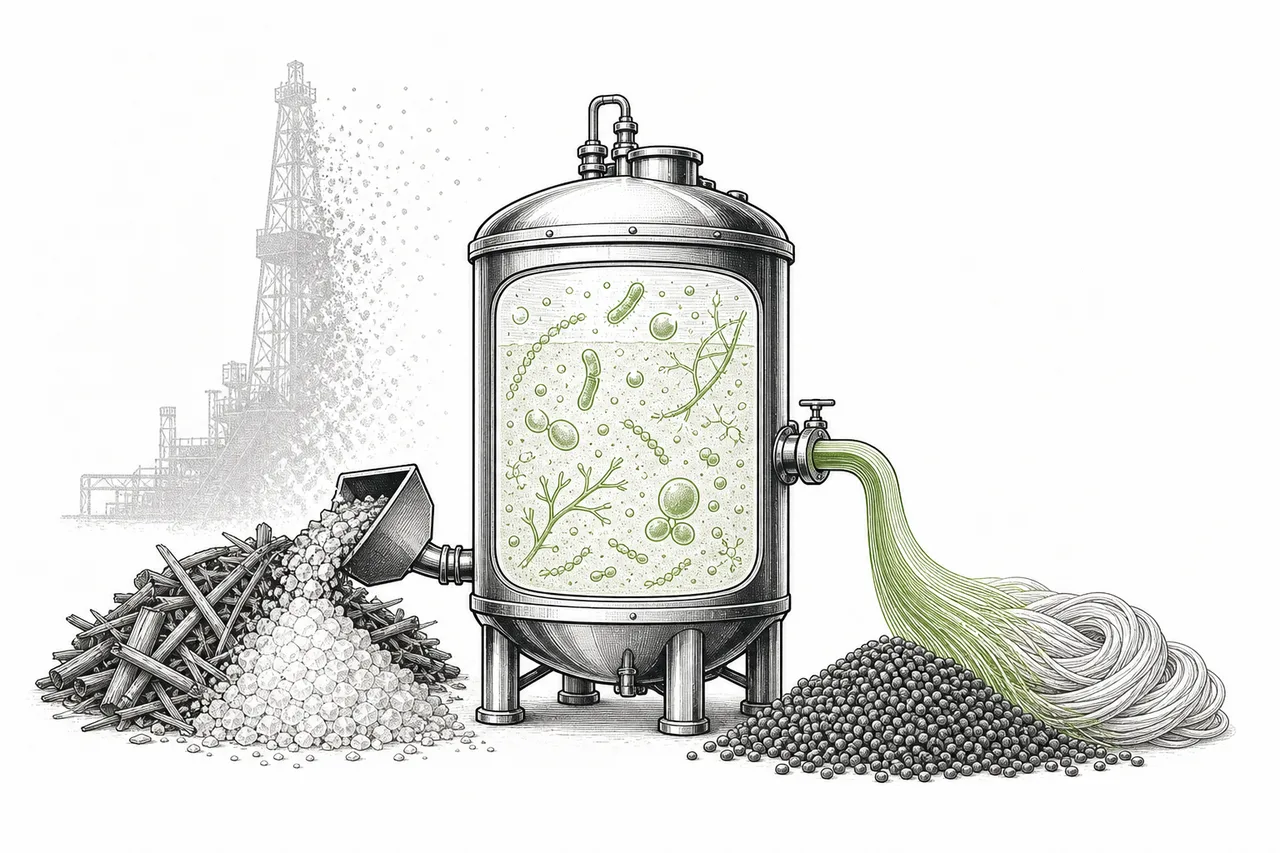
This node is the question that challenges that entire backbone: can we make the same materials and chemicals without relying on oil? The method: instead of "drill then refine," you take sugar or biomass (corn, sugarcane, crop waste) and feed it to engineered microbes or enzymes, then let them "ferment" that raw material into the target molecule — like brewing beer, except what comes out is plastic or a chemical instead of alcohol.
It covers four main groups:
- Bioplastics: plant-based plastics, like PLA (made from lactic acid fermented from sugar, used in coffee cups and packaging) and PHA (a plastic microbes make inside their cells, which breaks down even in the ocean)
- Bio-based fibers/polymers: nylon and fiber precursors fermented instead of synthesized from oil
- Industrial enzymes: "biological scissors" added to laundry detergent, animal feed, paper, and tanning to replace energy-intensive chemical processes
- Renewable chemicals: building blocks like 1,4-butanediol or adipic acid, fermented from sugar instead of refined from oil
The biotech world is split by "color" — red is medicine/pharma, green is agriculture, and white is using biology to make industrial materials and chemicals. This whole node is white biotech. Its challenge is completely different from red's: no matter how expensive a drug is, people will pay — but plastic has to fight against cheap stuff that's been made from oil for a hundred years. This game is decided by cost, not technology.
On the megatrend map, this node sits under Synthetic Biology (non-pharma) — it's about taking the tools of synthetic biology and applying them to the "material world" rather than to food (its sibling is Alt-Protein) or medicine.
02Why it matters to the world
Three forces are pushing this trend at the same time. The first is decarbonization — the chemical and plastics industries emit enormous greenhouse gases because their starting material is pure fossil fuel. Switch to carbon from plants (pulled out of the air) instead, and you cut the source of carbon emissions for a whole pile of materials.
The second is circularity and regulation — the EU and many other countries are starting to ban single-use plastics and force producers to take responsibility for their own waste (EPR), giving degradable plastics like PHA a place to stand. The third is supply-chain security — countries that have no oil but plenty of crops see fermenting materials from biomass as a way to cut their dependence on oil imports.
But you have to read the numbers right: the total bio-based chemicals market is "big" because it lumps in things that are already profitable, like enzymes. The star everyone gets excited about — bioplastics — is still just a sliver of the entire global plastics market (global bioplastics production capacity in 2025 was about 2.3 million tons, versus the 400+ million tons of plastic the world makes a year). This is a story of "right direction, but the base is still small and profit is still hard."
03How it works (two paths to the same molecule)
The heart of it: there are two paths that end at the same molecule. The old path starts underground; the new path starts on the farm.
The petrochemical path: pump up crude oil, send it into a cracker that uses high heat to smash big molecules into small building blocks, then assemble those into plastics or chemicals. The biological path: grow plants, convert them to sugar, feed it to genetically engineered microbes in a fermentation vat. The microbes "eat" the sugar and "excrete" the target molecule, which you then separate and purify — getting the exact same substance.
This is why the whole thing comes down to cost: if you get the same product, customers pick the cheaper one, and oil is very cheap — its refining process has been polished for a hundred years. So the fermentation side has to chase that rock-bottom cost — a job that works for some molecules and not for others.
04How it connects in the ecosystem
This node sits at the intersection of several megatrends:
- Sibling of Alt-Protein: both use "fermentation in a vat" as the same tool — they only differ at the finish line, one fermenting out protein, the other plastic. So a company that's great at industrial-scale fermentation can play on both fields
- Depends on DNA Synthesis & Synbio Platform Tools: to "design a microbe" that can ferment your target molecule, you first have to write and assemble DNA — DNA-synthesis tools are upstream of everything in this chapter
- Substitutes for raw materials and supply chains: the direct goal is to cut dependence on oil and fossil chemicals — it's a "substitute" for the old petrochemical chain
- Depends on AI: designing microbial strains that produce better and cheaper leans more and more on computational biology and AI, to shorten the cycle of trial and error
05Where it stands now — the real "white graveyard"
To understand this trend, you have to start with a painful truth: the first wave of synbio-materials companies collapsed one after another — not because the technology didn't work, but because the economics of fermentation couldn't beat the price of oil. This is the "white-biotech graveyard" that investors need to know about.
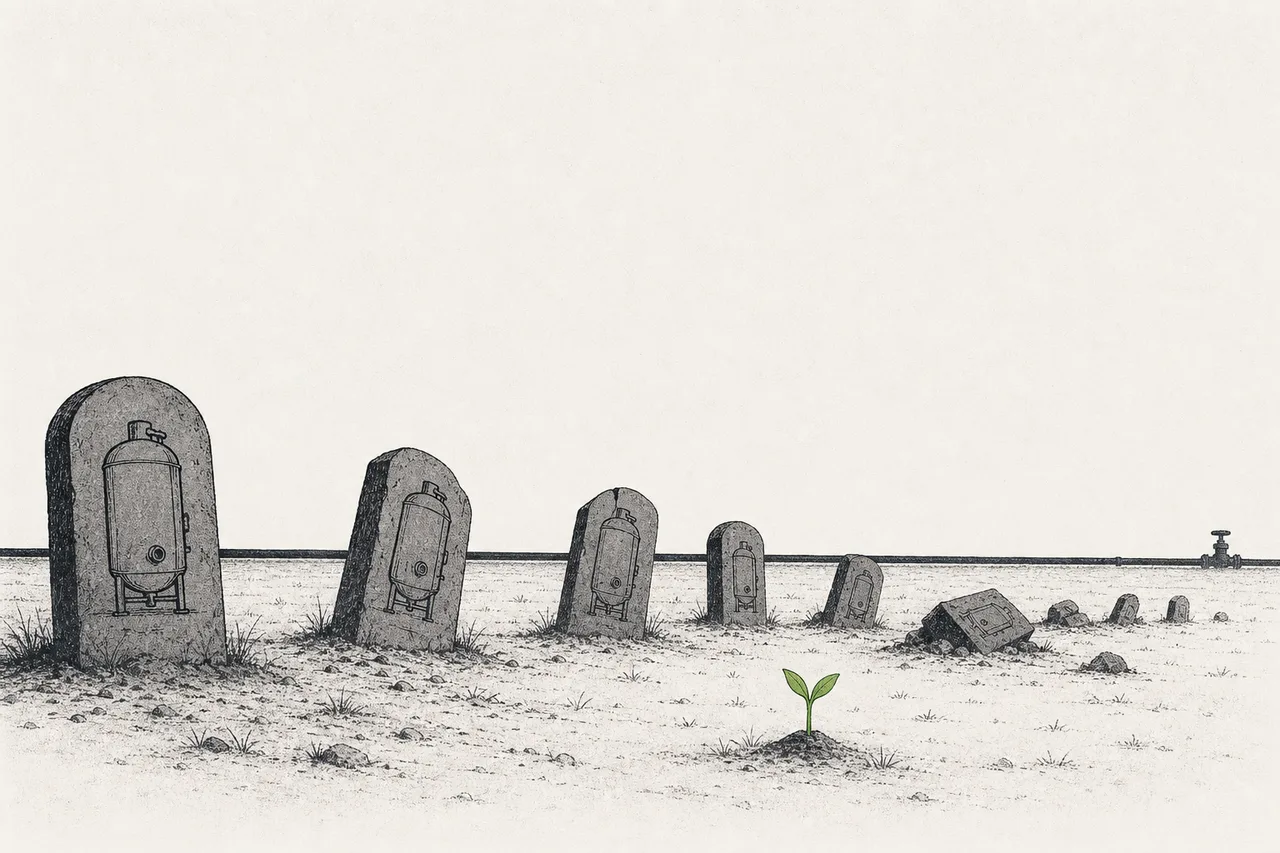
Amyris was once a star of the field — fermenting all sorts of compounds from sugarcane sugar, from anti-malaria drugs to cosmetics to fuels. But in August 2023 the company filed for Chapter 11 bankruptcy, had to sell off its cosmetics brands, and shrank back to just its core research and fermentation. Zymergen went public in 2021 on sky-high expectations, but its flagship product (optical film for displays) couldn't scale, and its stock collapsed within months. In the end it was bought whole by Ginkgo Bioworks for only about $300 million in late 2022. And before that, in 2017, Solazyme/TerraVia (fermenting algae oil) had already fallen.
And the story isn't over — in March 2025, Danimer Scientific, a maker of PHA (the ocean-degradable plastic, brand Nodax) that was once a great hope, also filed for Chapter 11 after a major customer (a fast-food chain) suddenly cut its orders, leaving a freshly expanded plant running below capacity. It was acquired by Teknor Apex in June 2025 — the PHA technology isn't dead, but the independent public company is.
But beneath this wreckage, there's an "other half" of the industry that's quietly profitable and growing — a group that doesn't try to fight cheap plastic head-on, but sells high-value "enzymes" and fermentation inputs to other industries. The industrial-enzyme market in 2025 was about $8.4B, and market leader Novonesis (born from the merger of Novozymes + Chr. Hansen) holds roughly a 48% share — fat margins, unlike the deeply loss-making bioplastics portfolios.
Another one doing well is in China: Cathay Biotech (688065 Shanghai), the world leader in long-chain diacid from fermentation, now pushing bio-based nylon — 2024 revenue around 2.96 billion yuan, net profit around 487 million yuan, growth of ~33%. This is an example that if you pick molecules that are "genuinely cheaper to ferment than to refine" and do it at large scale in a market with demand (partnering with a battery maker like CATL), a material-fermentation business can turn a profit.
06The road ahead
The first direction is "pick the right battlefield" — the lesson of the white graveyard taught the whole field not to fight cheap commodity plastics head-on. The economics research is clear: base chemicals (like olefins, benzene) are "too cheap" for fermentation to pay off, but more oxygen-rich molecules like adipic acid, acrylic acid, and 1,4-butanediol can genuinely compete when fermented. So the future of the trend lies in "high-value molecules that are cheaper to ferment" — not everything.
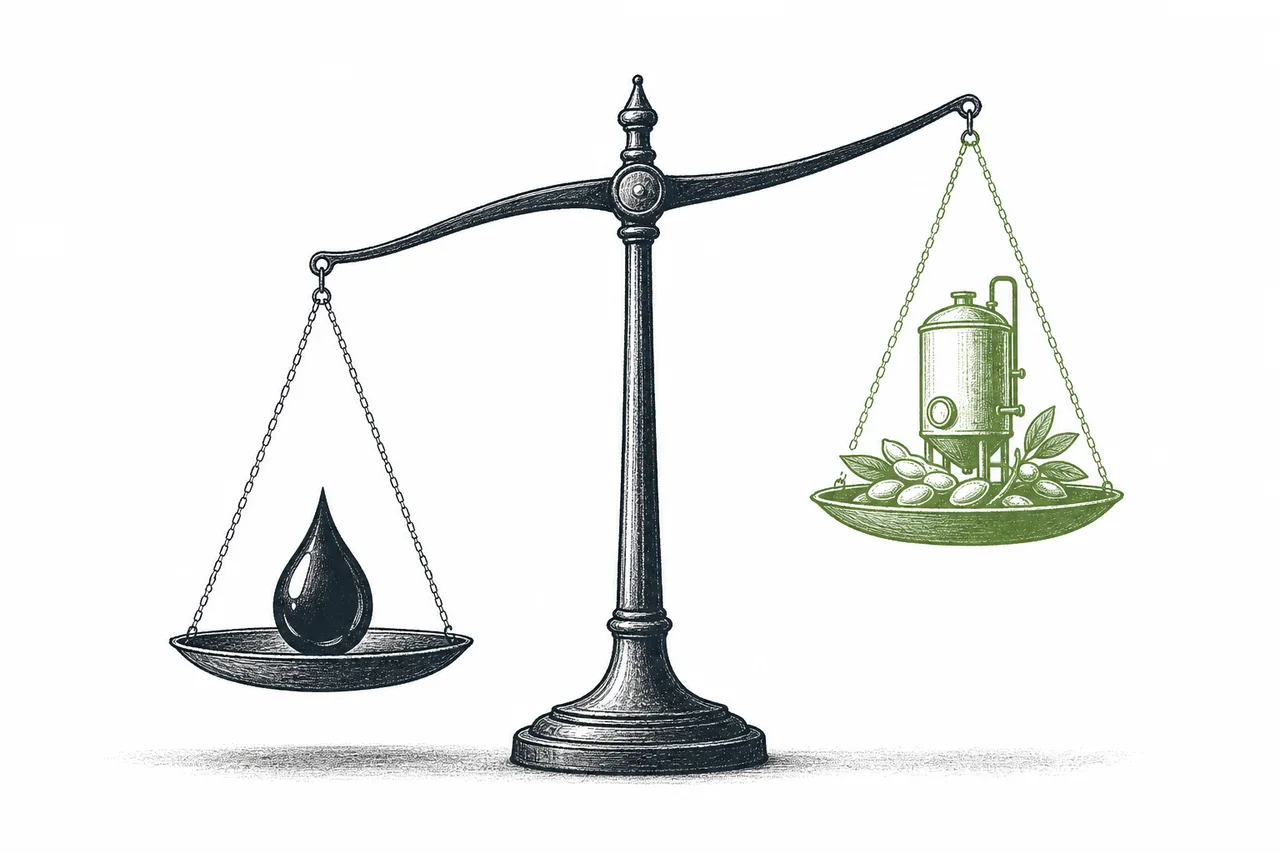
The second direction is regulation as a tailwind — single-use plastic bans and EPR rules in Europe and Asia give degradable plastics like PLA and PHA a "premium price people will pay" in certain markets (food packaging, organic-waste bags). Asia-Pacific is the fastest-growing region (CAGR ~21%), driven by regulation and adoption.
The third direction is AI accelerating design — the main problem with fermentation is that "trial and error" is long and expensive. Using computational biology and AI to design microbial strains that produce better from the very first rounds will cut costs and shorten timelines — this is the line running straight to AI, and it may be what flips the economics of the whole game.
07Challenges & risks
The first and biggest risk is cost-vs-oil — this is the blade that killed the industry's first wave. Oil is still cheap, and its refining process has been polished for a hundred years; when the oil price falls, bio-based materials get harder to compete instantly. So the whole trend's competitiveness is unavoidably "tied to the price of oil" — a macro risk companies can't control themselves.
The second risk is scale-up — being able to ferment in a test tube doesn't mean you'll get the same yield and cost fermenting in a 200,000-liter vat. "Scaling up the vat" is the chasm Zymergen and Danimer fell into. A plant built big but running below capacity = unit costs spike = losses.
The third risk is capital intensity — building fermentation capacity takes enormous money and a long time before it pays back. Companies rely on raised capital or major customers; if capital markets tighten or a customer pulls out (as happened to Danimer), they can collapse instantly — which is why the survivors tend to be large companies with diversified portfolios, not small pure-plays.
In short: this is the story of a dream to "stop drilling for oil and ferment materials instead" — a dream that's right scientifically and environmentally, but had its first wave sliced down by the reality of cost. Those who'll survive and grow in the next wave are the ones who understand that this game isn't decided by "can you ferment it," but by "where can fermenting beat oil on price" — and who choose to fight only on that ground.