Megatrend · Climate Adaptation & Water
Growing more food on a planet where the weather no longer plays fair
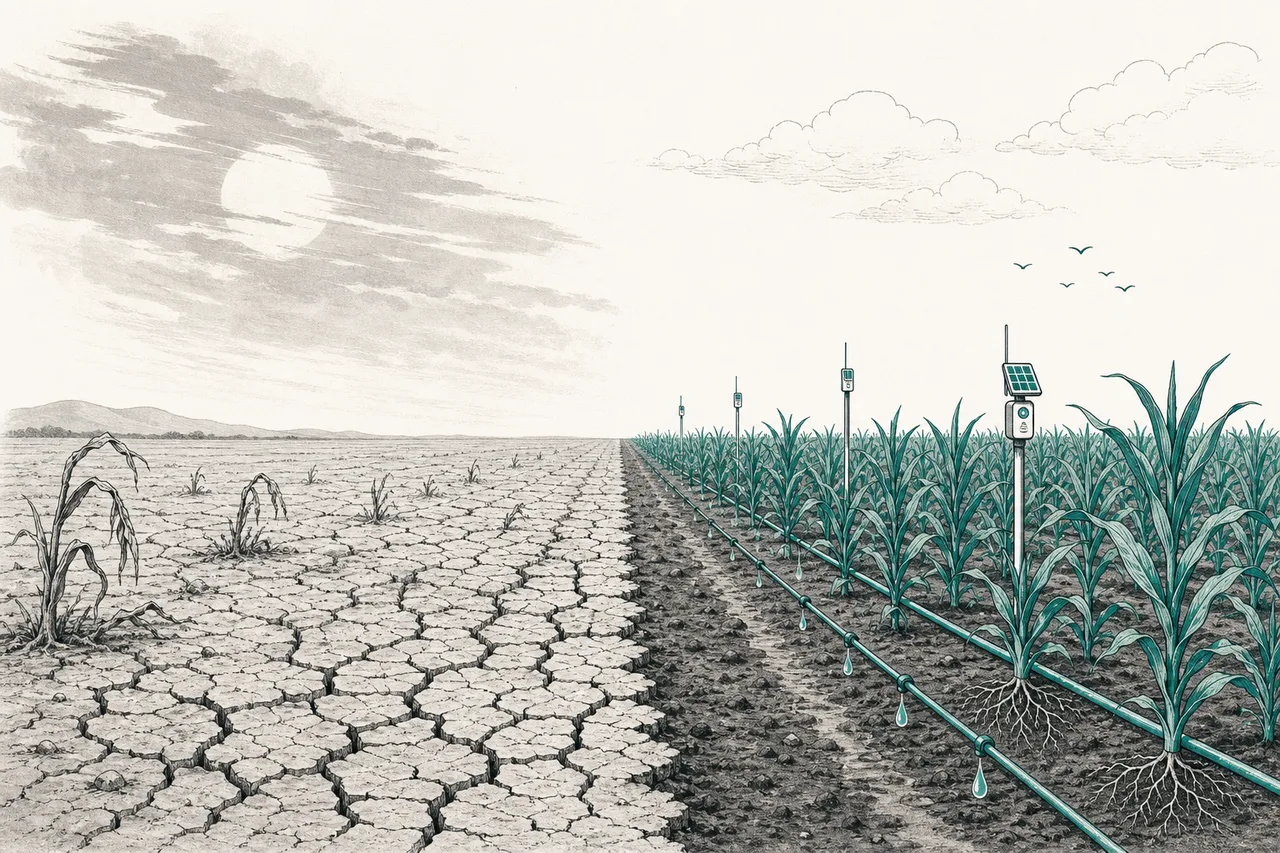
Drought, heat waves, and out-of-season rain are quietly eating into crop yields around the world — Europe's maize could lose up to 20%, and wheat around 10%, versus a world without global warming. And yet we need to produce roughly 70% more food by 2050. This lesson is about "adaptation," not cutting carbon — it's the business of growing more food using less water and land, through three levers: seeds that handle drought and heat · precise sensors and machines · and water systems that don't leak away.
01What is it? (and the "three levers")
Picture a farmer who's worked the land for 30 years. They knew which month the rain would come and how hot it would get, and they planned the planting around it. But these days that "calendar in their head" no longer holds — the rain comes late, comes too hard, or doesn't come at all. A heat wave shows up mid-season and the seedlings wilt right there in the field. This node is about the businesses that help a farm keep producing food even when the weather turns into the enemy.
On the megatrend map, this node is a sub-branch under Climate Adaptation & Water — the trend of "adapting" to a hotter world (not cutting carbon to prevent warming, which is a separate thing). Here's the key point: whether or not the world's decarbonization policies succeed, the heat and dryness already baked in will keep hitting farms. So demand for adaptation is structural, not a passing fad.
This node splits into 3 sub-categories that are really "three levers" working together on the same field:
- Resilient seeds and crop inputs — seeds bred to handle drought and heat, plus the nutrients and crop-protection products that go with them (in plain terms, "making the plant itself tougher")
- Precision-ag equipment and automation — tractors, sensors, and AI that apply fertilizer, spray, and seed "only where it's needed" instead of blanketing the whole field
- Drip irrigation and water-efficient systems — delivering water straight to the plant's roots instead of flooding the whole field and letting most of it evaporate or run off
This node covers traditional "breeding" and selective breeding (bred seed) — while engineering organisms (engineered organisms, synthetic microbes) belongs to a separate trend, Synthetic Biology. That line matters when you're working out who plays on which field.
02Why it matters — feeding a world under stress
Start with the biggest picture: by 2050 the world will have about 2 billion more mouths to feed, and the FAO estimates we'll need to produce roughly 70% more food than today. That's already a hard problem — but it gets harder still, because we have to do it while the climate is eating into yields.
The damage isn't a future worry; it's already here. Many studies find that global maize, wheat, and barley yields are about 4–13% lower than they should be because of past climate trends. Looking ahead, Europe's maize could drop by as much as ~20%, while global wheat might be ~10% higher without warming — maize gets hit especially hard because it gets almost no benefit from the "CO₂ fertilization" effect and is often grown in already-hot regions.
This is why "adaptive agriculture" is an unavoidable business. If the weather eats into yields every year, but the world needs more food every year, that gap has to be filled with technology — tougher seeds, more precise machines, and water used more efficiently. Not just "grow more," because land and water are limited.
03The mechanism: stress pushes yield down, three levers push it back up
The simplest way to think about this is to picture a "yield line" pulled from both sides. On one side, climate stress — heat, drought, off-season rain — pushes the yield line down. On the other, the three levers of adaptation push that line back up. The goal of this whole industry is to make the upward push beat the downward one.
The key point is that these three levers don't replace each other; they reinforce each other. A drought-tolerant seed still needs water at the critical moment — drip irrigation delivers exactly that, and sensors say when and where it's needed. A good seed with wasted water, or good water with sloppy fertilizer, still loses efficiency. The real power shows up when all three work at once on the same field. Now let's dig into each lever.
04Lever 1 — tougher seeds
The first lever is making the plant itself more resistant to stress. This is the Resilient Crop Inputs sub-category, which includes seeds bred to handle drought and heat, plus nutrients and crop-protection products that carry the plant through the critical window.
A concrete example is Corteva's drought-tolerant AQUAmax maize, designed so the plant's roots and water use are more efficient when the rain cuts out. It's been planted on tens of millions of acres in the US since launch — one of the most widely used "drought traits" out there. The newest breeding also uses gene-editing tools like CRISPR to develop tougher varieties faster than before.
This market is large and growing. The "drought-tolerant seed" market is estimated at around $9B in 2024, on track for ~$16B in the early 2030s (CAGR ~8%). The overall crop-protection market sits at around $83B in 2025, expected to reach ~$106B by 2030.
But drought-tolerant seed is only the smallest layer of this lever — add fertilizer (~$230B) and crop protection (~$83B), and the "inputs" lever totals ~$380B/year, the biggest of the three levers. It's controlled by Corteva, Nutrien, Mosaic, CF Industries, and FMC (see → Resilient Crop Inputs).
The heart of this lever is "tough = stable" rather than "maximum yield." Farmers don't just want their best year — they want the worst year to not collapse entirely. A drought-tolerant seed might yield about the same as a regular variety in a wet, good year. But in a drought year it's the difference between "harvested" and "a total loss" — and in a world where drought years come more often, that stability is the value.
05Lever 2 — precision agriculture and robotics
The second lever is "seeing" your own field in fine detail, down to plant by plant, then applying inputs only where they're needed. This is the Precision-Ag Equipment & Autonomy sub-category — tractors, sensors, cameras, and AI that turn farming from "blanket the whole field evenly" into "manage it one spot at a time."
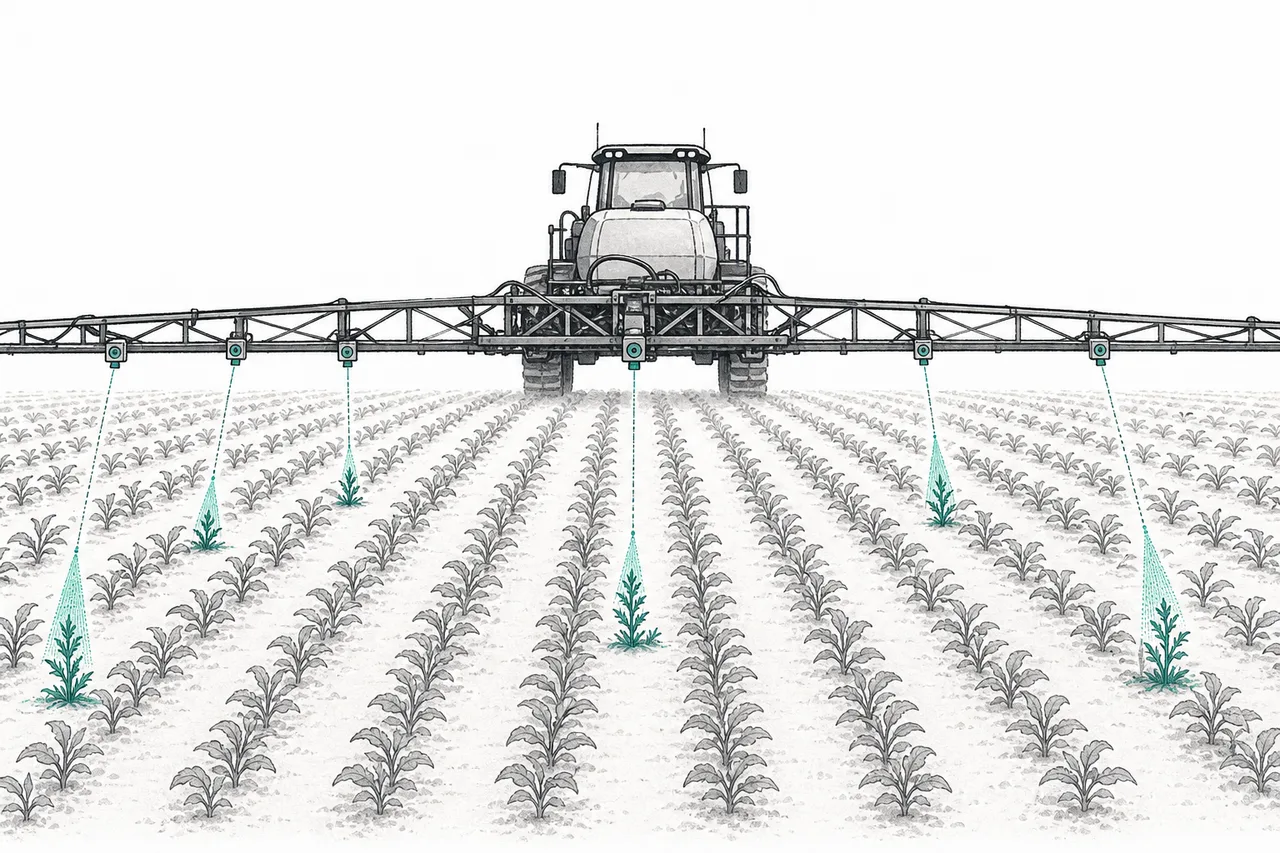
The clearest example is Deere's See & Spray, a system that uses cameras and AI to find weeds in real time and then spray only where it finds a weed instead of spraying the whole field. The result: farmers cut herbicide use by an average of ~50% on maize, soybean, and cotton fields — saving cost and reducing the chemicals left in soil and water at the same time. Deere is also pushing toward fully driverless tractors, targeting its first fully autonomous planting season around 2026–2027.
Why is this "adaptation" and not just convenience? Because as water, fertilizer, and planting time all keep getting more valuable, putting them in the right place, at the right time, in the right amount is how you squeeze more yield out of the same resources. Sensors say which soil is dry and which is short on fertilizer — making Lever 1 (seeds) and Lever 3 (water) work more precisely. It's the "brain" that directs the other two levers.
What makes precision agriculture attractive to investors is that the more a machine works in the field, the more data it collects (yield, soil conditions, weeds), and that data makes the AI smarter — a farmer who invests in one system tends not to want to switch to another, because the data and the familiarity lock them in. This is why the machinery leaders are trying to remake themselves from "sellers of steel" into "agriculture software platforms."
06Lever 3 — water that doesn't leak away
The last lever is water, and this may be the lever with the "clearest payoff." The Precision Irrigation & Water-Efficient Systems sub-category is about delivering water straight to the plant's roots instead of flooding the whole field and letting most of it evaporate or run off.
The numbers tell the story themselves. Flood irrigation is the most wasteful method, losing about 40–50% of the water to evaporation and runoff, while drip irrigation delivers it right to the roots at 90%+ efficiency — in practice saving around 30–60% of the water versus flooding. That's why, in regions where water is starting to run short, switching to drip isn't an option but a way to survive.
This lever's market is expanding fast. The micro-irrigation market is projected to grow from around $10.9B in 2024 to ~$27.4B in 2034 (CAGR ~9.7%). Players like Lindsay (Zimmatic) and Valmont (Valley) dominate the "center pivot" market — and what's interesting is that both pair it with water-management software (like Lindsay's FieldNET), bringing Lever 3 (water) directly together with Lever 2 (data).
The far end of this lever is controlled-environment agriculture — greenhouses and vertical farms that control water, light, and temperature completely. But be careful here: it only pays off for certain crops and certain places (we'll get to that in the risks section) — "control everything" and "economically worth it" are two very different things.
07What it connects to + the real players
This node doesn't float on its own; it's where several trends meet:
- A sibling to "water" in Climate Adaptation & Water: neighboring sub-categories like Water Utilities & Infrastructure and Drought, Wildfire & Flood Resilience share the same challenge — water is the axis of the whole trend, and agriculture is the biggest water user
- Complements Energy Transition & Power: indoor farms, greenhouses, and water pumps all consume electricity — energy cost is the variable that decides whether controlled-environment agriculture pays off
- Depends on Critical Materials & Supply Chain: fertilizer (potash, phosphate) and the raw materials for machinery all come from the materials supply chain
- Draws the line with Synthetic Biology: breeding sits in this node, but engineered microbes and organisms go over there
Today's picture has each lever held by a few giants. On the machinery side, Deere leads with revenue around $45.7B (fiscal 2025) and is turning itself into a precision-ag platform. On the seed and crop-protection side, Corteva leads — in Q3 2025 its sales grew 13% and it announced plans to split its seed business off from crop protection into two companies. On the water side, Lindsay and Valmont lead.
08The road ahead and the risks
The direction ahead is fairly clear: demand for adaptation is structural. As long as the climate eats into yields and the world needs more food, these three levers will be used harder and harder. And they'll fuse together more — machines that read the soil and then direct the drip irrigation and auto-calculate fertilizer amounts, seeds designed to pair with a specific management system. The endpoint is fields that "manage themselves" more. But that doesn't mean every investment in this space will pay off — there are real risks to look at squarely.
The first risk is commodity cyclicality. The revenue of machinery and seed players is tied to farmers' "mood," which depends on crop prices. When maize/soybean prices fall, farm income shrinks and farmers immediately hold off on buying new tractors — this is why Deere's revenue swings in cycles, and why machinery sales softened in some markets in 2025. So this business isn't "straight-line growth" but "growth that rises and falls with the agriculture cycle."
The second risk is adoption that's slower than expected. Most farmers are cautious with capital, and precision technology is usually expensive up front and takes years to pay back. Small farms in developing countries — where climate stress is harshest — usually have the hardest time accessing capital and know-how. The gap between "the technology exists" and "farmers actually use it" may be wide and slow to close.
The third risk is the unproven economics of indoor/vertical farms. This is where you have to be most honest. Vertical farming sounds like the perfect answer — control everything, use little water, grow near the city. But in reality it replaces free sunlight and rain with electricity and an expensive system, and the produce often can't sell high enough to cover that gap. In 2025, 14 controlled-environment agriculture companies went bankrupt — including Plenty (which raised ~$940M) and Bowery (~$700M, once valued at $2.3B). The lesson: the survivors tend to be the ones that focus on high-value crops (microgreens, herbs), not commodity lettuce that can't compete on price.
The fourth risk is that the very thing that makes this trend exist is also the source of the volatility — the weather. In a year with surprisingly good weather, urgent demand for adaptation technology may ease. Meanwhile, in a year of heavy disasters, farmers may go bankrupt before they have the money to invest in technology. So the link between "bad weather" and "strong sales" isn't always straightforward.
In short: when the weather turns into the enemy, growing more food using less water and land shifts from "nice if you can" to "something you have to pull off." The three levers — tough seeds, precise machines, and water used efficiently — are the most tangible answer to that problem. Understand which lever is proven and which is still a hope, and you understand why this node is both an opportunity and a trap at the same time.