Megatrend · Artificial Intelligence
When AI moves into the software you already use every day
A brilliant AI model is worthless if ordinary people can't reach it — this is the layer where AI leaves the lab and sits in the corner of Word, Excel, Salesforce, or the coding tool you open every morning, as a "copilot" that drafts for you, summarizes for you, writes code for you. The biggest question about all this money: does the value stay with the people building the apps, or does the model owner suck it all up?

01What is it?
Think back to the first time you tried ChatGPT — you had to open a browser and go find it, type your question, then copy the answer back into whatever you were working on. The AI Applications & Copilots layer is the next step: instead of making people walk over to the AI, we put the AI right inside the work people are already doing. It shows up as a button, a little chat box in the corner of Excel, a "write this for me" button in Word, a buddy that finishes your code as you type.
This is AI's "application layer" — the top layer that real users actually touch. It splits into two big species: horizontal copilots that help with general tasks across every job (write the email, summarize the meeting, build the slides), and vertical AI apps that go deep on one job — a coding assistant for programmers, a contract-drafting assistant for lawyers.
The word Microsoft made famous — it means "co-pilot." The key part is assistant: it doesn't fly the plane, you're still the captain. It just sits beside you, offers a draft, finishes your sentence, flags what you forgot — and a human still hits confirm. That's different from Agentic AI (autonomous agents), which you give a goal and it runs many steps on its own to the finish. This lesson is the "assistant in your software" layer; for agents that act on their own, read on at that node.
On the megatrend map this node sits under Artificial Intelligence at the "top of the stack" — below it are the chips, the cloud, and the models. But this is the one layer customers actually pay for, because it gets the job done — not because it's smart.
02Why it matters — where AI meets revenue
Enormous money is being poured into building chips and AI models — but the question keeping investors up at night is, "so who's going to pay it back?" Almost the entire answer has to run through this layer, because it's the only one that actually collects money from customers. However good a model is, nobody pays for it unless it's embedded in the work people make money on every day.
IDC estimates enterprises worldwide will spend roughly $307 billion on AI in 2025, jumping to about $632 billion by 2028. Most of that money is software and services running on the cloud — which is exactly this app layer.
The clearest example is Microsoft. The pricing model is "per person per month (per-seat)" — the enterprise Microsoft 365 Copilot plan charges $30 per person per month on top of the existing Office fee. In its January 2026 earnings, Microsoft said 15 million seats were already paying for this Copilot, up ~160% in one year. Do the math: 15 million seats × $30 × 12 months = billions of dollars a year from a single feature — and that's exactly why every software company wants to own the "AI button" on their customers' screens.
What this layer of AI "replaces" isn't the software itself — it's the human time and labor in repetitive work: drafting documents, writing boilerplate code, answering customers, summarizing data. Every minute a copilot saves one worker is a reason for the company to pay a higher subscription.
03How it works + the question of who gets paid
The mechanics of this layer are simpler than you'd think. Picture it as a three-layer "stack" and ask what each layer does and how much profit it keeps.
The bottom is the foundation models — the real brains, smart but turning into a "commodity," because several of them are about equally good and they charge per call (per token). The top is the user who pays because the work gets done. And the middle — the app layer — is the battlefield. It buys its brains from below, then wraps them in what it owns: an understanding of the customer's workflow, the customer's specific data, and an existing channel to millions of customers.
This leads to the most expensive question in AI right now — the "thin wrapper" problem. If your app is just a "thin shell" wrapped around someone else's model, with nothing of its own, how does any value stay with you?

The optimists' answer: the value isn't in the model, it's in what surrounds it — three layers of moat: the customer data you've accumulated, the workflow embedded so deeply it's hard to switch, and the distribution you already have. That's why Microsoft has the edge — not because its AI is smarter, but because it had 450 million Office seats in hand before the race even started.
A "thin shell" — an app that does almost nothing itself except pass the user's request along to someone else's model and hand back the answer. The problem is anyone can rebuild it in a few weeks, and if the model owner ships the same feature themselves, the shell vanishes instantly — several reports (like McKinsey's assessment) put the 2-year survival rate of these apps very low. Surviving takes "something that can't be copied": data + workflow + a customer base.
04The ecosystem — where it sits
The app layer doesn't float alone — it's the "endpoint" of the whole AI stack. Everything below it exists so this layer can work:
- Sits on Foundation Models: every app has to buy its "brains" from the model layer — which is both supplier and competitor at once, because the model owners want to move up and build apps too
- Depends on Cloud & Digital Infrastructure: a copilot always runs on the cloud. Every time you hit "write this," you're calling a server somewhere — which is why Microsoft, Google, and Amazon have the edge: they own both the cloud and the app
- Evolves toward Agentic AI: a copilot is an "assistant that waits for orders"; an agent is an "employee that finishes the job itself" — and the line is blurring. Today's apps are slowly becoming tomorrow's agents
- Becomes a doorway to other trends: Cybersecurity copilots (like a threat-analysis assistant) are among the fastest-growing and highest-priced AI apps, because security work is complex and short-staffed
The most important angle of this ecosystem is the "love-hate" relationship with the model layer — apps have to rely on the models, yet they fear the models moving up to eat their market. Every time OpenAI or Google ships a new feature in their own chatbot, a lot of app startups feel a jolt: the feature they spent a year building may have just been given away for free.
05Where it stands now + the players
2025–2026 is when this field split cleanly into two camps — incumbent giants bolting AI on (bolt-on) and challengers born as AI from day one (AI-native).
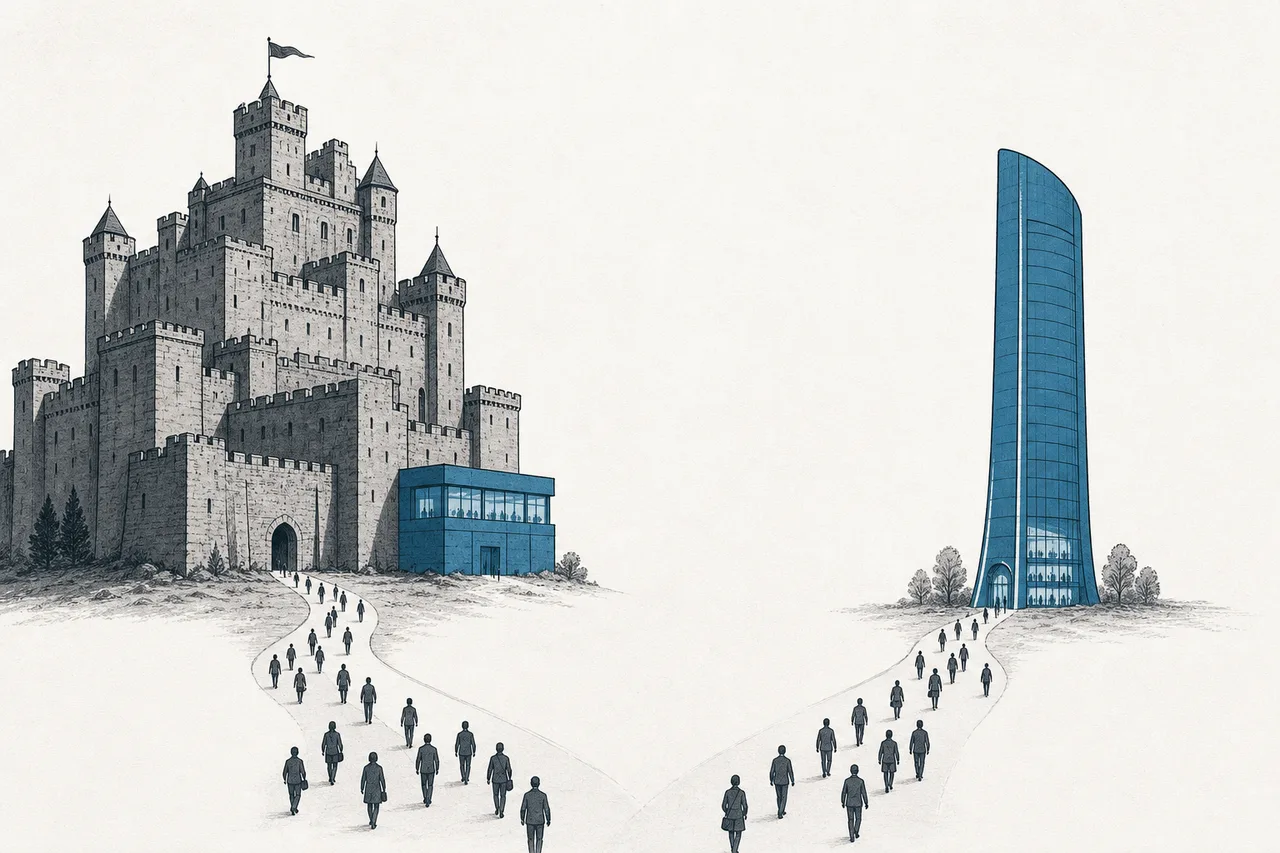
The incumbents play "distribution is the moat." They already have customers, so just switching on an AI button lets them upsell instantly — Microsoft has Copilot in both Office and GitHub (GitHub Copilot has around 4.7 million paying users and is used by nearly 90% of the Fortune 100). Salesforce pushed Agentforce to a billion-dollar ARR in under two years. ServiceNow raised its AI revenue target (Now Assist) from $1 billion to $1.5 billion, and Adobe reports that AI-influenced revenue is over a third of its ~$25 billion base.
The AI-native side is the most exciting story — companies built as AI through and through, with no legacy baggage. The standout is Cursor (parent company Anysphere), an AI coding tool whose annual revenue (ARR) rocketed from ~$100 million (January 2025) to $2 billion by February 2026 — the fastest climb from zero to $2 billion in the history of enterprise software, beating both Slack and Snowflake, with about 70% of the Fortune 1000 already using it. Cursor is still a private company (not on the stock market) — many of the real players in this layer are still private, because it's such a fresh wave.
06The road ahead
The first direction is the collapse of "per-seat" pricing. Charging $30/person/month is starting to fit the AI world poorly, because agents don't log in — they aren't "heads" — so how do you bill when AI does a whole team's work? The answer that's coming is charging by usage or by outcome — paying per "case closed" or per "ticket resolved." Gartner estimates that by 2030 at least 40% of enterprise-software spending will shift to usage/outcome models, and the per-seat share will drop from 21% to 15%.
The second direction is copilots morphing into agents. Today's assistant waits for instructions step by step; tomorrow you'll hand it a goal and it'll run many steps to the finish on its own — the line between this node and Agentic AI is about to dissolve. And that only raises the value of the apps that "know the customer's workflow most deeply."
The third direction is the win-loss split between the two camps. The incumbents win on distribution (easy upsell to existing customers); the AI-natives win on speed and having no legacy baggage — but both get squeezed from below, because the model owners want to move up and eat the app layer themselves. The survivors are the ones with the most "things that can't be copied."
07Challenges & risks
The layer that collects money best is also the most fragile.
The first risk is the "thin wrapper" and getting copied. If an app has nothing of its own beyond a shell around someone else's model, competitors can rebuild it in weeks — and more dangerously, the model owner can ship the same feature for free, paving over the whole market. Several reports see thin-wrapper AI apps with a very low survival rate over 2–3 years.
The second risk is margins squeezed from below. Unlike old-school software where serving one more customer cost almost nothing, AI apps pay the model fee every time a user hits go. The more people use it, the more the cost grows, so gross margins run lower than traditional software — and if you price it wrong, more usage can mean more losses.
The third risk is the "pilot that never turns into money". Many enterprises are trialing copilots, but multiple studies find most AI projects still can't show real ROI and run over budget. If customers feel they paid for a copilot and the work didn't actually get faster, a wave of cancellations could follow — which is why "outcome-based" pricing is rising to replace it, since it throws this risk back onto the seller.
In short: AI Applications & Copilots is the layer where AI turns into money — the final gate where machine intelligence converts into actual subscription revenue. But it's also the most brutal battlefield, because everyone knows the value is here. The winner won't be whoever has the smartest AI, but whoever embeds AI so deeply into your work that you can't quit it — and that's what turns a node that looks like "just a chat button on a screen" into one of the most expensive battlefields of the AI era.