Megatrend · Artificial Intelligence
From AI that "answers" to AI that "does"
Two years ago, AI was only good at answering. You'd ask, it would type a reply, done. But the new wave — called "agentic AI" — doesn't just answer. It plans on its own, picks up tools on its own, and runs a multi-step job to completion by itself. Put simply, it's gone from "a smooth-talking consultant" to "an employee who actually does the work." And that's the hottest money story in enterprise AI in 2026.
01What is it?
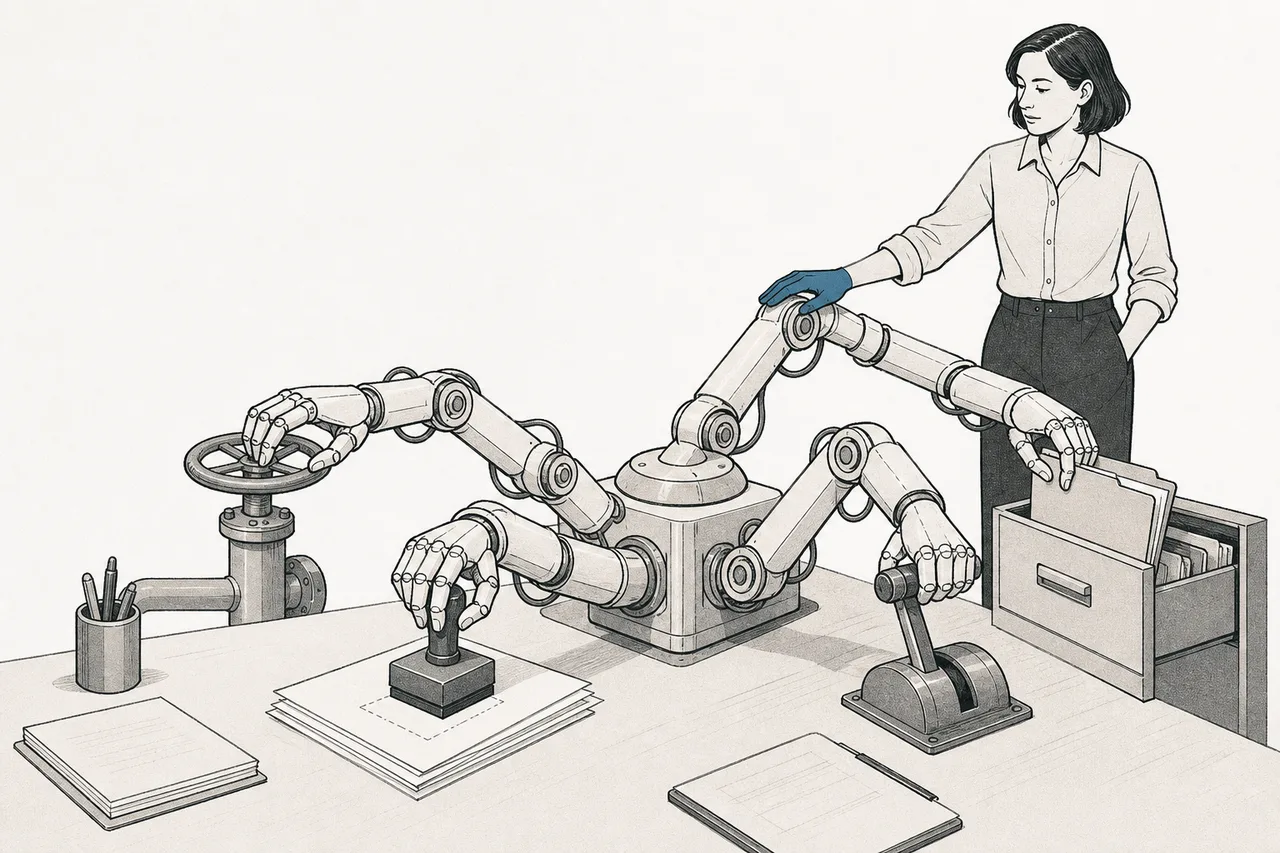
Picture the difference between a "consultant" and a "great personal assistant." Ask a consultant "how should I book a flight?" and they'll talk you through the steps — but you still have to do everything yourself. Ask a truly good assistant, though, and you just say "book me a flight to Tokyo next week, budget under 20,000," and they go find the flights, compare prices, fill in the details, pay, and come back with "all booked." That's the line between old-school AI and agentic AI.
Chatbot-era AI (like early ChatGPT) was good at "answering" — you type a question, it writes a reply, done in one round. But agentic AI is built to "run a multi-step job to completion on its own." It takes a broad goal from you, breaks it into smaller tasks, plans, calls external tools (search the web, send email, update a database, run code), looks at the result, adjusts the plan, and keeps going until the job is done.
Chatbot = answers in text, done in one round · Copilot = an assistant that "sits beside you" and suggests; you click to accept or reject (autocomplete code, draft an email), but you're still the one who acts · Agent = given a goal, it "takes many steps on its own," calling real tools and making decisions along the way — autonomy (the freedom to decide) is what separates an agent from the first two.
On the megatrend map, this node is a sub-theme of Artificial Intelligence, sitting in the "application" layer (putting it to real use). Its definition is short but on point: a system that can plan and run multi-step jobs on its own — and the fastest-growing story in enterprise AI in 2026.
02Why it matters to the economy
The whole industry is buzzing about agentic AI not because it's cool, but because it reaches straight into "labor". Early ChatGPT helped you "think faster." But an agent promises to "do the work for you" — and that work is the single biggest cost at nearly every company.
The numbers reflect that expectation clearly. McKinsey estimates that agents and smart robots could create around $2.9 trillion a year in US economic value by 2030, doing the equivalent of about 27% of today's work hours on average. And the "AI agents" software market specifically is expected to grow from $7.8 billion in 2025 to about $52 billion in 2030 — more than 46% a year.
But a more important number than market size is "who's actually using it." And here's where it gets interesting. McKinsey found that only 23% of organizations have started to "scale" agent systems in real work; another 39% are still experimenting. In other words — the buzz is huge, but the people using it for real are still a minority. We're genuinely in the "very early" days of this trend.
What executives are especially excited about is the promise of "productivity." Microsoft estimates that multi-step automation could cut manual work by 30–50% in knowledge work like marketing, sales, operations, and research. If even half of that holds true, it's enough to reshape the cost structure of almost any company.
03How it works — the agent "loop"
At the heart of every agent is something called the "agent loop". It doesn't think once and finish; it works in repeating "rounds" — observe → plan → act → check the result, then loop back and start again, until the job is done. Like a real worker who does and watches as they go, rather than planning the whole thing in their head and charging through in one go.
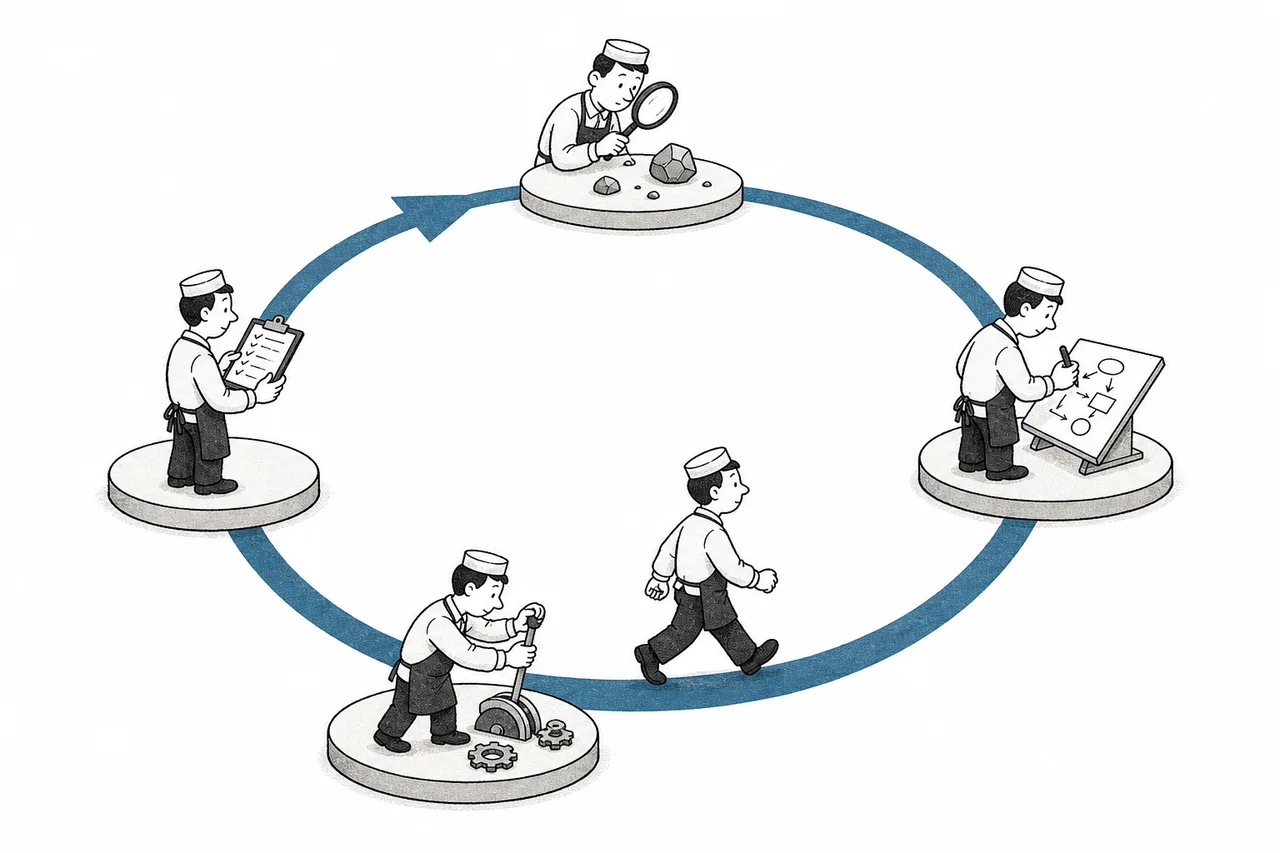
The most important step — and the heart of what makes an agent "actually work" — is step 3, "acting" by calling a tool (tool use / function calling). A language model on its own can only produce text. It can't hit send on an email, can't search a database, can't make a payment. But if we "hand it tools" (say, a send_email() or query_database() function), the model learns to "command" those tools — it decides which tool to use and what values to feed in, and the system does the real work. That's the bridge connecting "a brain that can talk" to "hands that can do."
Letting an AI model "call external functions" instead of just replying in text. The model returns a structured command — e.g. "call book_flight with destination=Tokyo, budget=20000" — and the surrounding system actually does that work and feeds the result back into the loop. This is the mechanism that turns "someone who talks well" into "someone who gets things done."
And because an agent "acts on real things," the indispensable piece is the "human-in-the-loop" — designing the agent to stop and ask a person for approval before doing anything irreversible, like transferring money, deleting data, or emailing a customer. This isn't a nice-to-have; it's the safety brake that lets companies dare to let an agent out of the lab.
04MCP — the "standard plug" that lets everything connect
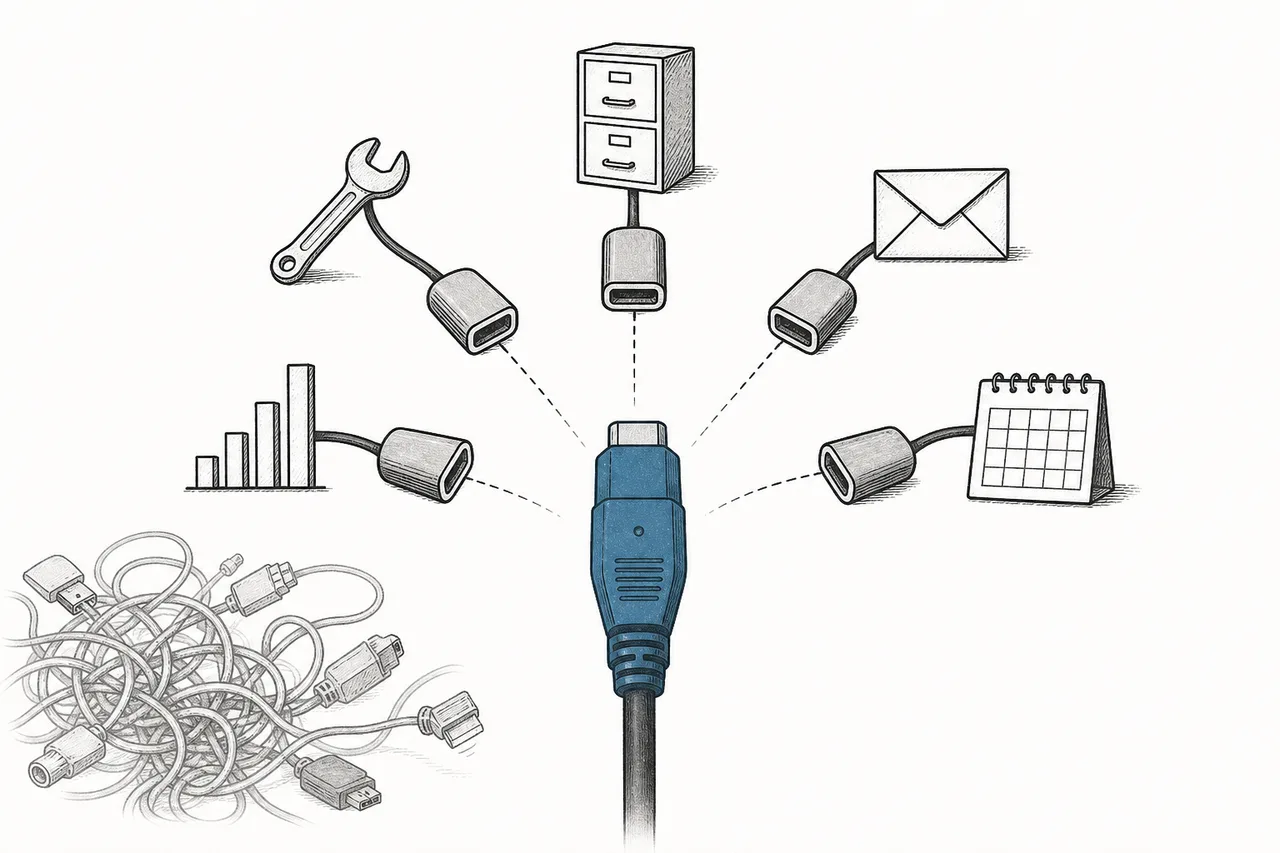
If tool use is what lets an agent use tools, the next question is — who's going to sit there writing code to connect the agent to "every" tool in the world (Slack, Google Drive, the company database, the accounting system…), one at a time? This is like the era before USB ports, when every device had a different-shaped connector and it was all a mess.
The answer is MCP (Model Context Protocol), an open standard that Anthropic launched in late 2024. Think of it as "the USB-C port of the AI world" — instead of every tool building its own custom connector, everyone agrees to use the same "standard plug." Any tool that ships an "MCP server" can be plugged into by any agent right away.
What's striking is how fast it spread. By the end of 2025 there were over 10,000 public MCP servers, and SDK downloads topped 97 million a month. It's supported by nearly every camp — ChatGPT, Gemini, Microsoft Copilot, Cursor, VS Code — and in December 2025, Anthropic "donated" MCP to the Agentic AI Foundation (under the Linux Foundation), set up jointly with OpenAI and Block, to make it a neutral standard no single company owns. A signal that the whole industry sees it as infrastructure, not one company's toy.
Beyond MCP, another layer is growing fast: "orchestration" and multi-agent — having several agents, each good at a different thing, work together. One agent gathers info, another writes the summary, another reviews it, with a "coordinator" splitting up the work and combining the results. Like a team with a team lead handing out tasks. This is the direction that lets agents take on increasingly complex jobs.
05Where it sits in the AI ecosystem
Agentic AI doesn't float on its own. It's the "top layer" riding on the layers beneath it in the whole AI tech stack. Picture a building — the agent is the floor users see, but it stands only because there's a solid foundation underneath.
- Rides on Foundation Models: the "brain" an agent uses to think, plan, and decide is the large language model itself. How smart an agent can be is capped by the foundation model it runs on — and the newer models' ability to "plan many steps and use tools" is exactly what unlocked agents in the first place
- Built with AI Tooling & MLOps: the frameworks for building agents, the orchestration systems, the tracking and monitoring of agent behavior — all are tools from this layer
- A cousin of AI Applications & Copilots: the line between "a copilot that suggests" and "an agent that acts" keeps blurring. Many products start as a copilot and gradually gain autonomy until they become an agent
- Eats huge amounts of AI Compute: because an agent loops many times, calling the model repeatedly step after step, it "burns" far more compute and tokens than a chatbot that answers in one round — which is why agents drive demand for both chips and data center power
And crucially, agents are the "arms and legs" that send other AI trends out to work in the real world. They're the mechanism by which AI enables Robotics and Physical AI (robots that plan and work on their own), all the way to helping research in Biotech and defending against cyber threats — an agent is "how AI takes action" in nearly every field.
06Where it stands now + who the real players are
The first real, tangible money in agentic AI didn't come from consumers — it came from enterprise automation: the repetitive back-office work that eats up people's time, like customer service, handling IT tickets, processing documents, and sales. Because here the ROI is clearly measurable: fewer people, less time, lower cost.
The clearest example is Salesforce and its product Agentforce, which has become the sharpest proof that "enterprise agents really sell." By Q4 of fiscal 2026 (ending Jan 2026), Agentforce's annual recurring revenue (ARR) hit $800 million, up 169%, with about 29,000 deals closed and over 2.4 billion jobs processed as "agent work units" — numbers that had the whole field scrambling to catch up.
On the enterprise infrastructure side, things are moving hard too. Microsoft launched Agent 365, a central "control tower" that lets organizations see, manage, and secure every agent in their systems, along with "Copilot Cowork" that's starting to handle multi-step work on its own. Meanwhile ServiceNow is pushing its AI Control Tower to "govern every agent in the organization" — notice that the shared theme of 2026 isn't just "build agents," but "how do we control a massive number of agents", which tells us this trend is entering large-scale real-world use.
07The road ahead
The first direction is agents "working together as a team" more. Today most are still a single agent doing a single job, but the future is a swarm of agents dividing up the work, with a coordinator queuing it all — which will push them to take on more complex jobs (like closing a whole company's books, or investigating a cyber incident end to end).
The second direction is "common standards" becoming a battleground. MCP being donated to a neutral foundation backed by OpenAI, Microsoft, Google, and AWS says every camp wants agents to talk to tools broadly — but whoever controls the "governance and security layer" (like Microsoft's Agent 365 or ServiceNow's Control Tower) may control the spot with the most leverage, because that's what companies fear most.
The third direction is the "copilot → agent" line disappearing. Products will gain autonomy one step at a time, from "suggest and wait to be accepted" to "do it and report back" — with humans shifting from "the one who does" to "the one who checks and approves." This is where the question about labor gets sharpest.
08Challenges & risks
Behind the hot momentum, agentic AI has some cracks worth saying plainly. And the most important number in this whole lesson might be this one: Gartner expects that more than 40% of agentic AI projects will be canceled by the end of 2027 — because of runaway costs, unclear business value, or unmanageable risk.
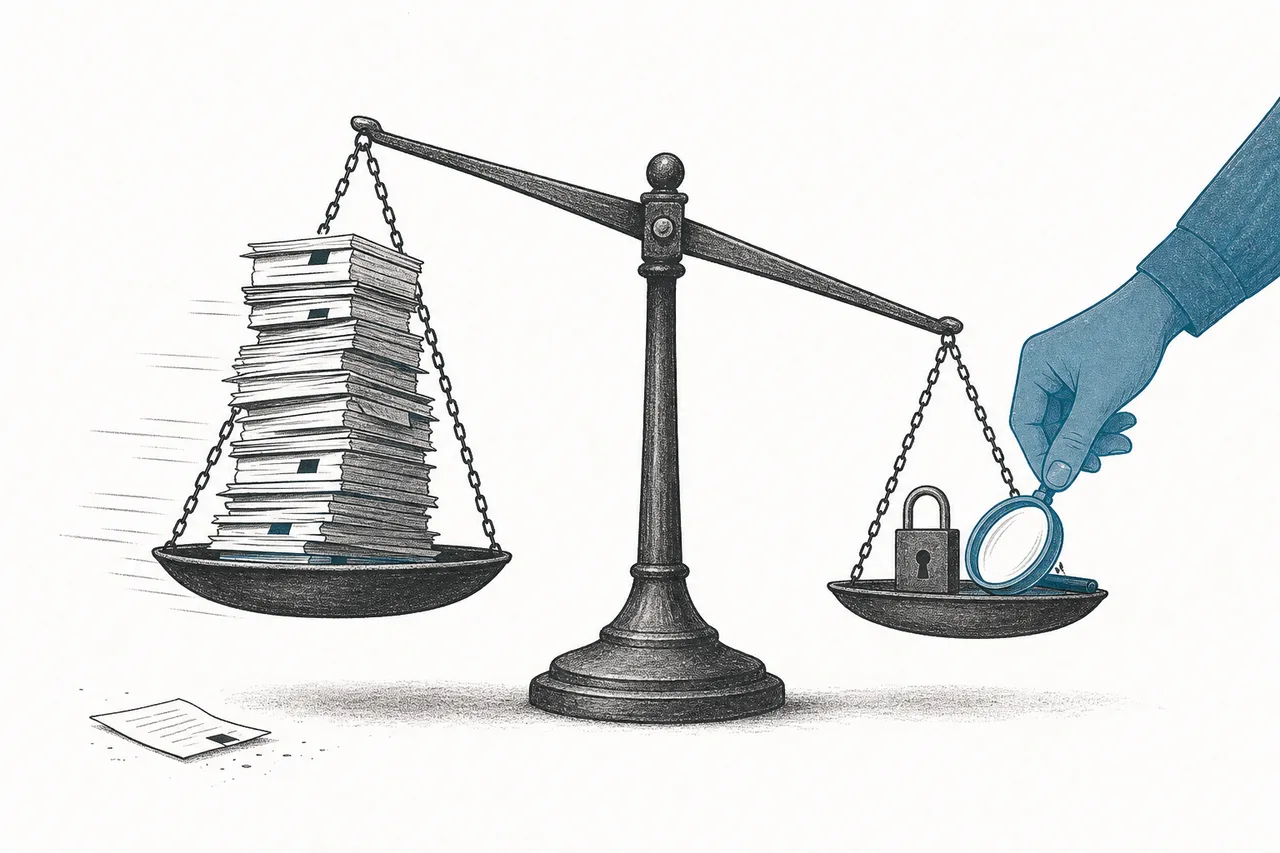
The first risk is "reliability." Language models still "make things up" (hallucinate) — and when an agent "acts" on made-up information, the result isn't just a wrong answer, it's a "wrong action," like sending a customer details of a policy that doesn't exist, or making a transaction off false data. The more autonomy an agent has, the further a single mistake spreads. Gartner even warns that in 2026, roughly 1 in 3 companies will "damage customer experience" by pushing AI out too fast.
The second risk is "agent washing" (overblown claims). Many vendors slap an "agentic" label on old products to ride the wave. Gartner estimates that out of thousands of vendors, only about 130 are real agents — for companies (and investors), that means you have to tell apart "the real thing that works" from "something that just got renamed."
The third risk is "security and governance." McKinsey found that nearly two-thirds of organizations point to "security and risk concerns" as the biggest barrier to scaling agents — bigger than technical or legal limits. Because an agent with access to real systems, if tricked or misfiring, becomes a security hole that can move around. That's why an "agent control tower" has become a product as hot as the agents themselves.
In short: agentic AI is the step from AI that "talks well" to AI that "gets things done" — and that's a much bigger step, because it reaches straight into labor costs. The deciding question isn't "can an agent work" (it already can), but "when can we trust it enough to let it do real work without a person watching every step" — and as long as the answer is still "not yet," the human-in-the-loop will remain an indispensable piece of this trend.