Megatrend · Spatial Computing / AR/VR
The ordinary glasses that became a "body" for AI
For a decade, everyone assumed the future of smart glasses was an "AR display floating over the real world." But the pair people actually agreed to wear turned out to be lightweight glasses with no display at all — just a camera, a mic, a speaker, and an AI assistant that answers questions about what you "see and hear." Ray-Ban Meta proved this form factor really sells, and it may be the true winner of spatial computing — not as AR glasses, but as a "wearable for AI."

01What it is
Picture a classic pair of Ray-Ban sunglasses. They weigh about the same as normal glasses, and you can wear them out all day without anyone realizing they're any different — until you say quietly, "Hey Meta, what building is that?" and the assistant's voice answers in your ear, even though you never reached for your phone. That's AI / AR Smart Glasses — glasses designed to be actually worn every single day, not a bulky device you only put on to game.
The heart of it isn't a "display," as many people assume — it's a camera + microphone + speaker + AI assistant working together. The camera and mic let the glasses know what you "see and hear," and a multimodal AI assistant (one that understands image and sound at once) can answer questions about whatever's in front of you — translate a foreign-language sign, tell you what species of flower you're looking at, take a photo from your point of view, or read out a recipe while your hands are covered in flour. A tiny display (if there is one) is just a bonus for showing notifications — not the star.
Older AI could only take in "text." But a multimodal AI takes in image + sound + text at once, so it can answer questions about what it "sees." This is the technology that lets glasses ask and answer about the real world — and the reason AI glasses are booming now, not five years ago: because AI has only just learned to "see" (see Foundation Models).
The industry's turning point came when Ray-Ban Meta (Meta together with EssilorLuxottica, which owns the Ray-Ban brand) chose to cut the full-blown AR display and focus on being a light, good-looking camera + audio + AI pair of glasses. The result: it became the first smart glasses people "actually agreed to wear" — and that changed everything.
02Why AI glasses matter — the wearable people actually wear
The tech world has spent a very long time hunting for "the device after the smartphone." The smartwatch turned out to be just an extension of the phone, and face-covering VR/AR headsets are too heavy to wear out of the house. The question is: will there ever again be a device people are willing to carry "all day"? AI glasses are becoming the most believable answer — because they build on something people already wear every day: eyeglasses.
The sales numbers tell the story best. Ray-Ban Meta took from launch (late 2023) to early 2025 to sell 2 million pairs. But in 2025 alone, EssilorLuxottica sold over 7 million pairs of Meta glasses — roughly 3 times more than in 2024 — bringing the cumulative total to ~9 million pairs, and the two are now discussing ramping production to at least 20 million pairs by the end of 2026.
It's not just Meta — the whole market is running hot. Global smart-glasses shipments grew +110% in the first half of 2025 and +139% in the second half, while Meta held a ~72% share of the XR market in 2025. More interesting still, IDC notes that almost all of the growth comes from glasses with no display — confirming the thesis that it's "AI glasses," not "AR glasses," doing the driving.
03How it works
How AI glasses work is simpler than you'd think. Let's trace the path of the data behind a single question: you're standing in front of a Japanese menu and you ask, "What does this mean?"
- See and hear: the camera in the temple captures the menu, the microphone picks up your question
- Send it to the AI to think: image + sound go to a multimodal AI assistant (usually processed in the cloud via a paired phone) to "understand" what's in the image and what you're asking
- Answer back: the answer comes back as voice through the speaker by your ear — and if that model has a small waveguide display, it also shows as text floating in the lens
The core to understand is this technology's two diverging paths: the left path is the "AI glasses" that emphasize voice + camera with no display — simple, light, long battery life, and already selling by the millions. The right path is the "full-blown AR glasses" that project graphics over the real world through a waveguide — hard to make, expensive, and still mostly prototypes. You can see it in the SVG below.
A technique for floating an image inside the glasses lens while the wearer can still see right through to the real world. Light from a tiny projector is "guided," bouncing back and forth within the lens until it reaches the eye. Making a waveguide that is clear, thin, bright enough, and wide-field all at once is the most expensive and difficult challenge in AR glasses — and the reason full-display glasses aren't yet a real product.
04Where it sits in Spatial Computing — the lightest wedge
This node sits under the megatrend Spatial Computing / AR/VR, which spans everything from VR headsets to factory virtual worlds. But AI glasses play a special role: they're the "lightest wedge" — the point where spatial-computing technology can slip into the daily life of ordinary people first, because it doesn't ask you to "strap something over your face," just to wear the glasses you already wear.
Compared with its siblings in the family: VR / MR headsets give you fully immersive, lifelike visuals, but they're heavy and can't be worn in public. AI glasses, by contrast, "trade away" display power in exchange for being wearable all day for real — a completely different philosophy. Both rely on the same optical components and displays (waveguide lenses, micro-LED), but AI glasses need them at a far tinier, far more power-efficient scale.
What's indispensable is that this node depends directly on AI — without multimodal AI that's good enough, camera glasses are just a camera on your face. What makes them "smart" is the AI model behind the scenes (see Foundation Models) that interprets image and sound. Put another way: AI glasses are hardware born to be a gateway to AI — which is why every owner of an AI model (Meta, Google, and in China, Alibaba and ByteDance) has jumped into making glasses, because whoever controls the gateway controls how AI gets used in real life.
05Where it stands now
2025–2026 is when every giant entered the arena at once. Meta still leads by a wide margin with Ray-Ban Meta and Oakley Meta, and in September 2025 it launched the Meta Ray-Ban Display at $800 — its first glasses with a real waveguide display in the right lens (using an RGB LED microprojector fired through an LCOS panel). This is a cautious first step from "path A" toward "path B."
On the rival side, Google has gotten serious with Android XR — a platform built with Samsung, with the Gemini assistant as its brain, teaming up with fashion-eyewear brands like Gentle Monster and Warby Parker. The first glasses are slated for late 2026. Apple, meanwhile, is coming later — the latest reports push its first glasses to late 2027, and crucially the first model won't have an AR display either, underscoring that even Apple is starting on "path A."
What many overlook is China, which is pushing hard. Xiaomi, Huawei, Alibaba, Rokid, and Xreal are competing fiercely — Xiaomi's AI glasses (39 grams, with the XiaoAi assistant and real-time translation) became the world's #3 best-seller in the AI-glasses segment despite being on sale for just one week in the first half of 2025. And in the "AR glasses with a display for watching video" group, Chinese brands (RayNeo, Xreal, Viture) together hold 96% of the market.
06The road ahead
The first direction is exploding volume. IDC projects global smart-glasses shipments to top 40 million pairs by 2029, and the XR market to grow +33.5% in 2026, with almost all the force coming from display-less glasses. If that holds, AI glasses will go from a "tech enthusiast's toy" to a mainstream product within a few years.

The second direction is a gradual climb from voice to display. The Ray-Ban Display is the first step — starting with a tiny display showing notifications and translations, then slowly expanding into graphics overlaid on the real world as waveguides get cheap and good enough. Full-fledged AR glasses like Meta's Orion prototype (a 70-degree field of view, using a silicon carbide waveguide) are still research, not a product, and likely years away from reaching ordinary people at an affordable price.
The third direction is the AI platform war. Once glasses become a "gateway to AI" sitting on people's faces all day, whoever owns the AI assistant on those glasses gains an enormous advantage — Meta AI, Google's Gemini, or Chinese models like Qwen/DeepSeek. This isn't just a hardware fight; it's a battle over which AI gets to "see and hear the world" through the user's eyes.
07Challenges & risks
AI glasses' success comes with shadows that have to be named plainly.
The first risk is privacy — a camera that sits on your face and may be "always on" means people around you could be filmed without realizing it. And when the owner of the main platform (Meta) is a company that earns its money from advertising, the question of "what will the captured images and sound be used for?" weighs even heavier. This is a social and legal risk that could slow adoption in many countries.
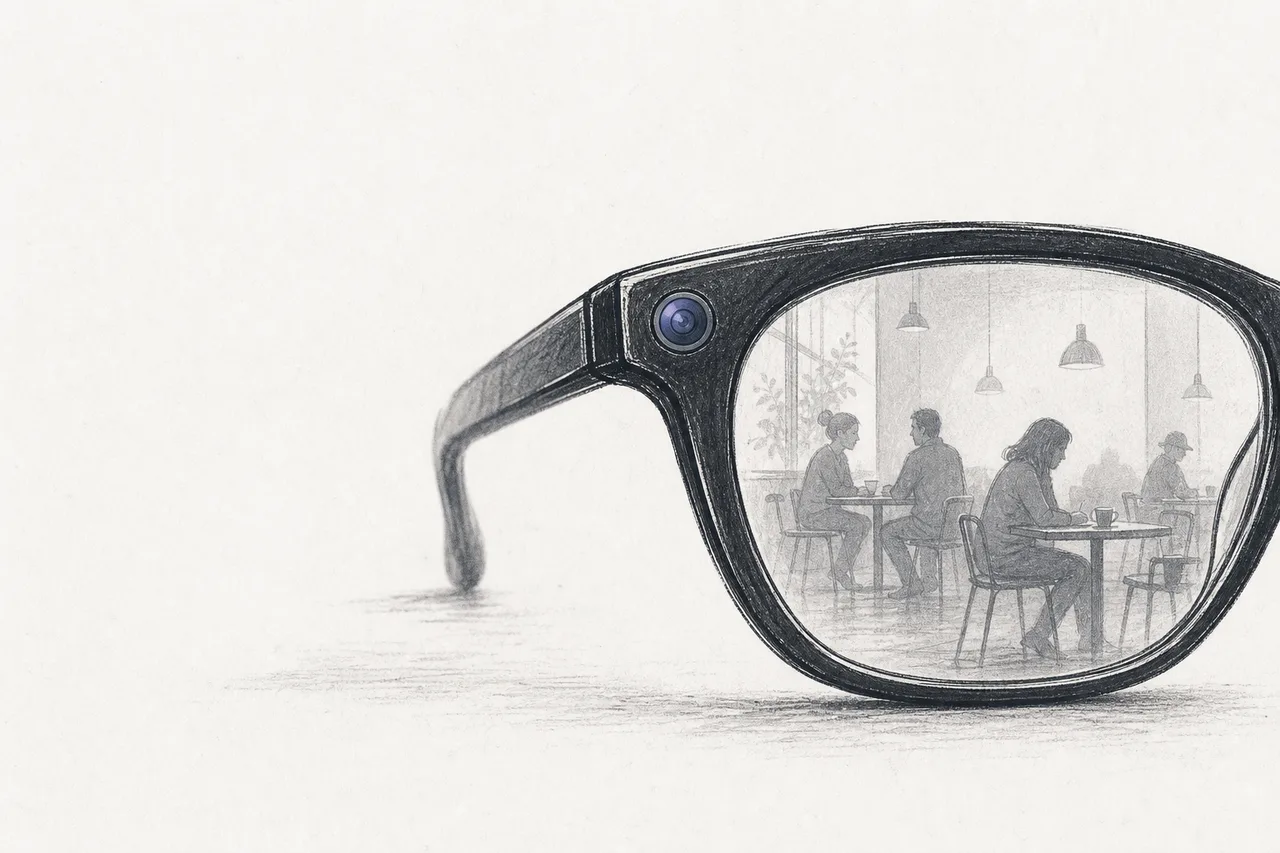
The second risk is the limits of physics — battery and heat. Shooting video, livestreaming, or asking the AI a lot drains the battery very fast, and a thin glasses frame has room for only a tiny battery. That's why the "voice-only, no camera, no display" design still survives — it's much lighter and lasts much longer. So the market splits into several paths depending on what users are willing to trade for what.
The third risk is the AR dream that's still far off. We have to be honest: AR glasses that project full graphics overlaid on the real world — the picture everyone dreams of — are still hard to make, expensive, and mostly prototypes. No one has yet solved the waveguide challenge — clear, bright, wide-field, thin, and cheap all at once — at a mass-market price. The risk is that investors may accidentally value the "AR dream" faster than the technology can catch up.
In short: the story of AI glasses is a lesson that the "killer app" usually isn't what everyone guessed. People thought the star would be an AR display floating over the world, but the pair people actually wore was the light glasses with an AI listening and watching alongside them. And if this form factor really becomes the standard, it may be the deepest path by which AI enters daily life — deeper even than the phone screen.