Megatrend · Spatial Computing / AR/VR
Why ultra-thin AR glasses still aren't here — the bottleneck is the thin sheet of glass in front of your eyes
The hardest problem in AR glasses isn't the chip or the AI — it's something basic: "how do you float a sharp, bright-enough image right in front of your eyes, inside something as small and light as a pair of sunglasses?" This node is the optical layer of Spatial Computing — the tiny displays that glow at a million nits, and the waveguides that leak that light back into your eye. It's a deep pick-and-shovel where a handful of companies hold the key IP — and where the whole industry is still stuck.
01What it is (two big problems)
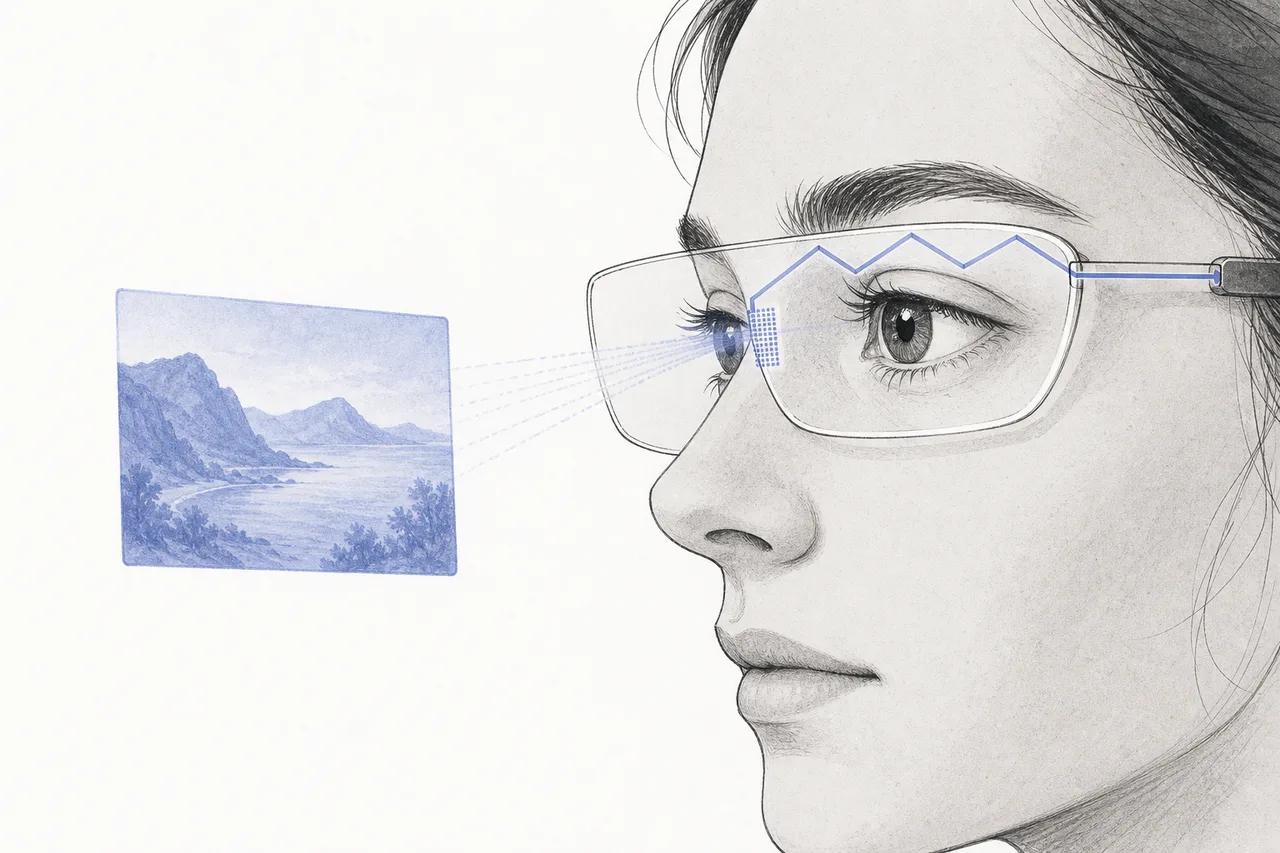
Picture the dream AR glasses — as thin as sunglasses, but with crisp digital images floating over the real world. The catch: making an image "float in front of your eyes" inside something that small and light is the toughest engineering problem in the field. And it breaks into two big problems that are completely different.
The first is the "image source" (microdisplay) — a tiny display, smaller than your fingernail, that creates the original picture. It has to be enormously bright (we'll soon see why it needs to hit "a million nits"). The second is the "thing that guides the light into your eye" (combiner / optics) — the part that takes the image from that tiny display and places the light precisely in front of your eyes, while still letting you see straight through to the real world.
On the megatrend map, this node sits in the supply-chain layer of Spatial Computing / AR/VR. It has two children that map exactly onto the two problems above — Micro-Displays (the tiny displays: micro-OLED / LCoS / microLED) and Waveguides & AR Optics (the light-guiding glass and lenses). This whole lesson is about these two working as a pair.
02Why it matters — the bottleneck for the whole industry
Why aren't the dream AR glasses on shelves for everyday consumers yet? Most of the answer isn't the chip or the AI — it's this optical layer. It's the real bottleneck of thin, light AR glasses. As long as no one can make light-guiding glass that's bright, sharp, AND mass-producible cheaply, AR glasses will stay expensive, heavy, or dim.
That makes this market a deep "pick-and-shovel" play — you're not betting on which brand of glasses wins, you're betting on whoever "sells the picks and shovels" to every brand. Anyone who wants to make AR glasses has to buy waveguides and tiny displays from a handful of specialists who hold patents and manufacturing know-how that's hard to copy.
But let's be honest: this is a small market, tied to AR's slow arrival. The AR waveguide market today is still tiny — only a few hundred million dollars. It's expected to grow fast (mid-range forecasts put it at roughly 25–35% a year, reaching ~$5.7B by 2030), but the base is still small, and everything depends on how quickly consumers accept AR glasses. The other half of this layer is the microdisplay market — just as big and growing just as fast — about $1.65B in 2025 to ~$5.33B in 2030 (~26%/yr), led by Sony, JBD, and Himax across the different technologies (see → ?node=48040100).
03How it works — light's journey into your eye Deep dive → ?node=48040200
The heart of thin, light AR glasses is a part called the waveguide (light-guiding glass) — a thin, transparent sheet of glass that acts as a "light pipe," carrying the image from a tiny display hidden in the temple of the glasses to right in front of your eyes. The idea is clever: instead of putting a screen in front of your eyes (which would block the real world and make the glasses thick), you hide the screen at the edge, "shoot the light into the glass" so it bounces back and forth inside until it reaches your eye, then "leak it out."
The mechanism that keeps the light from escaping the glass along the way is a phenomenon called total internal reflection — light traveling inside the glass at the right angle reflects back into the glass every time it hits the surface, never leaking out the sides, like a ball bouncing inside a pipe — until it reaches the "exit" at your eye, where a diffraction grating is etched in, pulling the light out and bending it into your eye — along with the real-world image coming straight through the glass at the same time.
It sounds beautiful, but the real problem hides in the details. Every time the light bends through a grating, it loses a huge amount of energy — which is why light efficiency ends up at just a few percent. Worse, because a grating bends each color (red/green/blue) at a different angle, you get a "rainbow artifact" that disturbs the image. And these nanometer-scale etchings are very hard to mass-produce uniformly — these three things (light leakage, rainbow color, hard to make) are the wall the whole industry is hitting.
Diffractive uses nano-gratings etched on the glass to pull the light out — it can be made with semiconductor processes, so it gets cheaper at volume, but efficiency is low and it shows rainbows · Reflective / geometric (the kind Lumus makes) uses tilted embedded mirrors in layers — brighter and more color-accurate (it claims ~5–10× more efficient than diffractive), but hard to make because it has to be assembled by hand from dozens of small pieces, so it's expensive. This is the central trade-off of the industry.
04The tiny display: micro-OLED vs microLED Deep dive → ?node=48040100
Back to the first problem — the image source. Remember the waveguide delivers only a few percent of the light to your eye? That forces the original screen to be shockingly bright. To make the image bright enough in your eye for use in daylight (around 1,000–3,000 nits), after subtracting roughly 85% loss in the optics, the tiny display has to hit 50,000–100,000 nits. For scale: a good phone screen is around 1,000–2,000 nits.
Three microdisplay technologies are competing, and brightness is the battlefield:
- micro-OLED: tiny OLED on a silicon wafer — sharp and great color, brightness up to several thousand to ~10,000 nits (Sony ECX350F). Good for opaque VR (like Vision Pro), but not bright enough for see-through AR in daylight
- LCoS: uses liquid crystal to reflect light from an external source — an older technology used in many AR projectors; cheap, but bigger and more power-hungry
- microLED: the rising star — tiny micron-scale inorganic LEDs, enormously bright (JBD has hit over 2 million nits), no burn-in, long life — this is the only answer bright enough for real daytime see-through AR
microLED's problem isn't brightness, it's "yield" (the rate of good units) — the mass-transfer problem that makes microLED hard to make (and the red-microLED challenge) is covered in depth in the child lesson → ?node=48040100.
On the VR side (opaque screens, no see-through needed), the story is different — there, micro-OLED rules the market. The clearest example is Apple Vision Pro, which uses Sony micro-OLED screens brighter than 5,000 nits — and that's one reason the Vision Pro costs $3,500.
05Where it fits in Spatial Computing
This node is the optical layer of Spatial Computing / AR/VR — the part every head-worn device relies on. It's connected inseparably to its neighbors in the same trend:
- Feeds VR / MR Headsets: the opaque VR side uses micro-OLED + pancake lens (a light-folding lens) that makes the device 40–66% thinner — a different kind of optics from AR, but still the same node
- Feeds AI / AR Smart Glasses: this is the real customer for the waveguide — thin, light glasses that need to be see-through rely directly on light-guiding glass + microLED
- A different layer from OLED & Display Materials: that node makes "emissive materials and display panels," while this node handles "projecting and guiding the light into your eye" — two layers next to each other in the chain
- Depends on Critical Materials & Supply Chain: specialty glass with an extra-high refractive index (high-index glass, like Corning's or SCHOTT's) is the core raw material of the waveguide
- Depends on AI and semiconductors: micro-OLED screens are built on a silicon backplane (the Vision Pro's is made by TSMC) — so optics and chips converge here
Put simply: if Spatial Computing is a body, this optics is the "eye" — and it's the hardest organ to make. That's why a handful of companies who are good at it hold bargaining power out of all proportion to the size of the market.
06Where it stands now + who the real players are
2025–2026 is when this stuff started coming out of the lab and onto real faces. The clearest signal: Meta Ray-Ban Display (Meta's 2025 AR glasses) uses Lumus's reflective waveguide — the first time a geometric waveguide proved it could be mass-produced. And at CES 2026, Lumus was the first to show a waveguide pushing the field of view past 70°. On the China side, glasses like the RayNeo X3 Pro use a single-layer diffractive waveguide + JBD's microLED to push in-eye brightness to 6,000 nits, while cutting the rainbow artifact by about 95%.
But here's the honest reality: the real players who hold the most important IP in this layer are mostly private companies not on the stock market (Lumus, DigiLens, JBD) — while the ones that are public are usually giants for whom XR optics is just one part of the business (lenses/glass/modules). So we arrange the players by their role in the chain rather than raw market cap.
07The road ahead
The first direction is microLED winning the brightness war. If manufacturers can solve yield and the red-microLED problem, it becomes the standard for see-through AR glasses — because it's the only technology that's truly bright enough. JBD starting volume production in 2025, and Kopin/Porotech racing to develop red, are signs this path is coming — slowly.
The second direction is waveguides getting better step by step — wider field of view (Lumus reaching 70°), better light efficiency (RayNeo claims +25%), less rainbow artifact (cut by 95%). No one has "solved it" yet, but every year it gets good enough to make products more usable. The question is how the two camps will coexist — reflective (bright/expensive) for premium/military, and diffractive (cheap/easy to make) for consumers.
The third direction is the arrival of consumer AR deciding everything. This optics market is a mirror of AR — if AR glasses explode like the smartphone, this market grows in a hurry. But if AR stays a niche, the market grows slowly along with its small base. This is a bet tied directly to the adoption of the parent trend.
08Challenges & risks
Let's be straight: this optical layer is deep-tech that's "beautiful on paper" but still has walls it hasn't broken through.
The first risk is the technical challenge that isn't finished — the waveguide's light efficiency is still low (a few percent), and microLED yield still isn't at consumer economics (it needs >99.99%, but it's still ~99.5–99.8%). This isn't a "done in another six months" problem — it's a physics and manufacturing-engineering challenge that could take several more years.
The second risk is a small market tied to a late-arriving AR. The waveguide market today is still only a few hundred million dollars, and every growth forecast rests on the assumption that AR glasses will catch on — which has already been pushed back several times. If consumers still don't come along, the players' revenue will grow slower than the dream.
The third risk is IP concentrated in private hands — many holders of the key technology (Lumus, DigiLens, JBD) are still private companies, making it hard for retail investors to reach the real thing. And it means the risk of a portfolio invested in the public names (which are usually a side business) may not reflect the true winners in this layer.
In short: the problem that looks the most basic — making a sharp, bright-enough image float in front of your eyes inside something small — turns out to be the wall that has blocked the dream AR glasses for years. Whoever breaks this optical wall down holds the key to the whole Spatial Computing trend.