Megatrend · Spatial Computing / AR/VR
The computer you wear on your face — and why it still hasn't won anyone over
Today's game console is tomorrow's smartphone — that's the promise tech giants have already poured nearly $70 billion into. This lesson tells the story of the "VR/MR headset" — the device trying to become humanity's next computer: how it works, why whoever controls it controls the whole ecosystem, and why, after a decade of hope, sales are actually shrinking, not growing.

01What it is
Imagine pulling a "VR headset" over both eyes, and suddenly you're no longer in your bedroom — you're standing on a mountaintop, or in a spaceship, or on a concert stage, even though your real body is still on the couch. That's what the devices in this node do. And the companies that make them, we call "headset OEMs".
This node is about the companies that make the whole "headset" itself — not the parts, not the apps, but the finished device you can just put on. Put simply, they're the "smartphone makers" of the Spatial Computing era. These headsets split roughly into two modes:
- VR (Virtual Reality): seals off your eyes from the real world entirely and drops you into a complete virtual world — good for games and entertainment
- MR (Mixed Reality) / passthrough: uses cameras to capture the real world around you and feed it to the display, then overlays digital images on top — you still see your own room, but with virtual screens floating in mid-air
OEM (Original Equipment Manufacturer) = a company that designs and assembles the "whole device" and sells it under its own brand (like Meta Quest, Apple Vision Pro) · Passthrough = when the headset uses outward-facing cameras to capture the real world in real time and show it on the inner display, turning an "opaque" headset into a Mixed Reality one that sees both the real world and virtual images at once
On the megatrend map, this node is a sub-branch under Spatial Computing / AR/VR, and it's the "platform layer" — the device that everything else (chips, displays, apps, games) has to converge onto, the way the iPhone became the platform the whole world's apps run on.
02Why it matters — the battle for the platform
The reason big companies are willing to take huge losses for VR headsets isn't the headset itself — it's what comes with it. In the history of technology, whoever owns "the device people use every day" becomes the owner of the gateway to everything inside it.
Apple controls the iPhone, so it controls the App Store, taking a 30% cut of every app sold on it. Google controls Android, so it controls mobile search worldwide. The trillion-dollar question is "if the next computer is a headset on our face, who owns that gateway?" That's why Meta, Apple, and Sony stepped into this arena — it's the next big platform bet, not just selling hardware.
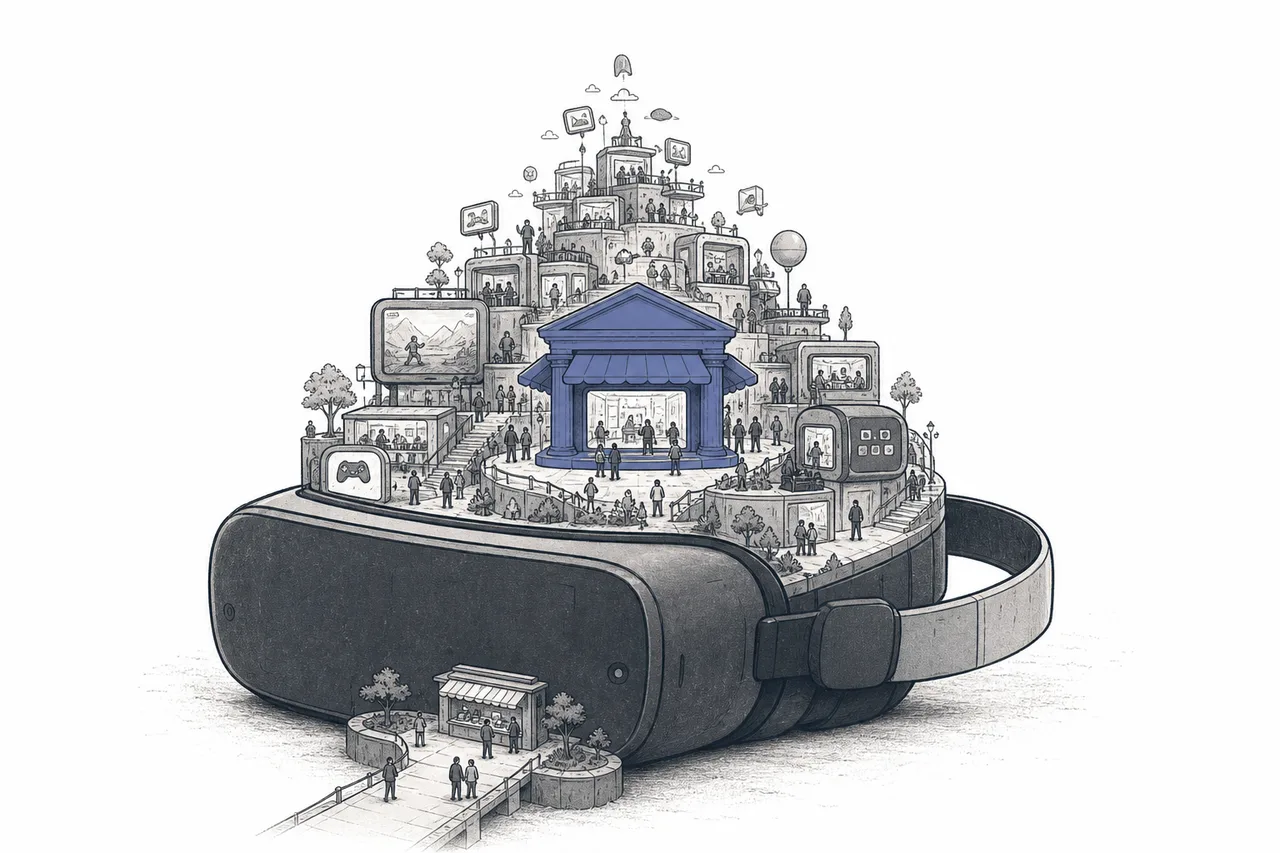
And this bet really is expensive. Meta changed its name from Facebook to "Meta" in 2021 to declare it was going all-in on the virtual world — and then it spent like it meant it. Meta's Reality Labs division has lost nearly $70 billion cumulatively since late 2020, and the losses get heavier every year.
03How it works
The magic of a VR/MR headset is that it has to trick your brain into believing "the virtual world is real" within a fraction of a second — and do it every single time you move your head, or you'll get dizzy instantly. At its heart is the coordination of 4 parts working in a loop that never stops:
- Display + lens project a sharp image into each of your eyes, creating a 3D picture
- Cameras + sensors around the headset watch the real world and your movements
- Processor (chip) calculates where your head is, then "draws" the new scene in time
- Motion tracking ties it all together — the moment you turn your head, the scene has to move with it
The cleverest part is "inside-out tracking". Older VR headsets needed cameras set up in the corners of the room to track your position (called outside-in) — a real hassle. But modern headsets moved all the cameras onto the headset itself and use an algorithm called SLAM to look for distinctive points in the room (the corner of a desk, the edge of a door) to figure out how it's moved — like how you can walk around your own room with your eyes closed because you remember where everything is.
SLAM (Simultaneous Localization and Mapping) = the headset "building a map of the room" and "knowing where it is in that map" at the same time, using cameras combined with a motion sensor (IMU) · 6DOF = tracking movement in all 6 directions (forward-back, left-right, up-down, plus rotation on 3 axes) — so you can actually walk around a virtual object, not just look at it from one spot
What sets each maker apart is how many "eyes" they add. The Meta Quest 3 uses 2 color cameras, 4 infrared cameras, and 1 depth sensor. The Apple Vision Pro goes much further with a total of 12 cameras, 5 sensors, and LiDAR for measuring distance — the more sensors, the sharper the passthrough image and the more accurate the tracking, but also the more expensive and heavier it gets.
04Where it sits in Spatial Computing
The whole headset looks like the star, but it's really the "convergence point" that depends on a huge array of surrounding parts and technologies. This is why the headset OEM sits at the platform layer of Spatial Computing — every other sub-category feeds into it:
- Specialized chips from XR Silicon & Processors — the brain that has to draw a 3D scene in time every fraction of a second while sipping little enough power to sit on your head
- Displays and lenses from Optical & Display Components — ultra-high-resolution micro-displays and lenses that squeeze a whole world into your eyes (this is the biggest cost in the Vision Pro)
- Apps and games from XR Content, Engines & Platforms — because an empty headset is worthless if there's nothing to do. This is the "chicken-and-egg" problem that has killed many platforms before
And it's also a "cousin" of AR Smart Glasses, which is turning into a scarier rival than expected — light AR glasses you can wear all day (like Meta's Ray-Ban) are outselling the heavy, opaque VR headsets, to the point where many are starting to wonder whether "the future of Spatial Computing might not be a face-covering headset, but ordinary-looking glasses."
In the big picture, this node also leans deeply on AI (AI helps track hands, track eyes, and understand the surrounding scene) and leans on materials & the supply chain for tiny OLED displays and precision parts that are hard to make — which keeps its price from coming down easily.
05Where it stands now
Time for the unpretty truth. After a decade of promises and hundreds of billions in investment, the VR/MR headset market is "shrinking," not growing. In 2024 the world sold about 9.6 million VR/MR headsets (barely growing, ~9%), but by 2025 IDC expects sales to plunge 42.8% — almost cut in half.
What hurts more is that it's almost a market of Meta alone. Meta holds about 75% of the share with its Quest family, priced far below rivals. But even as the market leader, Quest's own sales are sliding — from 5.6 million units in 2024 to just 1.7 million in the first three quarters of 2025 (down 16%). When even the market leader is selling less, that tells you the problem is the product itself, not just competition.
The most industry-shaking case is Apple Vision Pro. It launched in early 2024 at $3,499 (about 120,000 baht) with the most advanced technology on the market. But the result — about 390,000 units sold in 2024, then sales plunging to just ~45,000 units in a key quarter at the end of 2025. Apple cut the Vision Pro advertising budget by over 95%, and there are reports its manufacturing partner (Luxshare) temporarily halted the production line.

So what's the reason? It all converges on one problem — these headsets are still too heavy, too expensive, and have no "reason to use every day". People buy one for a few games (Beat Saber, Gorilla Tag) and then leave it in a drawer. So much so that IDC vice president Francisco Jeronimo says it bluntly: "the idea that AR/VR will replace the smartphone isn't happening, and it never will."
There are only a few bright spots left. Sony combines PSVR1 and PSVR2 into the second-largest VR ecosystem after Meta (8.7 million units combined). In China, ByteDance's Pico holds 46% of the consumer VR market in China and ~5% globally. But both are still niche players, not the mainstream.
06The road ahead
If you want to be optimistic, you have to admit this industry has a "history of over-promising" in its DNA. Back in 2016, Goldman Sachs predicted the AR/VR market would reach $80 billion by 2025 — which missed by a wide margin. Today many research firms still expect the total AR/VR market to hit $300–500 billion by 2030, but after a track record of repeated misses, these numbers should be read with caution.
The first direction to watch is "lighter, cheaper". Every maker knows the real enemy is weight and price. So the next generation is betting on getting thinner, lighter, and cutting prices — there's even talk that Apple may turn to a cheaper Vision, or jump to AR smart glasses instead.
The second direction is the contest between "headset" and "glasses". While the VR headset shrinks, AR smart glasses (like Ray-Ban Meta) are exploding. The big question of this decade is whether the final form of the "computer on your face" will be an opaque headset that takes us into a virtual world, or transparent glasses that lightly augment the real one — and that answer will decide who wins the platform war.
The third direction is the "killer app that still hasn't arrived". The smartphone exploded because it had a reason to use every day (chat, maps, camera), but the VR headset doesn't have that yet. If one day an "indispensable reason" shows up — whether it's work, meetings, or something we can't even imagine yet — the whole board could flip overnight. That's the bet Meta is still willing to pay nearly $20 billion a year to wait for.
07Challenges & risks
This node is a prime example of a trend that "everyone believes is huge but hasn't yet proven itself." So its risks are blunt and heavy.
The first and biggest risk is "mass demand that may not actually exist". After hundreds of billions invested and a decade of waiting, sales are actually shrinking. The scariest possibility for investors isn't "when will it grow" but "will it ever grow into the mainstream at all" — maybe the face-covering headset can only ever be a niche device (gaming, enterprise), not everyone's computer.
The second risk is the three-sided wall: weight, price, and use. Headsets are still too heavy to wear for long, too expensive for ordinary people to buy, and have no reason to use every day. All three are tangled together — making them lighter and cheaper usually means cutting sensors or specs that make the experience worse. It's an engineering problem no one has solved cleanly yet.
The third risk is being overtaken by "glasses" instead of the "headset". If the future of Spatial Computing really is light AR smart glasses, companies betting heavily on heavy VR headsets may turn out to be betting on the wrong path — like someone pouring everything into building the best digital camera just as the world was moving to taking photos on phones.
In short: the VR/MR headset is the story of a technology that's stunning in the lab but still can't find its place in real life. It's a lesson that being the "next platform" isn't guaranteed by money or the best technology — it needs a reason for an ordinary person to pick it up and put it on every morning. And to this day, that reason still hasn't arrived.