Megatrend · whole-trend overview
The last computer you won't realize is a computer
For a decade this industry kept promising "glasses will replace the phone," and kept disappointing — bulky face-covering VR never really sold in the millions, and the $3,499 Apple Vision Pro sold only around 400,000 units before production was cut. But then the thing everyone overlooked exploded: Ray-Ban Meta glasses, which look like ordinary sunglasses, sold 7 million pairs in a single year. This lesson is the map that strings the 8 categories of Spatial Computing together — who does what, where the real value is, and why this time might not be another false dawn (each category has its own deep-dive chapter).
01The big picture: the computer that dissolves into the world
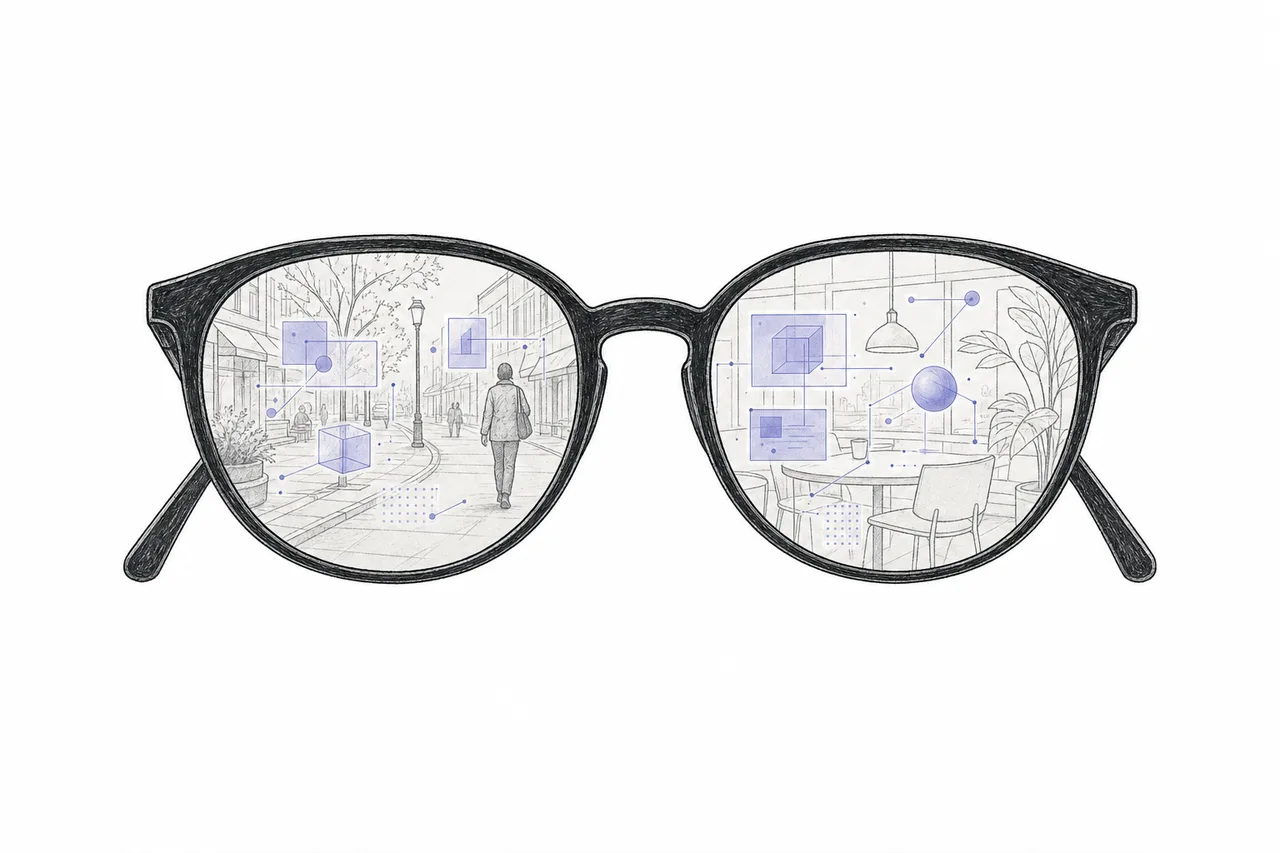
Every era of computing has had a "screen" we look into — the desktop screen, the laptop screen, the phone screen in our hand. Each time, we have to look down to find it. But Spatial Computing flips that: it lays the computer over the real world around us. Directions float on the road, translations hover over a shop sign, a video call sits on the couch across from you — digital imagery blends into 3D space until you barely feel like you're using a computer at all.
To be precise: this trend includes bulky VR/MR headsets, smart glasses, specialized chips (XR silicon), lenses and tiny displays (optics/displays), and 3D software and digital twins — but it does NOT include the AI models that generate content (those live in Artificial Intelligence) or cloud streaming (that lives in Cloud & Digital Infrastructure).
The market is forecast to be huge. Many shops see the combined AR/VR market growing from about $60 billion in 2024 to ~$300 billion by 2030 (about 25% CAGR). But — and this is the heart of the lesson — this trend's forecasts have "missed" several times already. The industry has a decade-long record of overpromising and shipping late.
So the reality in 2025–2026 is a "two-sided story" worth telling straight: on one side, bulky VR disappointed — global VR shipments fell 12% in 2024, the third year of decline, and Apple's Vision Pro flopped. On the other, AI-powered smart glasses exploded — and that's the storyline that changes everything.
02The map: 8 categories across 4 layers
The best way to understand Spatial Computing is to see it as a "4-layer tower" — from the deepest components inside, up to the device, then the platform, and finally the applications the user actually sees. Each of the 8 sub-categories sits in one of these layers — and each has its own deep-dive lesson (tap to read):
Base layer — components and silicon (Components)
- Optical & Display Components: lenses, waveguides, and tiny displays — the hardest part and the "bottleneck" for AR glasses, which have to be thin enough and bright enough to use in daylight
- OLED & Display Materials: micro-OLED (OLED-on-silicon) displays and the materials that make them — Sony makes the tiny displays for Vision Pro, and BOE/Samsung supply the whole industry
- XR Silicon & Processors: specialized "brain" chips that process 3D imagery in real time at low power — Qualcomm's Snapdragon XR2 owns this market
Middle layer — devices (Devices)
- VR / MR Headset OEMs: bulky face-covering headsets aimed at fully immersing you in a virtual world — Meta Quest, Apple Vision Pro, Sony PSVR2 (the disappointing side)
- AI / AR Smart Glasses: thin, light, normal-looking glasses with AI that listens, sees, and answers — Ray-Ban Meta is the star that exploded (the actually-succeeding side)
Upper layer — platform and content (Platform)
- XR Content, Engines & Platforms: the operating systems, game engines (Unity, Unreal), and content stores — the ecosystem owners that lock in developers and users
Top layer — real-world work (Applications)
- Enterprise AR & Field Service: bringing AR to on-site repair, floating a manual over the machine or letting a remote expert point things out — a quiet market that actually pays
- Industrial Metaverse & Digital Twin: building a "digital twin" of a factory or a whole city to simulate, test, and control production — growing quietly on corporate money
03How it connects (the stack)
The core that makes this trend easier to grasp is that it stacks in layers — the tiny components at the bottom feed up to the device, the device needs a platform to be usable, and at the very top sits the real work people pay for. Look at this tower:
The thing to watch is the upward flow — the lenses and chips below determine how thin, light, and bright the device above can be. As long as you can't make AR lenses (waveguides) thin enough, bright enough (>3,000 nits to read in daylight), and cheap enough, full AR glasses won't reach the mass market — which is why the real bottleneck is in the components layer, not the glasses themselves.
The technique for making AR lenses that "shoot" an image to travel inside the lens and reflect into your eye, making the lens as thin as a normal pair of glasses (not a thick box). It's the hardest part to make and very few companies can — Lumus, Dispelix — so it's the bottleneck for the entire AR industry.
04Where the value is (not in the glasses themselves)
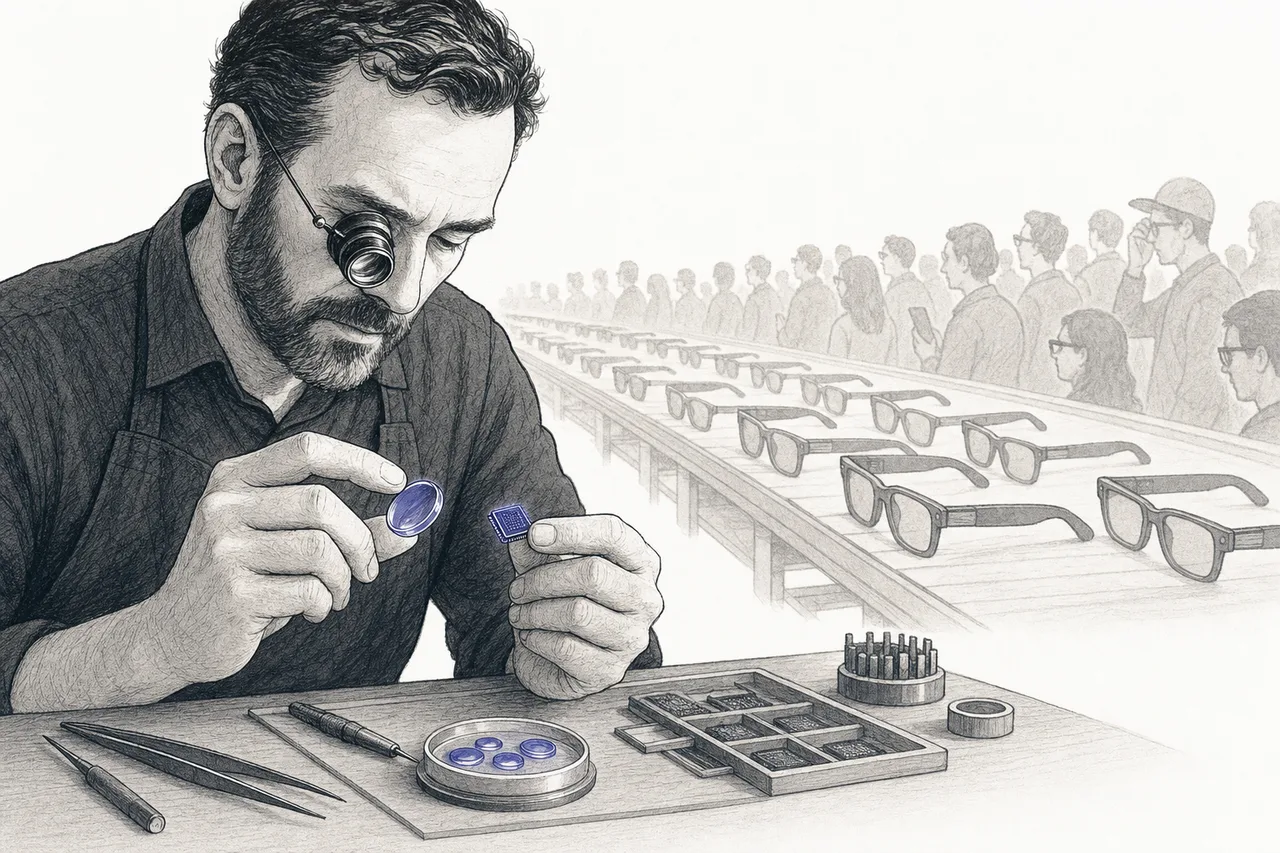
If you remember just one thing from this chapter, remember this: the money doesn't pile up in the glasses themselves — because the glasses are becoming something anyone can assemble (Chinese factories make AI glasses to sell for just 1,500–3,000 yuan ≈ $212–$424). When anyone can make them, it turns into a price war. So the real value flows to two places:
1. The hard-to-make components (picks-and-shovels) — waveguide lenses, micro-OLED displays, and XR chips are made by few companies and are indispensable. Whichever brand of glasses you sell, you end up buying from this group. Just like the gold rush — the ones who really get rich sell the picks and shovels, not the miners.
2. The platform and ecosystem owners — those who control the OS, the content store, and the user base (Meta, Apple, and Google through Android XR). Because as glasses get cheaper, bargaining power shifts to whoever owns the "customers" and the developers.
This explains why many of the most interesting companies in this trend don't sell glasses at all — Qualcomm sells XR chips to nearly every brand, Sony sells micro-OLED displays to both Vision Pro and its rivals, Corning makes the special glass, while EssilorLuxottica (Ray-Ban's owner) is the partner that makes Meta's glasses look like "real glasses" people want to wear. The lesson: don't just ask "who can sell the most glasses" — ask "who stands on a bottleneck that's hard to replace".
05Forces that move the whole trend
Even though each category differs, three big forces are moving the whole trend at once:
1. AI is what finally made glasses "useful" — this is the force that changed the game. For a decade, glasses didn't know what to do besides display floating labels. But the moment you add AI that listens to your voice, sees what you see, and answers, the glasses suddenly have a reason to wear all day — Ray-Ban Meta is the proof. The sales numbers show people accepted "glasses with AI" before "glasses with AR":
2. The two-sided story: VR disappointed, but thin-and-light glasses exploded — this force matters enough to decide who survives. The bulky-VR side has been down for 3 years, and Vision Pro sold only ~400,000 units before production was cut, while the thin-and-light side is surging — smart-glasses shipments are expected to grow at 100%+ CAGR to ~112 million units by 2030. The whole industry's investment money is tilting this way.

3. The display and lens supply chain sets the ceiling — everything runs back to the base layer. Display technology (micro-OLED, microLED) and lenses (waveguides) set the ceiling on how fast AR glasses can get good and cheap. The thing to watch is the lens target of full color, bright >3,000 nits, and under 2mm thick, expected to arrive around 2026–2028 — only then will full AR glasses have a shot at the mass market. And China (BOE, Sunny Optical, Goertek) is aggressively building its own version of this chain.
06Where it stands now + the champion of each category
2025–2026 is the point where this trend "picked a side" — the bet shifted from bulky VR headsets to AI-powered smart glasses. Microsoft drew the curtain on HoloLens (ending hardware development in Feb 2025, support through 2027), Apple throttled Vision Pro production, while Meta and the Chinese players (Rokid, XREAL) lead in thin-and-light glasses. Below are the "champions" of each category, showing how power is spread across several countries (US/Japan/Korea/China/Europe):
07The future, and the risk of a false dawn
Looking ahead, this trend has both clearer tailwinds and the traps that have burned people several times before.
On the opportunity side: AI made glasses genuinely useful for the first time — AR-glasses shipments alone are expected to grow from ~950,000 units in 2026 to ~32 million by 2030 (TrendForce). And once full-color waveguide lenses that are thin and bright enough arrive in 2026–2028, full AR glasses get a shot at the mass market. The enterprise side (digital twin, enterprise AR) is already growing quietly on real money.
On the risk side, there are three layers to watch:
- Repeated false dawns: this trend has a decade-long history of "almost arriving" — Google Glass (2013), Magic Leap, Meta's Metaverse, and HoloLens, which just died. Every time, a pretty forecast got folded up. This time AI glasses look more real, but it still has to prove it's not a passing fashion toy
- A technical ceiling at the base layer: if lenses and displays don't get thin, bright, and cheap enough on schedule, full AR glasses slip further out — the whole trend is tied to the progress of a small handful of component makers
- A price war at the device: as China makes glasses ever cheaper, the glasses makers themselves may earn thin margins. The value concentrates in components and platforms, not in the ones assembling the glasses

And that's why this chapter is a "map," not a "deep-dive guide" — the real value of seeing the whole trend is spotting that the whole tower strings together into one story and seeing where the real money flows, before you go explore each layer in detail — just tap into the deep-dive chapter of whichever category interests you.