Megatrend · Artificial Intelligence
One AI chip runs as hot as a clothes iron — so who keeps it fed with power and pulls the heat away?
Everyone talks about NVIDIA and AI chips getting faster and faster. But there's a quieter truth: the newest chips draw more than 1,000 watts each and run so hot that fans can't cool them anymore. What decides how fast AI can grow isn't the number of chips you can make — it's whether you can 'feed them power and pull the heat away' fast enough. This is the story of pipes, wires, and gear nobody sees — and it became the bottleneck of the AI era.
01What it is
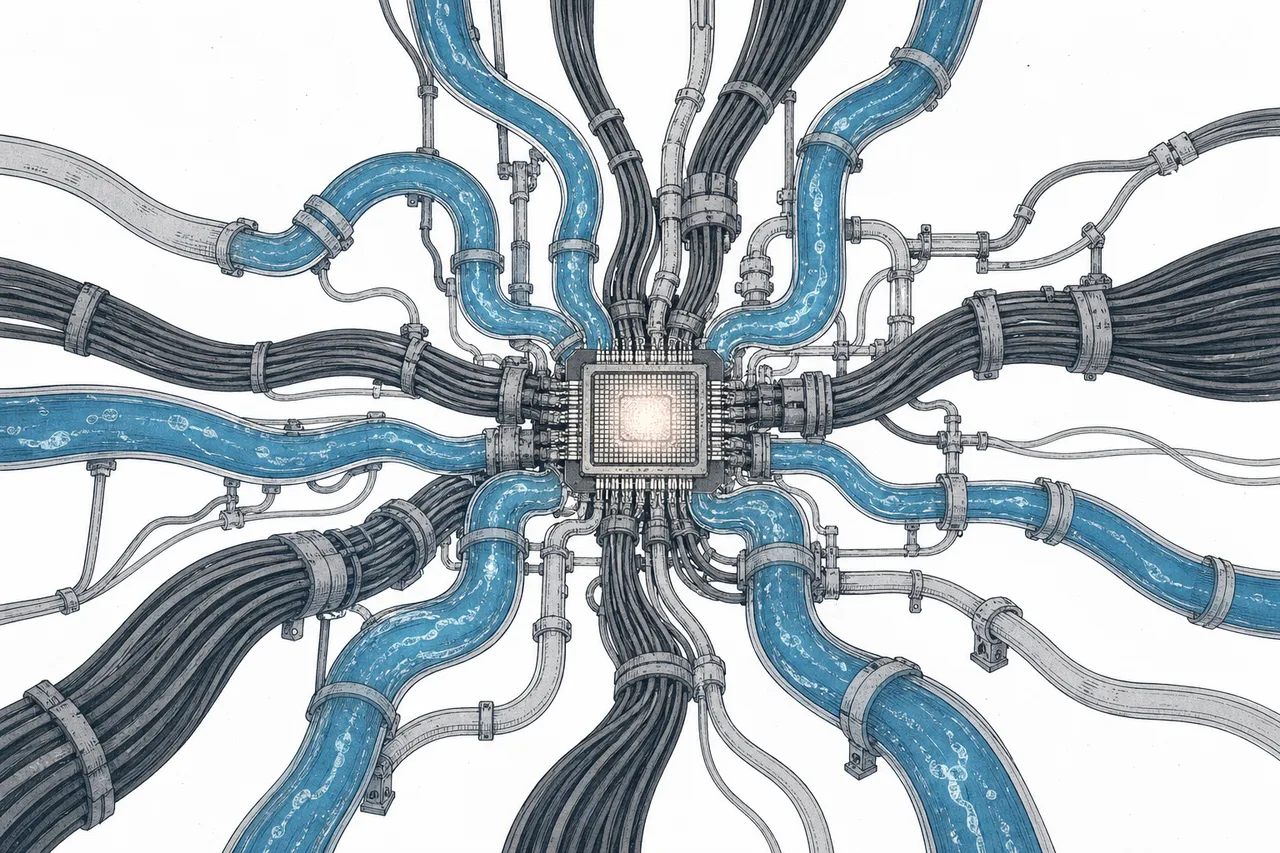
Picture an AI data center as AI's 'body' — the brain is the chip doing the computing, but the body can't survive without two systems: the power system (like blood vessels delivering energy) and the cooling system (like sweat keeping the temperature down). This node is about the gear for both of those systems — the things inside the data center building.
To be precise, AI Power & Cooling is the electrical and thermal gear inside the data center — uninterruptible power supplies (UPS), power distribution units (PDU), converters that step voltage down to the chip level, cooling-water systems, cold plates, and heat exchangers. They all do one job: give the chip enough power, and keep it from getting hot enough to break.
This node is the gear inside the data center — UPS, PDU, cooling-water systems. The generation of electricity and the national grid (where the power comes from, whether there are enough power plants) belong to Energy Transition & Power Demand, and the 'building' itself plus its construction belong to AI Data Center & Build-out. This chapter focuses only on 'power reaching the chip' and 'heat leaving the chip.'
On the megatrend map, this node sits under Artificial Intelligence in the 'infrastructure' layer, next to AI Compute (the chips), AI Networking (the links), and AI Data Center (the building) — it's the quietest piece, but it became the one that decides how fast the whole system can scale.
02Why it became AI's 'bottleneck'
It starts with a simple, alarming number. NVIDIA's H100 AI chip (2022) drew about 700 watts each — as much as a hairdryer. The next generation, B200 (Blackwell), pushed that to 1,000–1,200 watts, and the upcoming Rubin is expected to hit 1,800–2,300 watts for a single chip. That's clothes-iron levels of heat packed into the area of your palm.
Now, an AI data center doesn't have just one chip. It crams dozens of chips into a single rack. The result: power density per rack jumped 10× in just a few years. A typical data center used to sit around 36 kilowatts per rack, but NVIDIA's GB200 NVL72 rack today draws 120–140 kilowatts, and the Rubin roadmap pushes it to 500–600 kilowatts, heading toward 1 megawatt per rack.
This is where it turns into a 'bottleneck.' The biggest problem in building AI today is no longer how many chips you can get — it's whether you can feed them power and pull the heat away in time. If you can't cool fast enough, the chip throttles itself or breaks. If there isn't enough power, the rack won't even turn on. The whole ability to scale AI now hangs on this 'life-support system' that used to be seen as boring.
So enormous money is pouring in. The data-center cooling market was worth about $4.8 billion in 2025 and is expected to grow to about $27 billion in 2035 (~18% a year) — and that doesn't even include the electrical-gear side, which is several times bigger.
03How it works — from the 'wall of air' to cooling water
For decades data centers used air to remove heat — blow cold air through the rack, suck the hot air out. Simple and cheap. But air has a physical limit: for the same volume, water carries about 1,000× more heat than air. Once power density per rack passes about 20–30 kilowatts, air starts to 'lose the fight' — even adding fans until they're as loud as a jet isn't enough. This is the 'air-cooling wall.'
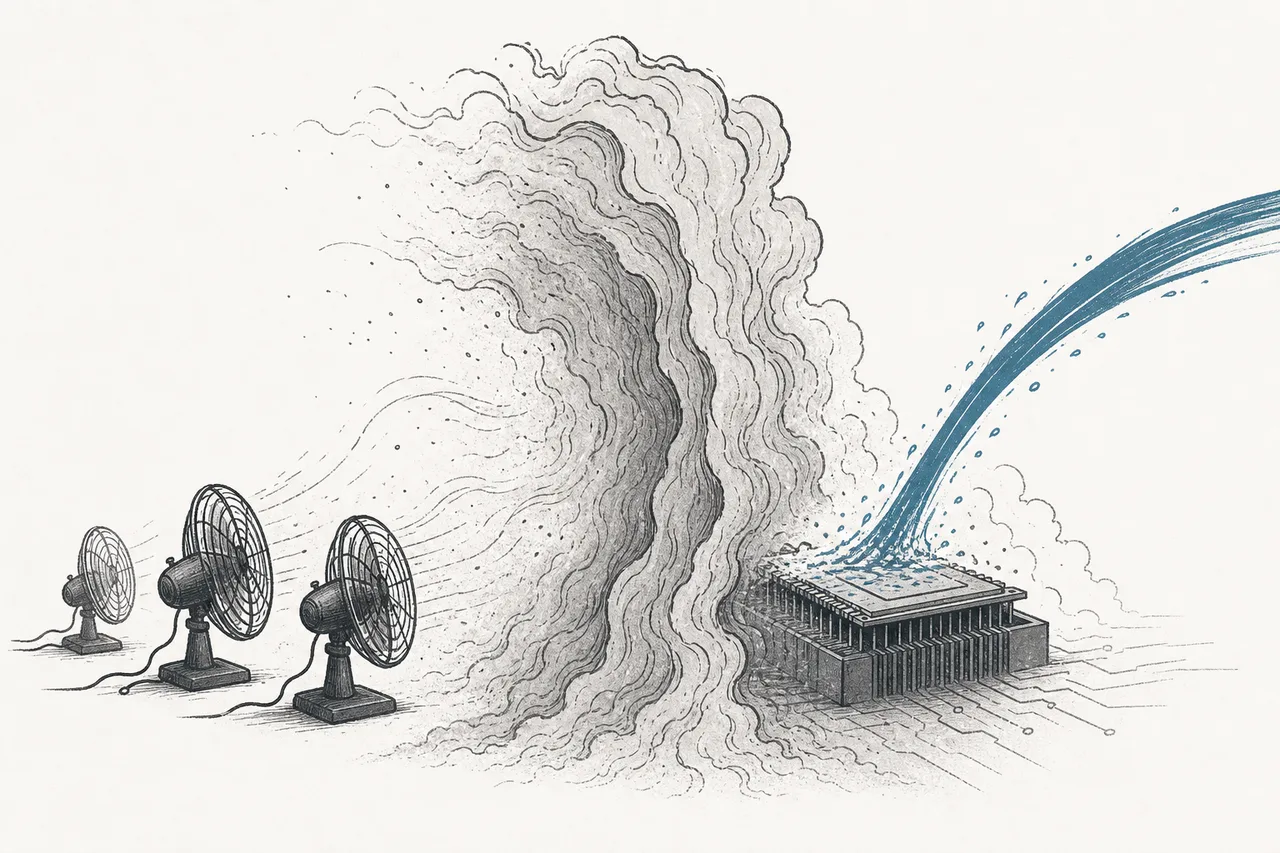
The answer is to bring in water (or a special liquid) to replace air. There are two main ways. The first is direct-to-chip — stick a 'cold plate' with water flowing inside it right onto the chip, pulling heat away at the source; this is the most widely used. The extreme one is immersion — submerge the whole server in a non-conductive liquid so heat seeps out from the entire body (about 17% of cooling investment).
The payoff isn't just 'cooler' — it's more power-efficient too. The metric the industry uses is PUE. Air-cooled data centers usually run a PUE around 1.5 (meaning for every 1 unit feeding the chip, you spend another half-unit on cooling and the like). Water cooling drops it to 1.05–1.15, and immersion reaches ~1.03 — cutting the cooling-related power by about 20–40%.
Total power the data center uses ÷ the power that actually feeds the computers · PUE = 1.0 is perfect (zero wasted power) · PUE = 1.5 means another 50% goes to cooling/losses · the closer to 1.0 the better — and that's a big reason the giants are willing to invest in switching to water.
04The power path: from the utility pole to the chip
The other half of the story is 'power.' Before electricity reaches the chip from the high-voltage line, it has to go through several 'conversions,' and each step loses a little energy as heat. Multiply that by the megawatt scale of an AI data center, and those small losses add up to enormous money and power.
The biggest trend on the power side right now is 800V high-voltage DC (HVDC). Instead of converting power back and forth (AC↔DC) several times before it reaches the rack, the new approach converts power from the high-voltage line (say, 13.8 kV) into 800V DC right at the data center's front door with a 'solid-state transformer,' then runs it straight into the rack — cutting out several conversion stages.
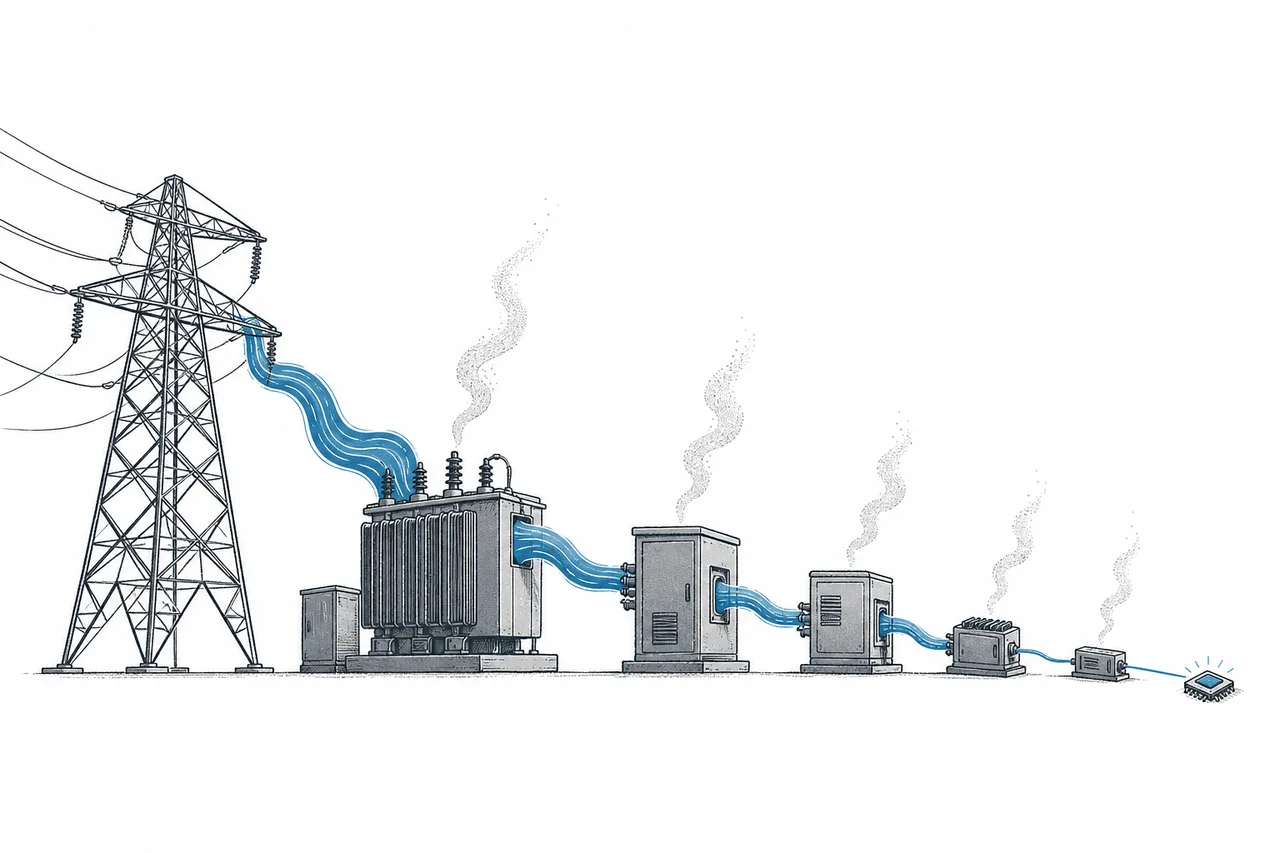
Why do it now? Because at 1 megawatt per rack, if you stick with the old low voltage, the copper wires you'd have to run get so thick and heavy that it's practically impossible. So NVIDIA has teamed up with ABB, Eaton, Schneider, and Vertiv to set an 800V standard and plans to use it for real in the Rubin Ultra (Kyber) rack in 2027 — meaning these power-gear makers are about to sell a whole new generation of products.
05How it connects in the ecosystem
This node is the 'bottom layer' that props up the entire AI pyramid — it connects tightly upward, downward, and sideways:
- Upstream is AI Compute (the chips): every time NVIDIA ships a chip that draws more power and runs hotter, it's an 'order' for the power & cooling side to upgrade immediately — the chip is the source of all the demand in this chapter
- Sits inside AI Data Center: this node is the gear inside the building that build-out constructs — the two always go together, but this chapter digs only into 'power and cooling,' not the building itself
- Pulls demand into Energy: AI data centers are becoming one of the world's biggest power consumers — the IEA estimates global data-center electricity use will grow from 415 TWh (2024) to about 945 TWh in 2030. This node is the 'endpoint' that consumes that power, but 'where the power comes from' belongs to Energy
- Depends on Analog & Power Semiconductors: at the heart of every conversion stage (and of 800V) are the power/conversion chips — especially new-material semiconductors like SiC and GaN that convert power more efficiently, so the power-semi side grows along with it
An easy way to remember it: AI Compute commands → Power & Cooling carries → Energy supplies. And if this 'carrying' layer can't keep up, the whole pyramid can't grow — which is why this quiet piece became the spot the whole industry's investors are watching.
06Where it stands now + the players
2025–2026 is the group's full-on 'boom.' Demand came so fast and hard that the market leaders' order numbers look like typos. The clearest example is Vertiv, the top maker of power & cooling gear: full-year 2025 revenue was $10.2 billion (+28%), but what's more startling is that its backlog (booked work not yet delivered) surged to $15 billion — more than 2× in a single year.
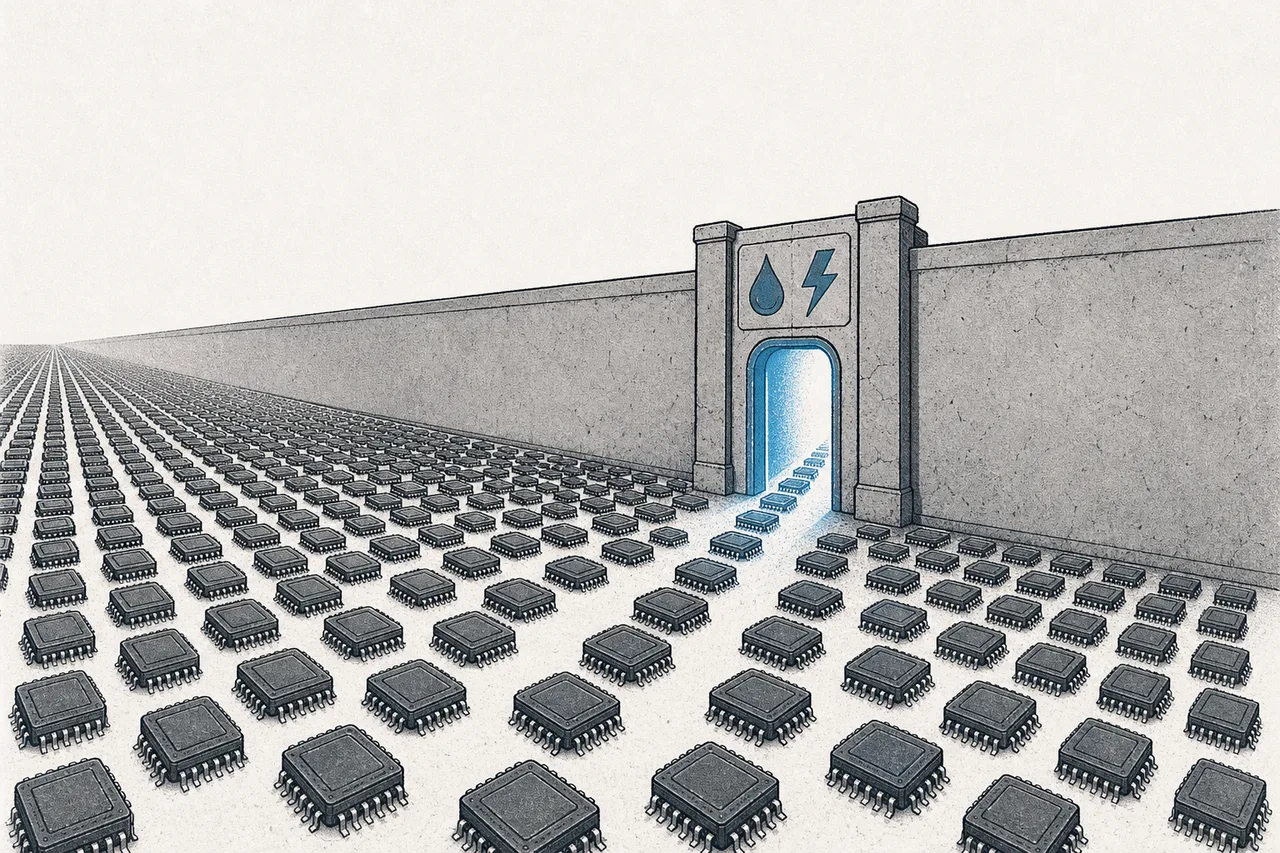
The number that best tells the momentum is Vertiv's book-to-bill (new orders ÷ deliveries), which ran about 2.9× in Q4 2025 — meaning for every $1 shipped out, $2.90 of new orders came in. Demand is growing far faster than capacity can catch up.
This market is concentrated in just a few hands. On the cooling side, Vertiv and Schneider Electric are nearly tied for first (about 0.1% apart, per Dell'Oro), and the top 5 hold about 35% of the market. On the electrical-gear side, Eaton, ABB, and Schneider are the core, joined by specialists like nVent, Boyd, and Munters in cooling connections and thermal management.
07The road ahead
The first direction is clear: water cooling becomes the standard, not an option. Once the Rubin chips that draw 2,000+ watts have no air-cooled version to choose from, every new AI data center will be designed for liquid from the start — and the old air-cooled ones will need major renovations, opening a big 'upgrade' market.
The second direction is the race at 1 megawatt per rack and 800V. When Rubin Ultra arrives in 2027, the whole power architecture changes. Whoever sets the standard and ships 800V first gains a huge edge — and this pulls demand all the way down to the power semiconductor (SiC/GaN) makers a layer deeper.
The third direction is heat reuse. When a data center pulls heat out with water, that warm water is starting to be used to heat nearby buildings or communities in some countries — turning 'waste' (heat) into a resource. It's still small but will grow under energy and environmental pressure.
08Challenges & risks
The first risk is dependence on the AI investment cycle. This group's hot demand is tied directly to the money the tech giants pour into building data centers (capex). If AI investment slows one day, or enters an 'overbuilt' phase, today's beautiful backlog could shrink fast — this group rides the boom up hard, and it can fall just as hard.
The second risk is power and the grid as the real ceiling. No matter how fast you make the gear, if the local grid can't supply enough power, the data center can't be built — this is out of the hands of the players in this chapter and ties directly to Energy. In many regions, waiting for a grid connection has become a bigger drag than waiting for equipment.
The third risk is unsettled standards and installation complexity. Water and electricity sitting close together means 'no leaks, no shorts' has to be done perfectly. The shift to liquid and 800V needs specialized technicians and services that are still in short supply. And if NVIDIA's standard changes, makers who've already invested in production lines have to adapt — the speed of technology change is both an opportunity and a risk.
In short: the AI story we hear usually stops at 'the chips got smarter.' But the truth is that smarter chips run hotter and hungrier for power until the old life-support system can't keep up. Whoever can solve the pipes, the wires, and the heat is the one who actually unlocks AI's continued growth — and that turned the once-most-boring piece in the data center into one of the most important bottlenecks of the era.