Megatrend · Artificial Intelligence
The biggest factory in history, built to 'think'
The AI you chat with every day doesn't float in a cloud — it sits inside concrete buildings the size of several football fields, drawing as much power as a whole city. This lesson takes you to AI's 'physical body': the race to build gigawatt-scale data centers that's become the largest construction in human history — and why 'electricity,' not chips, has turned out to be the real bottleneck.
01What it is (and how it differs from old data centers)
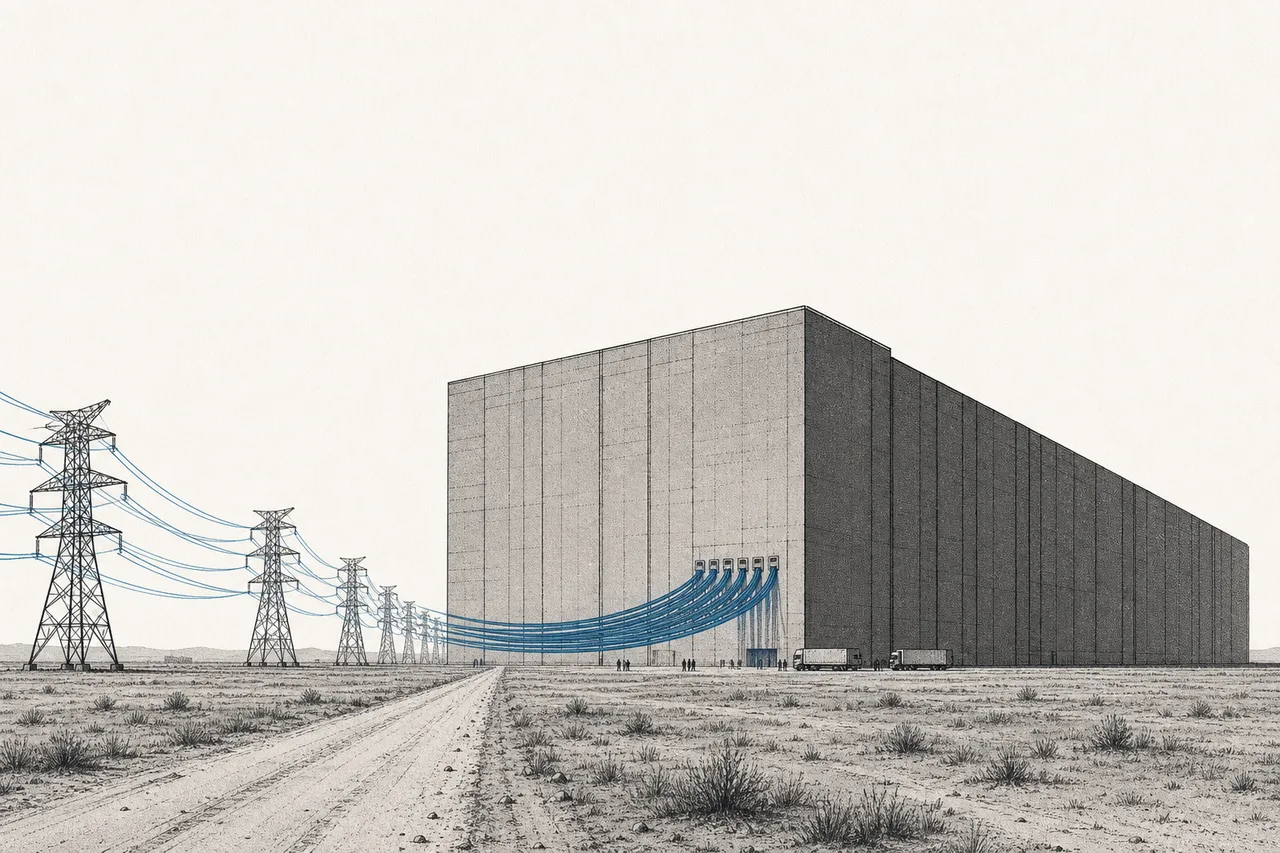
When you type to an AI and it answers, we tend to imagine it happening in the 'cloud' — a word that sounds as light as vapor. The truth is the exact opposite. That answer is computed inside concrete buildings weighing hundreds of thousands of tons, larger than dozens of football fields, drawing enough power to run a mid-sized city. This node is about actually building those buildings — from buying the land, pulling in the power, and pouring the concrete, all the way to lifting server racks in and installing them.
People in the industry have stopped calling them 'data centers' and started calling them 'AI factories', because they're nothing like the old kind. The data center of an earlier era (holding email, websites, company files) was like a 'warehouse' — about space and reliability. An AI factory is more like a 'steel mill' — it takes in raw material (enormous amounts of electricity) and produces output (tokens, the units of an AI's answer), at a heat and density so high the whole building has to be redesigned.
The biggest difference comes down to one number: power density per rack. A typical server rack (a cabinet about a person tall) in an old data center drew around 5–10 kilowatts. In the AI era, a server packed with GPUs jumped to 40 kilowatts, and the latest GB200 NVL72 rack from NVIDIA draws 132 kilowatts in a single cabinet — more than 10× the old level. That's why everything inside the building has to be built new.
Rack = a standardized cabinet that holds servers stacked in layers · Power density = the electricity one rack draws per cabinet. The higher it is, the hotter it runs and the harder it is to cool. Past about 30 kilowatts per rack, blowing air with fans can't keep up anymore — you have to switch to liquid cooling, pumping coolant right up against the chip. This is the line between the old data center and the AI factory.
On the megatrend map, this node is a sub-theme of Artificial Intelligence, and it's the 'physical layer' at the very bottom — if the AI chip is the brain, this node is the body and bones that wrap around and feed that brain. Without this body, even the most brilliant chip is just a sheet of silicon that won't switch on.
02Why it's the biggest construction in history
'Biggest in history' sounds like hype, but the numbers actually back it up. In 2025 the four big tech giants (Microsoft, Google, Amazon, Meta) spent a combined over $380 billion in capital expenditure (capex), most of it on building AI data centers. By 2026 that figure jumps to ~$630 billion, up more than 60% in a single year. NVIDIA CEO Jensen Huang calls it exactly what it is: 'the largest infrastructure build-out in human history.'
And that still doesn't count the most famous project of all — Stargate, the joint venture of OpenAI, Oracle, SoftBank, and MGX that has pledged $500 billion to build 10 gigawatts of AI power in the US by 2029. By late 2025 the project had nearly 7 gigawatts of sites planned and over $400 billion committed, with its flagship site in Abilene, Texas the first to go live.
Looking further out, McKinsey estimates the world will need $6.7 trillion in data center investment by 2030, about 70% of it because of AI. Goldman Sachs expects the four giants alone to spend a combined $5.3 trillion over 2025–2030. Figures at this scale are comparable to building a country's railroads, power grid, or highways in an earlier age — but compressed into just a few years.
The next question is, 'So why build so much yourself?' The answer is that large AI is hungry for compute with no ceiling. The smarter the model, the more chips it takes to train and serve. And every chip needs a 'home' with power, cooling, and a high-speed network connecting them all. Building these homes has become the arena where money is flowing in harder than anywhere else in business right now.
03How it's built — the construction stack
Building an AI factory doesn't start with the 'servers,' the way many people think. It starts with electricity. Picture the build as layers stacked one on top of another, where each layer has to finish before the next can begin — and one layer is the bottleneck for the whole thing.
Layer by layer: (1) Land — you need a large plot, hundreds of acres, near high-voltage lines, fiber, and water (for cooling). (2) Electricity — apply to connect to the grid, build a substation, install transformers. This is the slowest and most important layer. (3) The building (shell) — pour concrete, set the structure, and crucially, run the liquid-cooling plumbing. (4) Racks and servers — lift GPUs into the cabinets, connect power and coolant lines. (5) Network — run high-speed cabling so tens of thousands of GPUs can talk to each other as if they were a single chip.
The key thing to remember: every layer can be sped up except the electricity layer. Pouring concrete or buying GPUs — you can buy speed with money. But pulling hundreds of megawatts into the site means waiting on the utility to approve, build transmission lines, and manufacture transformers — all of it 'the real world's physical stuff that money can't buy time for.'
04The 3 pieces of the build-out
Break it down, and building an AI factory comes from three clearly different businesses that work together like a construction crew with different jobs:
- Colocation & Hyperscale REITs — 'the landlords who lease out space': companies that own the buildings themselves and sell or lease space — power and network included — for others to put their servers in. Many are listed as REITs (real estate investment trusts), because at heart the business is real estate with long-running rental cash flow. Examples are Equinix and Digital Realty, which are a direct bridge to the Cloud & Digital Infrastructure trend
- AI Server OEM & System Integration — 'the assemblers': companies that take GPU chips, assemble them into servers, and build out whole racks with cooling built in, delivered as 'ready-made racks' you can plug in and use right away. Examples are Dell, Supermicro, and Foxconn
- Build-out, Construction & Engineering — 'the contractors and tradespeople': construction firms, electricians, cooling-system technicians, and the makers of the power/cooling equipment that actually do the building. Examples are Comfort Systems (mechanical systems), United Rentals (construction-equipment rental), and equipment makers like Vertiv and Eaton
What's interesting is that value and profit aren't split evenly across these three groups. The group selling 'what's scarce and hard to make' — especially power gear and high-density cooling — has the most pricing power right now. Meanwhile server assembly, where many companies compete, runs on thinner margins. You'll see this picture more clearly in the players chapter.
05What it connects to in the AI ecosystem
This node is 'the point where AI touches the physical ground.' So it connects densely to other trends — both pulling things in and pushing demand out:
- Has to be filled with AI compute & chips: an empty building is worthless without GPUs in it. Build-out and chips are inseparable partners — the building is the 'house,' the chips are the 'residents'
- Has AI Power & Cooling at its heart: this is the closest sibling — power and cooling are what make the building actually work (this lesson is about 'building the building'; that sibling node goes deep on 'keeping it cool and powered')
- Pushes enormous demand onto energy and electricity: AI factories have become the world's biggest new electricity customer, sparking a whole new round of investment in power plants — gas, nuclear, and renewables
- Grew out of Cloud & digital infrastructure: the existing cloud providers are the biggest builders and renters of AI factories, and new players like Neoclouds exist purely to rent and build AI compute
- Depends on raw materials and the supply chain: copper for wiring, steel for structure, and transformers that can only be made in limited quantities — which makes build-out sensitive to tightness in the global supply chain
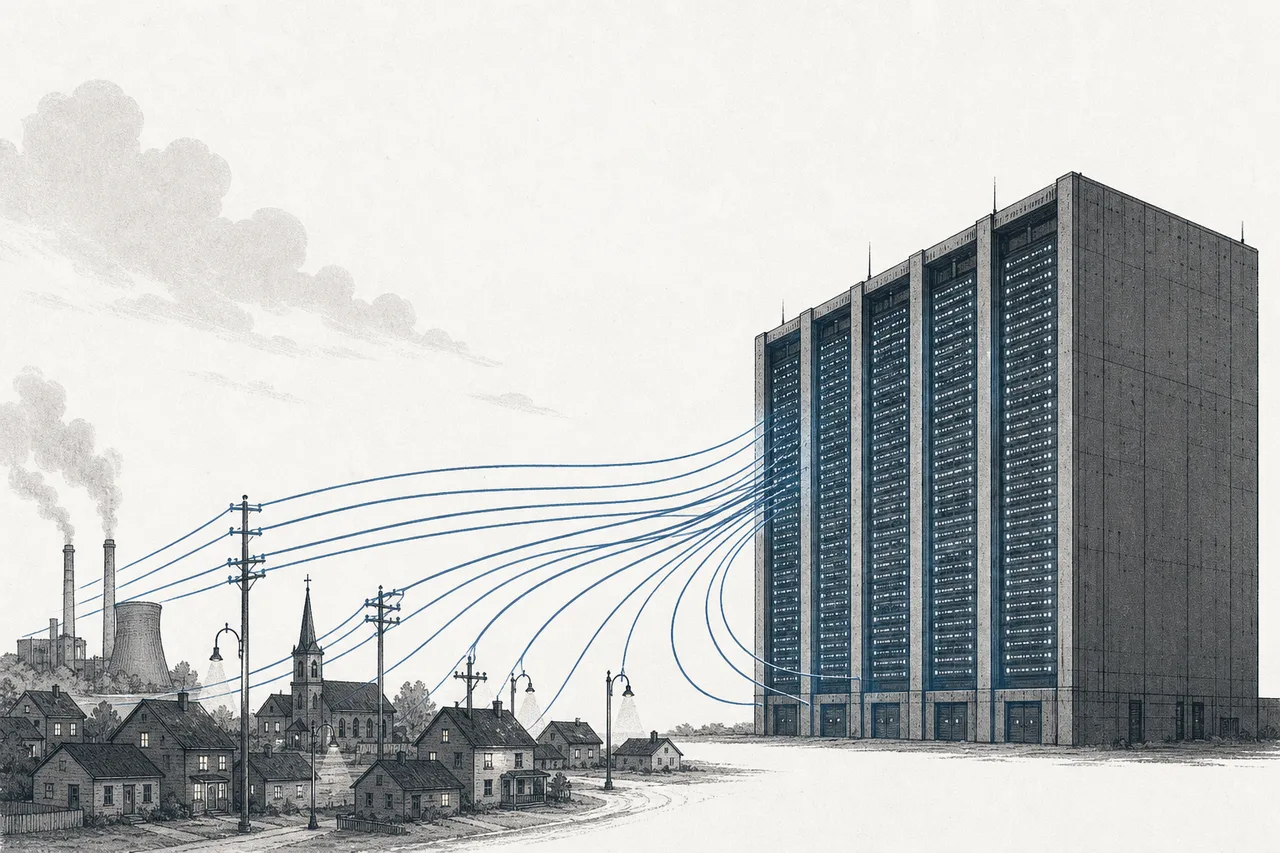
The relationship worth highlighting is with energy — a 'child growing faster than its parents' kind of bond. In the US, data centers drew about 4–5% of the country's electricity in 2024, but many forecasts see that jumping to 9–17% by 2030, nearly 3×. Power demand at this level is upending the whole country's plans for building power plants, and it's why the build-out trend and the energy trend are bound so tightly together.
06Where it stands now
We're in the 'building flat-out' phase. By late 2025 there was more than 23 gigawatts of data center capacity under construction worldwide, about three-quarters of it in the US. To picture it: 1 gigawatt is enough power for about 750,000 homes — and that's the power now being poured into 'AI brains' instead.
Construction costs are enormous too. An old-style data center was built at about $10–12 million per megawatt, but an AI factory — which has to support high-density racks and liquid cooling — runs to $30–40 million per megawatt once you add in the GPUs. Put another way, a single 1-gigawatt AI factory takes about $38 billion in investment — the equivalent of building several international airports.
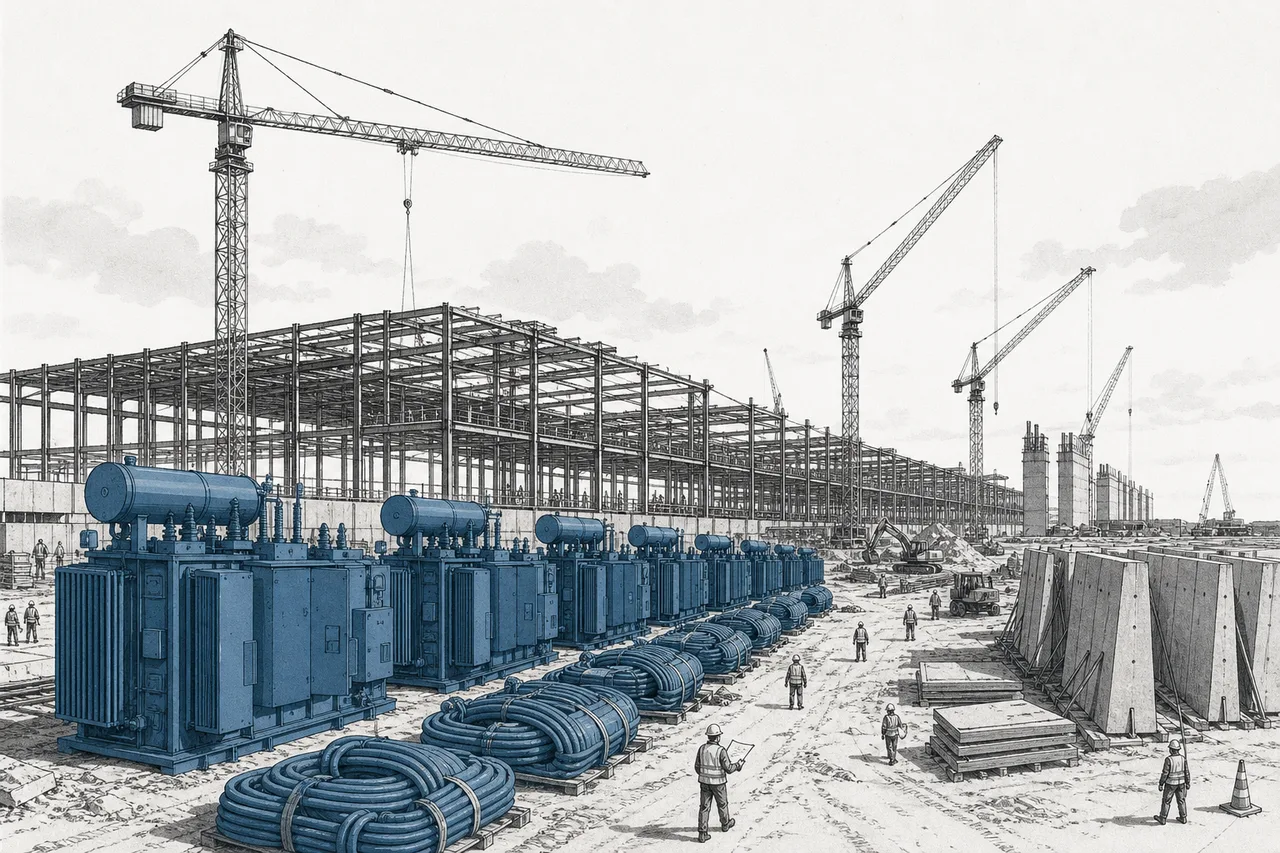
But the tightest spot in 2025–2026 isn't money or chips — it's 'physical stuff that can't be made fast enough.' High-voltage transformers now take roughly 2 years or more to deliver. Medium-voltage switchgear takes 22 months, and key equipment takes ~33 months on average. The queue to connect to the grid is long too — utility AEP, for example, has 190 gigawatts of connection requests in its raw queue. No wonder many projects are starting to build their own power plants right next to the site to skip the line.
The result of this tightness is that scarce power/cooling gear — like Vertiv and Eaton — has become a standout (a deep dive in AI Power & Cooling). On the building-owner side, two REIT giants — Equinix and Digital Realty — dominate at record-low vacancy. On the assembly side, the AI-server market of about $245 billion in 2025 is led by Dell and Taiwanese ODMs like Foxconn (deep dives in three sub-chapters: Colocation & Hyperscale REITs · AI Server OEM · Build-out & Construction).
Another big shift is 'who owns it.' AI compute is no longer concentrated only in the big tech giants. New players in the neocloud group, like CoreWeave, have exploded — planning to spend $30–35 billion on data center build-out in 2026 alone, while the neocloud group's combined revenue passed $23 billion in 2025. And don't forget: many of the real builders and owners are still private companies not on the stock market. So most of the players you can invest in are on the 'selling picks and shovels' side — equipment, contractors, and property owners — rather than the AI-factory owners themselves.
07The road ahead
The first direction is clear: the scale grows so large the unit changes. A few years ago we talked about data centers in 'megawatts.' Today we talk in 'gigawatts' (1,000×), and projects like Stargate are targeting several gigawatts per campus. This leap in scale means whoever locks up land + power + the equipment supply chain first gains an enormous edge.
The second direction is going to find your own power. Because the public grid has long queues, builders are starting to pair AI factories directly with their own power plants — natural gas, solar-plus-batteries, and the hottest of all, small nuclear (SMR). The line between 'tech company' and 'energy company' is blurring by the day — this is where build-out fuses inseparably with the energy trend.
The third direction is liquid cooling becoming the standard. When a new-generation rack draws 130+ kilowatts, air cooling is over. Every new design has to lay in coolant plumbing from the start. The liquid-cooling market is growing fast — 25–40% a year, roughly double the growth rate of data centers overall — and it's a new profit arena that players are racing to enter.
08Challenges & risks
A build-out this fast and this big comes with risks just as large.
The first risk, and the most debated, is 'overbuild.' Trillion-dollar investment rests on the assumption that AI demand keeps growing for years to come. If demand slows, or new-generation AI models use chips so much more efficiently that they need less capacity, the world could end up with AI factories running below capacity — like the dot-com era's fiber-optic bubble, which laid so much cable it went unused for a decade. This worry is growing among investors as capex climbs faster than AI's actual revenue.
The second risk is electricity and the grid. This is the real bottleneck — if you can't pull power, a finished building is just an empty concrete box. Demand set to reach 9–17% of the whole country's electricity by 2030 is creating tension with other power users — there are worries that household electricity bills could rise, and local politics is starting to push back on data centers that 'take the community's power and water.' This is a risk that lives off the balance sheet — on the power poles and in local politics.
The third risk is supply-chain delays. When transformers take ~2 years or more and key equipment averages 33 months, a beautifully planned project can stall because 'the parts don't arrive.' Relying on scarce goods also drives costs up and pushes schedules back, hitting the whole chain from owners down to contractors.
In short: the next time you talk to an AI and get an answer in an instant, picture what's behind it — concrete buildings the size of a city, dozens of cranes, transformers that take years to make, high-voltage lines run across state lines, and coolant pipes pressed against hundreds of thousands of AI chips. AI may look like magic on a screen, but behind it is the largest physical construction humans have ever undertaken — and we're only at the very beginning.