Megatrend · Artificial Intelligence
The chips that 'think for us' — and the one company holding the tap of the AI era
Every ChatGPT answer, every image AI draws, every model that gets trained runs through just a few special kinds of chip — and this market is dominated, almost completely, by a single company. Its 'moat' isn't built from the chip itself, but from software. This lesson walks through why matrix multiplication changed the world, how a GPU differs from a custom chip (ASIC), and why every tech giant is starting to design its own chip to escape the market leader.
01What it is (the chip that 'thinks')
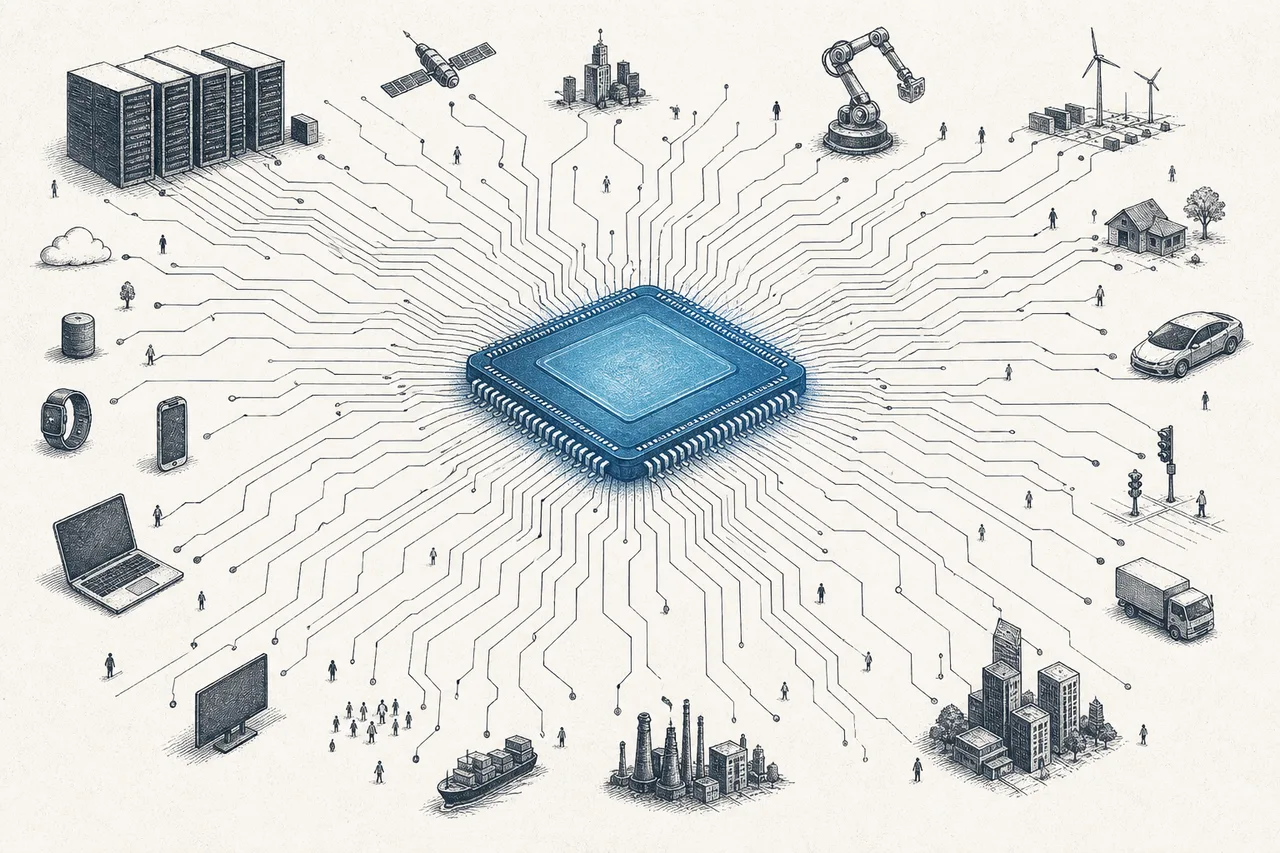
When you type a question into ChatGPT and get an answer back in seconds, behind it a huge number of chips are crunching numbers literally trillions of times. This node is about the 'silicon' that does that work — chips designed specifically to train and run (inference) AI models.
The word 'accelerator' matters a lot, because these chips don't replace the CPU, the main brain of a computer. They act as a 'special helper' that's hundreds of times better at one particular job — large matrix multiplication, which is the heart of every AI (we'll dig in deep in chapter 3).
On the megatrend map, this node is a sub-theme under Artificial Intelligence, and its definition says it plainly — it's the most supply-constrained layer of the whole trend. Put simply: no matter how brilliant your AI idea is, without chips you can't do anything.
CPU = the general-purpose brain — it can do anything, but one thing at a time · GPU (Graphics Processing Unit) = a chip with thousands of tiny cores that work in parallel; originally designed to render game graphics, but it happened to be perfect for AI · ASIC (Application-Specific Integrated Circuit) = a 'custom-built' chip designed for just one job, so it's faster and more power-efficient at that job but can't do anything else — Google's TPU and Amazon's Trainium are ASICs.
This node is broader than you'd think. It spans data-center GPUs (GPU & Merchant Accelerators), the tech giants' custom chips (Custom Silicon / ASIC), chips built specifically to run models (Inference-Optimized Silicon), the special HBM memory (HBM & AI Memory), all the way to AI chips in mobile devices (Edge & On-device AI Silicon) — this lesson threads them all together.
02Why it is the most supply-constrained layer of the AI era
The first reason is the sheer scale of the money. In fiscal 2026 NVIDIA's revenue hit $215.9 billion, up 65%. Its data-center chip business alone topped $200 billion — up from $115.2 billion the year before. This isn't ordinary company growth; it's one company pulling in the world's AI investment as a single main stream.
The second reason is that this market is ballooning. The AI accelerator chip market was around $140 billion in 2024, and many analysts expect it to grow past $400–600 billion by 2030–2033, at roughly 16–25% a year. Some (Bloomberg Intelligence) even see accelerators alone topping $600 billion by 2033 — and counting the whole stack (memory, networking, CPU) it could reach ~$1.7 trillion.
The third reason is that 'shortage' is no exaggeration. NVIDIA has booked out nearly all of its new Blackwell (B200) chip capacity through mid-2026, allocating it first to big customers like Microsoft, Google, Amazon, and Meta. The bottleneck isn't demand — it's production capacity, especially the advanced packaging step (CoWoS) that bonds HBM to the GPU.
03How it works — matrix multiplication, and why it has to be a GPU
To understand everything in this lesson, you need one fact: almost all of AI, underneath, is 'matrix multiplication' — taking two big tables of numbers and multiplying them, over and over, billions of times. A large language model with trillions of parameters is, at its core, a giant pile of matrices being multiplied without rest.
Here's where the magic is: matrix multiplication 'breaks into small pieces that can be computed at the same time' — each cell of the result can be computed separately, without waiting on the others. That's why a CPU, with few cores that do one thing fast, can't keep up — while a GPU, with thousands to tens of thousands of tiny cores, can split the multiplication into small pieces and charge through them all at once.
But this opens a second option too: if the job really is just matrix multiplication, why not design a chip that does only that job, as well as possible? This is the idea of the ASIC — a custom-built chip. A GPU is good at many things (flexibility is its strength), but an ASIC like Google's TPU strips out everything unnecessary and leaves only a giant matrix-multiply unit. The result: on the job it was designed for, it's usually cheaper and more power-efficient per computation — at the cost of not doing anything else, and being harder to develop.
No matter how fast an AI chip is, it's worthless if you can't 'feed it data' fast enough. So every one of them relies on a special memory called HBM (High Bandwidth Memory), stacked vertically and placed right beside the chip — NVIDIA's Blackwell, for example, uses HBM3E 192GB at 8 TB/s of bandwidth. This is exactly where this node meets HBM & AI Memory — and the HBM bottleneck is the bottleneck of the whole AI chip industry.
04Training vs running — a battlefield changing hands
AI chips work in two very different modes, and the difference is shaping the future of the whole industry.
- Training: teaching a model once, on a huge scale — it eats enormous power and needs tens of thousands of GPUs wired together for months. It's complex, flexible, and very tightly bound to NVIDIA's software
- Inference (running it): taking the trained model and 'running' it to answer real questions — happening millions of times a day, every time someone types a query. It's repetitive and predictable, so it suits cheaper custom chips
The turning point is this: as AI spreads, real-world use (inference) keeps outweighing training. And this is the weakest point of NVIDIA's moat, because the moat — called CUDA — was built mainly for 'training.' As the world tilts toward inference, the need to lean on CUDA loosens — opening a gap for the tech giants' ASICs and inference-specific chips (Inference-Optimized Silicon) to slip in.
CUDA is NVIDIA's software suite that lets developers command a GPU. The scary part: nearly every AI library and framework in the world is tuned to run on CUDA, and millions of developers have spent whole careers learning it. So switching to another brand's chip is expensive and time-consuming enough that it's rarely worth it — this is NVIDIA's real moat, the reason a rival with an equally good chip still struggles to win customers.
The economic logic is dead simple: if Google's, Amazon's, or Microsoft's custom chips can do inference at about 80% of a GPU's performance but at roughly 40% lower total cost (TCO), these giants have a huge incentive to move their own internal inference off NVIDIA — and that's exactly what's happening.
05How it connects in the ecosystem
The AI chip layer doesn't float alone — it's the point where several big trends meet:
- The foundation of all of AI: models, apps, and AI agents — everything in the layers above sits on top of this chip layer. If chips run short, the whole trend stalls
- Meets Semiconductors across the board: AI chips are the chip industry's biggest customer, spanning compute (Logic), memory (Memory / HBM), and manufacturing (Foundry) — TSMC makes nearly all the most advanced AI chips
- Draws power from Energy Transition & Power: AI data centers eat so much electricity they've become a major driver of global power demand — this node 'drives demand' for energy directly
- Depends on Critical Materials: high-quality silicon wafers, specialty chemicals, and rare materials are indispensable raw inputs
- Starts with design software (EDA & IP): before any chip exists, every design passes through the design software (EDA) of Synopsys/Cadence and IP blocks like Arm's cores — the upstream layer that collects a toll from every camp (see EDA & Semiconductor IP)
- Not just in the data center: not every AI chip runs in a data center — the NPUs in phones, PCs, and cars run inference on-device for speed and privacy (see Edge & On-device AI Silicon)
- Unlocks other trends: AI chips 'enable' Robotics, Biotech, and Cybersecurity — they're the infrastructure other trends stand on
From a value-chain view, this node is the 'bottleneck' where power is most concentrated, because it bundles three hard layers together — chip design (where NVIDIA leads), manufacturing (where TSMC monopolizes the cutting edge), and HBM memory (made by just 3 companies). Anyone who wants to compete has to break through all three gates at once.
06Where it stands now + the real players
The picture today is 'one giant + an army of challengers.' NVIDIA still held about 80–90% of the AI accelerator market by revenue in 2024–2025 (it touched ~90% in 2024). But analysts expect its share to slip gradually to ~75% by 2026 — not because NVIDIA is growing slower, but because the whole pie is growing faster than any one company can eat it.
The difference that tells the story most clearly is margins. In the quarter ending October 2025, NVIDIA's gross margin was about 73%, while AMD — the #2 rival — was around 50%. That gap is the 'CUDA moat toll' NVIDIA collects — and the reason every tech giant wants to design its own chip to dodge it.
The custom-chip side's pursuit is gaining real weight: Broadcom and Marvell handle almost all the ASIC design for the tech giants, together holding about 80–95% of this market, and custom-chip orders are surging (who's ordering how much from whom is in that node's own lesson).
07The road ahead
The first direction is the shift toward inference. As AI gets embedded in every app and device, 'running' models will keep eating more compute than 'training' them — a battlefield where custom and specialized chips have the cost advantage. This is the gap that will erode NVIDIA's share (but not its leadership) bit by bit.
The second direction is every tech giant will have its own chip. Google, Amazon, Microsoft, Meta, and OpenAI are all pouring money into ASICs through Broadcom/Marvell to reduce their NVIDIA dependence and control their own cloud costs — shifting the landscape from 'everyone buys from NVIDIA' to 'your biggest customers become your competitors too.'
The third direction is AI chips moving to the edge. Not every AI job needs to run in a data center — phones, cars, and IoT devices are starting to carry AI chips of their own (Edge & On-device AI Silicon) for speed, privacy, and cloud-cost savings — opening a new market where mobile players like Qualcomm and Apple have the edge.
The fourth direction is the bottleneck moving. Today the bottleneck is HBM and packaging (CoWoS); tomorrow it may move to power and cooling — because AI data centers eat so much electricity they're starting to hit the limits of the power grid. Whoever solves the next bottleneck first gains the advantage.
08Challenges & risks
The appeal of the AI chip layer comes with risks all its own.
The first risk is extreme concentration. Enormous value is tied to just a few companies — NVIDIA on design, TSMC on manufacturing, and just 3 HBM makers. If any one point stumbles (disaster, geopolitics, or technical), the whole chain shakes. And because the most advanced manufacturing is concentrated in Taiwan, geopolitical risk is far from remote.
The second risk is the CUDA moat may not be as wide as it was. As long as the job is training, CUDA stays sticky — but as the world shifts to inference, the dependence on CUDA loosens. If the tech giants' custom chips work well enough at a much lower cost, the leader's 73% margins and its share could be squeezed — the chip industry's lesson is that 'today's leader can fall by missing a single technology wave.'
The third risk is the cycle and 'bubble' question. AI chip demand is so strong right now because the tech giants are pouring in enormous capex all at once. If AI's payoff comes slower than hoped, or investment slows, the demand that looks bottomless could shrink fast — because most of it comes from the same few deep-pocketed customers.
In short: AI accelerators are the 'tap' that can genuinely turn the AI era on and off. Today one company holds that tap, more through software than the chip itself. But the field is shifting — as the world moves from 'training' to 'real-world use' and the biggest customers start building their own chips. Understand this layer and you understand why it's both the heart and the bottleneck of the entire AI economy.