Megatrend · Defense & Geopolitical Fragmentation
The shells are getting made. What can't keep up is the "filling" packed inside them
When the world rushed to build more factories stamping out 155mm artillery shells, most people thought the problem was steel and lathes. But the real bottleneck the Ukraine war exposed isn't the empty "shell" — it's the propellant and explosives (energetics) packed inside, made in chemical plants the West has let dwindle to a shockingly small number. This is the story of the "dumb" shell that became the most fragile point in global security.
01What it is
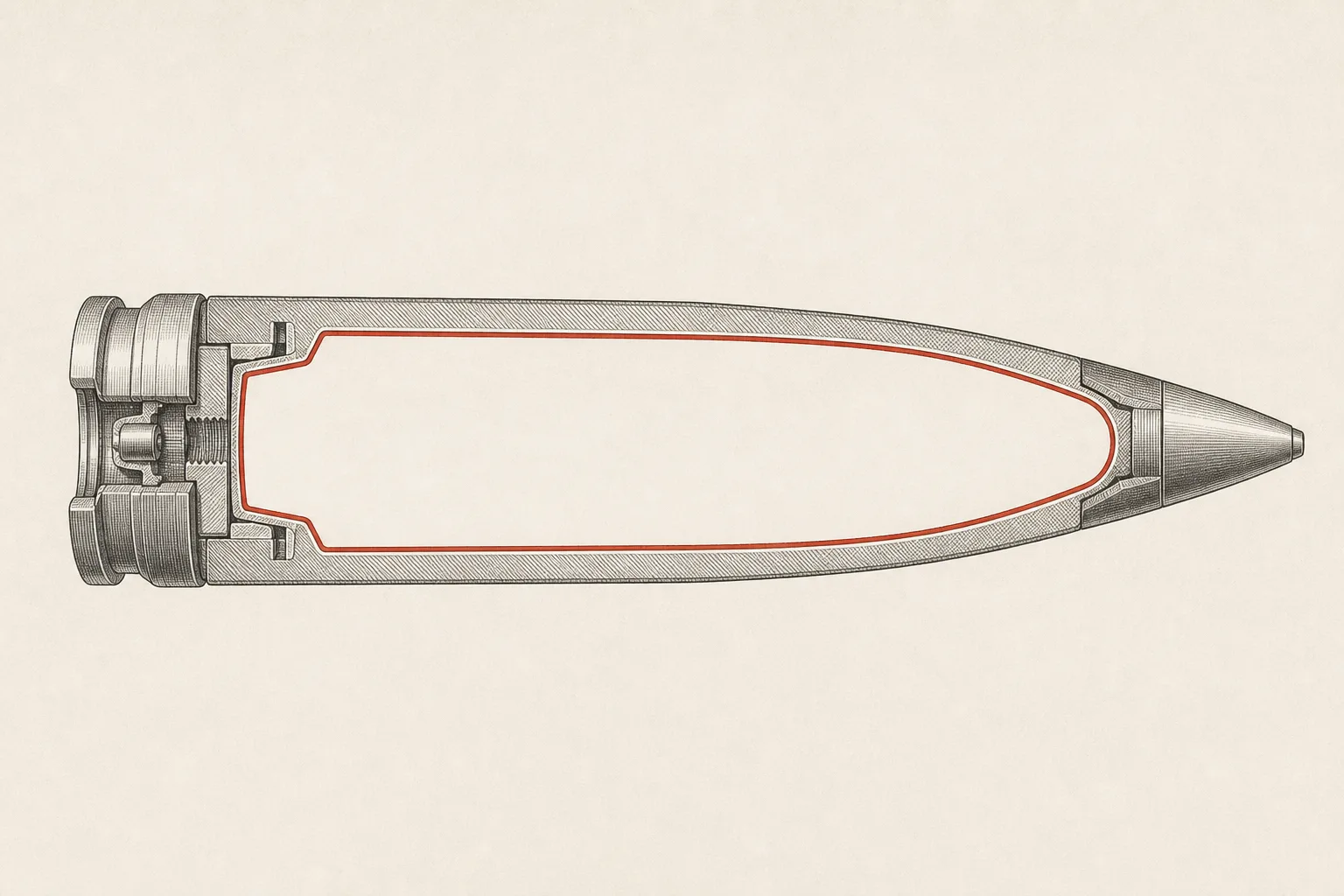
Picture a single 155mm artillery shell — a steel cylinder weighing around 45 kilograms, about calf-high. It looks very "plain": no screen, no chip, no guidance system of any kind. In a world of weapons full of smart missiles costing hundreds of millions a round, this is the most "dumb" thing there is — fired in an arc and falling wherever gravity takes it. But this node is about these dumb shells — and, more importantly, about the "thing packed inside" them.
A single shell really has two parts that have to "explode" at different moments. One is the propellant, ignited in the barrel to push the round tens of kilometers downrange. The other is the explosive in the warhead (like TNT) that detonates on impact. Together, these two chemical groups are called "energetics" — the real star hidden inside that ordinary steel shell.
Energetics = the group of chemicals that store enormous energy and release it very fast. They split roughly into two: propellant, which "burns" to create the pressure that pushes the round out of the barrel (made from smokeless powder built around nitrocellulose), and the explosive fill that "detonates" in the warhead, like TNT or newer formulas like IMX. All of this is the "filling" that turns a steel shell into a weapon. Without it, a shell is just an empty steel tube.
On the megatrend map, Ammunition & Energetics is the deepest branch (leaf) under Missiles, Munitions & Energetics within the big trend Defense & Geopolitical Fragmentation. It's the "raw-materials and consumables layer" at the very bottom of the entire defense industry. The key is to understand how it differs from its sibling next door, Missiles & Precision-Guided Munitions (missiles and guided weapons): a guided missile is "smart, expensive, few" — give it a brain and sensors to fly itself to the target. This node is "dumb, cheap, massive in number," made by the millions, and what decides life or death for it isn't smarts but "whether you can make it in time".
02Why it matters — the bottleneck is in the chemical plants, not the shell
Most people think: if Europe wants more shells, just build more steel-stamping plants — how hard can it be? The answer the Ukraine war exposed is — stamping out the steel shell isn't the problem at all. The problem is that there isn't enough "filling" to pack into it. And that's the heart of the whole node.
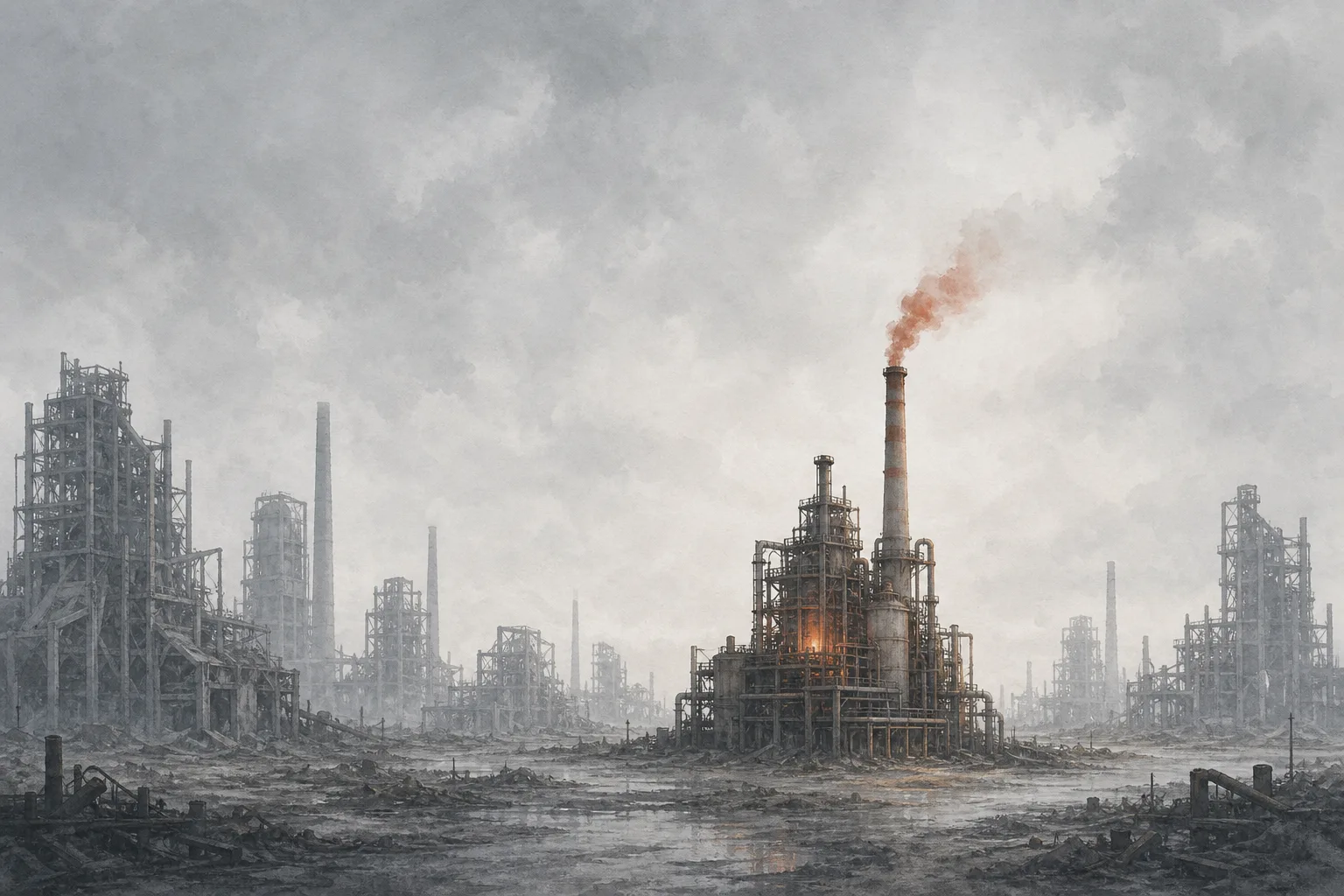
The most shocking number is in TNT. Europe, which had as many as 7 large TNT plants during the Cold War, now has only one main plant left — Nitro-Chem in Bydgoszcz, Poland, which makes about 10,000 tons of TNT a year, with all of its capacity already locked up under long-term contracts. That means even if someone places a new order today, there's almost no TNT left to give. Meanwhile Russia produces about 12 times more explosives than the whole of Europe combined.
The propellant side hits the same bottleneck. When the U.S. military tried to ramp "ready-to-fire" shell production to 100,000 rounds a month, the immediate constraint was the propelling charge, not the steel — because the U.S. can't make the grade of nitrocellulose it needs and has to import it from France, the Czech Republic, South Korea, and Canada. Europe needs about 20,000 tons of nitrocellulose a year but can only make about 4,500–10,000 itself — and its raw material is "cotton linters" (the short cotton fibers left over from the textile industry), which Europe imports more than 70% of from China.
What matters for investors is that this market is big and growing fast. The global artillery-shell market is around $5.6 billion in 2025 and is expected to reach ~$7.3 billion by 2030 (CAGR ~5.7%), with the "large caliber" segment the fastest-growing part of the whole ammunition market, at double-digit rates — because every country is "refilling its depleted stockpiles" at the same time.
03How it works (from chemical raw materials to a ready-to-fire round)
To understand why "the shell isn't the bottleneck, the filling is," the best way is to follow the real production line step by step. It runs as two parallel lines that meet at the end: one makes the steel shell, the other makes the chemicals (energetics).
Take the top line first: it starts with a bar of alloy steel (often grade 4140 or 4340), hot-forged at around 1,200°C into a hollow cylinder, then sent off to be machined, heat-treated, fitted with a driving band, and painted — heavy-metal work that's "hard but scalable" if you have the money and the machines. You can even convert a car-stamping plant to do it (Rheinmetall went so far as to turn an auto-parts factory in Berlin into one stamping out shell casings).
It's the bottom line that's the problem: nitrocellulose requires soaking cotton fibers in acid (nitration) and converting them into propellant, while TNT is a dangerous chemical process that releases toxic waste, needs environmental permits, and that nobody wants built near their home — these chemical plants take 3–5 years to build new and are a skill the West let atrophy for decades. Finally, in step 5, the two lines meet: the propellant and explosive are "packed" into the shell, a fuze and primer are added, and only then do you get a ready-to-fire round in step 6 — and the place where the whole line "stalls" is always the bottom line.
04Where it sits in the ecosystem
This node is the "foundation" that props up nearly every weapon — whether artillery, tanks, or even missiles, all need energetics as their filling. Here's how it connects to the rest of the defense universe:
- Critically dependent on Critical Materials & Supply Chain: this is the most fragile link, because the raw materials for propellant — cotton linters and chemical precursors — are more than 70% imported from China by Europe. Having the West's ammunition chain tie its filling to a strategic rival is the weakness every country is rushing to fix
- Different from its sibling Missiles & Precision-Guided Munitions: guided missiles are "smart and expensive," with high profit per unit but few in number, while this node is "cheap and massive," making money from volume and repeat orders. But both share energetics — a missile warhead needs explosive from the same line, so the bottleneck hits both
- Feeds the Defense Industrial Base: shells are a "consumable" you have to keep reordering once you fire them — unlike an aircraft or ship that sells once and lasts 30 years. It's a recurring-revenue model that keeps the whole production base "warmed up" at all times
- A root of the entire Defense & Geopolitical Fragmentation trend: the lesson from Ukraine is that a big war becomes a "war of factories" as much as a "war of battlefields" — and the most important factories are the ones making shells and propellant
05Where it stands now
The whole industry is in "full-throttle" mode. U.S. production of 155mm shells has moved from around 14,000 rounds/month before the war to ~40,000 rounds/month in 2025, with a target of 100,000 rounds/month — but that target slipped from 2025 to mid-2026, and the reason it slipped reflects everything in this lesson: making 100,000 rounds/month needs about 66,000 tons/month of explosives, which the West still can't make enough of itself. The bottleneck is exactly the "filling" we've been describing.
Europe is ramping just as hard. The EU set — and actually hit — a target of supplying 2 million artillery shells by the end of 2025 — but the point that exposed the weakness is that only about 25% came from Europe's own production base. The rest had to be ordered from outside the continent (mainly South Korea and South Africa), reflecting that domestic capacity still can't keep up with demand.
And the cost per round has surged with demand — a standard 155mm shell that cost around $2,000/round in 2022 climbed to $3,600 to over $8,000/round in 2024–2025, depending on spec and maker, reflecting both overflowing demand and the raw-material bottleneck.
The player that became the symbol of this era is Germany's Rheinmetall, targeting to raise shell-production capacity from ~70,000 rounds (2022) to ~1.1 million rounds/year by 2027 and ~1.5 million by 2030, with a new plant at Unterlüß able to stamp out up to 350,000 rounds/year. And most importantly — Rheinmetall isn't just making shells, it acquired a nitrocellulose maker (Hagedorn-NC) in 2025 to lock the filling in-house, showing the market leader understands the real value is in the bottleneck, not the steel.
06The road ahead
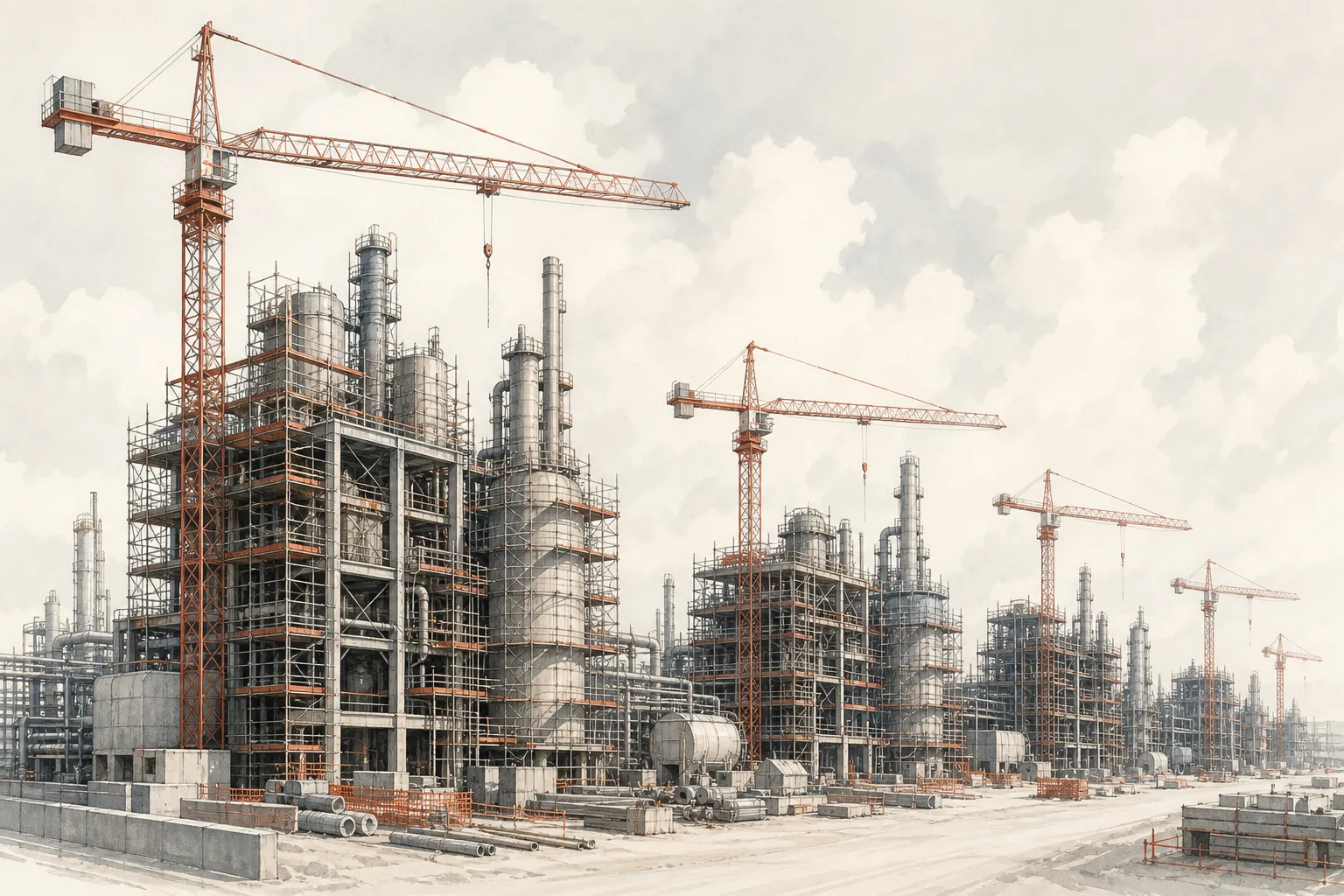
The first and most important direction is "rebuilding the filling at home" (energetics reshoring). Every country is pouring in huge money to build new TNT and propellant plants so it can stop relying on others — the U.S. has Repkon building a new TNT plant in Kentucky, Poland is expanding Nitro-Chem into a second site, France (Eurenco) is reviving its explosives plant at Bergerac, and there are startups like Swebal in Sweden raising money to build a new TNT plant. Reshoring this chemical supply chain will be the longest-running investment theme of this node, because chemical plants take years to build.
The second direction is diversifying raw-material sources and finding new formulas. Since cotton linters lean too heavily on China, the industry is looking for both other cotton sources and nitrocellulose made from wood pulp instead of cotton, plus newer explosive formulas like IMX that are safer than TNT and don't depend on the old chain — whoever develops a formula that "escapes the bottleneck" first gains an enormous strategic edge.
The third direction is the rise of Asian exporters, especially South Korea (Hanwha, Poongsan), which has become the West's reserve source of shells — with spare capacity, competitive prices, and fast delivery. South Korea is using the world's ammunition-stockpile crisis as a chance to climb into one of the world's major arms exporters.
07Challenges & risks
This seemingly hot trend has shadows you need to see in full.
The first risk is the energetics bottleneck possibly lasting longer than expected. Even if you order shells by the million, if the TNT and nitrocellulose plants aren't built yet (3–5 years to build, plus environmental-permit issues), actual capacity grows slower than the order numbers — the gap between "being able to order" and "being able to actually make" is the hidden risk, and the reason the U.S. target of 100,000 rounds/month has already slipped once.
The second risk is strategic dependence on China. As long as cotton linters and chemical precursors still come more than 70% from China, reshoring isn't really finished. If China restricts exports of these raw materials (as it has done with rare earths), the West's entire ammunition chain would be shaken instantly.
The third risk is the boom-and-bust cycle and the ESG issue. The ammunition business grows fast in conflict, but if a big war settles down, today's massive orders and factory-building investments could become overcapacity tomorrow — and specialized skilled labor (explosives chemistry) is hard to find and slow to rebuild. On top of that, many funds still have policies against investing in weapons, making this group's investor base narrower than usual (though lately many European funds have begun to relax that on security grounds).
In short: this node is a lesson that the "dumbest, most ordinary" thing on the battlefield turns out to be the most fragile point — because its heart isn't in the steel shell, but in a handful of chemical plants the West let atrophy for decades and is now racing to wake back up all over the world at once.