Megatrend · Defense & Geopolitical Fragmentation
When the world discovered its own ammunition stockpile was empty
Modern wars aren't won by how advanced your weapons are. They're won by who can keep firing longer. Ukraine and the Middle East just exposed a shocking truth: the West is burning through missiles and shells many times faster than it can build them. This is the story of an industry that became the bottleneck of global security.

01What is it?
When we say "weapons," we usually picture the big, expensive stuff — fighter jets, submarines. But those are really just the "gun." What gives them meaning is the "bullet" they fire. A fighter jet that costs billions is useless without missiles and bombs to carry. This node is about all the "ammunition" of modern warfare.
It splits into two very different worlds, which are the two sub-themes of this node:
- Missiles & Precision-Guided Munitions: the high-tech, expensive stuff (tens to hundreds of millions of dollars each), accurate enough to fly through a window — like the Tomahawk cruise missile or the Patriot anti-missile interceptor.
- Ammunition & Energetics: the "high-volume" stuff, like 155mm artillery shells — far cheaper per round, but needed by the millions — plus "energetics", the propellants and explosives that everything else starts from.
PGM (Precision-Guided Munition) = a guided weapon that "knows where it's going," with a guidance system built in — unlike a plain shell that just flies in an arc · Energetics = the family of chemicals that release enormous energy: propellant (which pushes a shell out of the barrel) and explosives (like TNT or RDX, packed into the warhead). They're the "raw materials" — without them, you can't make anything.
On the megatrend map, Missiles & Munitions sits under Defense & Geopolitical Fragmentation, and it's the deepest "supply-chain layer" of national defense — because no matter how modern an army is, in the end it can only fight as long as the ammunition in its magazine lasts.
02Why it became a big deal
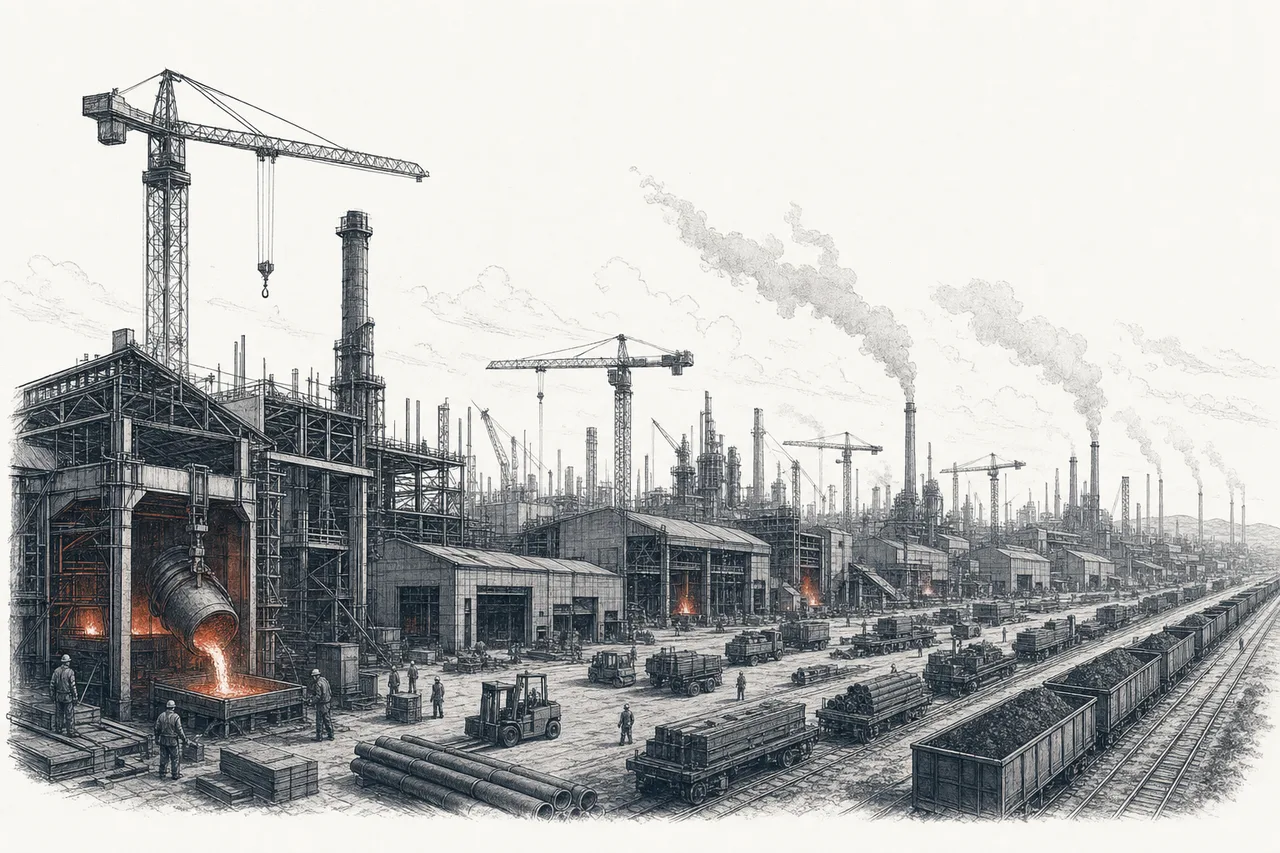
For decades after the Cold War, the West assumed big wars were over. So it slowly cut ammunition production, closed factories, and let stockpiles thin out. Then Ukraine erupted in 2022, the Middle East followed — and everyone hit the same realization: we're burning through ammunition many times faster than we can make it, and the stockpiles are running dry.
The most jarring number came from the US Navy, which fired over 850 Tomahawks during operations in the war with Iran (the most in history) — while it can only build about 100 a year. Someone summed it up sharply: "The Navy spent 30 years of stockpiled missiles in 15 months."
The result is a "rearmament supercycle." Around the world, countries are raising defense budgets and ordering ammunition in huge batches. Europe, which used to lean on the US, is starting to invest on its own; Germany declared a "turning point" (Zeitenwende); South Korea has become a major arms exporter.
You can see the scale of this wave in Rheinmetall, the German weapons firm that's become the symbol of this era — its order backlog hit a record €63.8 billion at the end of 2025 (up from €46.9 billion a year earlier), with 2026 sales expected to grow another 40–45%.
And this is only one slice of a large, growing market. The global precision-guided munitions (PGM) market alone was around $44 billion in 2025, and is expected to grow to ~$83 billion by 2035.
03Why production can't keep up
Everyone asks the same thing: "Just make more — how hard can it be?" The answer is it's much harder than it looks, and understanding why is understanding the heart of this whole node.
The first problem is what's called "magazine depth." In peacetime, nobody wants to pay to stockpile mountains of ammunition just sitting there (it's expensive and it has a shelf life), so factories make "just enough" on small production lines. When a real war hits, usage jumps a hundredfold overnight — but expanding a factory takes years.
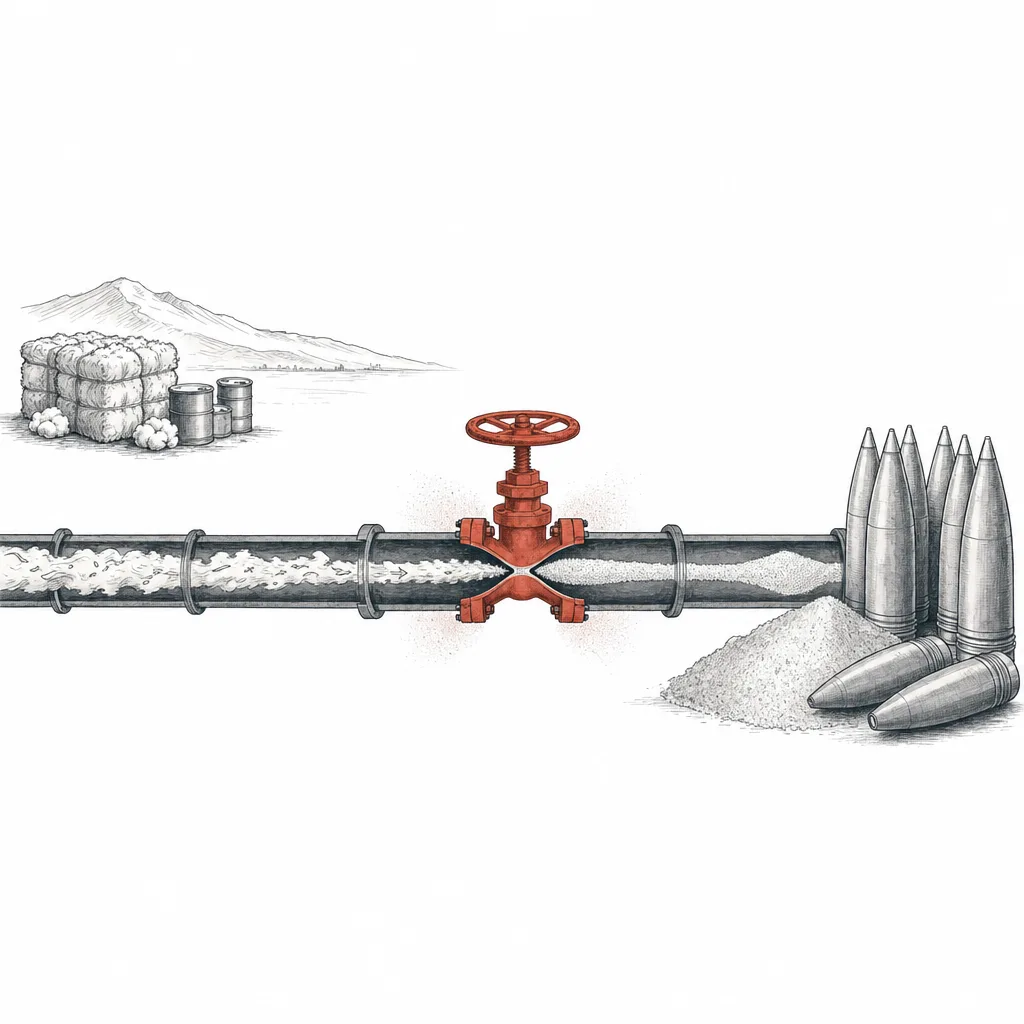
The second problem runs deeper, and outsiders barely know it: the "energetics" bottleneck. The guts — energetics (propellants and explosives) — are the real bottleneck, and they depend on China. So even if you want to make more shells, you hit the "inner core" you can't produce fast enough and rely on others for (we dig in deeper in the child lesson → Ammunition & Energetics).
The term strategists use for "the ability to keep fighting without running out of ammunition" — it's not just having good weapons, but having enough ammunition and producing it fast enough to fight a long campaign. The lesson from Ukraine: a big war is as much a "war of factories" as a "war of battlefields."
04How it connects in the ecosystem
This node is the "stomach" of the defense industry — it takes in raw materials from upstream and feeds "ammunition" to every platform downstream:
- depends critically on key raw materials: this is the most dangerous relationship, because energetics (nitrocellulose, precursor chemicals) depend on China. The West's ammunition chain being tied to a strategic rival is the vulnerability every country is now scrambling to fix.
- feeds the major defense primes: missiles and shells are "consumables" that generate repeat revenue for the big firms — unlike jets or ships sold once. It's a revenue model investors love.
- depends on AI: the "precision" in PGMs comes from guidance systems that increasingly use AI and sensors.
- competes with drones & unmanned systems (a sibling field): this is the most important game-changer — cheap drones are rewriting the entire equation of this node (more on that in "Where it stands now").
05Where it stands now
The whole industry is in "full-throttle" mode. US production of 155mm artillery shells has climbed from about 14,000 rounds/month before the war to ~40,000 rounds/month in 2025, with a target of 100,000 rounds/month (though the target slipped from late 2025 to mid-2026 because of the energetics bottleneck).
The missile side is ramping just as fast. After stockpiles ran dangerously low, the US is pouring budget into a step-change in capacity — for example, the Patriot PAC-3 interceptor aims to go from 600 to 2,000 units/year by 2030, and the Tomahawk from ~100 to as many as 1,000 units/year.
The artillery-shell side is running just as hot — a global market of about $5.6 billion (2025), growing double digits in large calibers, with Rheinmetall going so far as to buy a nitrocellulose maker to lock down its own "inner core" (see → Ammunition & Energetics).
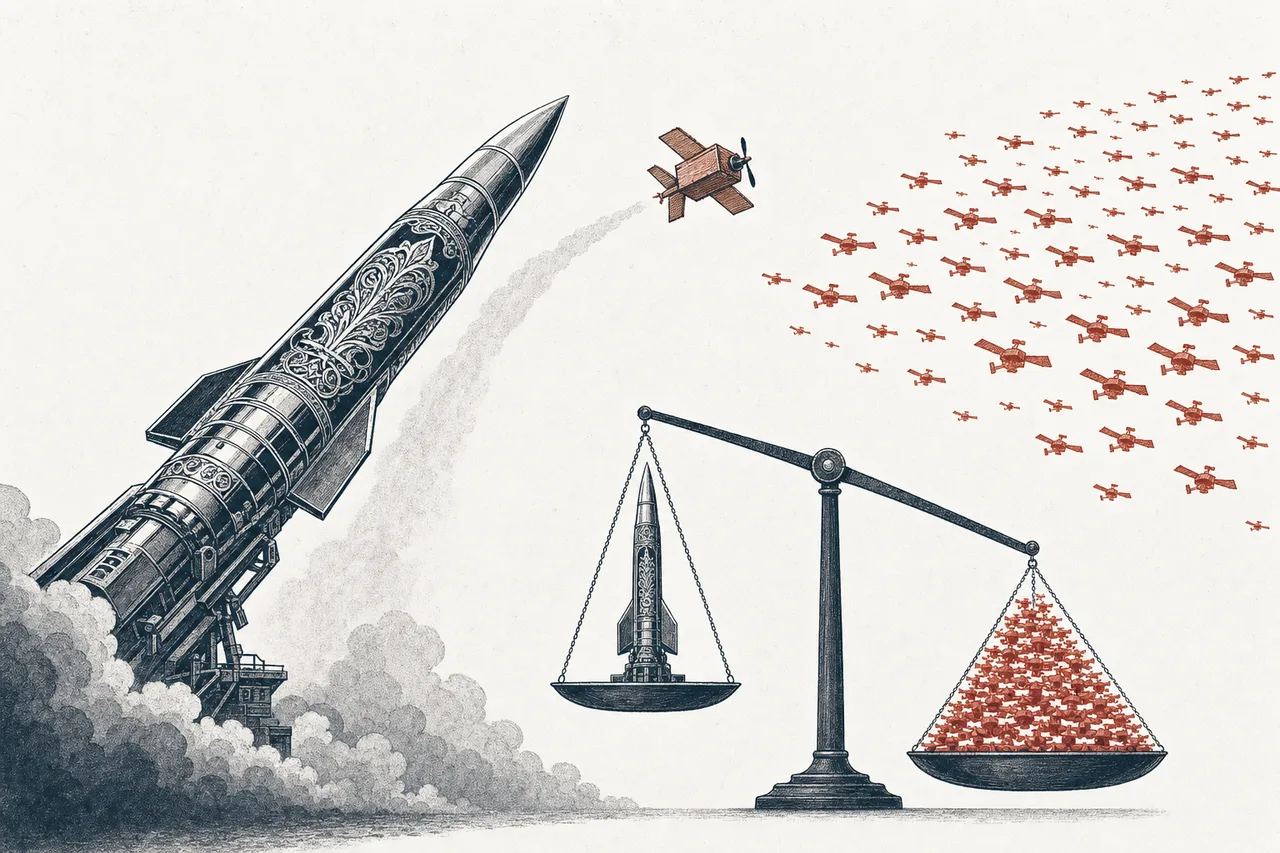
But what's shaking the whole industry the most is the "upside-down cost equation." In the Red Sea and the Iran war, militaries had to use $3–5 million interceptors (PAC-3) to shoot down drones that cost just ~$50,000 — a cost disadvantage of dozens to one. Even if you hit every shot, the defender goes "broke" before the attacker runs out of drones.
06The road ahead
The first direction is "solving the cost equation." Since you can't keep shooting cheap drones with expensive missiles, the answer is a new generation of defensive weapons with a far lower cost per shot — especially directed-energy weapons (lasers), where the cost per shot is just pennies, plus low-cost anti-aircraft guns. This will be a hot new money-maker.
The second direction is "cheap mass." Instead of a few advanced, expensive weapons, militaries are turning to making things cheap enough to be "used and thrown away" in large numbers — attack drones and loitering munitions costing a few hundred to a few thousand dollars are becoming the new ammunition of war.
The third direction is "reshoring production." Every country is racing to build its own energetics base to stop depending on China. BAE is developing a propellant that doesn't need nitrocellulose, while the US is investing in new TNT and propellant plants — reshoring the ammunition chain will be a major investment theme for years to come.
07Challenges & risks
This red-hot trend has shadows you need to see in full.
The first risk is the "cost trap" we've already covered — if the makers of expensive weapons can't keep up with the cheap-drone game, the value of some high-priced products could be called into question. The Ukrainian battlefield has proven that sometimes a drone the price of a motorcycle can destroy a tank worth hundreds of millions — a disruptive force that could change "what kinds of weapons are worth investing in."
The second risk is strategic dependence. As long as the energetics core is tied to China, the whole chain stays fragile. Reshoring is possible, but slow and expensive — and the gap between "being able to place an order" and "actually being able to produce" is the hidden risk.
The third risk is the cycle and the "peace" risk. Defense businesses boom in times of conflict, but if a big war winds down, today's massive orders could slow. There's also the ethics-and-ESG issue — many funds have policies against investing in weapons, which makes this sector's investor base narrower than usual (though lately several European funds have begun easing that on security grounds).
In short, this node is a lesson that security isn't measured by the most advanced weapon, but by "the ability to keep producing." The world just discovered that ammunition factories are the true front line — and that has triggered the biggest investment wave in this industry in decades.