Megatrend · Defense & Geopolitical Fragmentation
Two submarines ordered a year, but only one actually gets built — because the "small parts" run short
The grand-looking fighter jets and submarines are actually held back by things nobody talks about — titanium bars America imports almost entirely, giant "cast and forged" parts that only a handful of plants can make, and chips that survive the radiation of space. This is the story of the deepest layer of the "defense industrial base" — the strategic materials and precision parts the West is now racing to pull back home, before these bottlenecks become the ceiling on military power.
01What it is
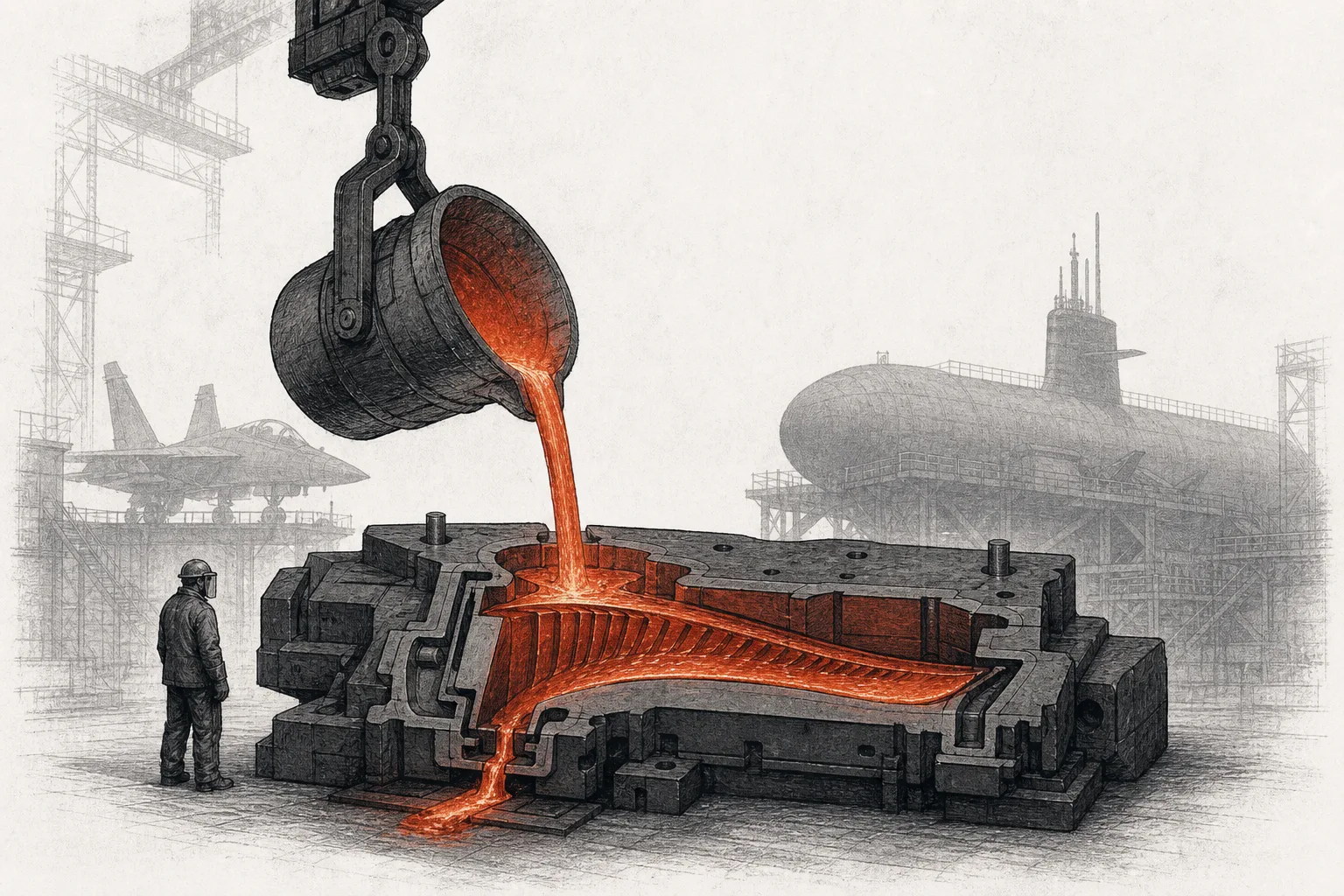
The sister lesson next door — rare earths and magnets — covered the "furthest upstream" of the defense chain: the raw ore and the magnets that spin the motors. This node is the next layer, sitting between the raw ore and the finished weapon — strategic metals already melted and shaped, and precision parts that go inside aircraft, missiles, ships, and submarines. They're the "small parts no one sees," but you can't do without them.
Picture the defense industrial base as a pyramid. At the top are the big companies that assemble aircraft (Lockheed, Boeing), a layer down are engines and systems, and the base of the pyramid that props up everything is this node — split into two connected groups:
- Strategic materials: special metals that resist heat, force, and corrosion — titanium for airframes, superalloy for turbine blades that run hotter than the melting point of ordinary metal, special steels, and carbon composites for the fuselage
- Mission components: giant "cast" (casting) and "forged" (forging) parts that form the main structure, engine turbine blades, and ruggedized/rad-hard electronics — chips and processing boards that survive vibration, heat, and the radiation of space
On the megatrend map, this node is a sub-theme under Sovereign Supply — Minerals & Reshoring Industrials within the broader trend Defense & Geopolitical Fragmentation. Its heart comes down to one word — "reshoring" — because over the past several years, parts of this pyramid base slipped into the hands of strategic rivals, or were left with a single producer in the whole world.
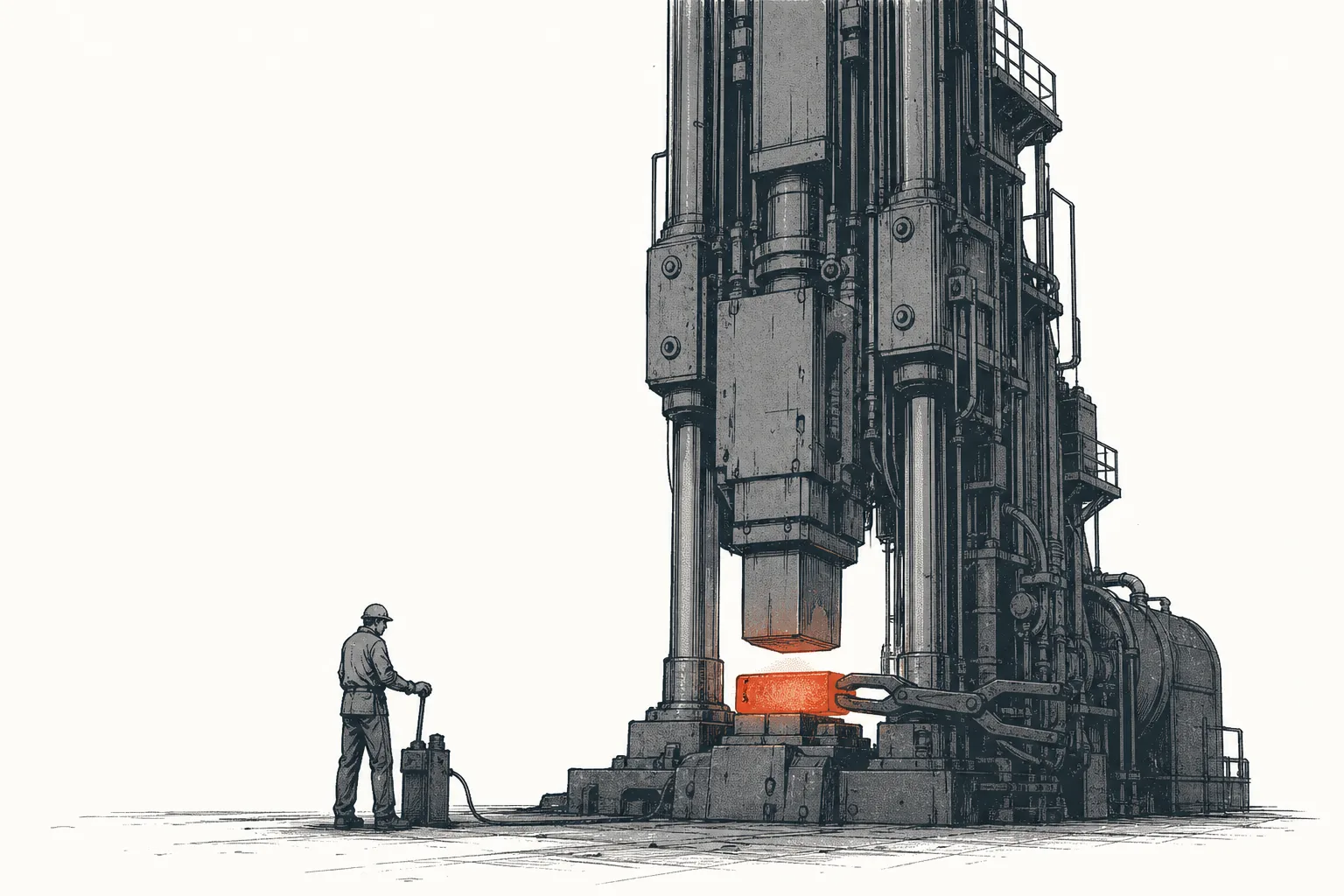
Superalloy = a special alloy (usually nickel-based) that stays strong even inside a furnace hotter than 1,000°C; used for jet-engine turbine blades · Casting = pouring molten metal into a mold to form a complex shape in one piece · Forging = hammering/pressing hot metal with enormous force to make it dense and especially strong (used for high-stress parts like a submarine shaft) · Rad-hard (radiation-hardened) = a chip designed to survive cosmic radiation in space or a nuclear battlefield without failing
02Why it matters — the bottleneck hidden deepest
There's one brutal rule of supply chains: the speed of the whole production line is set by the slowest point, not the fastest. And in defense, the slowest point usually isn't the modern-looking aircraft assembly plant — it's the old foundry that's the only one in the country able to make a giant part, or a metal bar that has to be ordered from abroad.
The clearest example is submarines. The US Navy orders Virginia-class submarines at a rate of 2 a year, but since 2022 it has actually built only ~1.1–1.2 a year — not because it can't design them, but because one submarine relies on thousands of suppliers, and many are the "single source" (single-source) for a casting, a valve, or a special part that has to pass nuclear-grade certification. If that one source can't keep up, the whole boat is stuck in the dock.
The problem starts right at the raw material itself — the US imports over 95% of its "titanium sponge" (titanium sponge, the starting material) for defense, and the world's sponge capacity is concentrated with Russia and China together at about 75%. That means the main metal of fighter-jet airframes and jet engines starts from a raw material almost entirely in a rival's hands.
Why did this only become a national priority now? Because three things converged at once — (1) post-COVID jet-engine demand surged on both the commercial and defense sides, flooding special-metals makers with orders · (2) war and geopolitical tension forced governments to rush to refill their arsenals · and (3) the risk of relying on Russia/China became real, not theoretical. Together, this once-overlooked pyramid base became the point that decides how fast a military can build.
03How it works (from ore to platform)
To see where the bottleneck hides, follow the journey of a single lump of metal from "ore" to "a part in a fighter jet." It has to pass four main gates, and at each gate the number of producers keeps shrinking.
Why is gate 3 the bottleneck? Because casting and forging large parts — like a submarine propeller shaft, or a turbine blade that has to survive furnace-level heat — requires colossal furnaces and presses, decades of accumulated specialized know-how, and very strict quality certification. Plants like this are hard to build from scratch, cost enormous amounts, and the market is too small for several players to compete — the result is that many parts are left with a single producer in the whole country.
04How it connects in the ecosystem
This node is the "base layer" that feeds materials and parts up into the entire defense industrial base, and it also ties into several other trends:
- Always paired with its sibling, rare earths and magnets: that sub-theme handles the "furthest upstream" (raw ore + the magnets that spin the motors), while this node is the "midstream" (melted metal + shaped parts) — the two sub-themes connect into one reshoring chain. If you want to understand the magnet/rare-earth layer, go read that one
- Feeds the rugged version of chips and microelectronics: the rad-hard and RF parts at gate 4 are the "military offspring" of the semiconductor industry — same base technology, but designed to survive radiation and the battlefield. So the security of domestic microelectronics is one and the same story
- Depends directly on Critical Materials: titanium, tungsten, nickel, and other special metals are all raw materials this node processes further. Tension in the global raw-material chain reaches here before anywhere else
- Shares raw materials with commercial aviation and the space economy: the same titanium, superalloy, and composites defense wants are also wanted by Boeing, Airbus, and rocket companies — making demand and the scramble for raw materials run even hotter. And it extends on to advanced air mobility (eVTOL), which needs the same light, strong metals
05Where it stands now
2025 was the year makers of defense materials and parts all had "more orders than they could handle" at the same time. The cause was a wave of demand for new jet engines (LEAP, GTF) plus the rush to refill arsenals — and the earnings numbers reflect it clearly.
Howmet Aerospace, the leader in cast-and-forged parts and structural titanium, posted full-year 2025 revenue up 11% to a record, with its Engine Products segment growing 17% in Q3. ATI, a maker of titanium and special metals, posted 2025 revenue of about $4.6 billion, with the aerospace-defense group at ~68% of sales and a backlog topping $4 billion, a new record.
On the special-metals side, Carpenter Technology posted its "most profitable year ever" in fiscal 2025 — adjusted operating income of $525 million, up 48%, with aerospace-defense over 60% of revenue. The company estimates that ramping LEAP and GTF engines alone will add 1,300–1,700 tons a year of superalloy demand by 2028. On the parts-and-electronics side, Curtiss-Wright reported its Naval & Power group growing about 18% on submarine demand, and Mercury Systems is one of the leaders in radiation-hardened (rad-hard) electronics, growing along with space missions and ISR.
Governments are stepping in as direct "strategic investors" too. Under the Defense Production Act (DPA) law, the Pentagon has begun actually subsidizing the reshoring of the raw-material chain — for instance, a $47 million grant to IperionX to build an end-to-end domestic titanium chain, followed by an Army contract under the SBIR Phase III program worth up to $99 million. The Navy, meanwhile, is racing to build alternative suppliers for cast-and-forged parts, pushing its "Foundry of the Future" and using 3D printing to break the bottleneck.
06The road ahead
The first direction is that "demand has structural tailwinds in several layers". The entire aerospace-defense materials market is projected to reach about $49 billion by 2035; aerospace titanium alone is expected to grow from about $1.8 billion in 2025 to ~$2.9 billion in 2035, driven by both a commercial fleet that needs re-engining and the defense buildup — demand growing in every direction at once.
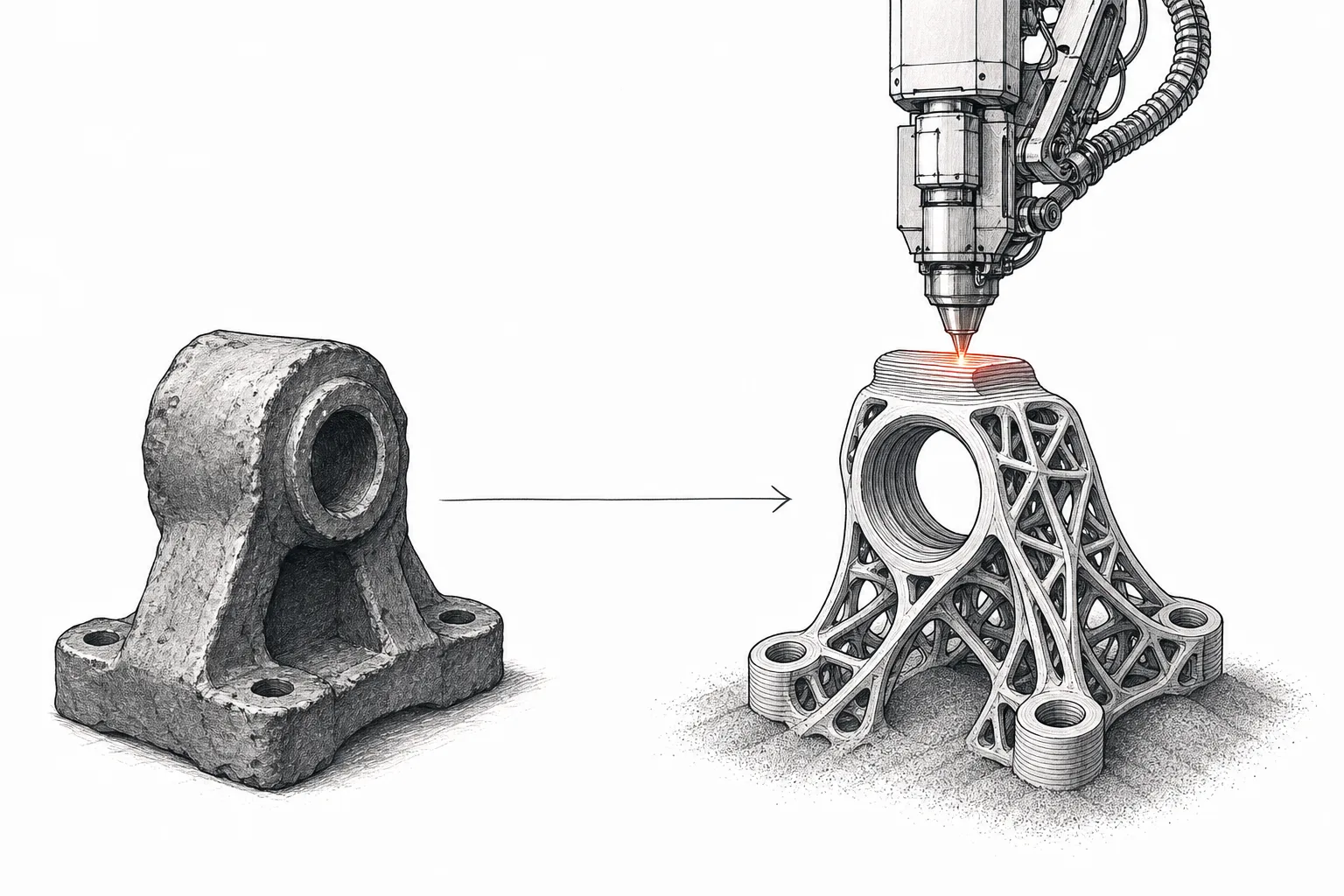
The second direction is metal 3D printing (additive manufacturing) shaking up the bottleneck. When traditional casting and forging are left with few producers and are slow, printing metal parts layer by layer can "shortcut" that step. In 2025, the US Navy put nearly 120 3D-printed parts into development and trimmed over 1,400 days off accumulated delays — a sign this technology is turning from "experimental" into a "real bottleneck-breaking tool."
The third direction is that "the state-backed model gets copied". Just as the state stepped in to prop up the rare-earth chain (see the Sovereign Supply lesson), governments are expected to use the same tools — DPA funding, offtake contracts, alternative-supplier development — to wake up domestic production of titanium, superalloy, and cast parts, turning a layer once left to the market into a security agenda the state invests in itself.
07Challenges & risks
This hot-looking theme has shadows you have to see in full.
The first risk is that "single sourcing can't be fixed overnight". Many parts are left with a single producer not because no one wants to compete, but because building a large cast-and-forge plant takes enormous money, many years, and has to pass strict quality certification. Even if you pour money in today, a second supplier will still take a long time before it can actually deliver — this gap is the risk hidden in every program.
The second risk is "skilled labor is scarce". Casting, forging, and welding defense parts requires craftsmen trained for years in a specialty, and they're badly short-handed as the older generation retires. Machines can be bought with money, but skill and experience can't be grown fast enough to meet demand — this is a "people" bottleneck stacked on top of the "plant" bottleneck.
The third risk is "the budget cycle and political continuity". This group's demand is tied to defense and commercial investment cycles, which rise and fall in waves. In a boom, orders overflow, but when the cycle flips or the government cuts budgets, orders can shrink — and much of the reshore subsidy money is tied to political will that can change with every election. A project that takes 10 years to pay off but is tied to policy that changes every 4 years is an uncertainty investors have to weigh.
In short: this node is a lesson that military power doesn't start on the battlefield but at "the furnace and the press." The world just discovered that the small parts no one sees — titanium bars, cast parts, radiation-hardened chips — are a military's true ceiling. And that has turned governments from "weapons buyers" into "investors in smelters and foundries" on the biggest scale in decades.